McLaren’s Strategic Overhaul: Beyond Downforce, Targeting Core Car Characteristics for F1 Revival
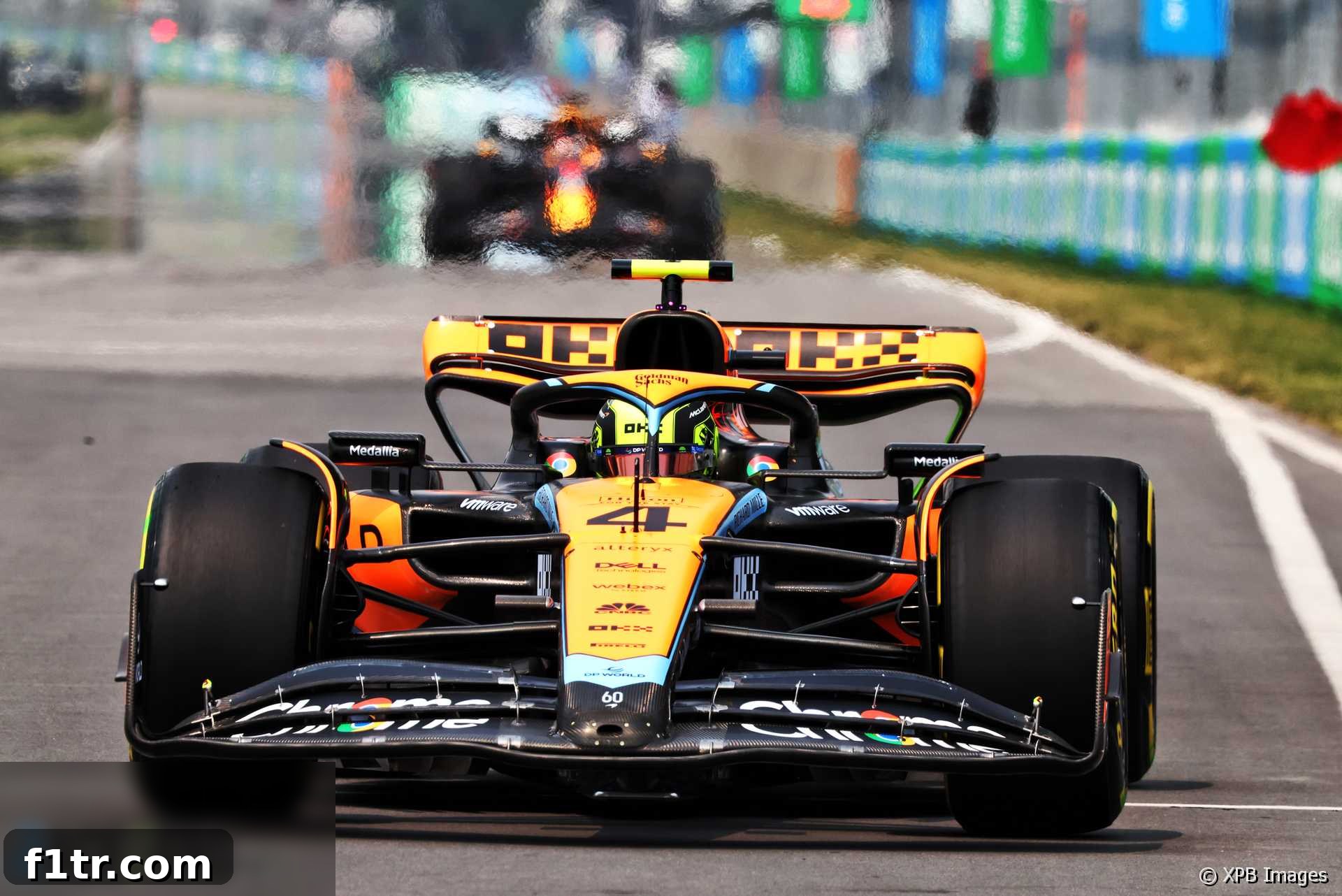
McLaren is poised to introduce a substantial upgrade package for their MCL60 Formula 1 car, with the initial phase debuting this weekend at the Austrian Grand Prix. However, according to their lead driver, Lando Norris, this ambitious development push is targeting far more than a simple increase in downforce. The comprehensive overhaul aims to tackle fundamental handling characteristics that have significantly hampered their performance and contributed to a challenging start to the 2023 season.
This crucial multi-phase upgrade, set to be rolled out across the next three race weekends, signifies McLaren’s determined effort to reverse a concerning slump in form that has persisted since the previous season. The imperative to improve is undeniable, as the Woking-based outfit strives to regain its competitive edge in a fiercely contested Formula 1 midfield, where every tenth of a second and every point matters immensely.
Addressing the MCL60’s Critical Weakness: Long Corners
One of the most evident limitations of the MCL60 has been its inconsistent performance, particularly pronounced through extended, slower corners. The Red Bull Ring, host of this weekend’s pivotal race, presents several such corners, making it an immediate and crucial testing ground for the initial upgrades. Norris unequivocally highlighted the critical need for the team to enhance the car’s behavior in these specific scenarios, stressing that merely adding more downforce would be an insufficient solution to the deep-rooted issues.
“We struggle in corners,” Norris explained, providing a candid assessment of the car’s limitations. “Long corners are definitely a lot worse for us, while high-speed corners are where we truly excel. In high-speed sections, I would say we are actually very competitive, often close to being one of the best on the track.” This striking contrast between their performance in different corner types underscores that the problem lies not with an overall lack of aerodynamic capability, but rather with specific handling quirks and an imbalance in how the car generates and maintains grip through varying radii and speeds. He further elaborated, “The opposite holds true for slow-speed corners in a way.”
To provide a clearer illustration, Norris cited recent race examples. “If you take the last sector in Barcelona, turns 10 and 12, this is a disaster for us. It’s so painful.” These types of corners, characterized by sustained steering input and complex energy management, vividly expose the MCL60’s inherent instabilities and its struggle to maintain optimal performance throughout the entire corner phase. The challenge, as Norris meticulously explained, extends far beyond a simple deficiency in peak aerodynamic grip.
“It’s different things; it’s not just the fact it’s a long corner,” he continued, delving deeper into the nuances. “It’s how you’re able to drive corners, how you’re able to release the brake, that we just don’t have. That’s just not good either. It’s not just that we’re missing 20 points of downforce on the front, 20 points downforce on the rear. It’s the actual handling, the characteristic of the car that we also need to fix in some ways.” This profound insight from Norris, who has been an integral part of the team since his Formula 1 debut in 2019, strongly suggests that McLaren is grappling with deep-seated design philosophies and fundamental mechanical and aerodynamic interactions, rather than merely superficial aerodynamic tweaks.
Unraveling Long-Standing Car Characteristics and Performance Discrepancies
Norris’s extensive tenure at McLaren affords him a unique and invaluable perspective on the car’s persistent traits. He revealed that some of the handling characteristics being targeted by the new upgrades are issues he has experienced consistently throughout his entire Formula 1 career with the team. “There are feelings I have in the car that we’ve had for the last five years and haven’t changed,” he stated, highlighting the deeply embedded nature of these challenges within McLaren’s car design ethos. “So trying to understand all of these and actually make a difference, that’s also what we need if we want to compete and be a better team.” This candid admission points towards a more holistic and systemic approach to car development, aiming to transcend incremental gains and address fundamental design alterations that have long dictated the car’s behavior.
The Persistent Puzzle: Qualifying Versus Race Pace
McLaren’s performance profile this year has consistently revealed a noticeable disparity between their raw pace over a single flying lap in qualifying and their ability to sustain that performance throughout longer race stints. Both Norris and his promising teammate, Oscar Piastri, have demonstrated the capability to place their MCL60s within the top 10 on Saturdays, only to struggle significantly in converting those strong starting positions into valuable championship points on Sundays. This recurring pattern, weekend after weekend, strongly suggests an underlying issue affecting the car’s ability to maintain optimal performance over extended runs and across differing tire compounds and fuel loads.
Norris observed that this phenomenon of varying Saturday-Sunday performance isn’t exclusive to McLaren, noting similar disparities across various teams on the grid. He believes this partly explains the seemingly insurmountable gap to the championship-leading Red Bull team. “It definitely seems more evident that you see, say, Ferrari better on a Saturday, worse on Sunday. Red Bull are just good in both senses. They’re extremely good on Sunday,” he explained. This consistent, all-around performance across both qualifying and race conditions is the defining characteristic of truly dominant Formula 1 machinery, a benchmark McLaren aspires to reach.
He further added, “Mercedes were pretty good in Barcelona on Sunday; their race pace was very strong.” This highlights how different teams manage the complex interplay of car setup, tire degradation, and fuel loads over a race distance. For McLaren, the enduring challenge is to uncover that elusive sweet spot that allows their car to perform consistently well across both single-lap efforts and full race distances. “We do seem a little bit better on a Saturday then comparing to a Sunday. But I wouldn’t say it’s too different to normal or even to last year,” Norris reflected, suggesting the issue might be an ongoing characteristic of their recent designs.
The Intricacies of Tyre Management and Optimal Car Balance
The highly sensitive Pirelli tyres employed in modern Formula 1 significantly amplify any underlying car balance issues. Norris emphasized this point: “I think the tyres make things a little bit harder, so if you don’t have the correct balance to go with how these tyres act, therefore you struggle with things at the same time.” An imbalanced car can quickly overheat its tires, leading to accelerated degradation and a dramatic drop in performance, forcing drivers to manage their pace defensively rather than attack aggressively.
This dynamic is perfectly exemplified by the overwhelming dominance of Red Bull. “There’s just a lot of things that Red Bull do very well from a cooling end and all that side of stuff, from an aerodynamic side as well, that makes it an easier car to drive at the same time as just being quick,” Norris stated. This desirable combination of “ease of driving” coupled with raw speed is the holy grail in Formula 1. It empowers their drivers, particularly Max Verstappen, to push consistently throughout a stint without unduly stressing the tires or compromising the car’s delicate aerodynamic balance, leading to exceptional race pace and superior strategic flexibility.
Norris further elaborated on this crucial distinction, underscoring the point that peak downforce figures are only one component of the performance puzzle: “Even if we had the kind of the same overall downforce as what the Red Bull have, we wouldn’t be able to beat the Red Bull because of the characteristics at the same time which need be correct.” This profound statement highlights that the manner in which downforce is generated and, critically, maintained throughout a corner – and how it interacts harmoniously with the tires and suspension – is absolutely paramount for consistent performance.
“That’s why certain cars like a Ferrari will be able to compete against the Red Bull on a Saturday sometimes, but if you go to a Sunday it’s miles off the pace,” Norris explained. “It’s just the characteristic of how the car handles through the corners and with the tyres and things like that; it’s a bigger player. So that’s what we’re trying to work out.” The ability to consistently extract optimal performance from the tires over a race distance, without sacrificing outright speed or compromising crucial handling stability, is the ultimate differentiator between a fast car and a winning car.
The complexity of this engineering challenge cannot be overstated. “It’s not simply that we just need 30 points more front, 30 points more rear; it’s how those 30 points actually stay through a corner and things like that, which again is even more complicated than what we’d like,” Norris concluded. This intricate balance of transient aerodynamic stability, mechanical grip, and meticulous tire management is precisely what McLaren’s engineers are now diligently attempting to unlock with this comprehensive upgrade package.
Cautious Optimism for a Potential Turning Point
Despite the “extremely difficult” nature of diagnosing and rectifying these deep-seated performance deficits, Norris conveyed a clear sense of cautious optimism regarding McLaren’s trajectory. He firmly believes the team is making tangible progress, and this improvement is anticipated to be significantly reflected in the forthcoming upgrade package. “We are getting there. There’s clear evidence that we’ve taken some good steps in the right direction, going down the right path; that’s very evident from what we see back at the factory,” he affirmed. Such positive feedback from internal data, simulations, and wind tunnel results provides a vital morale boost for the dedicated team at Woking.
The 2023 season has proven notably challenging for McLaren, with the team accumulating a mere 17 points so far, a stark contrast to the 65 points they had secured at the equivalent stage last season. This substantial drop in performance unequivocally highlights the urgency and immense importance of this upgrade. Norris is understandably eager to experience the changes firsthand but admitted he is carefully managing his expectations to avoid getting “too overexcited” by the prospect of a suddenly more competitive car, maintaining a pragmatic outlook.
“Of course, I look forward to it,” he said, acknowledging the immense effort and countless hours invested by the team. “There’s been a lot of work that’s gone into it, too. I think we’ve been quite patient with what we’ve had; we’ve been chipping away at many other things at the same time, so we’ve not brought a lot of lap time – like, pure lap time – to the table, since the beginning of the year.” This patient and methodical approach suggests a deliberate focus on foundational improvements and establishing a sound development direction, rather than chasing quick, isolated fixes.
He referenced the new floor introduced earlier in Baku, clarifying its primary purpose: “Of course, we had the new floor in Baku, but that was more philosophy than absolute performance.” This indicates that McLaren has been strategically laying the groundwork for a broader, more impactful development direction, of which the current comprehensive upgrade is a major, tangible manifestation. It’s about building a better platform for future growth.
“But putting it all together, putting in the work that we’ve been doing, I think we’ve been doing a good job with what we’ve had, made the most of the opportunities that we’ve had. Maybe one or two that we’ve missed out on, but that’s about it,” Norris reflected on the team’s diligent efforts despite the inherent limitations of the current car package, emphasizing their ability to maximize available potential.
The anticipation for the new parts, which represent the culmination of extensive engineering efforts and numerous design changes, is understandably high within the team. “So anything that’s new – and there’s been a lot of work, a lot of changes – seeing all of this kind of come together and see what we can do with it [is encouraging]. But of course, it’s not on track just yet,” Norris mused. The ultimate and most critical test will arrive when these components are fitted and rigorously evaluated under demanding race conditions.
While confident in the positive trajectory indicated by factory data, the precise magnitude of the performance gain remains an open question. “I’m confident it will be a step forward, but how much is the question. So I don’t want to get too overexcited about all of it like I never do,” Norris reiterated his characteristically pragmatic stance. “A lot of work that’s gone into it, so I’m excited to see all of that kind of come through and see what we’re capable of doing.” The F1 community shares this excitement, eager to see if McLaren can ignite their 2023 campaign.
The Road Ahead for McLaren’s Revival
This comprehensive upgrade package marks a potentially pivotal moment for McLaren in their challenging 2023 Formula 1 campaign. It stands as a testament to their unwavering commitment to not just adding raw straight-line speed or peak downforce, but fundamentally re-engineering the MCL60 to evolve into a more balanced, predictable, and ultimately faster race car that performs consistently across all track conditions and corner types. The strategic focus on deep-seated handling characteristics, particularly in the notoriously difficult long corners, signals a decisive shift towards addressing the core issues that have fundamentally hindered their competitive aspirations.
The upcoming races, commencing with the high-speed and demanding Red Bull Ring, will be absolutely crucial in determining the true efficacy and impact of these extensive developments. The entire motorsport world will be watching closely to ascertain whether McLaren can successfully translate their promising factory progress into tangible, sustained on-track results. Their ability to do so will be key in empowering Lando Norris and Oscar Piastri to consistently compete for higher points finishes and reclaim their rightful position among Formula 1’s leading contenders. The journey to recovery and consistent podium contention is inherently complex, fraught with technical challenges, but McLaren appears to be taking decisive, well-considered steps on what they hope is the right and most rewarding path forward.