McLaren Team Hub Fire at Circuit de Catalunya: A Paddock Safety Incident
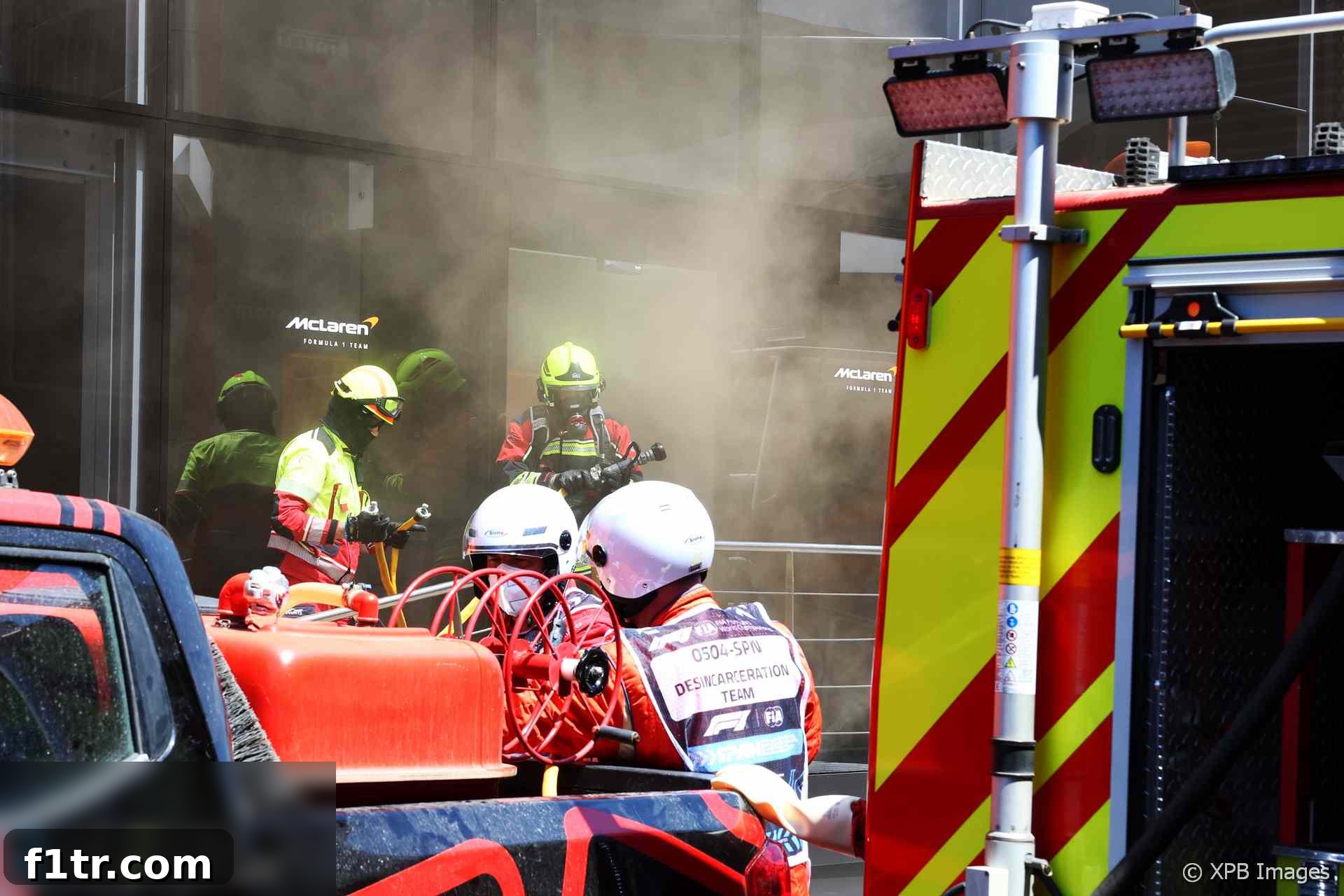
The exhilarating atmosphere of the Formula 1 Spanish Grand Prix at the iconic Circuit de Catalunya was momentarily overshadowed on Saturday by an unexpected incident involving the McLaren F1 team. A fire erupted within the team’s temporary trackside facility, known as the Team Hub, around midday, prompting an immediate evacuation and a swift response from emergency services.
Smoke was observed billowing from the structure, situated within the bustling Formula 1 paddock, alerting personnel and local authorities to the developing situation. The quick actions of the local fire brigade were crucial in containing and extinguishing the blaze, preventing what could have been a far more serious event in such a high-stakes environment.
Following the incident, McLaren promptly issued a statement to reassure the public and the F1 community. The team confirmed that all staff and guests who were inside the Team Hub at the time of the fire had been safely evacuated. While the immediate danger was averted, one McLaren team member was taken to a local hospital as a precautionary measure, highlighting the inherent risks involved even in controlled environments. Thankfully, all McLaren personnel and guests were accounted for, a testament to effective emergency protocols.
“This morning a fire was detected in our trackside Team Hub,” the team’s statement read. “The team hub was evacuated of all staff and guests, and circuit emergency services attended the scene within minutes. The circuit emergency services and local fire department have since extinguished the fire. One McLaren team member has been taken to hospital as a precaution, and all McLaren personnel and guests are accounted for. We would like to thank all the marshals and emergency services for their quick and professional response. We would also like to thank Formula 1, the FIA and our competitors who have offered to help our team and guests this weekend.” This outpouring of support from the wider F1 community underscored the camaraderie and mutual concern prevalent in the sport, even amidst fierce competition.
Minimal Disruption to Sporting Schedule for Lando Norris and Oscar Piastri
Despite the alarming nature of the fire, the incident surprisingly did not hinder McLaren’s participation in the crucial final practice session (FP3) of the Spanish Grand Prix weekend. Both McLaren drivers, Lando Norris and Oscar Piastri, were able to take to the track for FP3, which commenced at 12:30 pm local time, just hours after the fire was brought under control. This rapid return to normal operations demonstrated the team’s resilience and the effectiveness of the emergency response, allowing the focus to quickly shift back to on-track performance.
For a team like McLaren, contending for podium finishes and championship points, any disruption can have significant implications. The ability of Norris and Piastri to continue their preparations without major delay was vital for maintaining their competitive edge. The psychological impact on the team, however, cannot be entirely dismissed, as such incidents can be unsettling. Yet, the professionalism of the team members and the support received ensured that the drivers could concentrate on extracting maximum performance from their MCL38 cars as they geared up for qualifying and the race.
The McLaren Team Hub: A Beacon of Sustainability and Efficiency
The structure at the heart of the incident, the McLaren Team Hub, is more than just a motorhome; it represents a significant step forward in Formula 1 paddock logistics and sustainability. McLaren unveiled its innovative Team Hub in 2021, introducing it as a modern replacement for its traditional Brand Centre. The philosophy behind its design was rooted in efficiency and environmental responsibility, aiming to reduce the logistical footprint of the team’s extensive European race operations.
This more compact and intelligently designed structure drastically cuts down on transportation requirements, needing less than half the number of trucks previously used to move it from one circuit to another. This reduction in freight not only minimizes the team’s carbon footprint but also offers substantial logistical and cost benefits. Furthermore, the Team Hub incorporates elements largely constructed from parts recycled from the team’s previous motorhome, underscoring McLaren’s commitment to circular economy principles within its operations. The incident, therefore, also brings into focus the safety considerations for these advanced, yet temporary, structures that serve as the vital nerve centers for F1 teams on race weekends.
A Sobering Reminder: The Williams Garage Fire of 2012
The fire at the Circuit de Catalunya serves as a stark reminder of a similar, and more severe, incident that occurred at the very same venue 12 years prior. In 2012, the Williams F1 team suffered a devastating fire in their garage following the Spanish Grand Prix. This incident unfolded amidst jubilant celebrations after Pastor Maldonado secured Williams’ first victory in eight years – a truly emotional moment for the team. The celebratory mood quickly turned to crisis as flames engulfed the garage, highlighting the ever-present dangers in an F1 paddock filled with highly flammable materials.
The 2012 Williams fire was a significantly more serious event, resulting in seven individuals being taken to hospital for treatment, while another 24 received medical attention at the circuit’s medical centre for various injuries, including smoke inhalation and burns. The aftermath led to extensive investigations and further tightened safety protocols across the sport. While the McLaren incident was fortunately far less severe in terms of casualties and damage, it echoes the historical vulnerability of temporary F1 structures to fire, underscoring the critical importance of continuous vigilance and advanced fire suppression systems.
Paddock Safety: A Continuous Evolution in Formula 1
The Formula 1 paddock is a microcosm of advanced engineering, high-speed logistics, and intense competition, but it is also an environment with inherent risks. The presence of highly flammable fuels, specialized oils, composite materials, and complex electrical systems means that fire safety is a paramount concern for the FIA (Fédération Internationale de l’Automobile), Formula 1 management, and all participating teams. Each incident, regardless of its scale, provides valuable lessons that contribute to the ongoing evolution of safety standards.
Modern F1 safety protocols include rigorous inspections, mandatory fire marshals stationed strategically around the paddock and pit lane, advanced fire extinguishing equipment, and comprehensive emergency response training for all personnel. The rapid and professional response to the McLaren Team Hub fire demonstrated the efficacy of these measures. The collective offers of assistance from other teams, along with Formula 1 and the FIA, further illustrate the collaborative approach to safety within the sport, where human well-being always takes precedence over rivalry.
This incident at the Spanish Grand Prix not only put McLaren’s resilience to the test but also reinforced the critical importance of unwavering commitment to safety in all aspects of Formula 1. As the sport continues to push the boundaries of technology and performance, ensuring the safety of its personnel remains a foundational principle.
Looking Ahead for McLaren and the Spanish Grand Prix
The immediate aftermath of the Team Hub fire saw McLaren quickly regrouping, demonstrating the remarkable professionalism that defines F1 teams. While the full extent of the damage to the Team Hub and its internal equipment will require thorough assessment, the paramount concern – the safety of all individuals – was successfully addressed. For Lando Norris and Oscar Piastri, the focus quickly returned to qualifying performance and strategizing for Sunday’s main race. The Spanish Grand Prix is a key indicator of a team’s car development, and McLaren’s strong performances in recent races have positioned them as serious contenders.
The incident, while unsettling, ultimately served as a powerful reminder of the robust safety infrastructure and the strong community spirit within Formula 1. The collective sigh of relief from the paddock was palpable, allowing the sport to continue its thrilling weekend of racing with renewed appreciation for the safety measures in place. McLaren, known for its tenacity, will undoubtedly learn from this experience, further bolstering its operational protocols as the 2024 season progresses, aiming to turn this challenging moment into a testament to their unwavering dedication and resilience.
Don’t Miss a Moment from Formula 1 – Subscribe Today!
Stay updated with all the latest stories, exclusive insights, and breaking news from the world of Formula 1. Get our daily email digest – no marketing, no ads, just pure F1 content. Sign up here:
More from the 2024 Spanish Grand Prix
- Russell ensures Norris has still never kept his lead from pole position
- Williams repeatedly switch floors in search for Sargeant’s missing downforce
- “Why’s he not defending?”: How Russell sank to fourth after stunning start
- What radio calls reveal about Verstappen’s controlled pace and Perez’s struggles
- 2024 Spanish Grand Prix weekend F1 driver ratings
Browse all 2024 Spanish Grand Prix articles