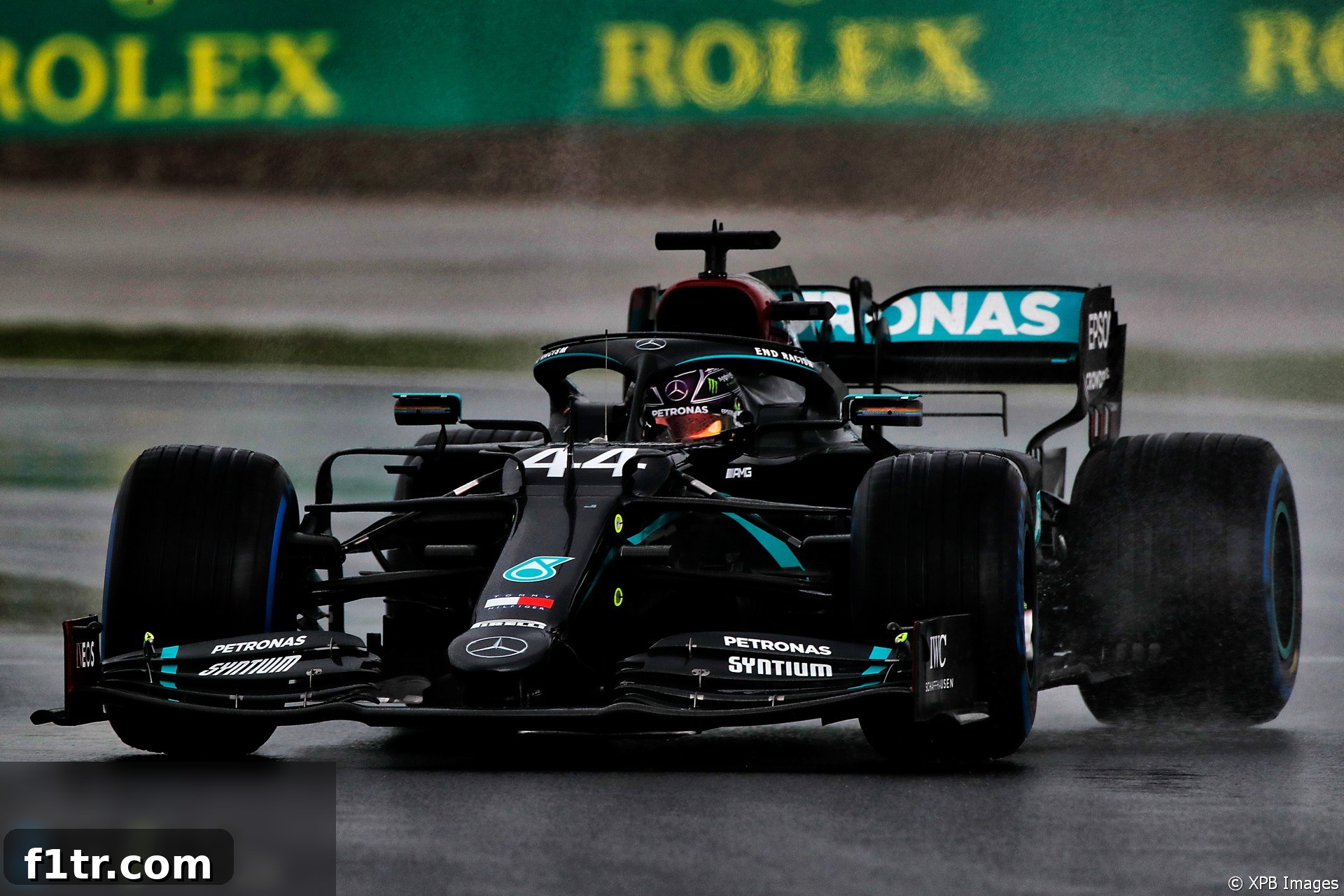
Mercedes’ Unprecedented Struggle: The Istanbul Park Qualifying Anomaly
In a sport often characterized by predictable dominance, the 2020 Turkish Grand Prix qualifying session delivered an unforeseen shockwave through the Formula 1 paddock. Mercedes’ previously unbeaten qualifying streak, a testament to their unparalleled engineering prowess and driver talent, came to an abrupt and spectacular end at the challenging Istanbul Park circuit. This wasn’t just a defeat; it was a profound unraveling, with the championship-winning W11 machines seemingly losing their way in the treacherous, low-grip conditions. The scale of their struggles was staggering, painting a vivid picture of a team grappling with an unfamiliar and deeply unsettling challenge.
The immediate clue to Mercedes’ downfall lay in the sheer performance gap: their best car lagged a colossal 4.5 seconds behind a competitor powered by the very same Mercedes engine. This significant deficit wasn’t merely a minor setback; it highlighted a fundamental mismatch between the W11 and the unique demands of the freshly resurfaced, cold, and wet Turkish track. It was a performance chasm that left observers and the team themselves scratching their heads, offering a stark contrast to their usual imperious form.
A Qualifying Session Like No Other: The Data Tells a Story
To fully grasp the abnormality of the Istanbul Park qualifying, a quick comparison to previous wet sessions is essential. Earlier in the 2020 season, under similar rainy conditions at a more typical circuit – the Red Bull Ring – Lewis Hamilton effortlessly secured pole position for Mercedes, outclassing his rivals by a comfortable 1.2 seconds. In that session, the entire Q3 field of ten contenders was separated by a mere 2.3 seconds, reflecting the usual tight margins of elite Formula 1 competition.
Fast forward to Istanbul, and the narrative flipped dramatically. The top ten cars in the bizarre Q3 session were spread across a monumental nine-and-a-half seconds. Even if we generously disregard the significant struggles of Antonio Giovinazzi, the remaining top nine still exhibited a staggering spread of nearly five-and-a-half seconds. To put this in sharper perspective, the entire field in Q1 at the Red Bull Ring, under similar wet conditions, was covered by a mere 3.6 seconds. Despite the slightly shorter lap at the Austrian circuit, the data unequivocally underscores the unparalleled chaos and disparity witnessed during the Turkish Grand Prix qualifying, marking it as one of the most unusual sessions in recent F1 history.
The Tyre Temperature Conundrum: A Vicious Circle of No Grip
The root cause of Mercedes’ dramatic slump, as quickly identified by the team, was a critical inability to generate and maintain sufficient heat in their Pirelli tyres. This wasn’t merely a minor inconvenience; it was a fundamental performance killer. In Formula 1, tyres operate within extremely narrow temperature windows to deliver optimal grip. When tyres are too cold, they fail to reach their intended operating temperature, resulting in significantly reduced adhesion to the track surface. For the W11, this problem escalated with each passing lap, trapping the car and its drivers, Lewis Hamilton and Valtteri Bottas, in a detrimental feedback loop.
Andrew Shovlin, Mercedes’ Head of Trackside Operations, articulated the team’s predicament with stark clarity: “We’re just too cold and that means we’ve got no grip.” He elaborated on the self-perpetuating nature of the issue: “But the issue is it becomes a bit of a vicious circle whereby if you haven’t got the grip, you can’t generate the temperature and you spiral down.” This phenomenon explains the increasing performance deficit; without grip, drivers cannot push hard enough to warm the tyres, and without warm tyres, they lack the grip to push. It’s a classic engineering challenge, amplified by the extremely slippery conditions at Istanbul Park, which made it almost impossible to find the necessary mechanical grip to build tyre temperature.
Shovlin further emphasized the severity of the problem by highlighting the gap to their competitors, particularly Racing Point. “When you look at the gap between us and pole and [Racing Point], how quickly they could bring the tyres in, you’re talking seconds and seconds,” he noted. Such immense time differences, he explained, are almost invariably linked to tyre temperature. “When you’re diagnosing problems, gaps that big are always linked to tyre temperature unless you’ve got some pretty major parts that have fallen off, but it’s almost always tyre temperature. So there’s a bit to learn.” This revelation underscored the profound impact of this singular issue on the W11’s overall performance, transforming a dominant machine into a struggling contender.
Engineering Philosophy: The Double-Edged Sword of Specialization
Mercedes’ recent engineering philosophy, while successful in most scenarios, proved to be a critical vulnerability at Istanbul Park. Shovlin confirmed that a primary focus for the team in recent years had been to improve the W11’s performance in higher temperatures – addressing what was once a relative weakness. This strategic development, honed over seasons of refining the car for scorching races and high-energy circuits, had inadvertently blunted their edge when confronted with extreme cold, coupled with the wet and exceptionally slippery surface of Istanbul Park.
“I think we’ve developed our car to be good in hot conditions,” Shovlin stated. “That used to be a weakness. We need to be able to adapt when the conditions are certainly very, very cold and we haven’t done that very well. And there’s no doubt a fair chunk to learn from today.” This insight reveals a classic trade-off in high-performance engineering: optimizing for one set of conditions can inherently compromise performance in another. The W11, a master of heat management in the warm, found itself utterly out of its element when heat generation became the paramount challenge.
The contrast with their performance in the rainier, but warmer, Austrian Grand Prix earlier in the season was telling. Shovlin explained, “What you want on a day like today is a car that overheats its tyres, that sort of kills them at most circuits, and suddenly you’re into a good place.” This highlighted that a car typically prone to overheating tyres might ironically thrive in such cold, wet conditions by generating heat more readily. “So it’s no big surprise why we were necessarily good there. It’s just the shock was being seconds off a Racing Point, seconds off a Red Bull, that’s the thing that has surprised us. But we do understand enough about the tyres to know how you can get yourself in that position.” The surprise wasn’t just losing, but losing by such a significant margin to direct competitors and even customer teams running identical power units.
The Unforeseen Challenge of Racing Point’s Ascendance
The dramatic qualifying session not only exposed Mercedes’ weaknesses but also showcased the remarkable over-performance of others, most notably Racing Point. This team, running Mercedes engines and often dubbed the “Pink Mercedes” due to its design philosophy, achieved a stunning first and third place in qualifying – a spectacular turnaround from their worst performance of the season at the preceding race. This stark contrast underscored how perfectly their car, or perhaps their setup and understanding of the Pirelli compounds in those specific conditions, aligned with the Istanbul anomaly. Their ability to switch on the tyres rapidly was the inverse of Mercedes’ struggle, highlighting the critical role of tyre thermodynamics in extreme conditions.
Race Day Prognosis: Uncertainty Looms for the Champions
As the teams looked ahead to Sunday’s race, a significant cloud of uncertainty hung over Mercedes’ competitiveness, irrespective of whether the Turkish skies delivered rain or shine. The fundamental issues identified in qualifying were not expected to miraculously vanish with a change in weather. Andrew Shovlin voiced the team’s profound concerns, outlining the challenges they anticipated.
“It is difficult to predict. I think if you’re looking at a wet race, the thing that we need to do a bit of head scratching about is how do we get the tyres to switch on quickly,” Shovlin explained. He painted a grim picture of their potential race pace, referencing Lance Stroll’s stellar qualifying performance: “Because you just look at our lap times over a two or three lap run today and you look at what, for instance, Stroll was doing in the [Racing Point] at the end, he will be 10 seconds up the road in no time.” This stark prediction underscored the urgency of their tyre warming dilemma. While changes could be made to the car’s heating levels for different climatic conditions, the fundamental difficulty remained.
The prospect of being “swallowed up by the pack” and watching “the leaders sprinting away” was a scenario designed to “keep us awake tonight,” Shovlin admitted. While confident in their ultimate ability to generate tyre temperature, the concern was the time it would take. “I think eventually we’ll get there because we have shown that we can generate temperature, it just takes us a long time.” In Formula 1, where every second counts, a “long time” to switch on tyres can mean losing crucial positions and falling out of contention for victory.
Even a dry race offered little solace, as the underlying issues persisted. “Looking at a dry race, though, the wet and the dry is not very different here. It’s the same issues: low grip, balance, generating temperature. The problems are identical, which isn’t the case at most circuits. So we’re really trying to solve similar things.” The unique, low-grip nature of the Istanbul Park surface meant that the challenges remained largely consistent across conditions. Furthermore, concerns about dry tyres included their difficulty in switching on, coupled with potential wear and graining as the circuit evolved. This complex interplay left Mercedes with a significant information deficit regarding tyre performance and optimal race strategy.
Navigating the Pack: A New Strategic Frontier
Beyond the fundamental performance issues, Mercedes faced a novel strategic challenge: starting deep within the pack. For a team accustomed to front-row lockouts, navigating mid-field traffic presented a different kind of race management puzzle. “Plus the fact we’re not used to starting so far down in the pack. So if we are quick enough we’ve got people to get by to think about, and strategy, how to try and get ourselves into a position where we can hopefully cause a bit of trouble for Red Bull.” This highlighted the multi-faceted nature of their task – not just improving car performance, but also executing an aggressive yet clean race to recover positions and challenge their main rivals, a scenario rarely encountered by the dominant silver arrows.
For a team renowned for its meticulous preparation and cautious ‘expectations management,’ it’s tempting for seasoned Formula 1 followers to dismiss these concerns and predict a rapid recovery. Mercedes has often downplayed its chances only to emerge victorious. Yet, the sheer magnitude of their qualifying deficit at Istanbul Park strongly suggested a truly exceptional set of circumstances. This weekend’s highly unusual conditions had indeed created a scenario reminiscent of the “Singapore 2015” Grand Prix, another rare instance where the dominant Mercedes struggled inexplicably. If nothing else, this dramatic upset ensured that the coveted record of achieving pole position at every race in a single season would remain an elusive milestone, preserving a sliver of unpredictability in an otherwise historically dominant campaign.
The Turkish Grand Prix qualifying will undoubtedly go down as a pivotal moment in the 2020 season, not for who won pole, but for the unexpected vulnerability it exposed in the sport’s most dominant force. It served as a powerful reminder that even the best can be challenged when the variables align in the most extraordinary ways.
Explore More Formula 1 Content
- Browse all 2020 Turkish Grand Prix articles
- Support independent F1 journalism