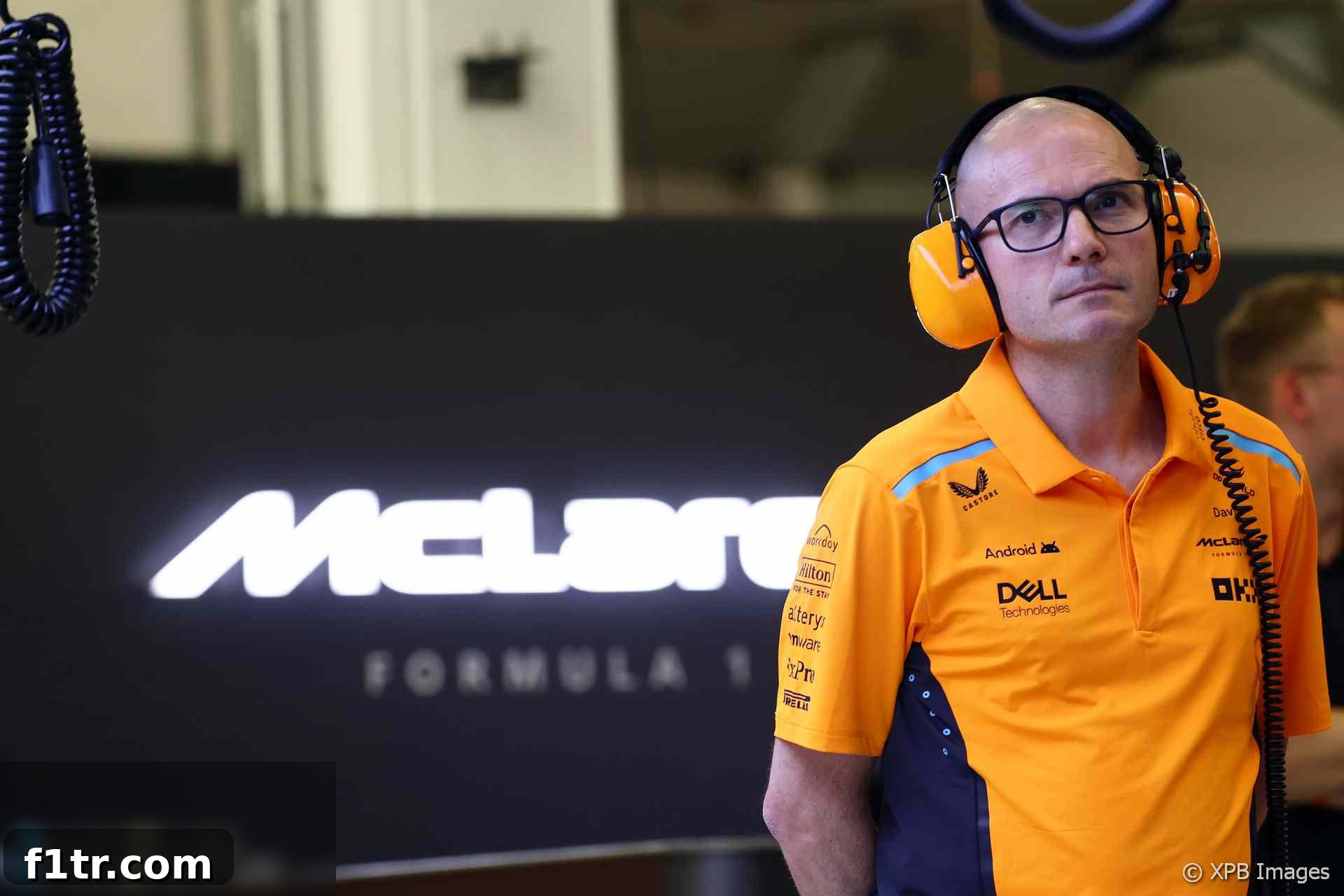
David Sanchez Departs McLaren After Brief Stint Amidst Technical Reshuffle
In a significant and somewhat surprising development within the Formula 1 paddock, David Sanchez has parted ways with McLaren, a mere three months after making his much-heralded return to the Woking-based outfit from Ferrari. The departure marks a swift end to a tenure that began with high expectations and was meant to solidify McLaren’s technical foundations.
McLaren team principal Andrea Stella confirmed the mutual decision, stating that he and Sanchez had agreed on a “misalignment” concerning the role Sanchez had officially taken on last January. This mutual understanding highlights the complex dynamics of leadership and expectation management within the intensely competitive world of Formula 1 team structures.
The Unexpected Turn: Role Misalignment and Mutual Decision
“Following thoughtful discussions between David Sanchez and the team leadership, the mutual decision has been taken for David to leave the team,” Stella articulated in his statement. He elaborated on the core issue, explaining, “Upon our joint reflection, it became apparent that the role, responsibilities and ambitions associated with David’s position did not align with our original expectations when he agreed to join us in February 2023.”
This candid admission from Stella underscores the critical importance of clear role definitions, especially within a high-stakes environment like Formula 1 where precision and clarity are paramount. The initial anticipation surrounding Sanchez’s arrival was immense, given his esteemed background and experience, particularly during his successful tenure at Ferrari. However, the practical application of his role at McLaren seemingly diverged from the initial vision.
“Recognising this misalignment, both David and I agreed that it would be best to part ways now, so to enable him to pursue other opportunities that will better leverage the full scale and breadth of his remarkable skillset,” Stella added. This suggests an amicable separation, with both parties acknowledging the situation was not ideal for long-term success. Stella concluded by expressing gratitude for Sanchez’s brief contributions: “We greatly and gratefully value the contributions that David has made during his relatively short time with us and we wish him the best in his future endeavours.”
Sanchez’s Return and McLaren’s Technical Overhaul
David Sanchez’s return to McLaren was initially announced in March of last year, positioned as a key component of a significant shake-up within the team’s technical division. This widespread restructuring followed McLaren’s challenging start to the 2023 Formula 1 season, which saw the departure of then-technical director James Key. The team was clearly seeking a fresh approach and new leadership to steer its car development program back onto a competitive path.
Sanchez was initially heralded as McLaren’s new technical director, a role that traditionally carries immense responsibility for the overall design and performance philosophy of the car. His appointment was seen as a major coup, leveraging his expertise honed over years at top F1 teams. His pedigree included a previous stint at McLaren, followed by a lengthy and impactful period at Ferrari, where he was involved in developing competitive chassis designs.
However, just two months after Sanchez’s initial announcement, McLaren revealed another high-profile acquisition: Rob Marshall from Red Bull Racing. Marshall, a highly respected engineer known for his contributions to multiple championship-winning cars, was given the title of “technical director, engineering and design.” This move significantly altered the landscape of McLaren’s technical leadership, leading to a reallocation of responsibilities.
In this revised structure, David Sanchez’s role was then specified as “technical director for car concept and performance.” Concurrently, Neil Houldey was appointed “deputy technical director, engineering and design.” While such specialization can be beneficial, it also carries the risk of diluting overall authority and potentially creating overlaps or, as in this case, misalignments in expectations. It is plausible that the defined scope of “car concept and performance” did not fully match Sanchez’s vision for his impact on the team, especially given his background in broader technical leadership roles.
David Sanchez’s Perspective and Future Aspirations
Echoing Andrea Stella’s sentiments, David Sanchez himself offered a poignant reflection on his departure. “While the role we envisioned and had agreed to was not aligned with the reality of the position I found, I leave with respect for the leadership, admiration for the dedication of my colleagues, and appreciation for the openness and honesty in which we discussed and arrived at this decision,” Sanchez stated.
His words confirm the core issue of differing expectations regarding the nature and scope of his responsibilities. Despite the disappointment of a short and unfulfilled tenure, Sanchez’s statement conveys professionalism and an understanding of the difficult decisions required in high-performance sports. It underscores the integrity with which both parties approached the resolution of this professional impasse. His emphasis on “respect for the leadership” and “admiration for the dedication of my colleagues” suggests that the issue was purely structural and not rooted in personal conflicts or team culture.
Sanchez’s career in Formula 1 is extensive and distinguished. He began his journey in F1 with Renault, a foundation that led him to his first spell at McLaren. After five years with the Woking team, he made the move to Ferrari in 2013, where he spent a decade contributing to various car development cycles before his recent return to McLaren. Given his rich experience and a proven track record in complex car design and aerodynamic development, Sanchez has indicated his strong intention to find a new role within the F1 paddock, suggesting that his passion for the sport and its technical challenges remains undimmed.
McLaren’s Latest Technical Reorganization
Following Sanchez’s departure, McLaren has once again had to revise its technical structure, demonstrating the fluidity and constant evolution inherent in modern Formula 1 teams striving for competitive advantage. The team has moved swiftly to reallocate responsibilities and ensure continuity in its development programs.
Under the new structure:
- Rob Marshall, who joined from Red Bull, will now assume the critical role of Chief Designer. This position is central to the overall architectural layout and detailed design of the Formula 1 car.
- Neil Houldey has been promoted to Technical Director for Engineering, signifying an expanded scope for his expertise in the practical application and integration of car components.
- Peter Prodromou, a long-standing and highly respected figure in Formula 1 aerodynamics, remains in his vital position as Technical Director for Aerodynamics, overseeing one of the most crucial performance differentiators in modern F1.
Furthermore, the team has revealed its intention to appoint a dedicated technical director for performance. In the interim, team principal Andrea Stella will personally hold this crucial position, highlighting the immediate importance McLaren places on extracting maximum performance from its current and future cars. This move by Stella also indicates a hands-on approach to stabilizing the technical department and ensuring that the team’s performance objectives remain on track.
The Broader Implications for McLaren and Formula 1
This latest technical reshuffle at McLaren, particularly the rapid exit of a high-profile recruit like David Sanchez, underlines the immense pressure and complex challenges faced by Formula 1 teams. The pursuit of marginal gains, coupled with the intricate nature of modern F1 car development, demands not only exceptional talent but also perfect synergy and alignment within the technical leadership.
For McLaren, this marks yet another chapter in its ongoing quest to return to the front of the grid. The team has shown signs of significant progress, particularly with its mid-season turnaround in 2023. However, consistent technical stability is often a hallmark of championship-contending teams. The constant adjustments in leadership roles, while sometimes necessary, can also introduce elements of uncertainty, potentially affecting long-term project continuity and team morale.
The F1 landscape is notoriously competitive, with every team constantly evaluating and refining its personnel to gain an edge. Technical directors and chief designers are often seen as the architects of a team’s future success, making their roles incredibly impactful. Sanchez’s departure, while mutually agreed upon, serves as a stark reminder of how quickly professional relationships can evolve when expectations and realities diverge, even for individuals with distinguished careers.
Looking ahead, McLaren will be keen to demonstrate that its new, streamlined technical structure is robust and capable of delivering sustained performance improvements. The leadership of Andrea Stella, alongside the expertise of Marshall, Houldey, and Prodromou, will be under intense scrutiny as the team aims to build on its recent progress and challenge the established front-runners. The search for a permanent Technical Director for Performance will also be a key priority, ensuring that Stella can eventually return his full focus to the broader team principal duties.
For David Sanchez, his proven capabilities suggest he will likely find a new and influential role within Formula 1. The paddock is a small world, and talent like his is always in demand. His next destination will undoubtedly be watched with great interest, as he seeks an opportunity where his vision and responsibilities are perfectly aligned, allowing him to fully leverage his “remarkable skillset” and contribute to future F1 successes.
Advert | Become a RaceFans supporter andgo ad-free
Formula 1 Related Articles
- Controversies, Norris, Newey and more: Five new motorsport books reviewed
- One of F1’s greatest races happened 15 years ago today. Or did it?
- “Overtaking is overtaking”: Domenicali denies F1’s yo-yo racing is “artificial”
- The crashes F1 is trying to prevent may be rare – but the danger is obvious
- F1 returning to India soon after 2027 sounds like wishful thinking
Browse all Formula 1 articles