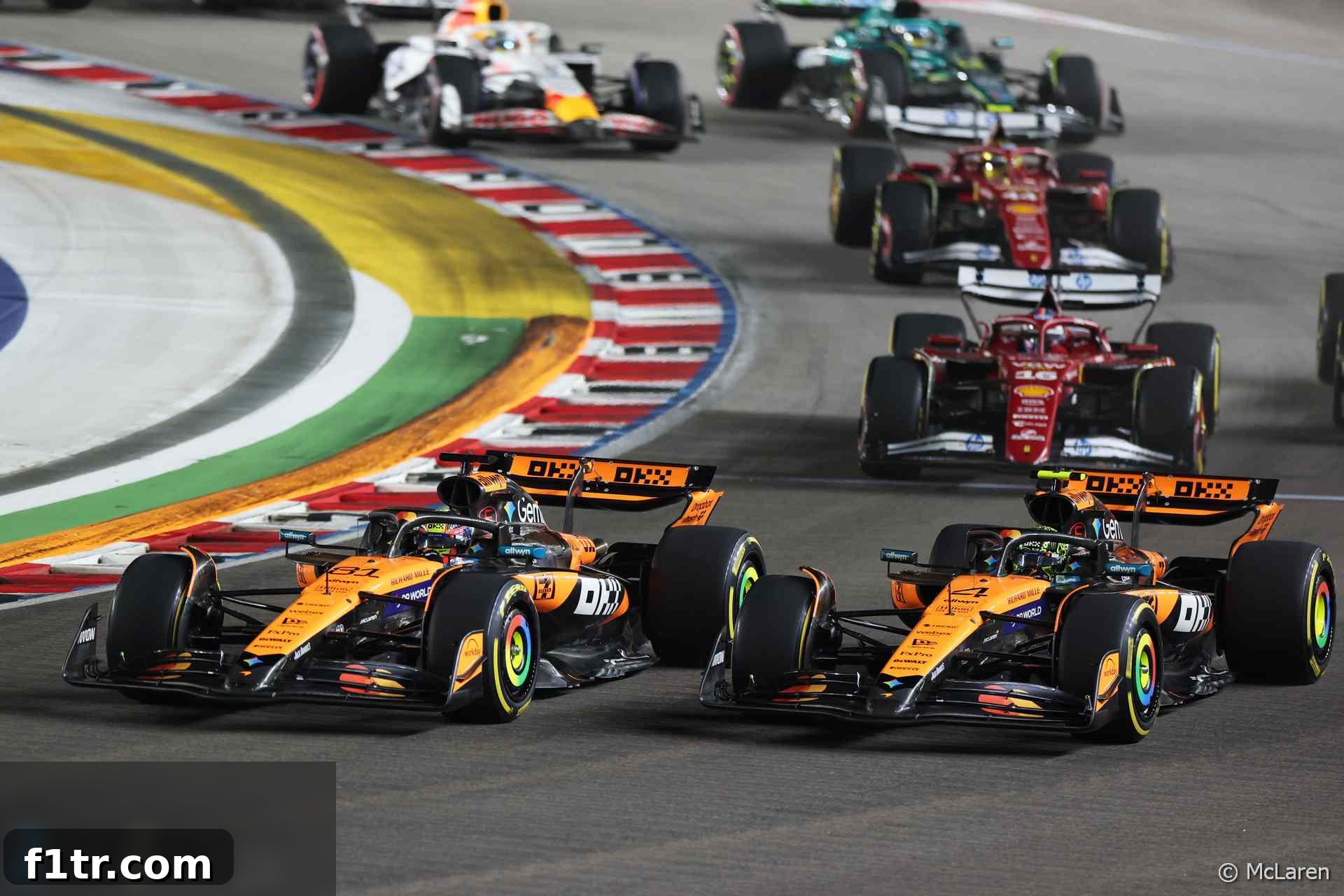
The McLaren Melee: Unpacking Norris and Piastri’s First-Lap Contact and the Team’s Stance
In the high-stakes world of Formula 1, where fractions of a second can dictate fortunes, the intensity often reaches its peak during the opening laps of a Grand Prix. Teammate battles, while a spectacle for fans, can present a unique challenge for team management. Such was the scenario recently witnessed involving McLaren drivers Lando Norris and Oscar Piastri, whose first-lap entanglement sparked questions and discussions, though McLaren itself quickly downplayed any serious concerns.
The Incident Unfolds: A Daring Dive at Turn Three
The sequence of events that ignited the controversy occurred at Turn Three during the frenetic start of the race. As the pack jostled for position, Lando Norris, known for his aggressive yet precise driving style, made a decisive dive past his teammate, Oscar Piastri. This bold maneuver, executed in what were described as challenging and damp conditions, resulted in contact between the two McLaren cars. While such incidents are not uncommon in the heat of a Grand Prix start, especially when multiple cars are vying for the same piece of tarmac, the internal team dynamics immediately brought it under scrutiny.
The contact wasn’t confined solely to the McLaren duo. In the preceding chaos, Norris also reportedly made slight contact with Max Verstappen’s car, leading to minor damage to his front wing endplate. This detail underscores the sheer difficulty and high-risk nature of the opening lap, where drivers are pushing the limits of grip and judgment with multiple competitors in close proximity. The damp track conditions further exacerbated this challenge, making braking points and cornering lines incredibly difficult to judge, even for seasoned professionals.
Piastri’s Frustration and the Question of Team Rules
Immediately following the incident, Oscar Piastri, audibly frustrated, raised the issue with his team over the radio on multiple occasions. His repeated inquiries centered on whether he believed Norris had adhered to McLaren’s internal racing rules – a set of unwritten or sometimes explicit guidelines designed to govern how teammates race each other. These rules are typically put in place to prevent unnecessary collisions, protect the team’s assets, and ensure fair competition without compromising the team’s overall performance or constructors’ championship aspirations.
Despite Piastri’s concerns and his direct questioning, the McLaren pit wall chose not to intervene. No team orders were issued to alter the running order, and both drivers were allowed to continue racing. Piastri ultimately finished the race behind Norris, a result that, combined with the earlier contact, likely added to his post-race reflections. The decision not to impose team orders or demand a position swap highlighted McLaren’s immediate assessment that the incident, while unfortunate, did not warrant direct intervention or a breach of their racing philosophy in that moment.
McLaren’s Stance: Tough, Fair, and Strategic Management
Following the race, McLaren Racing CEO Zak Brown addressed the incident directly, expressing his satisfaction that the contact between Norris and Piastri had been “fair but tough.” Brown’s comments offered insight into the team’s perspective, indicating a desire to allow their drivers to race hard while ensuring the boundaries of acceptable competition are respected. He elaborated, acknowledging the inherent difficulty of first-lap scenarios, especially when three or four cars are stacked up together, suggesting that such incidents are an occasional but understandable part of competitive racing.
“Like all race weekends, you’ll review everything,” Brown told Sky, emphasizing the team’s commitment to thorough post-race analysis. He noted the initial chaos involving Max Verstappen, Lando Norris, and other cars, leading to what he termed an “exciting turn two incident.” Brown’s measured response suggests a leadership approach that balances the need for competitive aggression with the imperative of team cohesion and asset protection. By characterizing it as “tough racing,” he subtly affirmed that while contact occurred, it was perceived as an outcome of intense competition rather than deliberate malice or a flagrant disregard for team protocols. The promise of a more in-depth review on Monday is standard practice, allowing emotions to cool and data to be analyzed objectively before any final conclusions or internal repercussions are considered.
Lando Norris’s Perspective: A Raceable Move in Tricky Conditions
From Lando Norris’s point of view, his move at Turn Three was firmly within the accepted parameters of aggressive F1 racing, especially given the challenging conditions. Norris openly acknowledged the dampness of the track, stating, “It was slippery, still wet in a lot of places.” This environmental factor significantly complicates a driver’s ability to judge braking zones and grip levels, often leading to slight miscalculations or more aggressive maneuvers to compensate for reduced traction.
Norris defended his action by framing it as a natural part of racing. “But it’s racing and I put it on the inside, I had a small correction, but nothing more than that. It was good racing,” he asserted. His explanation suggests that any contact was a byproduct of the inherent risks of racing in compromised conditions, rather than a reckless act. The concept of “good racing” in F1 often involves pushing boundaries, making bold overtakes, and navigating tight spaces, even if it occasionally results in minor contact. Norris’s confidence in his maneuver indicates his belief that he had a legitimate claim to the racing line and executed his move with the necessary intent and control, despite the fleeting contact.
Oscar Piastri’s Reflection: Seeking Clarity Amidst the Chaos
Oscar Piastri, while clearly expressing his concerns during the race, maintained a balanced perspective in his post-race comments. He described the opening lap as “a difficult first lap,” a sentiment that would resonate with any driver navigating the initial melee of an F1 Grand Prix. Despite the contact with his teammate, Piastri emphasized his belief in their ability to race each other cleanly.
“Yes, I think we do,” Piastri said when asked if he and Norris race cleanly. “I don’t think, obviously, there was any intention of contact, but there was [contact]. I need to look at the replay and see what exactly happened.” This statement reveals a mature approach, acknowledging the undesired outcome of contact while giving his teammate the benefit of the doubt regarding intent. Piastri’s desire to review the replay underscores the rapid and often unclear nature of on-track incidents from within the cockpit. His focus on understanding the specifics of the event highlights a commitment to learning and preventing similar occurrences in the future, fostering a professional relationship despite competitive pressures.
The Stewards’ Verdict: No Further Action Taken
Adding another layer to the incident, the race stewards, tasked with policing on-track conduct, noted the collision between the two McLaren drivers. However, after reviewing the available evidence and telemetry, they ultimately chose not to launch a formal investigation. This decision is significant, as it indicates that the stewards deemed the incident to be a “racing incident” – a common term used in motorsport when contact occurs during legitimate racing maneuvers without one driver being solely or predominantly at fault for egregious behavior.
The stewards’ verdict aligns with McLaren’s internal assessment and Lando Norris’s defense, suggesting that the contact, while undesirable, did not breach the strict rules of engagement typically enforced in Formula 1. This outcome allows the team and drivers to move forward without penalties, reinforcing the idea that aggressive, wheel-to-wheel racing, even between teammates, is generally permissible as long as it remains within the bounds of sporting conduct and does not involve reckless or dangerous driving. It underlines the nuanced interpretation of on-track actions in the dynamic environment of a Grand Prix.
The Broader Implications for McLaren
This first-lap incident, though resolved without penalties, carries broader implications for McLaren. Managing two ambitious, highly competitive drivers like Lando Norris and Oscar Piastri is a delicate balancing act for any Formula 1 team. The decision by Zak Brown and the team not to intervene sends a clear message: McLaren encourages its drivers to race hard against each other, trusting their judgment and skill, even if it occasionally results in contact. This philosophy can be a double-edged sword; it can foster intense competition that pushes both drivers to perform at their peak, but it also carries the inherent risk of further on-track clashes and potential damage to cars or, more importantly, to team morale.
For McLaren, navigating these internal rivalries successfully is crucial for their long-term championship aspirations. A well-managed internal competition can drive innovation and performance, benefiting the entire team. However, if not handled carefully, it can devolve into resentment and undermine team cohesion, impacting their ability to challenge for podiums and championships. The incident serves as a reminder of the constant tension between individual ambition and collective team success, a dynamic that McLaren will undoubtedly continue to monitor closely as the season progresses.
Navigating the Fine Line: Aggression vs. Discipline
The Norris-Piastri incident perfectly encapsulates the fine line F1 drivers walk between aggressive racing and maintaining discipline. In an environment where every tenth of a second counts and overtaking opportunities are scarce, drivers are conditioned to seize any advantage. This often means pushing to the very limit, even if it brings them into close proximity with rivals, or in this case, teammates.
Formula 1 celebrates bravery and decisive moves, but it also demands respect for fellow competitors and the sporting regulations. The ‘racing incident’ ruling from the stewards and McLaren’s internal view reflect a recognition of this inherent duality. It’s a testament to the skill of modern F1 drivers that such intense battles, especially in tricky conditions like a damp track, can occur with minimal lasting consequence. For fans, these moments add to the drama and unpredictability of the sport, showcasing the raw competitive spirit that defines Formula 1.
Conclusion: A Display of Competitive Spirit
The first-lap contact between Lando Norris and Oscar Piastri at Turn Three was a fleeting, yet impactful, moment that highlighted the intense competitive spirit within McLaren. Despite the immediate friction and Piastri’s questioning of internal rules, the team’s swift and consistent response, led by Zak Brown, affirmed their philosophy of allowing drivers to race hard and fair. The stewards’ decision not to investigate further solidified the view that this was a legitimate ‘racing incident,’ a common occurrence in the high-pressure environment of a Grand Prix start, especially under challenging track conditions.
Ultimately, the incident serves as a powerful reminder of the ongoing challenge of managing a successful Formula 1 team with two highly ambitious drivers. McLaren navigated this particular skirmish with a pragmatic approach, emphasizing tough but fair racing. As the season progresses, the development of the Norris-Piastri dynamic will undoubtedly remain a key storyline, showcasing how McLaren balances individual driver aspirations with their collective pursuit of championship glory.
Miss nothing from RaceFans
Get a daily email with all our latest stories – and nothing else. No marketing, no ads. Sign up here:
Related Articles: Insights from the 2025 Singapore Grand Prix
Stay updated with more in-depth analysis and news from the thrilling world of Formula 1, particularly focusing on the events and developments surrounding the 2025 Singapore Grand Prix:
- What are McLaren’s “repercussions” for Norris and why did they wait to apply them? – An analysis into the team’s delayed response to the incident and the nature of any disciplinary actions.
- Hamilton “had no choice” about cutting corners when brakes failed in Singapore – Explore another significant incident from Singapore, involving Mercedes driver Lewis Hamilton and critical technical failures.
- Norris reveals he faces ‘repercussions to the end of the season’ over Piastri clash – Lando Norris discusses the ongoing internal consequences he faces from McLaren following the first-lap contact.
- Russell denies Verstappen a ‘full set’ of wins, Hamilton breaks Schumacher record – A broader overview of key moments and record-breaking achievements from the Singapore Grand Prix.
- ‘Good shout on staying out’: Did Verstappen consider a second pit stop in Singapore? – Delve into Red Bull’s race strategy and Max Verstappen’s critical decisions during the Singapore race.
Browse all 2025 Singapore Grand Prix articles