Unpacking the 2024 F1 Qualifying Battles: A Deep Dive into Speed, Consistency, and Grid Dominance
The final qualifying session of the 2024 Formula 1 season has concluded, drawing a definitive line under a thrilling year of speed, strategy, and intense competition. As the dust settles, it’s time to meticulously analyze which drivers and teams mastered the art of extracting a flying lap, securing the coveted grid positions that often dictate race outcomes. Qualifying in Formula 1 is a brutal, high-stakes affair, where milliseconds can mean the difference between starting at the front or languishing in the midfield. It’s a true test of a driver’s raw pace, precision, and ability to perform under immense pressure, making it a critical aspect of any successful Grand Prix weekend. This comprehensive review delves into the intricate head-to-head battles, team performances across Q1, Q2, and Q3, and highlights the standout achievements and struggles that defined the 2024 qualifying landscape.
The Ultimate Showdown: Driver vs. Teammate Qualifying Head-to-Heads in 2024
One of the most compelling narratives in Formula 1 is the internal team battle, where drivers are pitted against their closest benchmark: their teammate. The 2024 season delivered a host of fascinating qualifying head-to-heads, showcasing a range of dominance, close contests, and unexpected upsets. These intra-team comparisons offer invaluable insight into a driver’s true pace and consistency, unfiltered by varying car performance across different teams. From reigning champions to rising stars and seasoned veterans, every driver faced the challenge of proving their superiority over the driver in the garage next door.
Max Verstappen vs. Sergio Perez: Red Bull’s Dominant Force
Max Verstappen once again asserted his near-unbreakable dominance in qualifying, achieving an astounding 23-1 record against his teammate Sergio Perez. This remarkable consistency underscores Verstappen’s unparalleled ability to wring every ounce of performance from the Red Bull RB20. Perez’s sole triumph came at the Azerbaijan Grand Prix, where he out-qualified the world champion by a significant two-tenths of a second. This solitary win marked a rare occasion, being the first time in 33 Grands Prix that Perez had managed to outpace Verstappen in a qualifying session. While a testament to Perez’s capability on certain tracks, the overall season statistics highlight Verstappen’s supreme one-lap pace, which consistently placed him at the very front of the grid.
McLaren’s Ascendant Duo: Lando Norris vs. Oscar Piastri
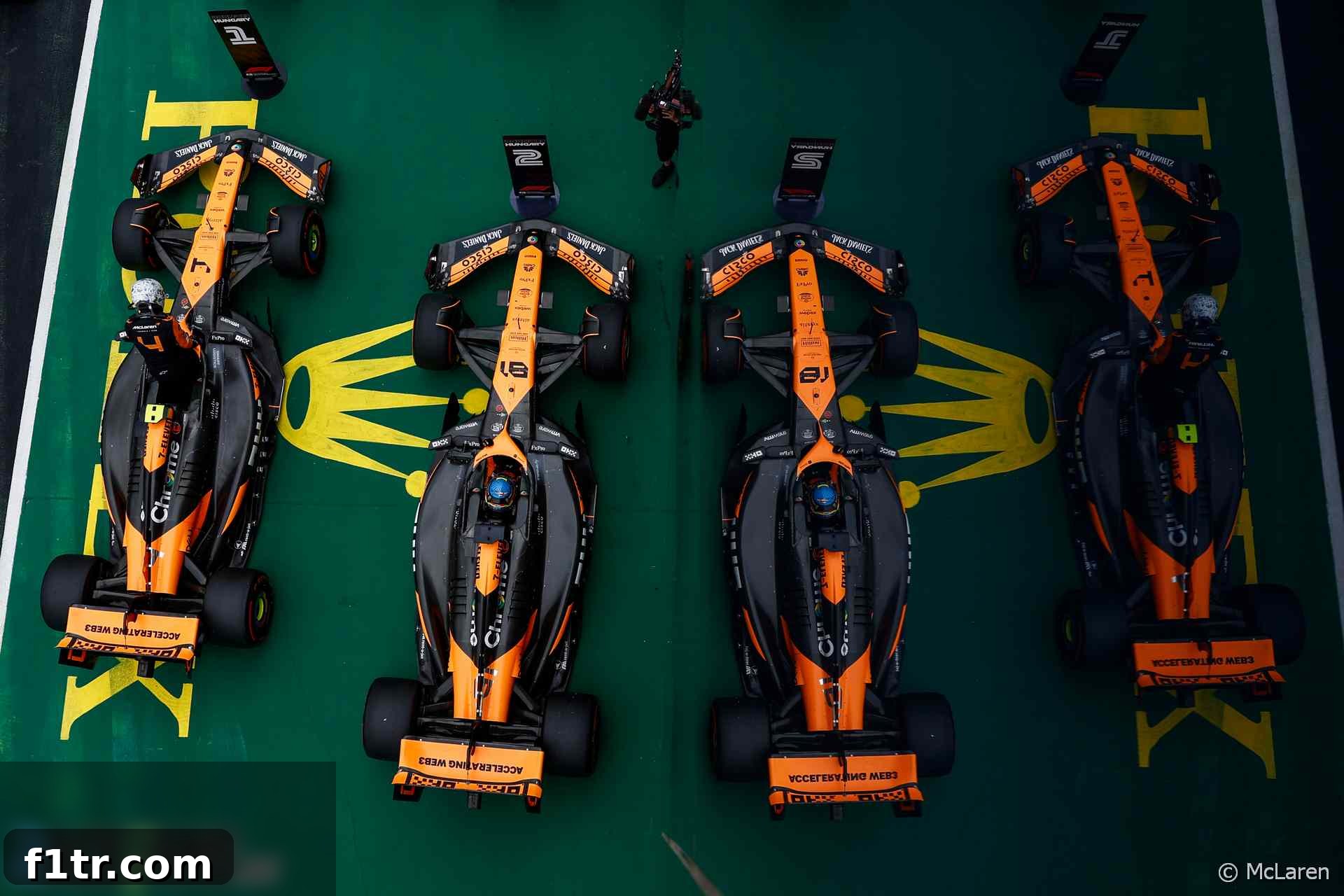
At McLaren, Lando Norris firmly established himself as the team’s qualifying spearhead, besting Oscar Piastri with a convincing 20-4 score. Norris’s exceptional talent for a flying lap was evident throughout the season, often placing the McLaren in prime positions to challenge for pole and strong race starts. Piastri, in his second Formula 1 season, showed flashes of brilliance and undeniable progress but ultimately couldn’t match Norris’s consistent top-tier performance on Saturdays. This dynamic, however, highlights McLaren’s overall strength and the intense competition within the team, pushing both drivers to perform at their peak.
Mercedes’ Intriguing Battle: George Russell vs. Lewis Hamilton
The Mercedes garage witnessed a compelling battle, with George Russell out-qualifying seven-time world champion Lewis Hamilton with a 19-5 record. Russell’s consistent edge over his more experienced teammate was a significant storyline of the season, demonstrating his evolving maturity and mastery of the Mercedes W15. This qualifying advantage often placed Russell in a stronger strategic position for the races, reflecting his growing confidence and capability. Hamilton, despite his unparalleled career achievements, faced a tougher qualifying challenge in 2024, yet his race craft often allowed him to recover positions.
Aston Martin’s Veteran Prowess: Fernando Alonso vs. Lance Stroll
Fernando Alonso continued to defy expectations with his remarkable consistency and ability to extract maximum performance from the Aston Martin AMR24. His 19-5 lead over Lance Stroll showcased the veteran’s enduring speed and precision. Alonso’s knack for delivering critical laps in qualifying was a key factor in Aston Martin’s ability to challenge for Q3 appearances and secure valuable grid slots, often making the difference for the team’s weekend prospects. Stroll, while capable, found it challenging to consistently match the two-time world champion’s one-lap heroics.
Sauber’s Internal Struggle: Valtteri Bottas vs. Zhou Guanyu
At Sauber, Valtteri Bottas demonstrated a clear upper hand over Zhou Guanyu, securing a 19-4 advantage. In a season where Sauber often struggled for pace, Bottas’s ability to consistently out-qualify his teammate highlighted his experience and skill in maximizing the car’s potential, even when it was inherently limited. This internal dominance was crucial for the team, as every grid position gained was hard-fought and valuable.
Haas’s Dynamic: Nico Hulkenberg vs. Kevin Magnussen / Oliver Bearman
Nico Hulkenberg enjoyed a strong qualifying season, particularly against Kevin Magnussen, whom he out-qualified 16-6. Hulkenberg’s precise driving and ability to find the limits of the Haas VF-24 were instrumental in securing important Q2 and even Q3 berths for the team. However, his performance was starkly contrasted by the impressive two appearances from substitute driver Oliver Bearman, who remarkably out-qualified Hulkenberg on both occasions. Bearman’s instant impact served as a significant talking point, showcasing raw talent and adaptability that raised eyebrows across the paddock.
Ferrari’s Tight Contest: Charles Leclerc vs. Carlos Sainz
The battle at Ferrari was one of the most closely contested, with Charles Leclerc holding a narrow 14-9 advantage over Carlos Sainz. This closely matched performance reflects the competitive nature within the Scuderia and the consistent development of the SF-24 throughout the season. Both drivers pushed each other relentlessly, contributing to Ferrari’s strong overall qualifying record and their frequent presence at the sharp end of the grid. Leclerc’s slight edge often came from his ability to deliver breathtaking final sector performances.
Williams’ Unbeaten Run: Alexander Albon vs. Logan Sargeant / Franco Colapinto
Alexander Albon continued his dominant qualifying form from the previous season, maintaining an unbeaten 12-0 record against Logan Sargeant. Albon’s exceptional ability to extract performance from the Williams FW46 consistently placed him far ahead of his American teammate, often carrying the team’s hopes into Q2. Following Sargeant’s departure, Franco Colapinto stepped in and, despite his rookie status, managed to out-qualify Albon twice in their nine head-to-heads, showcasing promising potential and adaptability.
RB’s Dynamic Rookies and Returnees: Yuki Tsunoda vs. Daniel Ricciardo / Liam Lawson
Yuki Tsunoda had a standout qualifying season, securing a 12-6 lead over experienced teammate Daniel Ricciardo. Tsunoda’s mature performances and consistent speed marked a significant step forward in his career, often placing the RB VCARB 01 in unexpected positions. He further cemented his reputation by achieving a flawless 6-0 record against substitute driver Liam Lawson, who filled in for a few races. This strong showing underscored Tsunoda’s impressive development and increasing confidence.
Alpine’s Bitter Divide: Esteban Ocon vs. Pierre Gasly
The closest internal battle occurred at Alpine, where Esteban Ocon held a slender 12-11 lead over Pierre Gasly before Ocon’s early departure from the team. Had Ocon not been dropped prior to the final race weekend, Gasly would have had the opportunity to level the score, making this one of the tightest and most hotly contested intra-team qualifying duels of the year. This intense rivalry, while pushing both drivers, also highlighted the internal pressures within the team. Gasly also notably out-qualified substitute Jack Doohan in his single appearance.
| Qualifying Scores (Driver 1 – Driver 2) | ||
|---|---|---|
| Max Verstappen | 23 – 1 | Sergio Perez |
| Lando Norris | 20 – 4 | Oscar Piastri |
| George Russell | 19 – 5 | Lewis Hamilton |
| Fernando Alonso | 19 – 5 | Lance Stroll |
| Valtteri Bottas | 19 – 4 | Zhou Guanyu |
| Nico Hulkenberg | 16 – 6 | Kevin Magnussen |
| Charles Leclerc | 14 – 9 | Carlos Sainz Jnr |
| Alexander Albon | 12 – 0 | Logan Sargeant |
| Yuki Tsunoda | 12 – 6 | Daniel Ricciardo |
| Esteban Ocon | 12 – 11 | Pierre Gasly |
| Alexander Albon | 7 – 2 | Franco Colapinto |
| Yuki Tsunoda | 6 – 0 | Liam Lawson |
| Oliver Bearman | 2 – 0 | Nico Hulkenberg |
| Charles Leclerc | 1 – 0 | Oliver Bearman |
| Pierre Gasly | 1 – 0 | Jack Doohan |
Methodology: For each Grand Prix weekend, the driver who reached a later qualifying stage or set a faster lap time in the same stage was judged the winner. If a driver did not set a time due to an incident or penalty, they were considered to have lost that specific head-to-head. This robust methodology ensures a fair and consistent comparison across all qualifying sessions throughout the demanding 2024 season.
Q1: Navigating the Opening Gauntlet and Avoiding Early Exits
The first session of qualifying, Q1, is a high-pressure sprint where the slowest five cars are eliminated. It’s a critical moment for every team, as an early exit can severely compromise a weekend’s strategy and morale. The 2024 season saw predictable patterns emerge, but also some surprising struggles and standout performances in this initial phase. Track evolution, traffic management, and the ability to put in a clean lap become paramount as drivers fight to simply survive and advance.
Team Performance in Q1: Surprises and Struggles
Sauber endured a particularly challenging 2024 season, a fact clearly reflected in their Q1 performance. They were by far the weakest team over a single flying lap, with their cars being eliminated in more than half of all Q1 opportunities. Zhou Guanyu, in particular, struggled immensely, progressing beyond the first round on a mere four occasions throughout the entire season. This consistent struggle in Q1 highlighted the inherent limitations of the Sauber C44 and the difficulty both drivers faced in extracting competitive one-lap pace, making every race weekend an uphill battle from the start.
On the flip side, McLaren stood out as the undisputed kings of Q1, demonstrating exceptional consistency. Their drivers only fell at the first hurdle once each across the entire season, a testament to the strong baseline pace of the MCL38 and the skill of both Norris and Piastri in navigating crowded tracks and optimizing their initial laps. This consistent Q1 performance allowed McLaren to build momentum early in each weekend, setting them up for strong Q2 and Q3 runs.
Intriguingly, even Red Bull, the dominant force of the season, recorded six Q1 eliminations. However, all of these were attributed to Sergio Perez. This pattern underscored Perez’s occasional struggles with consistency and adapting to track conditions, especially in the earlier stages of qualifying. While Max Verstappen rarely faced any threat in Q1, Perez’s issues occasionally put additional pressure on the team and highlighted a disparity in raw qualifying pace between the two Red Bull drivers.
NB. It is important to note that there was one fewer Q1 elimination than Q2 elimination during the 2024 season. This anomaly occurred at the Australian Grand Prix, where only one Williams car participated in qualifying, following a significant crash that ruled out the other chassis. This unique circumstance slightly altered the typical elimination numbers for that specific event.
Q2: The Midfield Crucible and the Path to the Pole Shootout
Q2 is often described as the most fiercely contested session in Formula 1 qualifying. With the slowest ten cars eliminated in Q1, the remaining fifteen drivers battle for one of the ten coveted spots in the final Q3 shootout. The 2024 season, characterized by a tightly matched midfield and the consistent strength of the top four teams (Red Bull, McLaren, Ferrari, Mercedes), saw Q2 become a true crucible. This session was where midfield aces could truly make a difference, pulling out stellar laps against the odds, while top teams aimed to comfortably book their passage to the final round.
Midfield Heroes: Fernando Alonso and Nico Hulkenberg’s Q2 Masterclass
Among the midfield, Fernando Alonso was a prime example of a driver consistently excelling in Q2. He took his Aston Martin into Q3 an impressive 16 times, significantly outpacing his teammate Lance Stroll, who managed just seven Q3 appearances. Alonso’s ability to extract every last tenth from the AMR24 in this critical session was a recurring theme, often elevating the car beyond its perceived performance. Similarly, Nico Hulkenberg delivered a masterclass in Q2 for Haas, claiming 11 Q3 appearances while Kevin Magnussen managed just three. These veteran drivers’ experience and consistent ability to perform under pressure in the tight margins of Q2 proved invaluable to their respective teams, often securing them crucial starting positions and the chance to compete for points.
Top Teams’ Dominance: McLaren, Mercedes, Ferrari, and Red Bull in Q2
At the very top, McLaren demonstrated unparalleled consistency in Q2, being the only team which never saw any of its drivers drop out in this session. This perfect record highlights not only the speed of the MCL38 but also the exceptional consistency of both Lando Norris and Oscar Piastri. Their 46 combined Q3 appearances were the most of any team, underscoring McLaren’s status as a front-running contender. They were closely followed by Mercedes and Ferrari, both achieving 41 Q3 appearances, showcasing their strong overall car packages and driver talent. Red Bull secured 38 Q3 spots, a slightly lower number partly due to Sergio Perez’s occasional struggles in Q1 and Q2. This consistent presence of the top four teams in Q3 often meant that only two spots were truly up for grabs for the rest of the midfield, intensifying the competition in Q2 even further.
Q3: The Battle for Pole Position and Elite Consistency
The final qualifying session, Q3, is the ultimate test of a driver’s speed and nerve. Here, the ten fastest drivers from Q2 battle it out for pole position, with every millisecond scrutinised and every corner demanding perfection. It’s where legends are made, and where the most significant psychological advantage for Sunday’s race is secured. The 2024 season saw intense battles for the top spots, with several drivers demonstrating incredible consistency in reaching this elite stage, while others faced a season-long struggle to break into the top ten.
Near-Perfect Records: The Elite Four in Q3
While no driver managed to reach Q3 in every single race weekend of the 2024 season, an impressive four drivers came incredibly close, making it on 23 out of 24 possible attempts. This elite group included Lando Norris, George Russell, Oscar Piastri, and Max Verstappen. Their near-perfect records highlight not only the consistent pace of their cars but also their remarkable ability to perform under pressure throughout the grueling season. Each missed Q3 appearance was due to specific, often unforeseen, circumstances rather than a lack of pace.
- Lando Norris: Missed Q3 due to catching a yellow flag in Q1 during the Azerbaijan Grand Prix, a rare moment of misfortune in an otherwise stellar qualifying year.
- George Russell: His only Q3 miss came in Hungary when he had to pit due to insufficient fuel in Q1, highlighting the fine margins and technical regulations that can derail even the best efforts.
- Oscar Piastri: Was caught out in Q1 during the Mexican Grand Prix, failing to make the cut in a session that proved tricky for several drivers.
- Max Verstappen: Uncharacteristically missed his last chance to set a time in Q2 at the Brazilian Grand Prix when Lance Stroll crashed, bringing out a red flag and denying the world champion a final run.
These isolated incidents underscore just how challenging it is to maintain a perfect record in the unpredictable world of Formula 1 qualifying, where external factors can often play a decisive role.
Zhou Guanyu’s Season-Long Struggle: The Only Driver Without a Q3 Appearance
In stark contrast to the elite drivers consistently reaching Q3, Zhou Guanyu was the only driver who participated in every single round of qualifying but never once reached Q3. This statistic paints a clear picture of Sauber’s struggles throughout the 2024 season and the immense challenge Zhou faced in extracting sufficient performance from the C44 to compete with the midfield. His inability to break into the top ten underscores the performance deficit of his machinery and the difficulty he encountered in finding that crucial extra pace required for the ultimate shootout. This challenging year in qualifying will undoubtedly be a key area for improvement for both Zhou and the team moving forward.
Conclusion: The Defining Moments of 2024 Qualifying
The 2024 Formula 1 qualifying season was a captivating blend of expected dominance and surprising internal battles, showcasing the raw talent and relentless pursuit of perfection that defines the sport. From Max Verstappen’s near-unblemished record against Sergio Perez to the close-fought battles at Mercedes and Ferrari, the head-to-head statistics provide a fascinating insight into driver performance. McLaren’s flawless Q1 and Q2 consistency marked them as a formidable force, while the struggles of Sauber highlighted the brutal realities of Formula 1’s competitive landscape. The ability of veterans like Fernando Alonso and Nico Hulkenberg to consistently drag their cars into Q3 was a testament to their enduring skill, while the impressive cameos of Oliver Bearman hinted at a bright future.
Ultimately, qualifying in 2024 reaffirmed its status as a cornerstone of Grand Prix racing. The fight for grid position is not just about raw speed; it’s about precision, strategy, adapting to changing conditions, and the mental fortitude to deliver under immense pressure. As we look ahead, the lessons learned from the 2024 qualifying sessions will undoubtedly shape team strategies and driver preparations, promising even more thrilling Saturday showdowns in seasons to come. The pursuit of that perfect flying lap remains one of Formula 1’s most fundamental and exhilarating challenges.