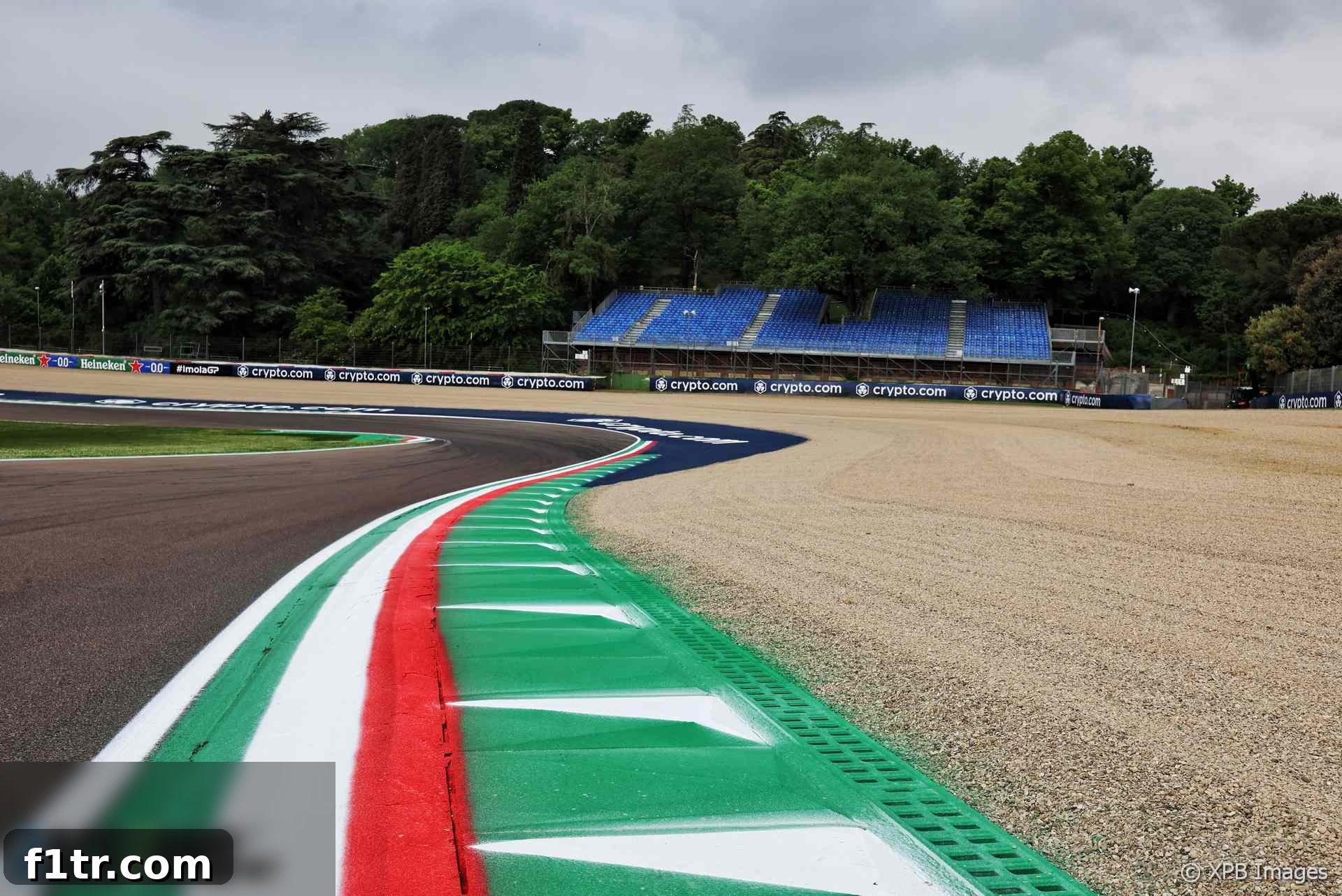
The legendary Autodromo Internazionale Enzo e Dino Ferrari, more commonly known as Imola, is set to host the Emilia-Romagna Grand Prix this weekend, marking its fourth appearance on the Formula 1 calendar since its celebrated return in 2020. Ahead of this highly anticipated event, a significant philosophical shift in circuit design has been met with widespread approval from Formula 1 drivers: the strategic reintroduction and expansion of traditional gravel traps at several critical points around the historic track. This pivotal move signals a clear intent to re-emphasize driver accountability and the immediate sporting consequences of exceeding track limits – a topic that has long been a subject of intense debate and discussion within the pinnacle of motorsport.
While the iconic and revered layout of the Imola circuit remains fundamentally untouched, extensive work has been undertaken to meticulously modify various run-off areas and kerbs. These changes are designed to fundamentally alter the level of challenge presented to competitors, demanding greater precision and respect for the circuit’s boundaries. Race director Niels Wittich has communicated a comprehensive list of fifteen notable changes to the circuit compared to the last Grand Prix held here in 2022. Among these, the most impactful and widely discussed are the three major sections where vast expanses of asphalt run-offs have been diligently reverted to the more unforgiving and traditional gravel traps. This decision has been widely praised as a decisive step towards making circuits more challenging, less forgiving of minor errors, and ultimately enhancing the purity of competition, aligning with a growing sentiment among drivers and avid fans alike.
One of the primary beneficiaries of this welcome return to traditional circuit architecture is the exit of **Piratella**. This fast, sweeping left-hand turn, which crests the top of a hill, has historically been a significant and demanding challenge for drivers. Previously, an expansive asphalt run-off area on its exit provided a relatively soft landing and a second chance for drivers who might have carried too much speed or misjudged their apex. Now, this generous tarmac has been entirely replaced with a deep bed of gravel, strategically placed and ready to ensnare any car that dares to venture wide at this crucial 200kph corner. The implications for drivers are clear and immediate: absolute precision and unwavering discipline will be paramount. Any error will now carry a genuine and tangible penalty, most likely resulting in a significant loss of lap time, potential damage to the car, or even an early and disappointing end to a session. This change effectively reinstates a layer of inherent risk that was arguably diminished by the previous asphalt expanse, thereby transforming Piratella into a true test of a driver’s nerve, skill, and judgment once again.
Continuing down the challenging descent from Piratella, drivers must then tackle the rapid **Acque Minerali** sequence – a quick and technical double-right hander. Here too, the wide, artificial run-off areas that previously characterized this section have been diligently removed, with gravel now precisely lining the very edges of the track. Both turns within this demanding sequence have received the same treatment, effectively transforming them into formidable and unforgiving challenges. Drivers will now face an uncomfortable, time-consuming, and potentially car-damaging ride through the gravel if they carry excessive speed into the corners or make even a minor error in judgment. This modification ensures that pushing the absolute limit through Acque Minerali will demand flawless execution, as the consequences of straying beyond the track’s confines will be immediate, decisive, and tangible. The psychological pressure on drivers to hit their marks perfectly through these high-consequence sections will be immense, adding another fascinating strategic layer to both qualifying performance and crucial race pace management.
Further up the hill, the notoriously challenging chicane at **Variante Alta** has also undergone significant and impactful modification. This particular section gained considerable notoriety during the 2022 Imola race when Ferrari driver Charles Leclerc, pushing hard to maximize his lap, spun into the tyre wall after misjudging his entry. While Leclerc miraculously managed to recover his car and rejoin the track on that specific occasion, the scenario would be drastically different and far more severe this weekend. Thanks to the newly installed and expansive gravel trap on the exit of Variante Alta, any similar mistake will now carry a much heavier and more immediate penalty. The gravel will not only prevent a swift and easy rejoin but could also potentially beach the car, causing significant delays, forcing a pit stop for damage assessment, or even resulting in an unfortunate retirement from the race. This specific change directly addresses past incidents, powerfully reinforcing the message that track limits are not merely abstract lines on asphalt but absolute boundaries that demand unwavering respect, with immediate and undeniable consequences for infringement.
This widespread embrace of gravel traps across key sections of the Imola circuit has been met with an overwhelmingly warm and positive reception by the drivers themselves. Alpine’s Pierre Gasly, a vocal proponent of traditional circuit characteristics and challenging track designs, enthusiastically welcomed these revisions, unequivocally stating that the reintroduction of gravel traps was a “great” and much-needed enhancement to the circuit. “It just sets the limit,” Gasly explained, articulating the fundamental and desired principle behind these changes. “I think it works fine. If you go over the limits, you get penalised and you can’t get away with it.” His comments resonate deeply with many drivers who have long felt that modern circuits, with their vast asphalt run-offs, have inadvertently diluted the pure sporting challenge, allowing competitors to explore track limits without sufficient deterrents or immediate penalties. Gasly further elaborated on this sentiment, stating, “I do believe that’s how it should be because with all these run-off and Tarmac, then you tend to sometimes get away with limits, with lock-ups, trying more stuff, going off the track, coming back without really much disadvantage and we kind of lost a bit the way it was in the past.” This insightful perspective powerfully highlights a collective desire among the current generation of racers to bring back a more authentic, high-consequence form of motorsport, where precision, restraint, and flawless execution are consistently rewarded. He concluded by commending the FIA and Formula 1 management for their positive reaction and their decisive decision to implement these crucial and impactful changes at Imola.
Beyond the elite Formula 1 paddock, drivers in the fiercely competitive supporting series, such as Formula 2 and Formula 3, who will also be competing on the challenging Imola circuit this weekend, have offered their valuable perspectives. Prema F2 racer Oliver Bearman, while acknowledging the significance of the gravel trap changes, expressed his belief that the newly installed kerbs at ten of the circuit’s corners will ultimately have a more profound and subtle impact on overall driver approach and performance. “I think the more important one is the changes to the kerbs, which are actually in almost every corner,” Bearman told media, including RaceFans. “It could change slightly the kind of approach [you take].” He suggests that these specific kerb modifications might subtly alter optimal racing lines, demand different car setups, and influence driving techniques more consistently than the gravel, which primarily serves as an immediate and severe punishment for more significant errors. Regarding the gravel traps themselves, Bearman noted, “In terms of gravel traps, not really [a major change to approach]. Maybe if people make mistakes, they will cause a few more stoppages. The other potential thing is that if there is gravel being [brought] onto the track in those corners, it could be a bit frustrating.” Despite these minor, practical reservations about potential track cleanliness issues that might arise, Bearman ultimately endorsed the underlying philosophy, stating, “But I like the fact that you get punished for, for taking too much risk or for making mistakes. That’s a proper track.” This powerful sentiment underscores a common thread among dedicated racing drivers: a deep appreciation for circuits that genuinely test their abilities, demand absolute precision, and provide clear, immediate consequences for pushing beyond acceptable boundaries.
Bearman’s spirited F2 rival, Franco Colapinto, shares a very similar view regarding the enhanced challenge that Imola now presents, predicting an increase in on-track incidents and race stoppages as a direct result of these modifications. “Imola is one of the best ones of the calendar and I think it’s always been very, very challenging for the drivers,” Colapinto remarked, echoing the sentiment of many. He then astutely highlighted the significant strategic implications of the gravel’s return: “I think it will be a case that, of course, with more gravel traps, there will be more red flags, more Safety Cars. Which can affect a lot, in a F2 race, with the different strategies and all these things.” Colapinto’s foresight points directly to the potential for a more unpredictable, tactically complex, and potentially dramatic race weekend, particularly for the junior categories where varying strategies, sudden race interruptions, and unexpected events can significantly reshuffle the order and determine outcomes. While some might initially view increased stoppages as a disruption to the flow of racing, it undeniably adds an element of heightened drama, strategic intrigue, and pure spectacle, forcing teams and drivers to remain agile, adaptable, and quick-thinking throughout the races.
The strategic return of gravel at Imola is not merely an aesthetic or nostalgic choice; it represents a profound and significant philosophical shift in contemporary circuit design and safety enforcement within motorsport. For many years, the prevailing trend in circuit design heavily leaned towards incorporating expansive asphalt run-offs, primarily driven by a commendable desire to minimize serious accidents and facilitate easier, quicker recovery for drivers who ran wide. However, this approach, while enhancing safety in certain contexts, inadvertently encouraged drivers to push far beyond established track limits with considerably less fear of immediate or severe penalty, often leading to protracted debates over consistent enforcement of track limits. The reintroduction of traditional gravel traps directly addresses this inherent challenge, providing a natural, self-enforcing, and immediate boundary. A spin or excursion into a gravel trap typically results in a bogged-down car, a significant loss of precious lap time, potential damage that requires a pit stop, or even an unfortunate and immediate retirement from the race. This makes the consequence of an error far more impactful and decisive than a brief excursion onto a forgiving tarmac surface. Ultimately, this brings an element of old-school grit, challenge, and accountability back to the racing, where precision, respect for the track’s confines, and masterful car control are absolutely paramount.
These specific circuit changes are particularly poignant and historically resonant for Imola, a circuit deeply steeped in rich, and often tragic, history. The devastating accidents involving Ayrton Senna and Roland Ratzenberger in 1994 led to an unprecedented paradigm shift in Formula 1 safety protocols, prompting extensive and fundamental modifications to Imola and countless other circuits worldwide. While driver safety remains, as it always should, the absolute and unwavering priority, the current modifications at Imola seek to strike a delicate and crucial balance: making the circuit inherently challenging and demanding without compromising fundamental driver well-being. The updated run-off areas, including the isolated single Tarmac addition at the Villeneuve chicane exit, illustrate a nuanced and considered approach. Tarmac run-offs are still intelligently utilized where high-speed impacts or specific angle risks dictate an essential need for maximum deceleration space, but gravel is deliberately chosen for areas where track limits enforcement, immediate sporting penalty, and enhanced sporting challenge are the primary and desired goals.
The implications of these sweeping changes for the upcoming Emilia-Romagna Grand Prix weekend are considerable and far-reaching. During the intense qualifying sessions, drivers will be compelled to be exceptionally precise and utterly fearless, as even a minor slip-up or a fraction of an inch beyond the track limits could mean the crucial difference between a pole position attempt and a ruined lap, or even worse, a damaged car requiring significant repairs. In the race itself, the stakes will be even higher. The very real prospect of multiple Safety Car periods or even outright red flags, as predicted by the insightful Franco Colapinto, strongly suggests a potentially chaotic, strategically complex, and utterly thrilling event. Pit stop strategies will undoubtedly become more critical and dynamic, and teams will need to be exceptionally well-prepared for sudden and unpredictable shifts in race dynamics. Furthermore, should wet weather descend upon Imola, as it often can unpredictably, the newly expanded gravel traps will become an even greater and more unforgiving hazard, amplifying the already immense challenge and significantly increasing the likelihood of spectacular incidents and dramatic moments.
Ultimately, the overwhelming consensus from the Formula 1 paddock and the broader motorsport community is that these strategic and deliberate modifications at Imola represent a genuinely positive and forward-thinking step. They powerfully reflect a renewed commitment to preserving the raw challenge, the unforgiving nature, and the inherent excitement of historic circuits like Imola, while simultaneously enhancing driver accountability and upholding the highest standards of sporting integrity. As the powerful cars hit the track for the Emilia-Romagna Grand Prix, the expanded gravel traps will not merely be passive obstacles; they will stand as silent, yet decisive, arbiters of skill, precision, courage, and ultimate consequence, promising a race weekend filled with heightened drama, genuine sporting challenges, and unforgettable moments. Imola is truly ready to remind everyone why it holds such a special and cherished place in the hearts of motorsport enthusiasts worldwide, now more challenging, more rewarding, and more spectacular than ever before.
Imola’s Revised Gravel Traps: A Visual Guide
More from the 2024 Emilia-Romagna Grand Prix:
- Ferrari expect qualifying gain after spotting rivals’ power strategy tactics
- How Alonso and Stroll copied Verstappen’s tactic plus more unheard Imola radio
- Verstappen beats Hamilton’s winning rate with Emilia-Romagna GP victory
- How Russell resisted losing position to Hamilton “for no reason” with extra stop
- “Lando’s found some pace”: Unheard radio from Verstappen-Norris Imola duel
Browse all 2024 Emilia-Romagna Grand Prix articles