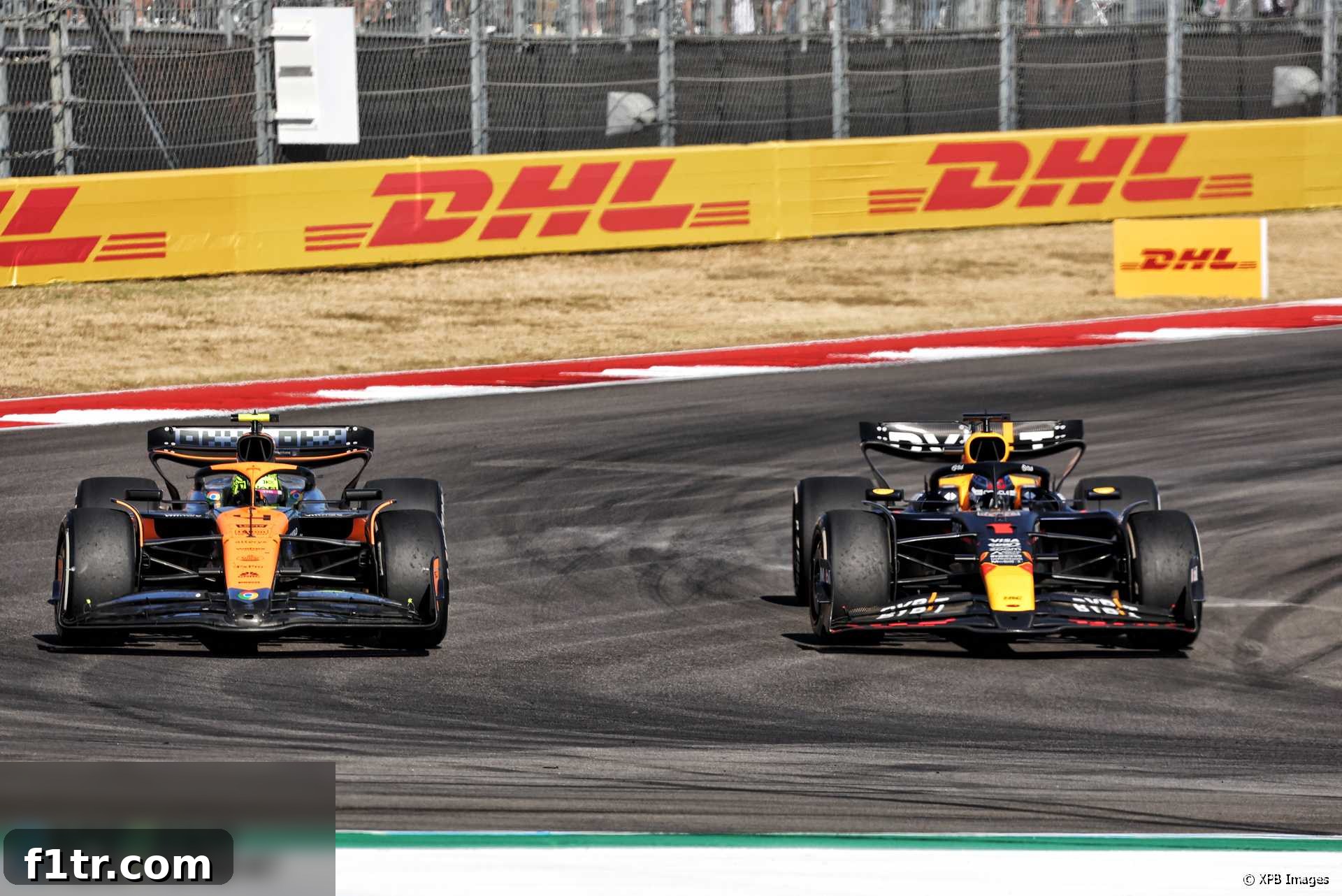
In a significant development that underscores the often contentious nature of Formula 1 stewarding and the unwavering pursuit of competitive advantage, McLaren has officially requested that the FIA stewards review their decision to impose a penalty on Lando Norris during the recent United States Grand Prix. This formal challenge sets the stage for a critical hearing, the outcome of which could not only alter Norris’s final race standing but also send ripples through the interpretation of racing rules and track limit infringements across the sport.
The Controversial Incident: Lando Norris vs. Max Verstappen at COTA
The core of McLaren’s petition revolves around a five-second time penalty handed to Lando Norris for an incident that unfolded at Turn 12 on lap 52 of the Austin race. Norris was penalized for passing Max Verstappen off the track, a maneuver deemed to have gained an unfair advantage by completing the overtake beyond the defined circuit boundaries. What made this incident particularly contentious was that Verstappen, in his defensive action, also ventured off the track at the very same moment, blurring the lines of culpability and sparking immediate debate among drivers, teams, and fans alike.
Turn 12 at the Circuit of the Americas (COTA) is notorious for its challenging apex and run-off areas, frequently leading to discussions about track limits. On this specific lap, as Norris mounted a determined attack on the Red Bull of Verstappen, the reigning world champion executed a characteristically aggressive defensive move. Multiple perspectives emerged after the race: Norris and other drivers questioned the legality of Verstappen’s “divebomb” defense, arguing that he braked so late that he could not make the turn himself, inevitably forcing the McLaren wide and leaving Norris with little choice but to go off-track to avoid a collision while completing what he believed was an already legitimate overtake. McLaren’s Right of Review submission is expected to heavily lean on this interpretation, contending that Norris’s off-track excursion was a direct consequence of Verstappen’s defensive tactics rather than an intentional shortcut.
Understanding the FIA’s Right of Review Process: A Stringent Challenge
McLaren’s move triggers a specific, rarely invoked, and highly rigorous procedure governed by Article 14 of the FIA International Sporting Code: the “Right of Review.” This process is distinct from a simple appeal; it provides an opportunity for a team to challenge a stewards’ decision, but only if they can present genuinely “significant and relevant new element which was unavailable to the party seeking the Review at the time of the decision concerned.” This is a formidable evidentiary hurdle designed to prevent frivolous challenges and ensure the finality of race results.
The initial phase of this process is entirely focused on assessing whether this stringent requirement has been met. The stewards, who exercise “sole discretion” in this determination, will first convene to hear McLaren’s argument and review any presented evidence. Only if they are convinced that genuinely new, significant, and relevant information has indeed come to light, which was not available during their original ruling, will the process advance to a second stage. If this initial threshold is not met, the petition is rejected, and the original penalty stands unchanged. The scarcity of successful Right of Review petitions in Formula 1 history underscores the difficulty of clearing this bar, as teams typically have access to vast amounts of data, video, and audio immediately following an incident.
Advert | Become a RaceFans supporter andgo ad-free
The Summons: Key Players Gather at Autodromo Hermanos Rodriguez
Following McLaren’s formal petition, representatives from both McLaren and Verstappen’s Red Bull Racing team have been summoned to a crucial meeting with the stewards. This pivotal video conference is scheduled for Friday, October 25, 2024, at 2:30 PM Mexico time, taking place at the Autodromo Hermanos Rodriguez – the venue for the upcoming Mexican Grand Prix. The timing is strategic, occurring just one hour after the conclusion of the first practice session, ensuring that the eyes of the F1 world will be fixed on this procedural battle even as on-track action resumes.
Red Bull’s presence at the hearing is essential, as they are considered a “concerned party” due to Max Verstappen’s direct involvement and the potential impact of any revised decision on their driver’s results and reputation. Their representatives will undoubtedly be prepared to articulate their perspective, defend Verstappen’s actions, and scrutinize any “new evidence” McLaren might present. This adversarial yet structured dialogue is fundamental to ensuring a fair and thoroughly considered assessment of the incident under review.
Divergent Driver Perspectives: A Battle Over Racing Rules and Ethics
The immediate aftermath of the US Grand Prix saw a clear and passionate divide in opinion between the drivers involved and the broader paddock. Lando Norris, along with several other drivers, openly questioned the legitimacy and fairness of Verstappen’s defensive maneuver. They emphasized that Verstappen appeared to lose ground to Norris on the approach to Turn 12, then engaged in an extremely late braking maneuver that compromised his own ability to make the corner correctly, thereby creating a situation where Norris was undeniably forced wide. Norris firmly articulated his view that it was “incorrect” for the established rules to permit such an aggressive, track-limit-pushing defensive tactic, arguing that he was left with no viable alternative but to momentarily leave the track to avoid an outright collision and complete the overtake he had rightfully initiated.
Conversely, when pressed on the legality of his defensive action, Max Verstappen remained resolute in his stance, placing the onus of the infringement squarely on Norris. “You cannot overtake outside of the white line, that’s a very clear rule and I’ve been done [for] it myself,” Verstappen unequivocally told Sky Sports, invoking a foundational principle of circuit racing. He further expressed his disbelief at the sudden calls for regulatory changes, stating, “So I don’t understand why suddenly now we need to scream for changes in the regulations when it’s been like that forever.” This fundamental disagreement highlights the enduring tension in F1 between the pursuit of aggressive, wheel-to-wheel racing and the strict, consistent enforcement of track limits – a debate that McLaren’s review request aims to bring into sharper focus.
McLaren’s Strategic Imperative: Beyond Just Points
While the recovery of valuable championship points for Lando Norris and McLaren is undoubtedly a primary driver, the team’s decision to pursue a Right of Review carries a broader strategic significance. This move serves multiple objectives:
- Seeking Regulatory Clarity: McLaren aims to push for enhanced clarity and greater consistency in stewarding decisions, particularly concerning the intricate interplay between aggressive defensive driving and track limit infringements. They are likely advocating for a precedent that differentiates between a driver deliberately going off-track for advantage and one forced off-track by an opponent’s potentially illegal or overly aggressive defense.
- Unwavering Driver Support: By actively challenging the penalty, McLaren demonstrates powerful backing for Lando Norris, reinforcing team morale and signaling to their drivers that they will exhaust every avenue to support them in contentious situations.
- Competitive Advantage: Every single point holds immense value in Formula 1, influencing not only drivers’ standings but also the Constructors’ Championship, which has significant financial implications and prestige.
- Highlighting Systemic Issues: The sport has faced persistent criticism regarding perceived inconsistencies in track limit penalties and stewarding across different circuits and seasons. McLaren’s challenge serves to amplify this ongoing debate, potentially prompting a more unified and transparent approach from the FIA moving forward.
Ultimately, the outcome of this review, irrespective of whether the penalty is overturned, will contribute significantly to the ongoing dialogue about how racing incidents are adjudicated and how rules are applied. It has the potential to influence future regulatory discussions within the FIA and reshape the parameters of acceptable racing conduct.
Official Announcement from the Stewards
The Stewards have received a petition for a Right of Review in accordance with article 14 of the FIA International Sporting Code, from McLaren Formula 1 Team, in respect of the Decision of the Stewards of the 2024 United States Grand Prix, document 69, breach of article 33.3 of the FIA Formula One Sporting Regulations in relation to car four [Norris].
The team representative is required to attend a video conference with the stewards at 1430 hrs Mexico time on Friday October 25, 2024 in relation to the above. Any other “concerned party” may seek the permission of the stewards to appear.
It should be noted that this hearing will be in two parts. The first part will be to hear evidence as to whether or not there is a “significant and relevant new element which was unavailable to the party seeking the Review at the time of the decision concerned”.
Should the stewards determine, in accordance with Article 14.3, (in their sole discretion) that such element exists, a second part of the Hearing will be convened at a time to be advised.
The Two-Part Hearing: A Deep Dive into the Procedural Steps
As clearly outlined in the stewards’ official announcement, the Right of Review hearing is structured into two distinct and crucial phases. The initial part is singularly dedicated to addressing the stringent evidentiary requirement. McLaren must present compelling new evidence that was genuinely unknown or unavailable to them, or to the stewards, when the original decision was made. This “new element” could take various forms:
- Unexamined Telemetry Data: A more granular analysis of car telemetry, such as intricate data on brake pressure application, steering angle inputs, or tire temperatures, which might reveal nuances previously overlooked in the immediate aftermath.
- Alternative Visual Evidence: High-definition onboard footage from other competing cars, previously unreleased trackside camera angles, or even authenticated spectator videos that offer a novel perspective of the incident.
- Expert Testimonial: Insights from independent racing analysts or technical experts who can provide an authoritative interpretation of the physics, driver intentions, and racing lines involved, potentially challenging the initial assessment.
- Audio Communications: Previously unheard or unanalyzed team radio communications or even inter-driver communications that could shed new light on the immediate context or instructions related to the incident.
Following McLaren’s presentation, the stewards, acting with their “sole discretion,” will meticulously evaluate whether this evidence unequivocally satisfies the strict criteria set forth in Article 14.3. If they conclude that the new information is insufficient or does not meet the “significant and relevant” threshold, the petition for review will be summarily rejected, and the original penalty will stand. However, should the stewards determine that a legitimate “significant and relevant new element” indeed exists, the hearing will then proceed to its second phase. This subsequent stage would involve a full re-evaluation of the entire incident, critically considering all available evidence, including the newly accepted elements. This could potentially lead to a reconsideration, modification, or even a complete reversal of the initial penalty. The exact timing for this potential second part of the hearing would be announced at a later date, allowing all involved parties ample time to prepare for a more in-depth examination of the incident’s specifics.
Potential Outcomes and Broader Implications for Formula 1
The decision emanating from McLaren’s Right of Review request carries substantial weight, extending far beyond the immediate points for Lando Norris. It will have significant implications for the landscape of Formula 1 stewarding and the ongoing evolution of racing regulations. Several potential scenarios could unfold:
- Rejection of the Review Request: This outcome is historically the most frequent for such petitions, largely due to the exceptionally high bar for “new evidence.” If the request is rejected, Norris’s five-second penalty would remain, solidifying the original decision and likely fueling continued debate among teams, drivers, and the fan base regarding consistency in stewarding.
- Acceptance of New Evidence, Penalty Upheld: It is conceivable that the stewards might acknowledge the presence of new evidence but, upon a thorough re-evaluation, conclude that it does not fundamentally alter their original judgment regarding Norris’s penalty. In this case, the penalty would still stand.
- Acceptance of New Evidence, Penalty Overturned or Modified: This would represent the most impactful and surprising outcome. If the penalty were to be overturned or reduced, Norris would regain the lost points, potentially shifting his standing in the Drivers’ Championship and impacting McLaren’s position in the Constructors’ Championship. Such a decision would also establish a powerful precedent regarding the interpretation of defensive driving and track limits, particularly in scenarios where a driver is perceived to have been forced off-track. It could significantly influence future stewarding decisions and driver conduct.
Beyond the immediate points, this entire process underscores the inherent tension between the desire for thrilling, aggressive, wheel-to-wheel racing and the fundamental necessity for clear, consistently applied rules to uphold safety and fairness. Formula 1 has consistently grappled with track limit issues across various circuits and corners for many years. McLaren’s petition serves as a stark reminder that consistency, transparency, and logical reasoning in stewarding remain paramount for maintaining the integrity and credibility of the pinnacle of motorsport.
The stewards’ decision on Friday will be awaited with bated breath by teams, drivers, and fans around the globe. It is more than a mere review of a single incident; it is a crucial test of the FIA’s regulatory framework and its capacity to adapt and respond to the dynamic challenges of modern Formula 1 racing.
Miss nothing from RaceFans
Get a daily email with all our latest stories – and nothing else. No marketing, no ads. Sign up here:
2024 United States Grand Prix Related Articles
- McLaren insist stewards made ‘provable error’ after losing bid for review of Norris’ penalty
- Why McLaren’s focus on Verstappen’s driving failed to overturn Norris’ penalty
- Stewards reject McLaren’s request to review Norris’ United States GP penalty
- McLaren know Norris’ penalty is likely to stand – so what do they hope to gain?
- McLaren request review of Norris’ penalty for off-track pass on Verstappen
Browse all 2024 United States Grand Prix articles