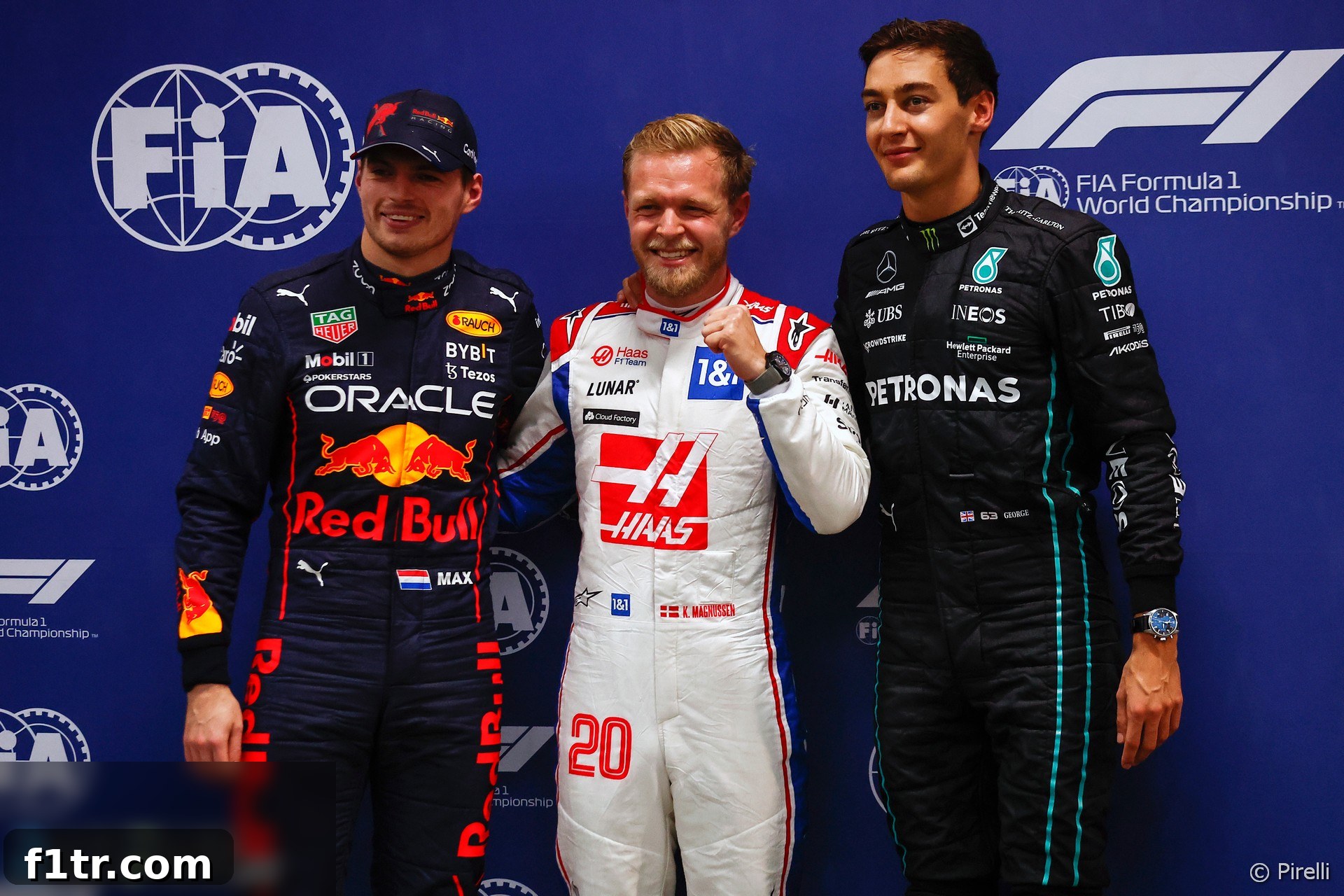
Kevin Magnussen’s Shock 2022 Brazilian Grand Prix Pole Position: A Masterclass in Strategy and Serendipity
In the high-stakes world of Formula 1, moments of pure magic are rare, especially for teams battling outside the traditional front-runners. The prospect of Haas F1 securing a pole position in the 2022 season seemed, to many, an almost impossible dream. Throughout the year, while demonstrating flashes of brilliance, the team’s performance level suggested that only an extraordinary confluence of unlikely events – a perfect storm – could ever grant them a genuine chance to top a qualifying session.
Advert | Become a Supporter & go ad-free
Yet, in a breathtaking twist of fate during Friday’s qualifying session for the Saturday sprint race at Brazil’s iconic Interlagos circuit, the racing gods seemingly intervened. Just under four minutes into the crucial Q3 segment, a serendipitous spin by George Russell brought the session to an abrupt halt with a red flag. This dramatic moment unfolded precisely as the rain intensified, further drenching the circuit and effectively denying any other driver the opportunity to challenge Kevin Magnussen’s provisional pole time. The world watched in stunned silence as the Danish driver, and the Haas F1 team, found themselves on the precipice of their first-ever Formula 1 pole position.
The immediate assumption was that Russell’s untimely mistake had gifted Magnussen this incredible feat. However, a deeper dive into the events leading up to the red flag reveals a compelling narrative that suggests the most stunning qualifying result of the season was already firmly in Magnussen’s grasp, cemented by strategic brilliance and rapidly deteriorating track conditions, long before the Mercedes veered off track.
The Improbable Rise: Haas’s Underdog Story in 2022
To truly appreciate the magnitude of Magnussen’s pole, one must first understand Haas’s standing in the 2022 Formula 1 season. As one of the smaller, independent teams, Haas consistently fought valiant battles in the midfield, often punching above their weight but rarely contending for top honours. Their VF-22 car, while competitive on occasion, particularly early in the season, was not designed to outperform the likes of Red Bull, Ferrari, or Mercedes in a straightforward fight for ultimate pace. Max Verstappen and Red Bull’s late-season dominance further underscored the challenge facing any aspiring underdog.
Interlagos, officially known as Autódromo José Carlos Pace, is a circuit renowned for its unpredictable weather patterns. Its location in São Paulo, Brazil, often sees sudden shifts from bright sunshine to torrential downpours within minutes, making tyre strategy and quick decision-making paramount. This inherent unpredictability makes it a potential breeding ground for upsets, where driver skill and strategic foresight can briefly overshadow raw car performance.
Magnussen’s journey to Q3 itself was a testament to his determination. He had scraped through the second qualifying session with a vital improvement on his final flying lap, securing his place among the top ten drivers with just 70 seconds left on the clock. As he completed that crucial lap, which saw him move safely into seventh place, a light drizzle, which had been intermittently falling for the past three hours, began to return. Grip levels across the circuit started to noticeably fade, making it difficult for those in the drop zone to make significant improvements before the clock hit zero.
The Q3 Gamble: Haas’s Strategic Masterstroke
The critical five-minute interval between the end of Q2 and the start of Q3 saw the rain persist, albeit gently. Critically, it remained light enough that slick tyres were still deemed the optimal choice for the initial phase of Q3. It was at this juncture that Haas executed a strategic masterstroke that would ultimately define the session. Taking full advantage of their garage being strategically situated at the very end of the pit lane, they wasted no time in sending Magnussen out. He was the first car to queue at the pit exit, positioning himself a full 80 seconds before the green light signaled the start of Q3.
This decision was not arbitrary; it was a calculated gamble. Magnussen’s race engineer, Mark Slade, conveyed the urgency and potential implications to his driver as he sat patiently awaiting the session’s start. “So the first lap could be it,” Slade warned, emphasizing the rapidly evolving conditions. “But if you think it’s clearly too wet for the dry tyres, we’ll box and fit inters.” This instruction highlighted the razor-thin margin for error and the critical importance of Magnussen’s immediate feedback on track conditions.
Advert | Become a RaceFans supporter andgo ad-free
Directly behind Magnussen in the pit lane queue was Charles Leclerc, the only driver among the top ten opting for intermediate tyres – a choice that would prove disastrous for the Ferrari driver. The moment the green light flashed, Magnussen launched into his out-lap with furious intent, determined to get to the timing line as swiftly as possible, warming his slick tyres optimally for the crucial flying lap.
Meanwhile, Ferrari seemed to have misjudged the conditions or Leclerc’s tyre choice, as he tip-toed gingerly out of the winding pit exit, struggling for grip. By the time Carlos Sainz Jnr passed his team mate into Descida do Lago, Magnussen was already navigating Ferradura, a staggering 600 metres further up the road. This significant track position advantage meant Magnussen experienced the circuit at its absolute driest and fastest, a fleeting window of optimal conditions that would rapidly close for his rivals.
The Rain Closes In: Rivals Struggle as Grip Vanishes
Magnussen began his flying lap with his slick tyres perfectly warmed from his aggressive out-lap. One minute and eleven seconds later, he crossed the line to establish a provisional pole position time – a truly remarkable feat given Haas’s typical pace. The pressure was now on the following drivers. Carlos Sainz, who enjoyed the second-best track conditions, failed to match Magnussen’s blistering time, coming in six-tenths slower.
Max Verstappen was next, and while initially quicker than Magnussen through the first seven turns, a lock-up under braking for the eighth corner caused him to run wide, costing him precious time and momentum. The reigning world champion completed his lap two-tenths slower than Magnussen, placing him second after the initial runs. This near-miss by Verstappen was a critical indicator of the rapidly deteriorating conditions; even a driver of his caliber could not extract the same performance as Magnussen had just moments earlier.
At this crucial juncture, the rain’s impact on grip became profoundly evident. Magnussen, sensing the immediate and dramatic fall in grip levels, wasted no time in communicating his assessment over the radio. “It’s too wet, now,” he declared as he meandered through the middle sector. “Qualy’s over now.” His prophetic words underscored the fleeting nature of the opportunity he had seized.
Sainz, attempting to push after his first flying lap, quickly corroborated Magnussen’s assessment, reporting a significant loss of grip. “Ugh, no grip!” he relayed over the radio. “Raining heavy now.” The track was transforming into a treacherous surface faster than anyone had anticipated, rendering further improvements on slick tyres increasingly improbable.
Advert | Become a RaceFans supporter andgo ad-free
Behind him, Verstappen was instructed to complete a recharge lap in preparation for a second push. However, his concern about the worsening conditions was palpable. “I think it’s very slippery now,” Verstappen warned his race engineer, Gianpiero Lambiase. Despite Lambiase’s encouragement to “keep up the pace,” Verstappen’s immediate and unequivocal reply was, “Gah, it’s impossible. It’s starting to rain.” This exchange between one of the sport’s greatest drivers and his engineer powerfully illustrated the severity of the conditions.
Russell’s Spin: The Final Nail in the Coffin, Not the Starting Gun
As the session continued, drivers like Lando Norris, Esteban Ocon, Fernando Alonso, and Lewis Hamilton all reported a noticeable escalation in the rain’s intensity during their third Q3 laps. The only drivers who showed any form of improvement on their third attempts were Sergio Perez, who had been significantly impeded by Leclerc on intermediate tyres during his first push lap, and the two Mercedes drivers, George Russell and Lewis Hamilton.
However, even these improvements were qualified. Perez, despite setting the fastest first sector, was tellingly failing to improve in the middle sector compared to his earlier, compromised timed lap. This suggested that the track was already past its best, even for those making up lost time. Hamilton, having improved through the first three corners of his second lap, was forced to back off abruptly. Marshal posts ahead flashed yellow as he approached Descida do Lago – his team mate, Russell, had spun and beached the sister Mercedes in the gravel, bringing out the red flag.
Advert | Become a RaceFans supporter andgo ad-free
With eight minutes and ten seconds still remaining in Q3, the session was formally red-flagged. The rain, which had already started to fall heavily, continued its relentless descent, naturally washing away any remaining grip the drivers had enjoyed at the start of Q3. By the time the session eventually restarted, the Interlagos circuit was thoroughly soaked. There was simply no realistic chance for any of the ten drivers to improve their times in the remaining eight minutes. Magnussen and the Haas team could only wait, enduring what felt like an eternity, for their maiden pole position to be officially confirmed.
“It was the longest minutes of my life,” a jubilant Magnussen recounted later. “I mean, it looked like it was going to be wet so it was safe. But you just never know and you don’t want to jinx it.” His words encapsulated the anxiety and disbelief of the moment.
It’s tempting, and perhaps easy, to attribute Magnussen’s stunning result solely to the good fortune of a well-timed red flag. The narrative often suggests it prevented the likes of Verstappen or Leclerc from inevitably snatching pole with a second flying lap. However, the comprehensive struggle for grip reported by all drivers on their third laps, coupled with Perez’s failure to significantly improve in the middle sector, strongly indicates that the track was already well past its peak. Magnussen was, in all likelihood, already on course for pole position had those final eight minutes been run entirely uninterrupted.
A Testament to Strategy and Trust
Magnussen himself was quick to credit his team for creating the opportunity. Having been sent out first to secure the best possible track position prior to the start of Q3, he acknowledged the pivotal role played by Haas’s strategic acumen. “The team put me out in the pit lane as the first car and that was the game-changer,” Magnussen stated unequivocally.
“It gave me the best piece of track because it was starting to rain. So I was the first one getting the most dry and we got pole. It’s crazy.” His words perfectly summarized a perfect blend of shrewd strategy, impeccable timing, and a touch of Interlagos magic. This pole position was not merely a stroke of luck; it was a testament to a team and driver who seized a fleeting opportunity with precision and boldness.
The 2022 Brazilian Grand Prix qualifying will forever be etched in Formula 1 history as the day Kevin Magnussen and Haas F1 defied expectations, demonstrating that with the right strategy and a sprinkle of serendipity, even the biggest underdogs can reach the pinnacle of the sport.
Advert | Become a RaceFans supporter andgo ad-free
Become a RaceFans Supporter
RaceFans is run thanks in part to the generous support of its readers. By contributing £1 per month or £12 per year (or the same in whichever currency you use) you can help cover the costs of creating, hosting and developing RaceFans today and in the future.
Become a RaceFans Supporter today and browse the site ad-free. Sign up or find out more via the links below:
- Become a RaceFans Supporter
- RaceFans Supporter FAQ
2022 Brazilian Grand Prix Related Articles
- Ferrari’s season of missed chances led to “difficult” criticism for Binotto
- How many victory chances did Hamilton have in his first winless F1 season?
- Red Bull “never envisaged” Brazil team orders situation – Horner
- Red Bull “accept Max’s reasoning” over radio row and condemn online abuse
- Russell’s first grand prix victory means F1 has a dozen winners – for one race only
Browse all 2022 Brazilian Grand Prix articles