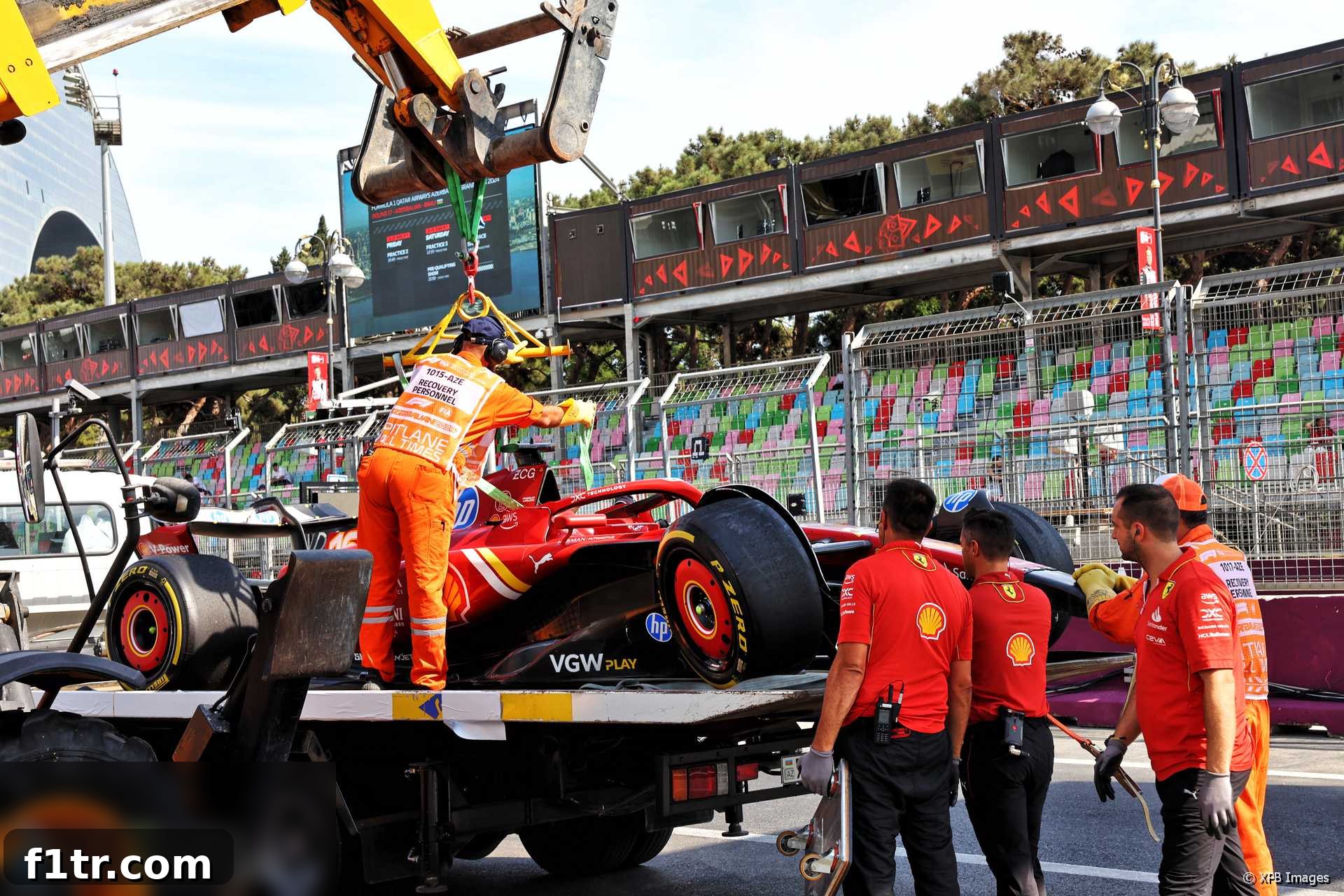
Charles Leclerc, the formidable Ferrari driver, faced a tumultuous but ultimately productive Friday at the track, navigating through two distinct and challenging incidents during the practice sessions. Despite an early crash that raised concerns, followed by an unexpected technical glitch in the subsequent session, Leclerc emphatically clarified that the latter issue was entirely unrelated to the damage sustained in his earlier accident. This assertion underscores both his acute understanding of his car and the diligent work of his Ferrari mechanics.
Advert | Become a Supporter & go ad-free
The day began with an unfortunate mishap during the first practice session (FP1) when the Monegasque driver lost control and made contact with the barrier at Turn 15. The impact was significant enough to cause substantial damage to the front end of his Ferrari SF-24, immediately throwing a shadow over his Friday preparations. Speaking candidly about the incident, Leclerc attributed the error to a momentary misjudgment combined with challenging track conditions.
Early Setback: Leclerc’s FP1 Incident and Its Aftermath
“I braked a little bit too much on the right,” Leclerc explained, recounting the moments leading up to the impact. “The track was still dirty, I locked up and it was too late to go to the right so I went into the wall.” This honest self-assessment highlighted the fine margins that define Formula 1, especially on a track where conditions can evolve rapidly. The early lock-up, combined with a track surface that hadn’t fully rubbered in, left him with no escape route, resulting in the collision.
The severity of the damage prompted immediate concerns within the Ferrari garage and among fans. Such incidents often lead to lengthy repair times, sometimes forcing drivers to miss crucial practice mileage. Leclerc, however, remained unfazed despite the initial setback. “So that wasn’t great to start the weekend,” he admitted, acknowledging the less-than-ideal beginning. Yet, his confidence in the car and his own abilities remained unshaken: “But I still had a lot of confidence in the car so there wasn’t much problem then.” This resilient mindset proved crucial as his team embarked on a race against time to prepare his car for the next session.
Ferrari’s Swift Response and the Unforeseen FP2 Challenge
The highly skilled Ferrari pit crew and engineers demonstrated their exceptional capabilities by meticulously repairing the extensively damaged car in time for Leclerc to participate in the second practice session (FP2). This quick turnaround was a testament to their dedication and efficiency, allowing Leclerc to recover valuable track time. However, the respite was short-lived. Soon after heading out for FP2, Leclerc began to detect an unusual sensation with his car, raising alarm bells despite no immediate data anomalies.
The unfolding scenario on the team radio painted a vivid picture of Leclerc’s growing unease. “Is everything okay on data?” he queried his race engineer, Bryan Bozzi, searching for confirmation of his perceived issue. Initially, Bozzi’s response offered little clarity: “For now, we don’t see anything strange.” This common occurrence in motorsports—where driver feel sometimes precedes telemetry data—set the stage for a tense exchange.
Leclerc’s conviction grew stronger with each lap, reaching a point where he felt compelled to take decisive action. Without waiting for further team instruction or confirmation, he made the executive decision to bring the car back into the pits. His radio message conveyed both frustration and absolute certainty: “I’m not driving with this car any more,” he declared firmly. “I’m pitting. It’s impossible that you cannot see that on data. It’s completely… it’s not straight.” His insistence highlighted a critical problem with the car’s alignment or handling, a flaw he felt acutely through the steering wheel.
Clarifying the Cause: A Distinct Technical Glitch
Following his return to the garage and the subsequent investigation by the Ferrari team, Leclerc was able to provide crucial clarification regarding the nature of the FP2 issue. He was adamant that this new problem bore no relation to the extensive repair work performed on his car after the FP1 crash. This distinction was vital, not only for dispelling doubts about the quality of his team’s repairs but also for understanding the true root cause of the anomaly.
Advert | Become a RaceFans supporter andgo ad-free
“When we started FP2 there was an actual problem on the car that we saw,” he elaborated in an interview with the official F1 channel. “Later on, once I stopped, we changed that particular part.” He stressed the independence of the two incidents: “It was nothing to do with the crash before. The mechanics had done a really good job, but we just had a problem on one new part that we had just put on the car.” While he refrained from diving into specific technical details, explaining, “I won’t go too much into details, but that was obviously giving me a very strange feeling with the steering wheel,” his words confirmed a component failure or defect rather than lingering effects of the earlier accident.
The swift identification and replacement of the problematic part by the Ferrari crew once again showcased their operational excellence. After the necessary adjustment, Leclerc was able to rejoin the session, and the issue was resolved. “We changed that, went again and then it was fine. So then it was okay,” he confirmed, expressing relief that the car was performing as expected. While the incidents curtailed his overall lap count for the day, reducing his track time compared to what he had hoped for, his performance upon returning demonstrated remarkable speed and adaptability.
Demonstrating Pace: Leclerc’s Competitive Edge
Despite the disrupted schedule and the dual challenges of the day, Charles Leclerc showcased his exceptional talent and the inherent speed of the Ferrari package. Towards the end of the second practice session, he delivered a blistering lap, ultimately setting the fastest time of the entire day. His impressive effort was a mere six-thousandths of a second quicker than Sergio Perez in the Red Bull, highlighting the incredibly tight competition at the top of the leaderboard. This performance was a clear indicator that even with setbacks, Leclerc and Ferrari possess the raw pace to challenge their rivals.
The close margins on the timing sheets often lead to intense speculation about true pecking order, but Leclerc offered a cautious yet optimistic perspective. “It’s very tight but it’s very difficult to see also with the different engine modes of everybody,” he noted, acknowledging the common practice of teams running varied engine settings during practice to obscure their true performance potential. This makes definitive conclusions from Friday practice notoriously difficult, yet Leclerc’s fastest lap certainly sent a strong message to the paddock.
Looking Ahead: Confidence and Room for Improvement
Leclerc also expressed his personal connection with the circuit, a factor that often plays a role in driver confidence and performance. “It’s one of the tracks that I quite like and we’ve been pretty quick in the past,” he shared, recalling previous successes and favorable experiences at the venue. However, he maintained a realistic outlook, understanding that past performance is not a guarantee of future results. “But that doesn’t mean it will be the case for tomorrow,” he cautioned, emphasizing the need for continued hard work and refinement.
Advert | Become a RaceFans supporter andgo ad-free
His focus now shifts to fine-tuning the car and his own driving ahead of qualifying and the race. “So we still have to work on the car. There’s plenty to do to improve,” he stated, indicating that both vehicle setup and driving technique still offer areas for optimization. The reduced track time in FP2 meant he spent less time gathering crucial data and refining his lines, which he plans to address. “There’s the driving to improve quite a bit because I was still taking a little bit my references in FP2.” Despite these areas for growth, the underlying pace provides a strong foundation: “But, again, we are fast so that’s a good sign. Hopefully just more to come tomorrow.”
In conclusion, Charles Leclerc’s Friday was a microcosm of the challenges and resilience inherent in Formula 1. From an early crash to a separate, unforeseen technical issue that required swift intervention from his team, the day was far from straightforward. Yet, his unwavering confidence, astute feel for the car, and undeniable pace allowed him to emerge from the practice sessions with the fastest time. This performance, coupled with his clear understanding of the incidents and his optimistic outlook for further improvements, positions him and Ferrari as strong contenders for the remainder of the weekend, setting the stage for an exciting qualifying session and race.
Miss nothing from RaceFans
Get a daily email with all our latest stories – and nothing else. No marketing, no ads. Sign up here:
2024 Azerbaijan Grand Prix: Latest Updates and Insights
Explore more news and in-depth analysis from the 2024 Azerbaijan Grand Prix weekend:
- Verstappen: “Important” for FIA to clarify legality of McLaren’s ‘mini DRS’ wing
- Hamilton explains suspension set-up change behind “miserable” Baku weekend
- Piastri needs “crazy” results to become title contender despite Baku win
- FIA taking new look at flexing bodywork amid intrigue over McLaren’s rear wing
- Norris knew Verstappen broke VSC rules in Baku because he did the same in Melbourne
Browse all 2024 Azerbaijan Grand Prix articles