F1 Strategic Moves and Crucial Upgrades: Unpacking the Latest Developments Ahead of the Dutch Grand Prix
The Formula 1 paddock is buzzing with strategic decisions and anticipated upgrades as teams prepare for the Dutch Grand Prix at Zandvoort. Amidst this flurry of activity, Charles Leclerc has offered a candid insight into Ferrari’s approach, revealing how the Scuderia intentionally compromised their performance over four recent Grand Prix weekends to address fundamental issues with their SF-24 challenger.
Team Insights and Technical Updates
Ferrari’s Calculated Sacrifice: Leclerc on Strategic Development for the SF-24
Ferrari’s 2024 season has been a rollercoaster of exhilarating highs and perplexing lows. A significant turning point emerged around the Emilia-Romagna Grand Prix, where a newly introduced floor upgrade, designed to boost performance, inadvertently triggered severe high-speed bouncing in the SF-24. This unexpected side effect severely hampered the car’s stability and driver confidence, jeopardizing their championship aspirations. In a move of strategic foresight, the Maranello-based squad made the tough decision to dial back their focus on immediate race maximization, instead dedicating resources to thoroughly understand and rectify the intricate aerodynamic problem.
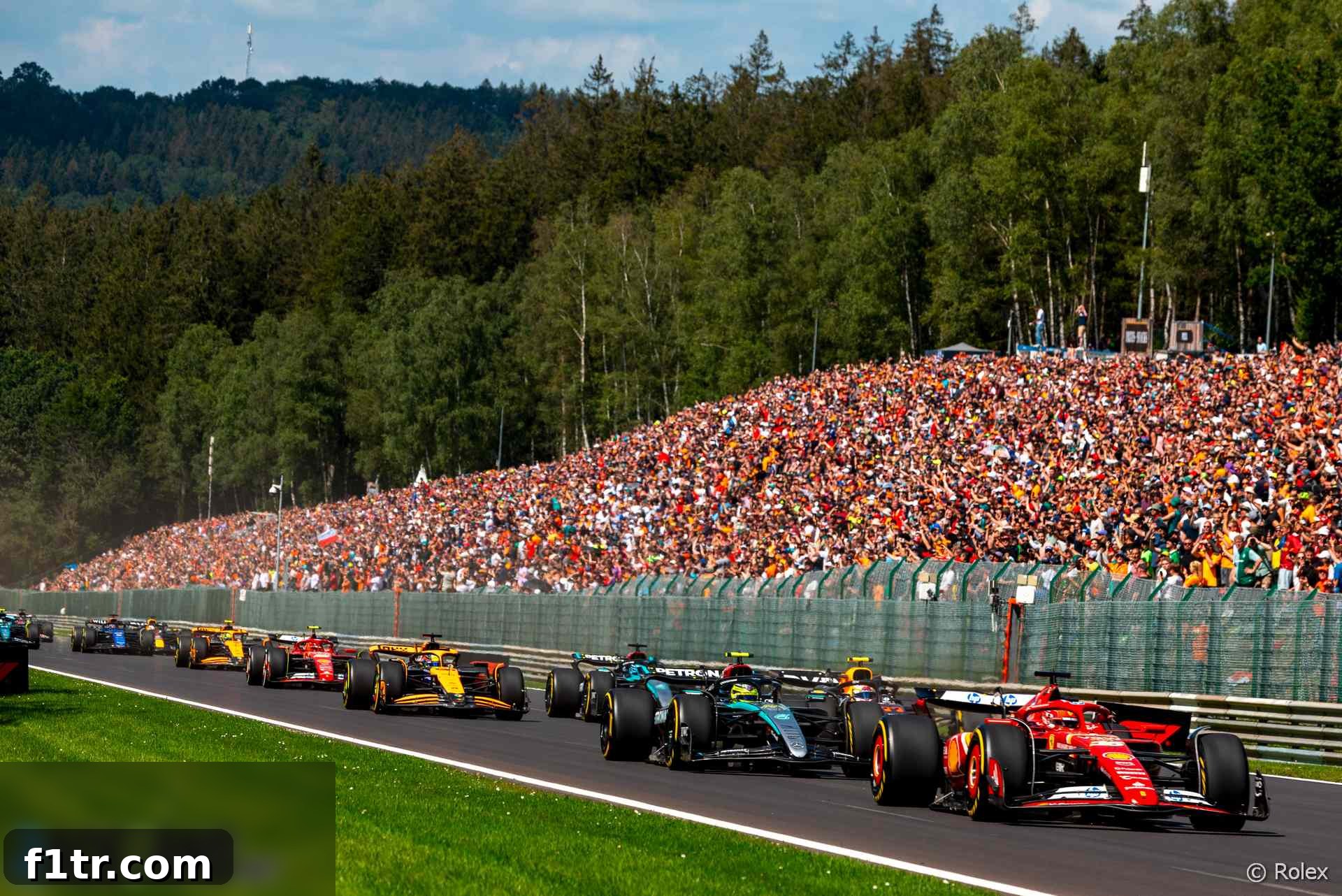
Charles Leclerc, who demonstrated the SF-24’s potential by securing pole position at Spa before a commendable third-place finish, articulated the team’s rationale. He drew parallels to a similar situation encountered in 2023 at Zandvoort and Monza, where specific weekends were consciously under-optimized to gather crucial data for future development. “It’s very close to the situation we found ourselves in Zandvoort and Monza last year, in ’23, where we sacrificed a little bit of the maximisation of the weekend in Zandvoort and Monza to understand and to do a big step forward after that,” Leclerc explained to the official F1 channel. “That’s what we have gone through.”
The Monégasque driver acknowledged that this year’s recovery period was more protracted than initially hoped. “Unfortunately, instead of being two races, it was four races, which is longer than what I had wished. But it’s been super-beneficial for the whole team to understand exactly the issue that we were facing.” This candid admission underscores the complexity of modern F1 aerodynamics and the significant challenges teams face in balancing immediate performance with long-term development. Ferrari’s decision, though potentially costing points in the short term, is a testament to their commitment to fully unlocking the SF-24’s potential and laying a stronger foundation for the 2025 season, ensuring a more consistent and competitive package for both Leclerc and his teammate.
Advert | Become a Supporter & go ad-free
Williams Unveil Long-Awaited Upgrade Package at Zandvoort
The back half of the 2024 Formula 1 season promises a fresh wave of competition, and Williams Racing is poised to make a significant push with a substantial car upgrade. The Grove-based squad has confirmed that its long-anticipated development package will debut at the Dutch Grand Prix in Zandvoort, marking the first race after the summer break. This upgrade is seen as a pivotal moment for Williams, a team that has shown flashes of potential but has often struggled for consistent points, particularly with the FW46 chassis.
Sporting director Sven Smeets expressed cautious optimism about the impending changes. “We are bringing one of our bigger upgrades to Zandvoort so will need some time to understand how the FW46 behaves and performs,” Smeets stated. The team’s engineers have been diligently working on these enhancements for several weeks, hoping to unlock a new level of performance and improve the car’s overall balance and aerodynamic efficiency. Historically, Williams has leveraged such upgrade windows to make significant strides, and the Zandvoort circuit, with its unique banking and demanding corners, will provide an excellent testbed for the new components.
For drivers Alex Albon and Logan Sargeant, this upgrade couldn’t come at a more crucial time. Improved performance from the FW46 would not only boost their confidence but also offer a more competitive platform to battle their midfield rivals. The team’s objective will be to quickly gather data during practice sessions to fine-tune the setup and extract the maximum potential from the updated car, aiming for stronger qualifying positions and, ultimately, more consistent points finishes as the season progresses. The motorsport world will be keenly watching to see if this long-awaited upgrade can propel Williams further up the constructors’ standings.
Zandvoort Pit Lane Expansion: Enhanced Race Operations for the Dutch Grand Prix
The iconic Zandvoort circuit, renowned for its challenging layout and passionate Dutch fans, has long presented a unique logistical hurdle for Formula 1 teams: its notoriously cramped pit lane. Known for being one of the narrowest and most restrictive on the F1 calendar, the confined space necessitates a reduced pit lane speed limit of 60 kph during race weekends, compared to the standard 80 kph at most other venues. This tight configuration can add pressure during critical pit stops and impact strategic decisions, making efficient operations paramount for teams.
However, race organizers have addressed this long-standing concern ahead of the upcoming Dutch Grand Prix. This weekend, Formula 1 will benefit from an additional six garages, significantly alleviating some of the pressure on teams. This expansion offers more breathing room for personnel, equipment, and crucially, provides a safer and more efficient working environment for pit crews. The added space could also enhance the flow of cars during busy pit stop windows, potentially streamlining race operations and reducing the risk of incidents in what is already a high-pressure environment.
The improvements demonstrate the circuit’s commitment to enhancing the Formula 1 experience for both teams and fans. While the fundamental characteristics of Zandvoort’s pit lane remain, these additional garages represent a welcome upgrade, reflecting the continuous efforts to optimize facilities and ensure the smooth running of Grand Prix events at this historic and beloved venue.
Advert | Become a RaceFans supporter andgo ad-free
Motorsport News & Links Roundup
Stay informed with the latest happenings across the motorsport world, from IndyCar drama to endurance racing tests and rising stars in single-seater categories. Here’s a curated selection of recent headlines:
Power makes peace with Malukas, Newgarden after WWTR outbursts (Racer)
‘He reached out and it was really funny, sarcastic Will. We’re definitely all good. And it was a nice message. He said, ‘I was a d***. I’m sorry.’’ This reconciliation highlights the intense rivalries and emotions that often boil over in the heat of competition, followed by mutual respect among elite drivers.
Cadillac’s Bamber: ‘COTA is super challenging… a real test of endurance’ (WEC)
‘The test in Austin went well. The circuit had not been repaved before we tested, though it has been repaved since with the new F1 tarmac. That won’t be too much of a surprise with how our car will react. I believe our car works well on European tarmac tracks like Qatar and Imola, which recently were repaved FIA-grade tracks.’ Earl Bamber’s comments underscore the demanding nature of Circuit of the Americas and the crucial role track surface plays in prototype endurance racing.
Nina Gademan secures wild card entry for round four in Zandvoort (F1 Academy)
‘Gademan, from Wijster in The Netherlands, made her single-seater debut this year. Currently competing in British F4, she earned her maiden podium at the Thruxton circuit.’ The F1 Academy continues to provide invaluable opportunities for young female talent, and Gademan’s wild card entry at her home Grand Prix weekend is a testament to her promising start in single-seater racing.
Formula E puts PR account out to pitch (PR Week)
‘A source at The Romans said: ‘Sadly, due to chunky budget cuts at Formula E, we’re not going to be able to participate in this one.” This development reflects the dynamic financial landscape within global motorsport, as even established series like Formula E navigate budgetary adjustments and strategic reevaluations.
We always endeavour to credit original sources. Got a tip for a link relating to single-seater motorsport? Please send it to us via the contact form.
Advert | Become a RaceFans supporter andgo ad-free
Social Media Highlights from the Motorsport World
Stay connected with the pulse of Formula 1 and other racing series through notable posts from X (formerly Twitter), TikTok, and more. Social media often provides immediate reactions, behind-the-scenes glimpses, and important news as it breaks.
The most successful driver-race engineer partnership in Formula 1 history will end this year.@LewisHamilton and Peter ‘Bono’ Bonnington have taken 84 wins over their 11-and-a-half years together at Mercedes so far.#F1 pic.twitter.com/WTNxdEGlVn
— RaceFans (@racefansdotnet) August 21, 2024
This poignant announcement from RaceFans highlights the conclusion of one of Formula 1’s most enduring and successful partnerships. Lewis Hamilton and his race engineer Peter ‘Bono’ Bonnington have been an integral part of Mercedes’ dominant era, racking up an astounding 84 victories over more than a decade together. Their collaboration has been a benchmark for synergy between driver and engineer, defining an era of unparalleled success. The news marks a significant shift in the F1 landscape as Hamilton prepares for a new chapter in his illustrious career.
Advert | Become a RaceFans supporter andgo ad-free
- Find more official F1 accounts to follow in the F1 Twitter Directory
Comment of the Day: The Ever-Growing Debate on F1 Car Size and Relevance
Today’s featured comment dives into a hot topic within the motorsport community: the ever-increasing size and weight of Formula 1 cars, and its broader implications for both the sport and road-going vehicles. Phil, a keen observer, articulates a perspective shared by many fans and experts alike:
All cars seem to getting bigger and heavier. Just look around your local car park. It’s ridiculous and unnecessary. Batteries might be adding weight but you don’t need a huge four-wheel-drive for a trip to the supermarket or to school. Not that this is that directly relevant to F1.
There obviously have been some decisions made which just make little sense. Go back to 1.8-metre cars and reduce the wheel and tyre sizes. That would help to start with. It would also help if a little less attention was paid to the whims of manufacturers, cars and tyres on road relevance. It’s time to accept that F1 is a sport so this link must be broken. It’s not the same as driving around a town or on a motorway.
If budgets have to increase a little to let F1 teams make lighter components then make this so. Maybe money could be saved by not having to travel to 24 races!
Phil Norman (@Phil-f1-21)
Phil’s insightful comment highlights a significant philosophical debate within Formula 1 regarding its identity and future direction. His point about cars generally becoming larger and heavier resonates with the observation that modern F1 machines have grown considerably in length, width, and mass over the past decades. While safety regulations and hybrid power units contribute to this trend, critics argue that it detracts from the nimbleness and pure racing spectacle that once defined the sport.
The suggestion to revert to narrower cars and smaller wheels/tyres directly challenges the current design philosophy, which often ties into manufacturers’ desire for “road relevance” in their F1 technologies. Phil advocates for a clear separation, asserting that F1 is fundamentally a sport, not a direct proving ground for everyday automotive solutions. This perspective raises questions about whether the pursuit of road relevance is hindering the sport’s ability to optimize for pure performance and exciting racing.
Furthermore, his call for increased budgets for lighter components, potentially offset by a reduction in the number of races, touches upon the ongoing discourse about sustainability, cost management, and the grueling calendar. It’s a comprehensive critique that reflects the desire among many fans for F1 to prioritize its sporting essence over commercial and engineering mandates that may not always align with the core spirit of grand prix racing.
Celebrating Milestones: Happy Birthday to Our Motorsport Enthusiasts!
On this special day, we extend our warmest wishes to members of our vibrant motorsport community. Happy birthday to Master Firelee and Kart22! We hope you have a fantastic day filled with celebration and all things racing. Your passion fuels the spirit of the sport, and we appreciate your continued engagement.
On This Day in Motorsport History
Delving into the annals of motorsport history often reveals fascinating stories and pivotal moments that have shaped the sport we know and love today. Seventy years ago, a legend etched his name deeper into the record books:
- 70 years ago today, Juan Manuel Fangio secured his second Formula 1 World Championship at the Bremgarten circuit. This victory marked a significant achievement for the Argentinian maestro, further cementing his status as one of the greatest drivers of all time. Poignantly, this race was also the last Swiss Grand Prix ever held, as Switzerland controversially banned motorsport the following year, a ban that remains largely in effect to this day.