Ferrari’s Team Order Controversy: Unpacking Leclerc and Vettel’s Russian Grand Prix Drama
The 2019 Formula 1 season delivered its fair share of thrilling races and intense rivalries, but few moments captured the sport’s inherent drama quite like the contentious team order situation at the Russian Grand Prix. At the heart of the storm were Ferrari’s two star drivers, Charles Leclerc and Sebastian Vettel, whose on-track battle and subsequent radio exchanges exposed the complex challenges of managing a championship-contending team with two ambitious drivers.
Advert | Become a Supporter & go ad-free
Leading up to the Sochi event, Ferrari had shown promising pace, and with Leclerc starting on pole position, flanked by Lewis Hamilton’s Mercedes and Vettel in third, expectations for a strong team result were high. However, what unfolded on race day quickly turned a potential Scuderia triumph into a public relations headache, reigniting the perennial debate about the fairness and effectiveness of team orders in Formula 1.
The Pre-Race Agreement: A Strategy for Success or Source of Conflict?
Before the lights went out in Sochi, a crucial team strategy had been put in place by Ferrari. With Leclerc starting from pole position and Vettel from P3, separated by Mercedes’ Lewis Hamilton, the team aimed to leverage the powerful slipstream effect on the long run down to Turn 2. The understanding was that Leclerc would provide a slipstream to Vettel, allowing him to pass both Hamilton and Leclerc himself, thereby securing a Ferrari 1-2 early in the race. Crucially, as confirmed by both drivers, the agreement stipulated that if their start performances were deemed “identical,” Vettel would eventually return the lead to Leclerc, ensuring Leclerc, as the pole-sitter, retained the advantage.
This kind of pre-race agreement is not uncommon in Formula 1, particularly when a team wants to maximize its chances against strong rivals. By working together in the opening laps, Ferrari hoped to establish an early dominance, protecting their positions and potentially consolidating their grip on the race. Such tactics are often deployed to counter a competitive threat from other teams, using combined driver efforts to negate any initial disadvantages. However, the success of such a strategy hinges entirely on clear communication, mutual trust, and unwavering adherence to the agreed terms – elements that would soon be tested to their limits in the intense pressure of race conditions.
The Start: Vettel’s Blistering Pace and Leclerc’s Frustration
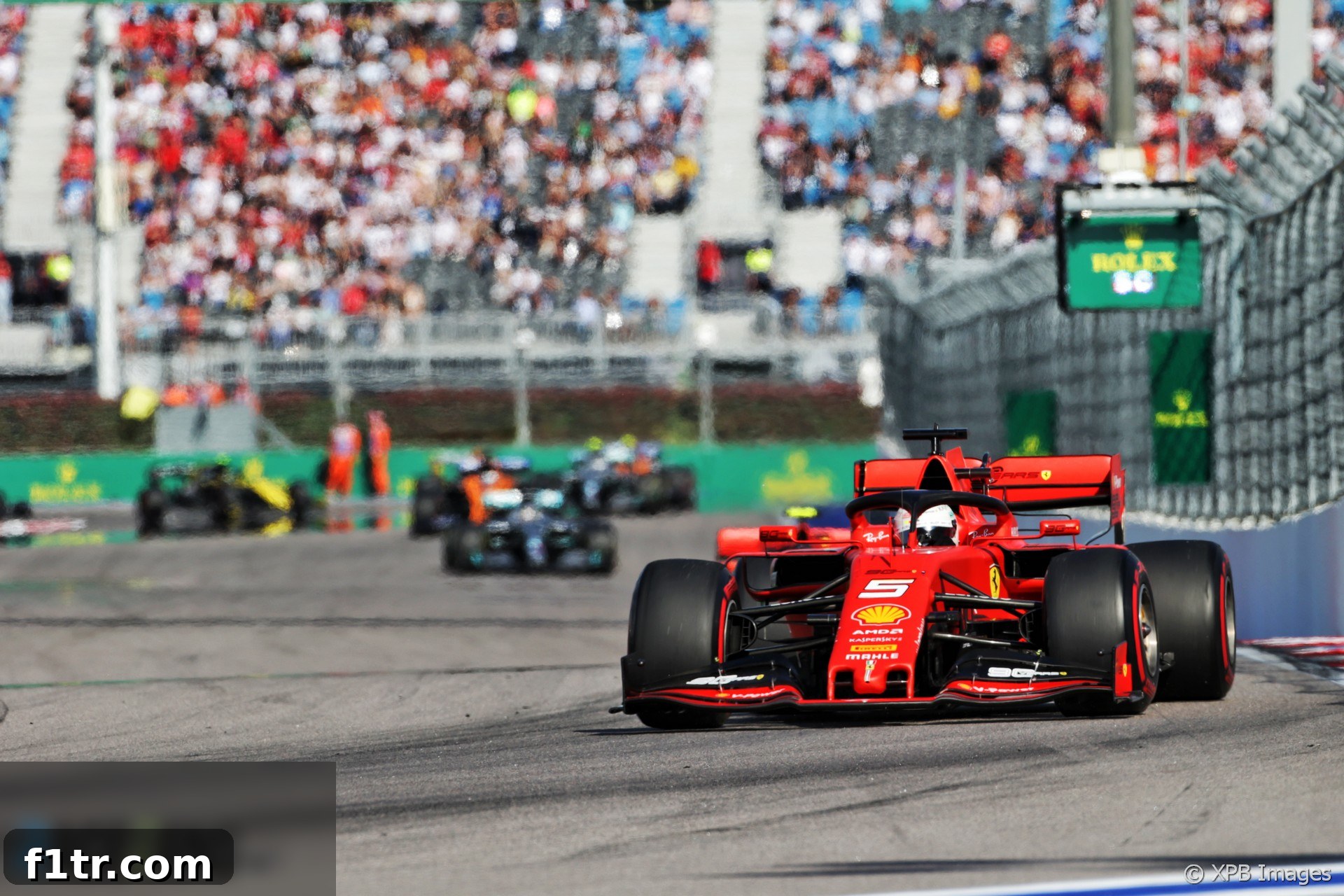
As the red lights extinguished, Sebastian Vettel executed a phenomenal start. Launching off the grid, he quickly tucked into the slipstream of his teammate, Charles Leclerc, who had also made a strong getaway from pole. Vettel’s superior traction and the aerodynamic tow allowed him to sweep past both Leclerc and Hamilton, seizing the lead of the Russian Grand Prix before Turn 2. It was a perfectly executed maneuver, putting Ferrari into an enviable 1-2 position and seemingly fulfilling the initial part of their strategic plan.
However, the seeds of discontent were immediately sown. While Vettel celebrated taking the lead, Leclerc’s perspective was notably different. Speaking after the race, Leclerc stated, “For sure he did a great start, but as it has been said on the radio – I don’t know whether it was broadcasted or not – but the start performance itself was exactly the same.” Leclerc further clarified that he had deliberately “stayed on the left to give him the slipstream,” implying that he had fulfilled his part of the bargain based on the pre-race pact. This subtle but crucial distinction between a “great start” (Vettel’s raw execution and track position gain) and “identical start performance” (Leclerc’s claim of similar reaction and launch from the grid) would become the focal point of the unfolding drama and Ferrari’s internal conflict.
The Team Radio Drama: “Do the Swap Further into the Race”
Immediately following the chaotic opening lap, the Ferrari pit wall sprang into action. Leclerc was quickly informed via team radio, “Our start performance was the same. We will do the swap further into the race.” This instruction was a clear directive to Vettel, signaling that the agreed-upon position swap was expected, thereby confirming Leclerc’s understanding of the pre-race pact. However, the subsequent radio communications painted a picture of increasing tension and Vettel’s outright defiance.
Vettel, having built a small lead in the initial laps, was then explicitly instructed to let Leclerc by. His response was firm and direct: he felt he was faster and should be allowed to build a significant gap before considering any swap. “If I let him by now, he’s going to fall into the dirty air of Lewis [Hamilton] and then he’s going to have a hard time,” Vettel argued over the radio, effectively refusing the order. This bold refusal put Ferrari in an incredibly difficult position. With both their cars running 1-2, they risked internal conflict jeopardizing a strong overall result, or even worse, falling victim to Lewis Hamilton’s relentless pursuit, who remained a formidable threat in third place.
The situation escalated as the laps ticked by. Ferrari tried to reason with Vettel, emphasizing the importance of adhering to the team strategy, but his conviction that he deserved to stay ahead remained unwavering. The team’s inability to enforce the direct swap through radio communication forced them to reconsider their strategy, leading to a more elaborate and ultimately successful workaround during the scheduled pit stop phase.
Strategic Masterstroke: The Undercut and the Enforced Swap
With Sebastian Vettel steadfastly refusing to cede position on track, Ferrari was forced to employ a strategic alternative to uphold their pre-race agreement and manage the escalating internal tension. The solution came in the form of an aggressive undercut during the scheduled pit stops. Ferrari opted to bring Charles Leclerc into the pits several laps earlier than Vettel. This move was designed to give Leclerc fresh, faster tires, allowing him to unleash a series of quick laps known as the ‘overcut phase’ before Vettel made his own stop.
The undercut strategy worked precisely as intended. Leclerc, on new soft tyres, put in a blistering sequence of laps, maximizing his advantage on the clear track. When Vettel eventually pitted, he emerged behind Leclerc, who had used the benefit of new tires and clear air to build enough of a lead to leapfrog his teammate. This clever pit stop strategy effectively accomplished the position swap that Vettel had resisted on track. It was a strategic masterclass from the Ferrari pit wall, demonstrating their ability to adapt and enforce their will without a direct “let him pass” instruction that would have been even more publicly contentious and potentially detrimental to team harmony. While it resolved the immediate on-track issue, it undeniably added another layer to the already complex dynamic between their two drivers.
Reflecting on the situation, Charles Leclerc commented, “There’s no big deals and at the end I think everyone respected their own things. We will try to speak now. I think everything has been respected in a way because I gave the slipstream, then we have to do the swap back which we did at the pit stop, and that’s it.” His statement, while diplomatic and aimed at defusing tension, hinted at the underlying friction and the clear need for further discussion and clarification within the team. For Leclerc, the core agreement – giving slipstream, then swapping back – had been fulfilled, albeit through an indirect and dramatic means.
The Broader Implications: Team Orders, Driver Dynamics, and Ferrari’s Future
The incident at the 2019 Russian Grand Prix was more than just a fleeting moment of on-track drama; it was a microcosm of Ferrari’s challenges during a season marked by fluctuating fortunes and internal struggles. The team order controversy brought several critical issues to the forefront, impacting both driver dynamics and the team’s strategic approach.
The Ethical Dilemma of Team Orders in Formula 1
Team orders have always been a contentious subject in Formula 1, sparking heated debates among fans, pundits, and even within the teams themselves. While often deemed necessary for a team to maximize its championship points, secure a strategic advantage against rivals, or protect its assets, they frequently clash with the individual aspirations of drivers and the pure spirit of competition. The Sochi incident perfectly encapsulated this dilemma. Ferrari believed their initial strategy was optimal for the team’s overall goal, yet Vettel’s refusal highlighted the drivers’ innate desire to race and win, even against their teammates. The question then becomes: when does a team’s collective goal supersede a driver’s individual ambition, and how can such decisions be enforced without alienating one of their star talents or damaging morale?
Intensifying the Leclerc-Vettel Rivalry
The 2019 season saw Charles Leclerc emerge as a formidable challenger to Sebastian Vettel’s established role as Ferrari’s lead driver. Having joined Ferrari in 2019, Leclerc quickly demonstrated his raw speed and potential, often outperforming the four-time world champion. The Russian Grand Prix incident further fueled this burgeoning rivalry, adding a distinct layer of mistrust and frustration between the two. While Leclerc publicly downplayed the severity of the situation, the episode undoubtedly strained their relationship, making future on-track cooperation potentially more difficult and leading to further contentious moments in subsequent races. For Vettel, it was perhaps a stark sign that his position as the undisputed number one driver was eroding, while for Leclerc, it was a battle won, albeit through the team’s intervention, reinforcing his growing stature and influence within the Scuderia.
Ferrari’s Strategic Management Under Scrutiny
The way Ferrari handled the situation also drew considerable scrutiny. Their initial inability to enforce the team order directly through radio communication exposed potential weaknesses in their driver management and hierarchical structure. While the undercut proved to be an effective tactical solution, the fact that it was necessary underscored the challenge of managing two highly competitive drivers when their interests diverge. In a season where Ferrari was often battling Mercedes for supremacy, such internal conflicts and the subsequent strategic diversions could easily derail their championship ambitions, providing an unwelcome distraction from the primary goal of beating their rivals.
A Missed Opportunity for Victory?
Ultimately, despite the successful execution of the position swap, Ferrari did not win the Russian Grand Prix. Lewis Hamilton, capitalising on a Virtual Safety Car period later in the race after Vettel’s MGU-K failed and forced him to retire, managed to leapfrog both Ferraris, securing an unexpected victory for Mercedes. This outcome raised pertinent questions about whether the initial internal squabble and the time and mental energy spent managing it inadvertently opened the door for their rivals. Had the initial agreement been smoothly executed without the drama, would Ferrari have had a stronger chance to maintain their 1-2 position and convert it into a definitive win against a determined Mercedes team?
Conclusion: A Defining Moment in Ferrari’s 2019 Season
The 2019 Russian Grand Prix will forever be remembered not just for the race itself, but for the profound team order controversy that unfolded between Charles Leclerc and Sebastian Vettel. It was a complex interplay of pre-race agreements, on-track ambition, and strategic maneuvering by the Ferrari pit wall. While the team ultimately enforced its will through a clever pit stop strategy, the incident highlighted the inherent difficulties in managing two top-tier drivers with equally fierce desires to win under the immense pressure of Formula 1.
For Ferrari, it served as a stark reminder of the delicate balance required to harness individual talent for collective success, particularly when championship aspirations are on the line. For fans, it provided a dramatic glimpse into the high-stakes world of Formula 1, where every decision, every radio message, and every inch of track can lead to glory or spark intense debate. The Sochi saga remains a defining moment of the 2019 season, underscoring the relentless pressures and compelling narratives that make Formula 1 one of the most captivating sports in the world, leaving a lasting impact on the dynamic between its star drivers and the team itself.
Don’t miss anything new from RaceFans
Follow RaceFans on social media:
- Join RaceFans on Facebook
- Follow RaceFans on Twitter
- Get daily email updates from RaceFans
Advert | Become a RaceFans supporter andgo ad-free
2019 F1 season
- Crying in the Melbourne car park at 2019 grand prix was my career low – Ocon
- McLaren Racing reports reduced £71 million loss in 2019
- Kvyat: Hockenheim podium last year was “my biggest achievement” so far
- How the FIA’s new encrypted fuel flow meter targets Ferrari’s suspected ‘aliasing’ trick
- “He smashed my office door”: 23 must-see moments from ‘Drive to Survive’ season two
Browse all 2019 F1 season articles