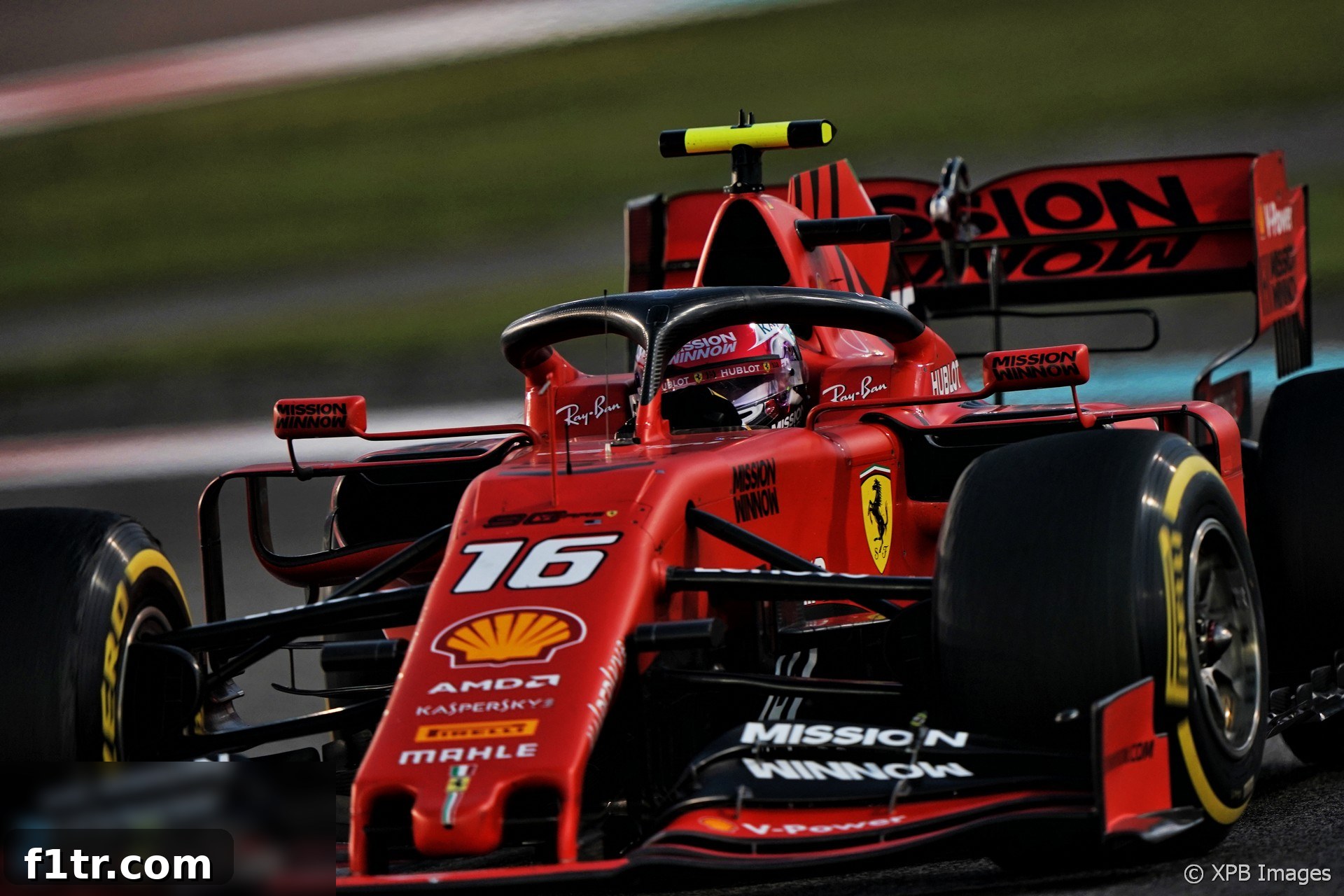
In a surprising turn of events preceding the Abu Dhabi Grand Prix, Scuderia Ferrari opted not to inform their star driver, Charles Leclerc, that his car was under investigation for a potential fuel regulation violation. This decision, shrouded in strategic secrecy, added an unexpected layer of tension to the Formula 1 season finale, leaving the Monégasque driver in the dark about a critical issue that could have jeopardized his race result.
The investigation, triggered just three-quarters of an hour before the lights went out at Yas Marina, concerned the amount of fuel declared by Ferrari for Leclerc’s car number 16. Such a breach could carry severe penalties, ranging from grid demotion to outright disqualification, making Ferrari’s choice to withhold this information from their driver a bold and perhaps risky strategic call.
Ferrari’s Fuel Controversy: Leclerc Unaware Amidst Abu Dhabi GP Scrutiny
The news of the potential fuel irregularity sent ripples through the paddock, even as the teams prepared for the final race of the season. For fans and media, it was a dramatic storyline unfolding in real-time. Yet, for the man at the center of it all, Charles Leclerc, the pre-race routine remained undisturbed by the looming threat of an investigation. Ferrari’s reasoning behind this decision speaks volumes about the intense pressures and strategic calculations that define Formula 1 at its highest level.
Leclerc’s Reaction: Unaware and Focused
The revelation that Leclerc’s car was under scrutiny broke a mere 45 minutes before the start of the race. Despite the gravity of the situation, Ferrari made the strategic decision to shield their driver from the distraction. Leclerc himself confirmed this immediately after the race, offering a glimpse into the isolated world of an F1 driver focused solely on performance.
No, I was not aware. I had to focus on driving, which I did. And I understand [why], to be honest. I’ve got no idea what the issues are. I will go to speak with the team. I don’t know.
Leclerc’s candid remarks highlighted his complete detachment from the off-track drama. His understanding of the team’s rationale – prioritizing his focus on driving – underscores the immense mental demands placed on Formula 1 drivers. For a sport where split-second decisions and absolute concentration are paramount, any distraction, particularly one concerning a potential rules infringement, could prove detrimental to performance.
The incident also raised questions about team communication protocols in high-stakes environments. While Ferrari’s intent was clearly to protect their driver’s mental state, the potential consequences of such a violation meant that Leclerc was unknowingly racing under a cloud of uncertainty. This dynamic between driver focus and team responsibility often forms the bedrock of strategic decisions in modern motorsport.
Quotes: Dieter Rencken
Advert | Become a RaceFans supporter andgo ad-free
Social Media Reacts: Insights and Frustrations from the F1 Paddock
Social Media Pulse
The final race of the Formula 1 season invariably sparks a flurry of activity across social media platforms. Drivers, pundits, and fans alike take to Twitter, Instagram, and other channels to share their thoughts on the season’s conclusion, team dynamics, and the on-track action. The Abu Dhabi Grand Prix was no exception, generating notable commentary that captured the varied sentiments of the F1 community.
Among the notable posts, former F1 driver Giedo van der Garde offered a dose of characteristic F1 sarcasm, highlighting the sometimes-superficial nature of driver farewells:
What I love about social media are the public heartwarming goodbye messages of F1 teams to the driver they dropped.
— Giedo van der Garde (@GvanderGarde) December 1, 2019
Van der Garde’s remark playfully underscored the often-unspoken realities of driver changes in the cutthroat world of Formula 1, where official farewells can sometimes contrast sharply with the actual circumstances of a driver’s departure.
Another prominent voice, IndyCar driver Oriol Servia, expressed his disappointment with the on-track spectacle at Yas Marina, reigniting perennial debates about circuit design and the role of DRS in modern F1 racing:
Not to be a downer but, last @f1 race of the season was a pretty bad show IMO. The moment DRS got activated not one real overtake happened, confirming once more my dislike for such thing. And Yas Marina circuit seems everything but exciting to drive?.
— Oriol Servia (@OriolServia) December 1, 2019
Servia’s critique echoed a sentiment often voiced by fans and drivers alike: the struggle for genuine, unassisted overtaking in certain circuits, and the dependency on Drag Reduction System (DRS) zones. His comment specifically targeted the Yas Marina circuit, which, despite its stunning aesthetics, has frequently faced criticism for lacking the natural flow and challenging corners that promote thrilling wheel-to-wheel combat. Such discussions highlight the ongoing quest within F1 to balance technological innovation with pure racing excitement, a challenge that consistently fuels online debate among enthusiasts.
- For those looking to stay connected with the pulse of Formula 1, find more official F1 accounts to follow in the F1 Twitter Directory, an essential resource for keeping up with the latest news and insights directly from the teams and personalities.
Team Perspectives: Race Summaries from the Abu Dhabi Season Finale
Further Insights and Links
Beyond the immediate controversy surrounding Ferrari and Leclerc, the Abu Dhabi Grand Prix provided a conclusive chapter to the season for all teams. Race reports from across the paddock offered a diverse range of reflections on performance, challenges, and aspirations for the future. These reports provide invaluable insights into the myriad experiences of drivers and team principals as they navigated the final competitive laps of the year.
Advert | Become a Supporter & go ad-free
Charles ends the season on the podium (Ferrari)
Despite the pre-race fuel scare, Charles Leclerc delivered a strong performance, securing a podium finish that offered a positive note for Ferrari at the end of what had been a roller-coaster season. Team Principal Mattia Binotto reflected on the race, noting Sebastian Vettel’s struggles in the early stages: “As for Sebastian, he struggled a bit in the early stages as he could not use DRS, when his soft tyres should have given him an advantage. After that he did all he could to finish in the points.” Binotto’s comments underscore the critical importance of DRS in strategic race scenarios and the challenges faced when a driver cannot fully leverage their tire advantage.
Abu Dhabi GP (Williams)
For Williams, the season finale encapsulated the challenges of their year. Robert Kubica described a physically demanding race marked by contact with competitors: “On lap one with George we touched at turn five and then later on with Giovinazzi, we touched quite heavily. I damaged the right-hand side of the floor quite a lot, so the last 35 laps were very difficult.” Such damage significantly impacts a car’s aerodynamic performance, making an already tough race even more arduous for the Polish driver in his final F1 appearance with the team.
Checo finishes as best of the rest in Abu Dhabi (Racing Point)
Racing Point celebrated Sergio Perez’s impressive drive to finish as the ‘best of the rest,’ a testament to his consistent performance. Lance Stroll, however, faced a more challenging afternoon, highlighting the domino effect of early-race incidents: “I had contact on the first lap with Gasly and had to pit because of the damage to my front wing. After that, we were out of position, running down the order, and it was really hard to get back into contention. We explored the strategy options and I stopped twice, but when you lose so much time early on by changing the front wing, it’s difficult to recover.” Stroll’s experience illustrates how a single incident can completely derail a meticulously planned race strategy and severely limit a driver’s ability to recover positions.
Race recap (Haas)
Haas concluded a difficult season with another tough race in Abu Dhabi. Kevin Magnussen, known for his strong starts, reflected on the team’s struggles with race pace: “I made a really good start again, my first lap was good. Unfortunately, from there we didn’t really have the pace that everyone else had, and I lost those places eventually. We fought as hard as we could. I’m happy with how the team’s been performing, in races like this it’s very tough, mentally, to stay on it, and keep extracting things from it when things have been bad.” Magnussen’s comments articulate the mental fortitude required to persist in challenging seasons where raw pace is elusive, praising his team’s unwavering commitment despite the adverse circumstances.
Curtain Call (Alfa Romeo)
Alfa Romeo also described a “challenging race” to close out their season. Team Principal Frederic Vasseur acknowledged the difficulties but emphasized the overall positive aspects of their year: “We bring this season to an end with a challenging race, but we won’t let this overshadow the good work we did this year. After yesterday’s qualifying we split the cars’ strategies to maximise the chances of a good result, but in the end the circumstances didn’t play in our favour.” Vasseur’s perspective reflects the resilience needed in F1, focusing on the broader achievements despite a less-than-ideal finale and the constant strategic gambles inherent in motorsport.
Danke, Nico (Renault)
The Abu Dhabi Grand Prix also marked the final race for Nico Hülkenberg with Renault, prompting a heartfelt farewell from the team. Alan Permane shared a memorable anecdote that perfectly captured Hülkenberg’s precise feedback and dry wit: “One time in Silverstone in 2017 when he had been telling us about a particular handling characteristic of the R.S.17 – he wanted to carry more speed into the corners and felt the downforce was dropping off just where he needed it most. We developed a new floor to help with this and finally got one in time for the British Grand Prix. He didn’t say anything for a while on the radio and then finally keyed up. He said: ‘I haven’t said anything but if you could see my face, you’d see there was a massive smile on it!’ It kind of sums him up: when he’s got something to say, it’s always worth listening.” This tribute highlights the valuable technical contributions and unique personality that Hülkenberg brought to the team throughout his tenure.
We always endeavour to credit original sources. If you have a tip for a link to feature in the next RaceFans round-up please send it in via the contact form.
Advert | Become a RaceFans supporter andgo ad-free
Fan Frustration: Critique of F1 Race Direction
Comment of the Day: Race Direction Under Fire
The Abu Dhabi Grand Prix, while marking the end of a season, also brought renewed criticism from fans regarding the television coverage and race direction. It appears the frustration felt by drivers like Carlos Sainz Jnr about the visibility of on-track action is shared by viewers, as evidenced by a particularly pointed “Comment of the Day.”
Once again the quality of today’s entertainment was significantly reduced by a rubbish programme direction. If I can sit at home and realise that they are focusing on the wrong action at the wrong time then they should be able to too, seeing as they are the professional. Race after race, this happens multiple times.
Will he get out of the pits before or after the competitor? Ooh, it’s gonna be tight! Nah, instead, show me an identical replay of a pit stop that I just watched.
@Shimks
The sentiment expressed by @Shimks resonates with a common complaint among dedicated Formula 1 followers: the perceived inability of the broadcast direction to consistently capture the most crucial and exciting moments unfolding on track. Viewers, with access to timing screens and multiple camera angles, often feel a disconnect between what is happening and what is being shown. The frustration often peaks during tense pit stop sequences or battles for position, where a crucial live shot might be missed in favour of a replay or an irrelevant scene. This ongoing dialogue between fans and broadcasters highlights the high expectations viewers have for a sport that thrives on drama and split-second decisions, emphasizing the need for a dynamic and responsive directorial approach to truly elevate the viewing experience.
F1 History and Milestones: Celebrating Birthdays and Anniversaries
Happy Birthday!
Wishing a very happy birthday to our fellow F1 enthusiasts, Katederby and Us Williams Fan! Your passion for Formula 1 adds vibrance to our community, and we hope you have a fantastic day celebrating.
If you’d like to receive a birthday shout-out on RaceFans, simply let us know your special day via the contact form or by adding your details to our dedicated list here. We love celebrating with our readers!
On This Day in F1 History
- Five years ago today, on December 2nd, Sebastian Vettel made his poignant farewell appearance at the Red Bull factory. This significant day marked the end of an incredibly successful era for both Vettel and Red Bull Racing, as the four-time world champion prepared to embark on a new chapter, transitioning to Ferrari in a move that shook the F1 world. His departure closed a chapter that included four consecutive drivers’ championships and cemented his legacy as one of the sport’s greats.