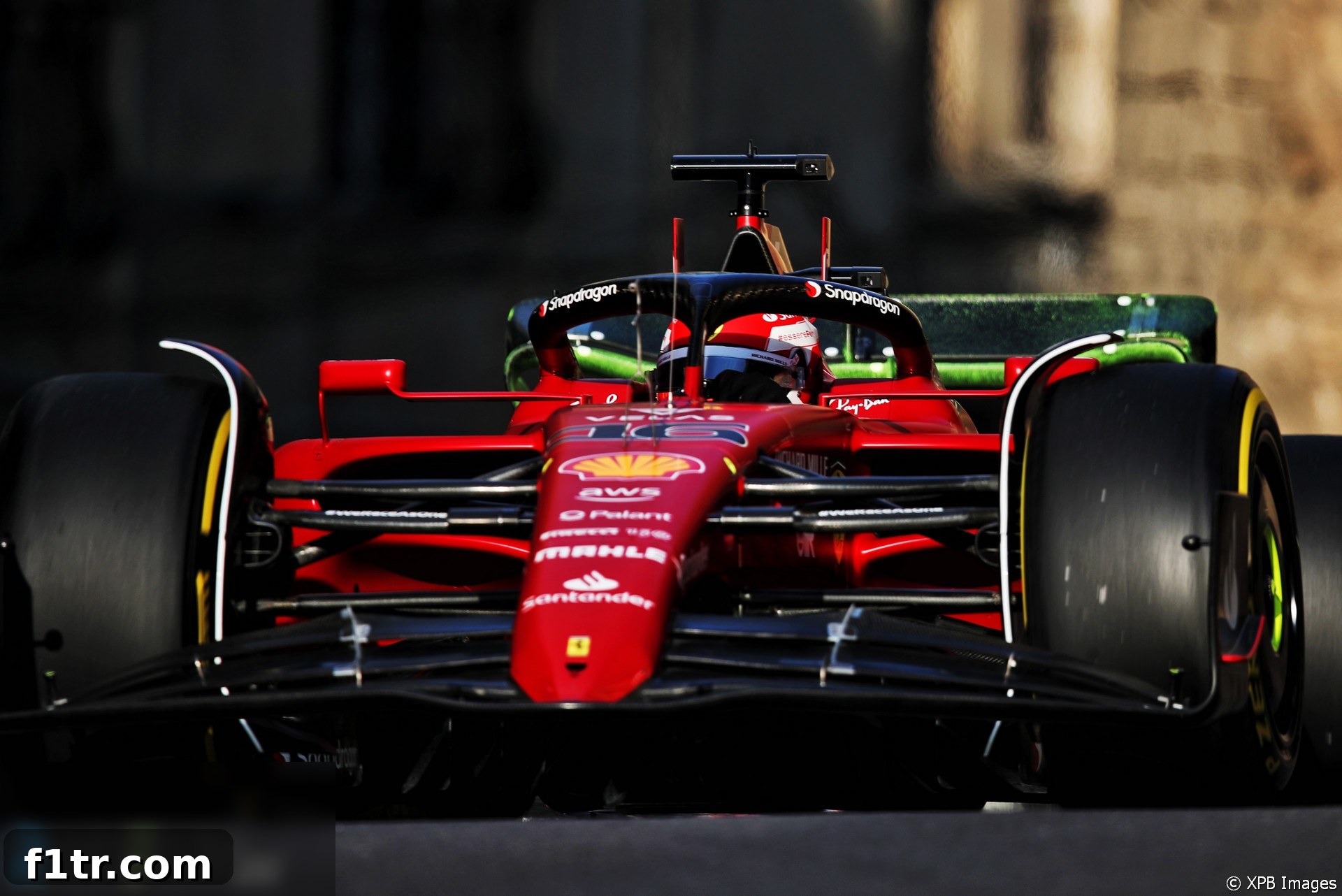
Leclerc Dominates Friday Practice in Baku, Setting Pace for Azerbaijan Grand Prix
Formula 1 roared back into action on the iconic streets of the Baku City Circuit for the Azerbaijan Grand Prix, and it was Ferrari’s star driver, Charles Leclerc, who emerged as the undisputed pace-setter during Friday’s crucial practice sessions. The Monegasque talent masterfully navigated the challenging urban layout, consistently extracting maximum performance from his F1-75 to claim the fastest overall time. This dominant showing from Leclerc immediately signaled Ferrari’s formidable intent for the weekend, positioning them as strong contenders for pole position and Sunday’s race victory.
Leclerc’s blistering speed saw him finish a quarter of a second ahead of his closest competitor, Sergio Perez, in the Red Bull. Perez, a previous victor on the Baku streets and renowned for his exceptional performance on temporary circuits, secured the second-quickest time, demonstrating Red Bull’s strong race potential. Their championship rival, Max Verstappen, completed the top three, indicating a tightly contested battle at the front. Further down the leaderboard, a truly promising session for Alpine saw veteran Fernando Alonso secure an impressive fourth position, ahead of Carlos Sainz Jnr in the second Ferrari. These early results have undoubtedly set the stage for a thrilling and unpredictable Azerbaijan Grand Prix weekend, promising high-speed drama and strategic intrigue.
Evening Practice Unfolds: Track Evolution and Cooling Conditions
The second and final practice session of Friday commenced as the sun began its picturesque descent, casting long shadows across Baku’s dramatic high-rise architecture. Starting at 6 PM local time, the ambient conditions had noticeably shifted since the earlier afternoon session. While the air temperature experienced a modest drop, the most significant change was the substantial cooling of the track surface. This reduction in asphalt temperature is a critical factor in Formula 1, directly influencing tyre grip, degradation rates, and ultimately, car balance and performance. Teams meticulously monitor these changes, making intricate adjustments to car setups to adapt to the evolving conditions.
As drivers ventured onto the cooling track, several immediately found themselves grappling with the fine line between adhesion and error that defines the Baku City Circuit. The unforgiving nature of a street circuit leaves little room for mistakes, and Friday’s running proved no exception. McLaren’s Lando Norris was an early casualty, momentarily bringing out yellow flags after an excursion into the run-off area at the fast Turn 3. His recovery required a cautious multi-point turn to rejoin the racing line, losing valuable session time. Similarly, four-time world champion Sebastian Vettel made an uncharacteristic mistake under heavy braking for the challenging Turn 1, also needing to reverse his Aston Martin to get back onto the circuit. These initial incidents highlighted the immediate challenge posed by the circuit’s demanding layout and the evolving track conditions.
Navigating Baku’s Unique Hazards: Debris and Bumpy Sections
The Baku City Circuit, an exhilarating blend of high-speed straights and incredibly tight corners, presents a unique array of challenges inherent to its temporary street circuit status. One recurring issue that drivers quickly encountered was the presence of miscellaneous debris on the racing surface. Being constructed within a bustling urban environment means that everyday items can, on occasion, find their way onto the track. Both Ferrari’s Carlos Sainz Jnr and Alpine’s Esteban Ocon voiced complaints over team radio about plastic bags drifting across the circuit, momentarily getting caught on their cars. While seemingly minor, such incidents can disrupt aerodynamic flow and pose a potential safety hazard at speeds exceeding 300 km/h.
Beyond the unexpected hazards, the circuit’s fundamental design also pushed both man and machine to their absolute limits. Baku is infamous for its complex, tricky turns and particularly bumpy braking zones, which demand unparalleled precision, courage, and a finely tuned car setup. These undulations and unforgiving kerbs proved to be a constant test throughout the sessions, catching out numerous drivers. Mick Schumacher, driving for Haas, notably ran off into the escape road at the technical Turn 4. Even front-runners were not immune to the circuit’s demands; Sergio Perez briefly went off at Turn 1, while even the session’s fastest man, Charles Leclerc, demonstrated the circuit’s difficulty by making a noticeable mistake into the tight, wall-lined Turn 8, requiring him to seek the sanctuary of the run-off area. These incidents underscore the demanding nature of Baku, where even a slight lapse in concentration can have significant consequences.
Strategic Tyre Management and Establishing the Pace
Friday’s practice sessions are not solely about setting the fastest lap, but critically, about gathering extensive data on tyre performance, degradation, and long-run consistency – all essential for a successful race strategy. Consequently, many teams initiated their programs with extended runs on the medium compound tyres. This allowed them to simulate race stints and understand how the tyres would behave over a longer period. It was during these medium tyre runs that Charles Leclerc first truly stamped his authority on the weekend. He clocked an impressive 1’43.806, a benchmark that was almost half a second quicker than his teammate, Carlos Sainz Jnr, underscoring his immediate comfort and prodigious speed on the Baku circuit.
The Red Bull challengers were, as expected, swift to respond to Ferrari’s early pace. Sergio Perez, displaying the same formidable form he exhibited in the earlier practice session, expertly navigated his RB18 to slot in between the two Ferraris, recording a time just over a tenth slower than Leclerc’s fastest medium-tyre effort. Not to be outdone by his teammate, Max Verstappen then improved further, narrowly surpassing Perez to claim the second position on the medium compound, closing the gap to Leclerc to an even tighter margin of less than half a tenth. This intense early tussle on the medium tyres provided a tantalizing glimpse into the fierce competition anticipated between the two championship-leading teams, showcasing their respective strengths across varying tyre compounds and hinting at a truly captivating battle for supremacy throughout the weekend.
Albon’s Bizarre Incident and Early Retirement
The session also saw an unusual incident involving Williams driver Alexander Albon, which brought his Friday running to an abrupt and premature end. The mishap occurred at the seemingly innocuous kink of Turn 17, a section of the track that is typically considered less challenging than others. In a peculiar turn of events, Albon somehow made contact with the inside wall at the very apex of this kink. The impact, despite the bend appearing harmless, was significant enough to cause substantial damage to his right-front wheel and suspension components. This unfortunate incident forced him to retire his car, triggering a brief Virtual Safety Car period while his Williams was recovered. Albon’s early exit served as a stark reminder that even the most benign-looking sections of a high-speed street circuit can catch drivers off guard, demanding unyielding focus and precision throughout every single lap.
The Soft Tyre Showdown: Leclerc’s Ultimate Dominance
As Friday’s second practice session entered its conclusive stages, the focus universally shifted towards outright qualifying simulations. This meant a transition to the soft compound tyres, identifiable by their red sidewall markings. These tyres are designed to offer maximum grip for a single flying lap, crucial for extracting the ultimate pace from the car. Unsurprisingly, Charles Leclerc once again rose to the occasion, unleashing a truly scintillating lap on the softs to further improve his quickest overall time to an outstanding 1’43.224. This exceptional performance not only solidified his position at the top of the leaderboard but also underscored Ferrari’s formidable one-lap pace advantage on this challenging, high-speed circuit, sending a clear message to their rivals.
However, the Red Bull contingent faced frustrating challenges during their critical soft tyre runs. Max Verstappen’s first attempt at a flying lap on the softer compound was unfortunately compromised by an incident involving his own teammate. Sergio Perez, pushing hard, ran wide and briefly went off the circuit at the notoriously tricky Turn 15. This incident triggered localized yellow flags, compelling Verstappen to back off significantly and abort his flying lap, thus preventing him from fully exploiting the peak performance of his new soft tyres on that particular run. This untimely disruption meant Verstappen remained slightly behind his teammate and, crucially, behind Leclerc in the final timings, adding an element of frustration to Red Bull’s afternoon.
Indeed, the challenging Turn 15 proved to be a consistent trouble spot as the session reached its dramatic climax. This corner, known for its deceptive entry and demanding braking point, caught out multiple drivers during their late qualifying simulations. Aston Martin’s Lance Stroll notably missed his braking point approaching the corner, requiring him to carefully reverse his car back onto the racing track. Ferrari’s Carlos Sainz Jnr then mirrored this mistake in the dying moments of the session, highlighting just how close to the absolute limit drivers were pushing. These repeated incidents at Turn 15 clearly illustrated the fine line between a perfectly executed lap and an costly error on the unforgiving streets of Baku.
Final Standings and Outlook for the Azerbaijan Grand Prix Weekend
As the chequered flag finally waved, bringing Friday’s practice sessions to a close, Charles Leclerc’s magnificent best time on the soft compound tyres remained unchallenged at the top of the standings. He ended the day as the fastest driver, maintaining a comfortable quarter-second advantage over Sergio Perez in the Red Bull. Max Verstappen, despite his disrupted soft tyre run, finished the session a further tenth behind his teammate, securing third place. A truly sensational effort from veteran Fernando Alonso in the Alpine saw him claim a superb fourth position, showcasing the French team’s unexpected but welcome competitiveness on this unique circuit, just ahead of the second Ferrari of Carlos Sainz Jnr.
Rounding out a tightly packed top ten, Pierre Gasly put in an impressive performance to secure the sixth-quickest time for AlphaTauri, demonstrating the strength of the Red Bull junior team. He was closely followed by George Russell in the Mercedes, who continues to consistently extract strong performances from the challenging W13. Yuki Tsunoda, in the second AlphaTauri, secured eighth place, while Esteban Ocon’s Alpine and Lando Norris’s McLaren completed the top ten, showcasing the intense midfield competition. The narrow margins across the field, coupled with the inherent unpredictability of the Baku City Circuit, suggest that Saturday’s qualifying session will be an enthralling and fiercely contested affair, with multiple teams and drivers vying for pole position. The unique characteristics of Baku promise a truly unpredictable and exciting race weekend, where strategy, driver skill, and a touch of fortune will all play absolutely crucial roles in determining the final outcome.
2022 Azerbaijan Grand Prix Second Practice Result
| Position | Number | Driver | Team | Model | Time | Gap | Laps |
|---|---|---|---|---|---|---|---|
| 1 | 16 | Charles Leclerc | Ferrari | F1-75 | 1’43.224 | 24 | |
| 2 | 11 | Sergio Perez | Red Bull | RB18 | 1’43.472 | 0.248 | 22 |
| 3 | 1 | Max Verstappen | Red Bull | RB18 | 1’43.580 | 0.356 | 18 |
| 4 | 14 | Fernando Alonso | Alpine-Renault | A522 | 1’44.142 | 0.918 | 22 |
| 5 | 55 | Carlos Sainz Jnr | Ferrari | F1-75 | 1’44.274 | 1.050 | 25 |
| 6 | 10 | Pierre Gasly | AlphaTauri-Red Bull | AT03 | 1’44.315 | 1.091 | 26 |
| 7 | 63 | George Russell | Mercedes | W13 | 1’44.548 | 1.324 | 26 |
| 8 | 22 | Yuki Tsunoda | AlphaTauri-Red Bull | AT03 | 1’44.567 | 1.343 | 24 |
| 9 | 31 | Esteban Ocon | Alpine-Renault | A522 | 1’44.609 | 1.385 | 24 |
| 10 | 4 | Lando Norris | McLaren-Mercedes | MCL36 | 1’44.771 | 1.547 | 23 |
| 11 | 5 | Sebastian Vettel | Aston Martin-Mercedes | AMR22 | 1’44.781 | 1.557 | 27 |
| 12 | 44 | Lewis Hamilton | Mercedes | W13 | 1’44.874 | 1.650 | 25 |
| 13 | 18 | Lance Stroll | Aston Martin-Mercedes | AMR22 | 1’44.874 | 1.650 | 26 |
| 14 | 3 | Daniel Ricciardo | McLaren-Mercedes | MCL36 | 1’45.059 | 1.835 | 25 |
| 15 | 77 | Valtteri Bottas | Alfa Romeo-Ferrari | C42 | 1’45.115 | 1.891 | 25 |
| 16 | 24 | Zhou Guanyu | Alfa Romeo-Ferrari | C42 | 1’45.264 | 2.040 | 24 |
| 17 | 20 | Kevin Magnussen | Haas-Ferrari | VF-22 | 1’45.588 | 2.364 | 26 |
| 18 | 23 | Alexander Albon | Williams-Mercedes | FW44 | 1’46.397 | 3.173 | 13 |
| 19 | 47 | Mick Schumacher | Haas-Ferrari | VF-22 | 1’46.425 | 3.201 | 21 |
| 20 | 6 | Nicholas Latifi | Williams-Mercedes | FW44 | 1’47.218 | 3.994 | 26 |
2022 Azerbaijan Grand Prix Related Articles
- FIA should black-flag cars if their porpoising endangers drivers’ safety – Horner
- Transcript: Why Norris reluctantly complied with McLaren’s Baku team orders
- Montreal is “going to hurt” in stiff 2022 cars say drivers hoping for bouncing fix
- Leclerc was heading to a ‘comfortable win’ before retirement – Ferrari
- F1 should penalise those who ‘obviously’ slow on purpose in qualifying – Norris
Browse all 2022 Azerbaijan Grand Prix articles