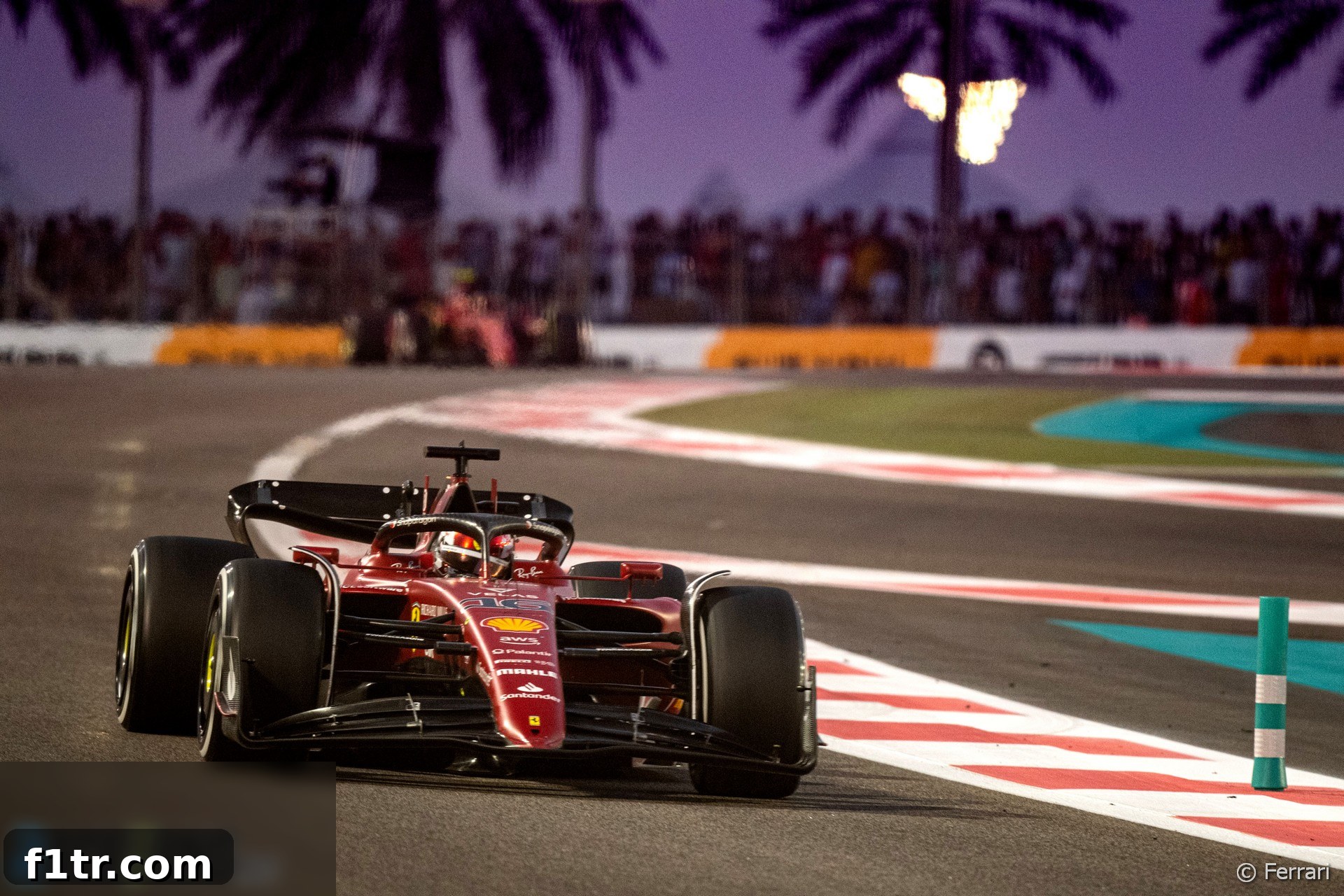
The 2022 Formula 1 season finale in Abu Dhabi delivered a nail-biting conclusion to the battle for second place in the Drivers’ Championship. Charles Leclerc, behind the wheel of his Ferrari, not only clinched the coveted runner-up spot but also showcased a significant stride forward for his team’s strategic prowess. His masterful drive, combined with a perfectly executed one-stop strategy, allowed him to secure second place in the race, fending off a charging Sergio Perez of Red Bull. This performance marked a critical turning point for Ferrari, often criticized for their tactical missteps throughout the season, proving their capacity for intelligent race management under immense pressure.
Leclerc’s Masterclass and Ferrari’s Strategic Redemption at Abu Dhabi
The Abu Dhabi Grand Prix was more than just the final race of the season; it was a direct shootout for second place in the drivers’ standings between Leclerc and Perez. Both drivers entered the weekend tied on points, adding an extra layer of intensity to their on-track rivalry. From the moment the lights went out at the Yas Marina Circuit, the stakes were incredibly high. Leclerc, starting from third on the grid, found himself in a close fight with Perez, who started second. The initial laps were crucial, with both drivers keenly aware that any mistake could cost them dearly, not just in the race but in the overall championship standings. The circuit’s characteristics, with its long straights and tight technical sections, presented a unique challenge for tire management and strategic planning.
Advert | Become a Supporter & go ad-free
A One-Stop Strategy That Outsmarted Red Bull
Ferrari’s plan for Leclerc was clear and audacious: a one-stop strategy. This decision stood in stark contrast to what many expected, especially given the aggressive two-stop approach typically favored by their rivals and the high degradation potential of the Yas Marina track. “The plan was always to do a one-stop,” Leclerc confirmed after the race, highlighting the team’s conviction.
The brilliance of Ferrari’s strategy lay in its ability to dictate terms to Red Bull. By committing to a single pit stop, Ferrari effectively forced Red Bull’s hand, compelling Sergio Perez to switch to a two-stop strategy to cover Leclerc’s pace and offset. Leclerc explained, “We managed to push them into doing two stops.” This strategic gambit paid off handsomely, creating a crucial track position advantage for the Monegasque driver. The execution involved maximizing the life of the initial set of medium tires without compromising outright pace, a delicate balancing act that Leclerc performed with exceptional skill. His ability to maintain a strong rhythm while conserving tire life in the opening stint was foundational to the strategy’s success.
The Lewis Hamilton Factor: A Timely Respite
During the critical initial phase of the race, Leclerc found himself in a tight battle not only with Perez but also with Lewis Hamilton, who was running just behind him in fourth. The close proximity to Hamilton posed a significant challenge to Leclerc’s tire management plan, as fighting aggressively would inevitably lead to higher degradation. “On the medium tyres obviously you do the first part of the race trying not to fight too much,” Leclerc recounted.
However, a pivotal moment occurred when Hamilton was instructed by his Mercedes team to yield a position back to Carlos Sainz Jr. This instruction came after Hamilton was deemed to have gained an unfair advantage by exceeding track limits earlier in the race, and failing to return the place quickly enough risked a time penalty. “After that I don’t know what happened, I think he had to give the position back to Carlos,” Leclerc commented. This unexpected turn of events provided Leclerc with invaluable “breathing space.” With Hamilton no longer breathing down his neck, Leclerc could focus entirely on preserving his medium tires, executing Ferrari’s one-stop strategy with greater precision. This incident, while external to Ferrari’s direct planning, played a fortuitous role in enabling Leclerc to manage his tires more effectively and maintain his strategic advantage. “Then at that point, I could manage my tyres a little bit better. It gave me a little bit of breathing space. And then from that moment onwards, then I think we did a great job.”
Advert | Become a RaceFans supporter andgo ad-free
The Grueling Final Stint: Hard Tyres and Relentless Pressure
Having successfully completed his single pit stop, switching to the hard compound tires, Leclerc embarked on a long and arduous second stint. This final phase of the race was a test of endurance, skill, and mental fortitude. Despite managing his tires meticulously, the inherent challenges of running hard tires for an extended period, especially towards the end of their life cycle, became increasingly apparent. As the laps wound down, Sergio Perez, on fresher tires from his second stop, began to relentlessly close the gap.
Leclerc described the final laps as “really tricky,” admitting to suffering from a lack of grip. The declining performance of the tires led to increased front-locking, a common issue as tires degrade, making the car harder to control and prone to errors. “Especially at the end of the stint on the hard, even though we did really, really good management, to be honest it’s tricky because when you get to the end of the race, the front-locking starts to become a problem, so it was very easy to do a mistake,” he explained. Every turn, every braking zone, presented a potential trap. The pressure from Perez was immense, but Leclerc demonstrated remarkable composure. He held his nerve, driving precisely on the limit without overstepping, and crucially, kept Checo Perez behind him. His ability to manage the delicate balance between pushing for pace and preserving tire integrity was exemplary.
“But at the end, we kept everything under control and managed to keep Checo behind,” he proudly stated, summarizing a performance that was both physically demanding and strategically brilliant. The margin of victory over Perez, a mere 1.3 seconds, underscored the intensity of the battle and the fine line between success and failure. Ferrari’s execution was “really perfect,” a sentiment that speaks volumes after a season riddled with strategic question marks. “I don’t think we have the pace of the Red Bulls still, and our goal from the beginning was to try and push Checo do something different, which we did perfectly. And again, with a great tyre management, we made the one-stop work, which eventually got us the second place.”
Ferrari’s Tactical Evolution: Learning from Past Mistakes
Throughout the 2022 season, Ferrari faced considerable scrutiny and criticism for a series of strategic errors that arguably cost Charles Leclerc valuable points, and even race victories. A prominent example often cited is the Hungarian Grand Prix, where Leclerc, leading comfortably, was inexplicably pitted for hard tires that proved to be disastrously slow, plummeting him down the order. Such miscalculations fueled narratives of a team struggling with critical race decisions.
However, Leclerc’s performance in Abu Dhabi, coupled with recent races, signaled a clear and encouraging shift in Ferrari’s approach. He acknowledged the team’s growth, stating, “I think we really did some step forwards in terms of strategy and the way we have been taking decisions recently, in the last few races.” This suggests that Ferrari has actively engaged in a process of introspection and improvement, learning from their past mistakes to refine their decision-making processes. While the latter part of the season saw Ferrari struggle to match Red Bull’s outright pace, making it harder to showcase their improved strategy, the underlying progress in their tactical acumen was undeniable. The successful execution in Abu Dhabi served as a powerful testament to this evolution.
Looking Ahead: Bridging the Gap to Red Bull
Despite the strategic triumph in Abu Dhabi, Charles Leclerc remains realistic about the pecking order in Formula 1. He openly admitted, “Unfortunately, it was a bit more difficult to show it because the pace is not as good as the beginning of the season.” Red Bull’s dominant performance in 2022 set a high benchmark, and Ferrari acknowledges the significant challenge ahead.
Nevertheless, the strategic improvement provides a strong foundation for future aspirations. Leclerc’s confidence in the team’s trajectory is palpable: “But I’m confident that in terms of pace, we will manage to catch Red Bull back next year.” This statement underscores a renewed sense of optimism within the Maranello squad. The 2022 Abu Dhabi Grand Prix was not just about securing second place; it was about demonstrating Ferrari’s capacity for intelligent, decisive strategy. As they look towards the 2023 season, this strategic refinement, combined with a relentless pursuit of performance improvements, will be crucial in their quest to challenge Red Bull for the Constructors’ and Drivers’ Championships. The lesson from Abu Dhabi is clear: Ferrari is learning, adapting, and gearing up for a stronger, more competitive future in Formula 1.
Advert | Become a RaceFans supporter andgo ad-free
2022 Abu Dhabi Grand Prix: Further Reading
- Norris dissatisfied with solitary podium finish: “One isn’t enough”
- Verstappen achieves most dominant title win since Vettel in 2013
- Magnussen’s experience makes him ‘positive’ ousted Schumacher can return to F1
- Overtaking still difficult at Yas Marina despite 2021 track changes, say drivers
- Depressing to consider points lost says Gasly after AlphaTauri slump to ninth
Browse all 2022 Abu Dhabi Grand Prix articles