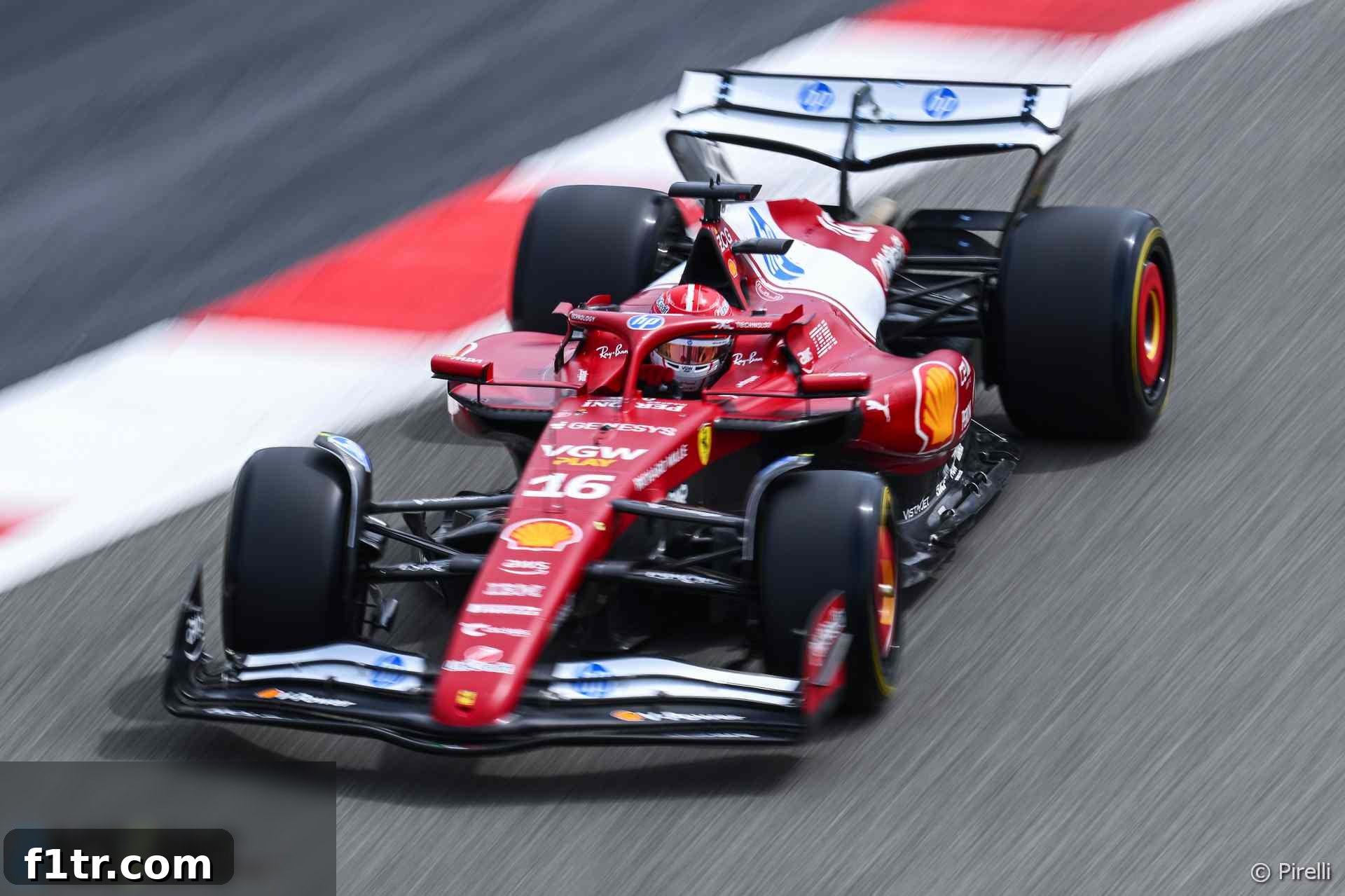
The highly anticipated final day of Formula 1 pre-season testing at the Bahrain International Circuit concluded with a flurry of activity and intriguing performances. As teams pushed their new machinery to the limit for the last time before the season opener, valuable insights were gleaned, setting the stage for what promises to be an exhilarating championship. The morning session, in particular, saw intense competition, with drivers eager to log crucial laps and validate their car setups under varying conditions.
Advert | Become a Supporter & go ad-free
Ferrari’s Charles Leclerc emerged as the fastest driver in the initial phase of the final day, marking a strong finish to his pre-season allocation. The Monegasque driver clocked an impressive best time of 1’30.811. While this was the fastest time of the morning, it notably stood almost one-and-a-half seconds off the overall best time set by the Ferrari team during the entire testing period. This discrepancy suggests that teams might have been running different engine modes, fuel loads, or tyre compounds, making direct comparisons challenging. Nevertheless, Leclerc’s pace demonstrates Ferrari’s potential, hinting at competitive form for the Maranello squad heading into the season. The cooler morning temperatures often allow for quicker lap times, but the increasing warmth throughout the day presented additional challenges for tyre management and car balance.
The conditions on the third day of testing were notably warmer than previous sessions, yet the characteristic blustery winds of Bahrain persisted, making for tricky driving conditions. These variable elements are crucial for teams, as they provide an opportunity to understand how their cars react to different environmental factors, a skill that will be vital during the season itself. Adapting to crosswinds and higher track temperatures requires fine-tuning aerodynamic balance and optimising cooling systems, aspects that were undoubtedly at the forefront of engineering efforts in the garages.
However, the final day was not without its peculiar interruptions. For the second time in this year’s Bahrain testing, an unusual incident brought the session to a halt. With just over three-quarters of an hour remaining, a red flag was deployed after a glass panel unexpectedly fell from a gantry located near the start/finish line. The panel shattered upon impact on the pit straight, necessitating a temporary stoppage of approximately 10 minutes to safely clear the debris. Such incidents, though rare, highlight the unpredictable nature of live testing environments and the paramount importance of safety protocols.
No sooner had the session resumed than another red flag was waved, creating a brief but frustrating double disruption. As young Mercedes talent Andrea Kimi Antonelli and seasoned veteran Fernando Alonso swiftly returned to the track, a course vehicle unexpectedly appeared on the circuit, prompting an immediate halt to proceedings. While these minor delays were certainly unusual, they were considerably less impactful than the significant power cut that plagued the first day of testing, which had substantially curtailed track time for many teams. The relatively swift resolution of these latest incidents allowed drivers to regain precious minutes for their final setup validations and long runs.
Amidst the top-tier performances, Haas made significant strides, with young British sensation Oliver Bearman impressing behind the wheel. Bearman recorded a time of 1’32.361, improving Haas’s previous best by a commendable seven-tenths of a second. Despite this improvement, the team still found itself at the bottom of the timesheets, indicating the considerable gap they face to the midfield contenders. Bearman’s session was also marred by a setback when a section of the left-hand side of his engine cover broke off, a concerning incident given that Haas experienced a similar issue during their shakedown run at Silverstone. This recurring reliability problem will be a point of focus for the team’s engineers as they prepare for the season, highlighting potential design or material weaknesses that need urgent attention to ensure race-day consistency.
The midpoint of the day saw a customary driver changeover, with eight teams planning to swap occupants for the afternoon session. Leclerc was among the eight drivers who concluded their pre-season running during the morning, having completed his designated test programme. Andrea Kimi Antonelli, the promising Mercedes junior, was another driver to complete his test duties, setting an eye-catching second-fastest time. Antonelli remained actively engaged on track, demonstrating his racecraft by strategically passing both Leclerc and Alexander Albon, showcasing his adaptability and awareness in a competitive environment. His performance further fuels speculation about his F1 future, solidifying his reputation as a talent to watch.
Advert | Become a RaceFans supporter andgo ad-free
Lando Norris of McLaren also completed his test programme, securing the third-fastest time, a strong indicator of McLaren’s progress and consistency throughout the testing period. Reigning world champion Max Verstappen of Red Bull was fourth quickest in the morning session, but unlike many of his rivals, he was scheduled to continue running in the afternoon. This decision by Red Bull suggests either a highly specific test plan requiring extended track time or a confident assessment of their car’s baseline performance, allowing for more comprehensive data gathering on long runs and varied conditions.
Unpacking the Data: Pre-Season Testing’s True Value
Pre-season testing is far more than just a battle for headline lap times; it is a critical phase for every Formula 1 team. The primary objectives revolve around validating new components, understanding the car’s fundamental behaviour, and gathering vast amounts of data. Reliability is paramount, as a car that can’t complete race distance is utterly useless. Teams conduct numerous long runs to simulate race conditions, assessing tyre degradation, fuel consumption, and component durability. They also experiment with various setup configurations, from suspension stiffness to aerodynamic wing adjustments, all aimed at finding the elusive sweet spot for performance.
While the lap times captured on the final day offer a tantalizing glimpse into potential pecking orders, they are inherently misleading. Teams operate with different fuel loads, engine modes, and tyre compounds, often deliberately obscuring their true pace. Some might be focused purely on reliability runs, others on qualifying simulations, and yet others on testing experimental parts. Therefore, a driver setting the fastest lap might have done so on the softest tyres with minimal fuel, while another further down the list could have completed a robust race simulation on harder compounds. The real insights come from analysing consistency, lap count, and the ease with which drivers extract performance, rather than just raw speed.
Outlook for the Upcoming Season
Based on the comprehensive data gathered during the Bahrain test, the 2025 Formula 1 season promises to be an enthralling spectacle. Ferrari appears to have made significant strides, with both Leclerc and his teammate displaying strong, consistent pace, potentially positioning them as genuine contenders to challenge Red Bull’s dominance. Mercedes, despite the impressive showing from Antonelli, seemed to be running a more conservative programme, focusing on understanding their new W16 challenger. Their true pace remains somewhat enigmatic, but signs suggest they are steadily improving.
McLaren has demonstrated solid performance, and Norris’s consistent presence near the top of the timesheets indicates their MCL39 is a well-balanced machine. Red Bull, as expected, maintained a strong but understated presence. Verstappen’s ability to extract performance effortlessly, combined with their extensive running, signals that they are once again the benchmark, albeit potentially facing a tighter challenge. Teams like Aston Martin and Alpine also showed flashes of promise, suggesting a competitive midfield where battles will be fierce. The reliability issues faced by Haas, however, underscore the intense development race that continues even after testing concludes.
2025 Bahrain test day three midday times
| Pos. | Car number | Driver | Team | Model | Best time | Gap | Laps |
|---|---|---|---|---|---|---|---|
| 1 | 16 | Charles Leclerc | Ferrari | SF-25 | 1’30.811 | 66 | |
| 2 | 12 | Andrea Kimi Antonelli | Mercedes | W16 | 1’30.888 | 0.077 | 61 |
| 3 | 4 | Lando Norris | McLaren | MCL39 | 1’30.943 | 0.132 | 57 |
| 4 | 1 | Max Verstappen | Red Bull | RB21 | 1’31.209 | 0.398 | 47 |
| 5 | 7 | Jack Doohan | Alpine | A525 | 1’31.239 | 0.428 | 61 |
| 6 | 23 | Alexander Albon | Williams | FW47 | 1’31.444 | 0.633 | 58 |
| 7 | 6 | Isack Hadjar | Racing Bulls | 02 | 1’31.761 | 0.950 | 76 |
| 8 | 14 | Fernando Alonso | Aston Martin | AMR25 | 1’32.084 | 1.273 | 50 |
| 9 | 5 | Gabriel Bortoleto | Sauber | C45 | 1’32.147 | 1.336 | 38 |
| 10 | 87 | Oliver Bearman | Haas | VF-25 | 1’32.361 | 1.550 | 59 |
Advert | Become a RaceFans supporter andgo ad-free
Formula 1
- One of F1’s greatest races happened 15 years ago today. Or did it?
- “Overtaking is overtaking”: Domenicali denies F1’s yo-yo racing is “artificial”
- The crashes F1 is trying to prevent may be rare – but the danger is obvious
- F1 returning to India soon after 2027 sounds like wishful thinking
- Verstappen loathes F1’s new generation of cars – but what do his rivals reckon?
Browse all Formula 1 articles