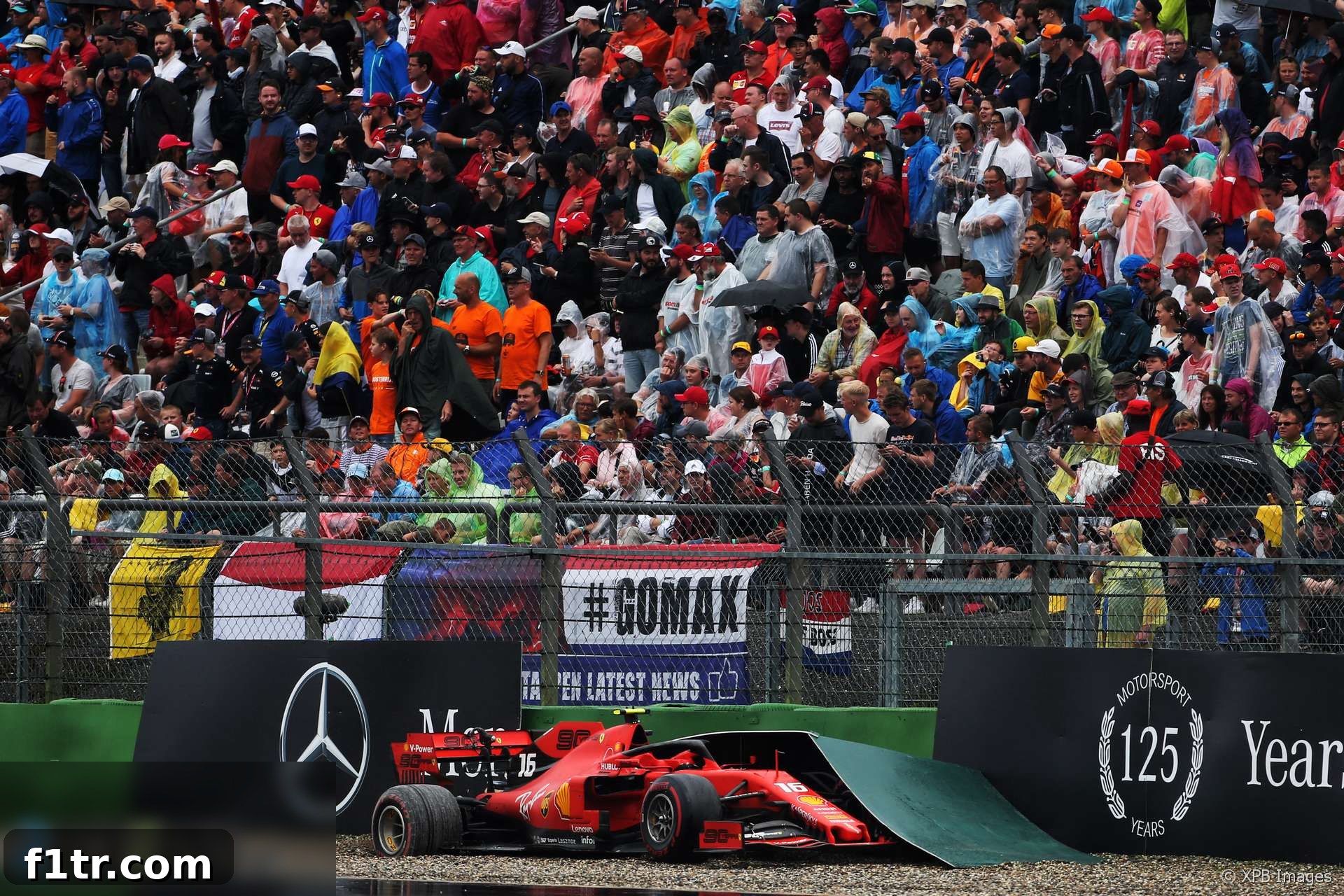
The 2019 German Grand Prix at Hockenheimring proved to be a weekend of high drama, unpredictable weather, and significant controversy, particularly concerning track safety. Amidst a chaotic race marred by multiple incidents, Ferrari’s Charles Leclerc found himself exiting the race prematurely after a costly mistake at Turn 15. However, while taking full responsibility for his error, the young Monegasque driver did not shy away from voicing strong criticism regarding the nature of the run-off area at that particular corner, labelling it “unacceptable” and “very dangerous.”
Advert | Become a Supporter & go ad-free
Charles Leclerc Criticises ‘Unacceptable’ Hockenheim Run-Off After German Grand Prix Crash
The incident occurred on lap 29 of the rain-soaked race. Having already endured a challenging start to the weekend with a fuel system issue that cut short his qualifying session and necessitated extensive overnight repairs, Leclerc was pushing hard to recover. His Ferrari SF90 had been a strong contender, demonstrating impressive pace despite the tricky conditions. However, as he navigated Turn 15, a corner that would prove problematic for several drivers throughout the race, Leclerc lost control. His car veered wide, sliding onto the Tarmac drag strip that served as the run-off at the exit of the corner. Once on this surface, he reported having “absolutely no control over the car,” leading to an unavoidable impact with the barrier and the end of his race.
Driver’s Dual Stance: Taking Blame, Demanding Safety
Following the crash, a visibly frustrated Charles Leclerc spoke candidly about the experience. “It was very slippery,” he stated, reflecting on the challenging conditions. His primary concern, however, was directed at the design of the run-off area itself. “The only thing I can say is I think it’s unacceptable to have this type of Tarmac exit out of the two last corners there. It’s like a dragster track and once you go on it, it’s just very, very dangerous.”
Leclerc’s comments ignited a debate within the Formula 1 community regarding the delicate balance between driver responsibility and track safety design. While acknowledging his part in the incident, he meticulously separated his personal error from his critique of the circuit. “So my mistake was not huge but the fact that going on this Tarmac I had absolutely no control over the car.” He reiterated this point firmly: “This is in no way an excuse to the mistake. I take full responsibility of it. But I believe that this type of Tarmac should not be on a Formula 1 track.”
This nuanced stance highlights a critical discussion point in motorsport: to what extent should a driver’s error be exacerbated by the inherent characteristics of the track itself? Modern Formula 1 circuits often employ large asphalt run-off areas, designed to prevent cars from getting stuck in gravel traps and to reduce the likelihood of high-speed barrier impacts. However, these surfaces can sometimes offer inconsistent grip levels, particularly in wet conditions, creating unpredictable scenarios for drivers operating on the very edge of control. Leclerc’s “dragster track” analogy vividly suggests that Hockenheimring’s specific tarmac surface offered dangerously low grip once a car ventured off the racing line, transforming what could have been a minor off-track excursion into a significant, unrecoverable incident.
A Weekend of Pressure and Disappointment for Ferrari and Leclerc
The German Grand Prix was already shaping up to be an intensely demanding weekend for Charles Leclerc. His race-ending crash came after a significant setback during qualifying on Saturday. A perplexing fuel system problem during Q3 prevented him from setting a representative lap time, relegating him to a suboptimal starting position on the grid. The dedicated Ferrari mechanics worked tirelessly overnight to repair his car, adding an extra layer of pressure and expectation for Sunday’s race. To then have his race end in such a fashion, through a combination of driver error and a perceived flaw in track design, was undoubtedly a bitter pill to swallow for the rising star.
Reflecting on the emotional toll, Leclerc expressed profound disappointment and regret: “It feels very bad. I feel very bad for the team, for the fans, for everyone that has been working also to put the car back together for today. It’s a big shame.” This sentiment underscored the collective effort involved in Formula 1 and the heavy responsibility drivers feel not just for their personal performance, but for their entire team and loyal supporters who invest so much hope and effort into each race weekend.
Hockenheimring’s Challenges and the Broader Track Safety Debate
Leclerc’s incident at Turn 15 was not an isolated event in the tumultuous 2019 German Grand Prix. The entire race was a spectacle of attrition and strategic gambles, largely dictated by the intermittent rain and treacherous track conditions. Many drivers struggled to keep their cars on the racing line, with several notable incidents occurring throughout the afternoon. Valtteri Bottas, for instance, also crashed out spectacularly at Turn 16 later in the race, albeit in a different manner. The challenging conditions and the specific characteristics of the Hockenheimring circuit, particularly its run-off areas, were constant talking points amongst teams, drivers, and pundits alike. Leclerc’s direct criticism added a specific voice to the broader concerns about driver safety and the integrity of racing when track conditions become so treacherous and the margin for error is so slim.
Such debates often lead to thorough reviews by the FIA (Fédération Internationale de l’Automobile), the sport’s governing body, who are ultimately responsible for circuit safety and homologation. While a specific, immediate alteration at Hockenheimring’s Turn 15 tarmac wasn’t globally mandated, incidents like Leclerc’s contribute significantly to ongoing discussions about the most effective and safest types of run-off areas for different corners and track layouts, especially when faced with varying weather conditions. The overarching goal is always to balance driver safety with the sporting challenge, ensuring that mistakes are appropriately penalized without inadvertently creating unduly dangerous scenarios or compromising the spectacle of close racing.
Leclerc’s F1 Journey: A Learning Curve in the Spotlight
The 2019 season marked Charles Leclerc’s highly anticipated debut with Scuderia Ferrari, following an impressive rookie year with Sauber. He was quickly establishing himself as a formidable talent, frequently challenging his four-time world champion teammate Sebastian Vettel. While this crash at Hockenheim was undoubtedly a painful lesson, it was also a crucial part of his steep learning curve within a top-tier team. Young drivers often push the limits relentlessly, and sometimes those limits push back with harsh consequences. Leclerc’s ability to take personal responsibility for his error while simultaneously offering constructive, pointed criticism about track design demonstrated a maturity beyond his years, indicating his potential as a future champion who is not only exceptionally fast but also thoughtfully engaged with the sport’s ongoing evolution and safety standards.
The German Grand Prix of 2019 ultimately became a memorable race for many reasons, not least for its dramatic twists, strategic gambles, and the spirited performances of drivers battling both each other and the elements. Leclerc’s outspoken comments ensure that his crash at Turn 15 remains a significant talking point, highlighting the perennial tension between the relentless pursuit of speed and the imperative of safety at the pinnacle of motorsport.
Don’t Miss Anything New from RaceFans
Stay connected with RaceFans for the latest updates, in-depth analyses, and exclusive content from the dynamic world of Formula 1. Follow us on social media and subscribe to our daily email updates to ensure you’re always in the loop with breaking news and insightful commentary:
- Join RaceFans on Facebook
- Follow RaceFans on Twitter
- Get daily email updates from RaceFans
Advert | Become a RaceFans supporter andgo ad-free
Explore More from the 2019 F1 Season
The 2019 Formula 1 season delivered countless unforgettable moments, from thrilling races to significant team developments and compelling driver narratives. Delve deeper into the events and stories that defined this captivating year:
- Crying in the Melbourne car park at 2019 grand prix was my career low – Ocon
- McLaren Racing reports reduced £71 million loss in 2019
- Kvyat: Hockenheim podium last year was “my biggest achievement” so far
- How the FIA’s new encrypted fuel flow meter targets Ferrari’s suspected ‘aliasing’ trick
- “He smashed my office door”: 23 must-see moments from ‘Drive to Survive’ season two
Browse all 2019 F1 season articles