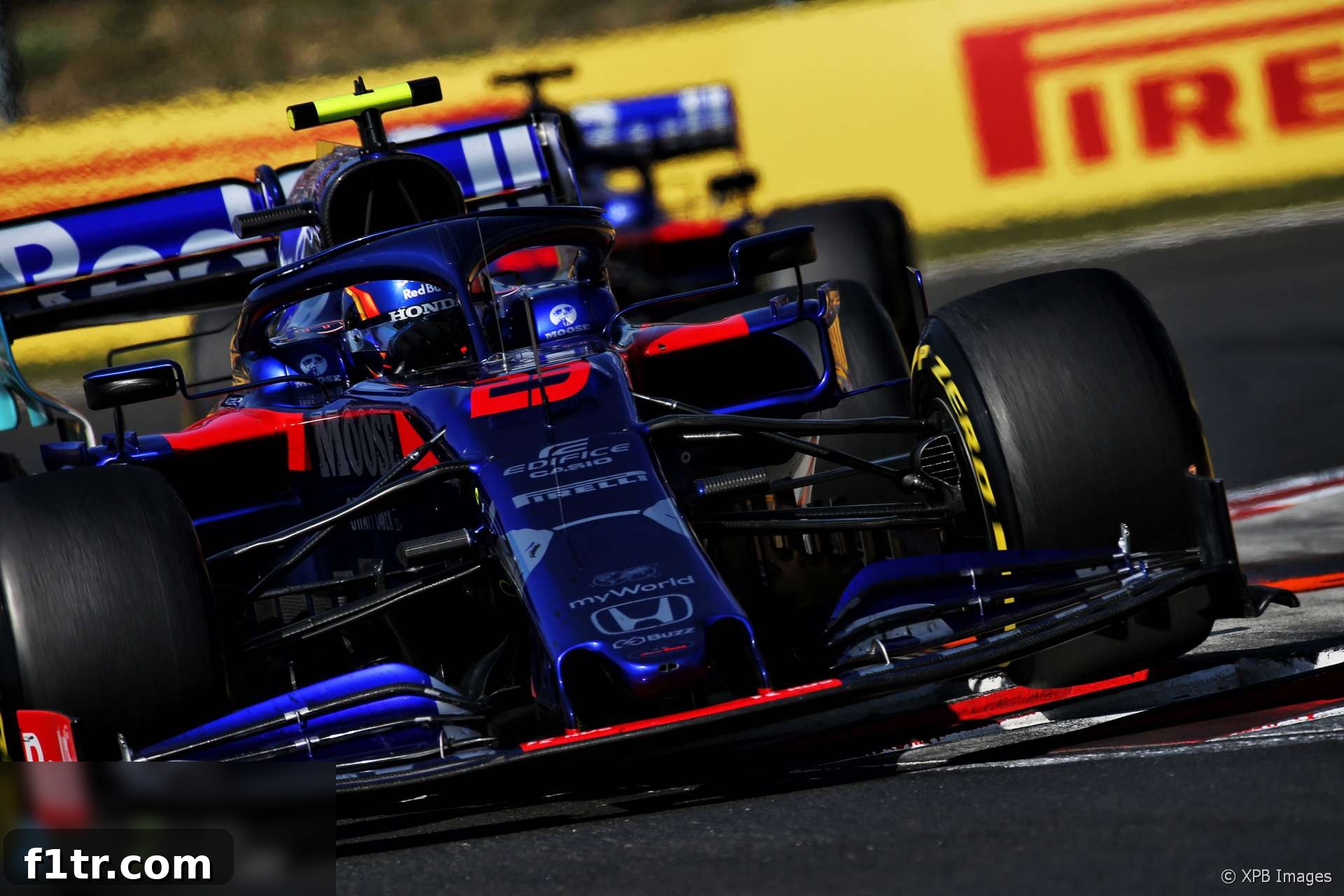
Strategic Misfortune: Daniil Kvyat’s Hungarian Grand Prix Disappointment
The intricate dance of strategy, tyre management, and on-track battles often defines the outcome of a Formula 1 Grand Prix. For Daniil Kvyat, the 2019 Hungarian Grand Prix served as a poignant reminder of this complexity, as he narrowly missed out on a crucial championship point. Kvyat later reflected that his teammate, Alexander Albon, ultimately secured the final scoring position due to what Kvyat described as a “much better strategy” orchestrated by their Toro Rosso team. This race highlighted the fine margins in Formula 1 and how a seemingly minor decision can profoundly impact a driver’s fortunes, particularly in the cutthroat midfield battles.
The Early Scramble: Teammates Side-by-Side
From the outset, the Hungarian Grand Prix presented a challenging but opportunistic scenario for the Toro Rosso drivers. Known for its tight, twisty layout, the Hungaroring demands exceptional car balance and precise driving, often leading to intense wheel-to-wheel action. Kvyat and Albon, both eager to make their mark in the competitive midfield, found themselves in close proximity during the early laps. The pair engaged in a spirited battle, swapping positions as they navigated the circuit’s demanding corners. For several thrilling corners, they ran side-by-side, a clear testament to their competitive instincts and the team’s allowance for fair racing. This early skirmish, while exciting for fans, would subtly lay the groundwork for the divergent strategic paths that would ultimately separate their race outcomes.
Establishing track position early is often critical at the Hungaroring, where overtaking is notoriously difficult. Kvyat and Albon were pushing hard, trying to gain any advantage they could over their rivals and each other. Their intense duel, though brief, demonstrated the raw speed and ambition within the Toro Rosso garage, setting a high benchmark for their individual performances as the race progressed. Little did Kvyat know that this early fight, combined with subsequent strategic calls, would unravel his promising start.
The Pivotal Pit Stop: A Gamble on Hard Tyres
The turning point in Kvyat’s race, and arguably the defining moment for his eventual disappointment, came with his initial pit stop. Opting for a relatively early stop, Kvyat’s car was fitted with the hard compound tyres for his second stint. This was a strategic gamble, aiming to make the long-lasting but slower hard tyres work for a significant portion of the race. Kvyat himself admitted to an element of hopeful thinking at the time: “You always hope you might make it for some magic reason, but I thought OK, it might not be an easy one.” His intuition proved correct; the hard tyres posed an immediate challenge.
In stark contrast, Alexander Albon remained out on track for significantly longer, extending his first stint by seven laps compared to Kvyat. This extended period on softer, more durable tyres, coupled with the benefit of clear air, allowed Albon to manage his pace effectively and gather crucial data on tyre degradation. The difference in strategy became glaringly apparent to Kvyat as the race unfolded. “Then they told me my team mate pitted 12 laps later than me or something and I thought that was a much better strategy,” Kvyat recalled, highlighting the stark realization of his team’s divergent approaches and its immediate implications for his own race prospects. Albon’s longer first stint meant he had fresher tyres for the crucial closing stages of the Grand Prix, a luxury Kvyat would soon discover he sorely lacked.
The Unforeseen Complication: Battling Sergio Perez
As if struggling with tyre wear wasn’t enough, Kvyat’s situation was further compounded by an intense and protracted battle for position with Sergio Perez, then driving for Racing Point. This wasn’t merely a brief skirmish; it was a sustained fight that demanded Kvyat’s full attention and, more critically, his tyres. Kvyat explained the dilemma: “They were asking me to fight Perez. It’s tricky, you can’t just manage all your race.” The team’s instruction to engage Perez, while understandable in the context of securing track position and potential points, came at a significant cost to Kvyat’s already deteriorating hard compound tyres.
In Formula 1, tyre conservation is often paramount, especially when attempting a long stint. However, being locked in a fierce battle with another driver forces a racer to push harder, brake later, and accelerate more aggressively, all of which accelerate tyre degradation. Kvyat found himself in an unenviable position: either fight Perez and burn through his limited tyre life, or concede the position and potentially lose touch with the points scorers. He chose to fight, demonstrating his characteristic tenacity. “I tried to fight Perez, I used all my tyres behind him,” Kvyat recounted. The intensity of their duel was such that even Perez, a known master of tyre management, eventually succumbed to similar issues later in the race, illustrating the extreme demands placed on their machinery. This battle, while showcasing Kvyat’s fighting spirit, proved detrimental to his ability to conserve his tyres for the long haul, directly impacting his pace in the latter stages of the Grand Prix.
The Dreaded Tyre “Cliff” and Kvyat’s Decline
The relentless demands of the Hungaroring, coupled with the early pit stop onto hard tyres and the energy-sapping battle with Sergio Perez, ultimately pushed Kvyat’s tyres beyond their optimal performance window. In Formula 1 parlance, his tyres “hit the cliff.” This phenomenon describes a sudden and dramatic drop-off in tyre performance, where grip vanishes almost instantaneously, making the car incredibly difficult to drive and severely impacting lap times. Kvyat vividly described the experience: “Once you hit the cliff, what we call it with the tyres, it’s gone. You’re about three or four seconds a lap slower. It was done pretty much.”
A performance deficit of three to four seconds per lap is an eternity in Formula 1. At this point, a driver is essentially a passenger, unable to defend against faster cars or maintain any semblance of competitive pace. The car becomes unresponsive, sliding through corners, and offering minimal traction. This abrupt decline left Kvyat vulnerable. His once “amazing” early pace had evaporated, replaced by the struggle to merely keep the car on track. It was at this critical juncture that Alexander Albon, benefiting from his fresher tyres and superior strategy, was able to effortlessly dispatch his struggling teammate. Kvyat’s race was, effectively, over as a points-scoring contender once his tyres gave up.
Albon’s Late Race Surge and The Final Point
While Kvyat grappled with his fading tyres and the ignominy of the “cliff,” Alexander Albon executed his race plan to perfection. Having extended his first stint and thus preserving his harder compound tyres for the latter half of the race, Albon was in a prime position to capitalize on the struggles of those around him. As Kvyat’s pace began to drop dramatically, Albon, with a clear strategic advantage, found it relatively straightforward to overtake his teammate. This pass was not a sign of Albon’s superior skill in that exact moment, but rather the culmination of a better-timed strategy that allowed him to have fresher, more effective tyres when it mattered most.
The strategic brilliance wasn’t confined to just passing Kvyat. With his tyres in a much healthier state, Albon then set his sights on Sergio Perez, who, like Kvyat, had suffered from an intense earlier battle and was now also struggling with tyre degradation. Albon’s fresher rubber allowed him to attack with confidence, and he cleanly passed Perez to secure the crucial tenth position – the final point-scoring spot. For a midfield team like Toro Rosso, every single point is invaluable in the constructor’s championship, making Albon’s strategic gain a significant achievement for both him and the team. His performance in Hungary further bolstered his growing reputation and undoubtedly played a role in his eventual mid-season promotion to Red Bull Racing, highlighting the profound impact of effective race strategy on a driver’s career trajectory.
Kvyat’s Reflection: Strategic Regrets and Lessons Learned
In the aftermath of the Hungarian Grand Prix, Daniil Kvyat harbored a clear sense of regret regarding the strategic decisions made during his race. Despite his initial strong pace, he felt that the “call came a bit too early,” referring to his pit stop for hard tyres. This hindsight is a common challenge in Formula 1, where real-time decisions, made under immense pressure and with incomplete data, often dictate success or failure. The fine line between an aggressive undercut that gains track position and a premature stop that compromises tyre life for the remainder of the race is incredibly thin.
Kvyat’s disappointment was palpable, especially considering his strong start: “In the beginning of the race the pace was amazing,” he added. This bittersweet feeling of what could have been underscores the frustrations drivers face when their potential is curtailed by strategic missteps. While he understood the rationale behind the team’s initial strategy, the outcome clearly demonstrated its flaws on that particular day. For Kvyat, the Hungarian Grand Prix served as a harsh but valuable lesson in the critical interplay of strategy, tyre management, and the unpredictable nature of on-track racing. It reinforced that even with exceptional driving, a suboptimal strategic call can be the ultimate determinant of a driver’s fate in the fiercely competitive world of Formula 1.
Broader Implications and Teammate Dynamics
The events of the 2019 Hungarian Grand Prix, particularly the differing fortunes of Daniil Kvyat and Alexander Albon, offered a fascinating insight into the broader implications of strategy and the internal dynamics within a Formula 1 team. For Toro Rosso, the race was a mixed bag, securing a point but through a somewhat fractured performance between its drivers. The outcome further intensified the intra-team battle, which is always under close scrutiny, especially in a junior team like Toro Rosso, often viewed as a proving ground for Red Bull Racing.
Albon’s strong finish and strategic success in Hungary were part of a consistent run of form that eventually led to his promotion to Red Bull Racing later that season, replacing Pierre Gasly. This highlights how crucial such individual race performances, particularly when out-strategizing and outperforming a direct teammate, can be for a driver’s career progression. For Kvyat, while disappointing, the experience was another chapter in his resilient career, emphasizing the relentless pressure to perform and the psychological toll when strategy doesn’t align with a driver’s race feeling. It underscores that in Formula 1, it’s not just about raw speed, but also the harmonious execution of a complex race plan by both driver and team, where every decision, from pit stop timing to tyre choice, can be the difference between glory and strategic misfortune.
Ultimately, the Hungarian Grand Prix of 2019 served as a microcosm of Formula 1 itself: a sport where human skill, technological prowess, and strategic acumen must converge flawlessly for success. Kvyat’s experience was a testament to the unforgiving nature of this balance, a reminder that even the most talented drivers are often at the mercy of the strategic chess match unfolding on the pit wall.
Related: 2019 F1 Season Insights
- Crying in the Melbourne car park at 2019 grand prix was my career low – Ocon
- McLaren Racing reports reduced £71 million loss in 2019
- Kvyat: Hockenheim podium last year was “my biggest achievement” so far
- How the FIA’s new encrypted fuel flow meter targets Ferrari’s suspected ‘aliasing’ trick
- “He smashed my office door”: 23 must-see moments from ‘Drive to Survive’ season two
Browse all 2019 F1 season articles