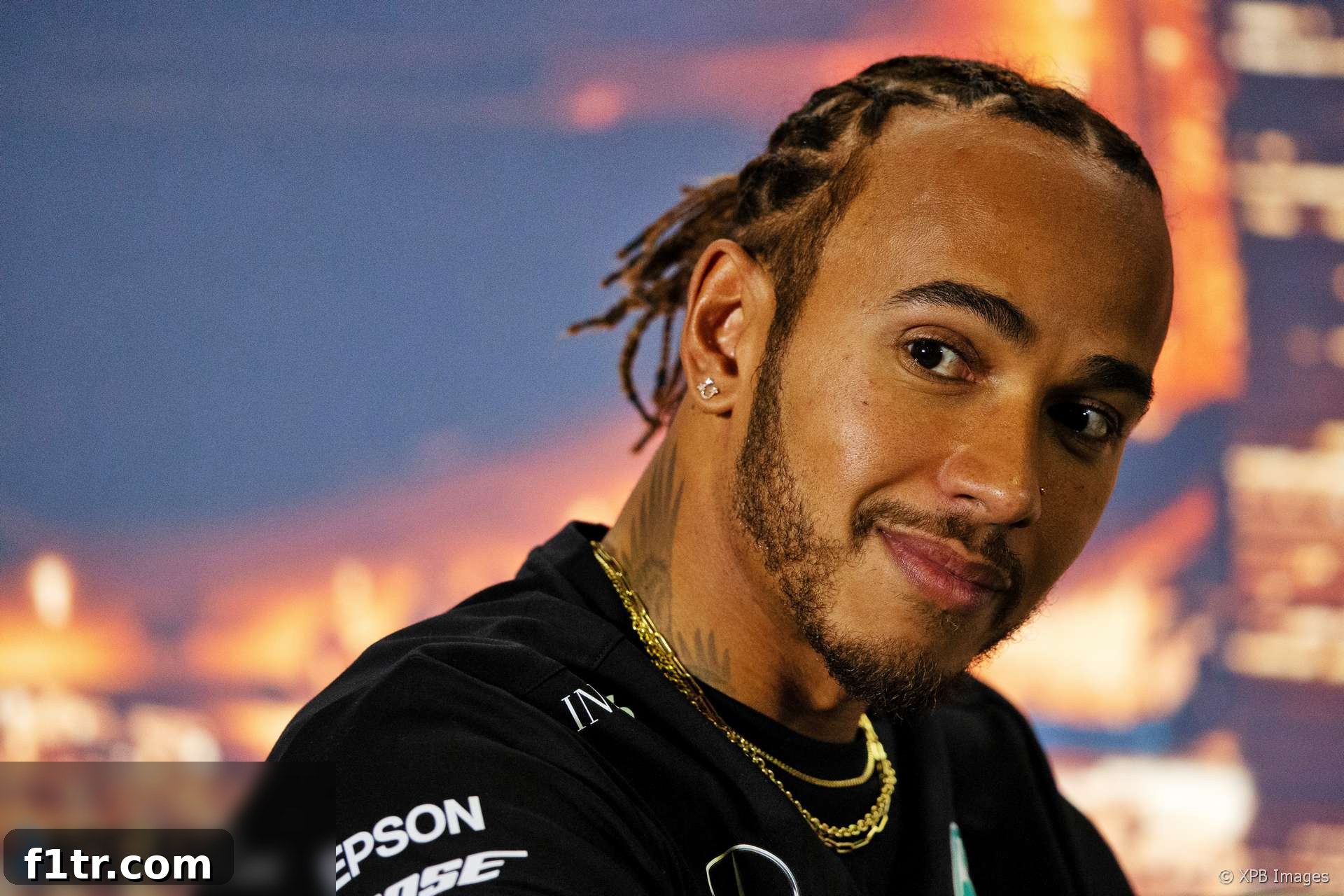
Former Formula 1 team principal and renowned pundit Eddie Jordan has weighed in on one of motorsport’s most enduring debates: who is the greatest driver of all time? While acknowledging the immense talent of many legends, Jordan singles out Alain Prost as the best driver he personally witnessed during his three decades in the sport. However, Jordan firmly believes that Mercedes superstar Lewis Hamilton is on the verge of eclipsing all others and solidifying his legacy as the undisputed greatest in F1 history.
Advert | Become a Supporter & go ad-free
Hamilton, already a titan of the sport with an impressive tally of six world championship titles to his name, is rapidly approaching Michael Schumacher’s record of seven. Jordan highlights Prost’s own championship record, noting that the Frenchman secured four titles but also “lost one by half a point [and] lost another world title by a point,” underscoring how close Prost came to an even more remarkable tally. These narrow misses illustrate the razor-thin margins at the pinnacle of Formula 1 racing and how a few points can dramatically alter historical narratives.
Alain Prost: The Professor’s Unyielding Challenge
“For me, the best driver I’ve seen in the 30 years that I was around was Alain Prost,” Jordan revealed during an interview with Off The Ball. Prost, often dubbed ‘The Professor’ for his intellectual and analytical approach to racing, was known for his smooth, economical driving style and his exceptional ability to manage tires and fuel. He was a master tactician, often outsmarting his rivals rather than relying solely on raw speed. His career spanned a golden era of Formula 1, marked by intense rivalries and formidable competitors.
What truly set Prost apart in Jordan’s eyes was his fearless attitude towards competition within his own team. Prost consistently embraced the challenge of championship-winning teammates, never shying away from lining up alongside giants like Niki Lauda, Keke Rosberg, and most famously, Ayrton Senna. “The one point that comes out for me stronger than anyone else [is] he never minded who his mate was,” Jordan emphasized. “He was a team player.” This willingness to measure himself against the very best, even when it meant intense internal battles, speaks volumes about Prost’s character and confidence in his own abilities. His rivalries, particularly with Senna at McLaren, are legendary, pushing both drivers and the sport to unprecedented levels of performance and drama. Prost’s legacy is built not just on his four championships, but on the manner in which he achieved them – through sheer tactical brilliance and an unshakeable resolve against the sport’s elite.
Lewis Hamilton: The Ascendant Icon
Despite his profound admiration for Prost, Jordan predicts a changing of the guard at the top of the ‘greatest’ list. “But that’s probably going to change very shortly because I do feel that Lewis Hamilton has achieved all of those things,” Jordan stated. The rapid accumulation of titles by Hamilton in the modern era has shifted the goalposts, and Jordan believes it’s only a matter of time before Hamilton clinches his seventh world championship, matching Michael Schumacher’s record, and potentially surpassing it.
Jordan acknowledges the context of Hamilton’s success, particularly the dominance of the Mercedes-AMG Petronas F1 Team. “OK, in a different era where there is a monopoly, the car is just quite simply staggering. But nevertheless, he’s maximised it.” This sentiment echoes a common debate among F1 enthusiasts: how much of a driver’s success is attributable to the machinery underneath them? While Mercedes has undeniably built an engineering marvel, Hamilton’s consistent ability to extract the maximum performance from the car, year after year, in varying conditions, against different teammates, and under immense pressure, is a testament to his unparalleled skill. His record-breaking pole positions, race wins, and championship victories demonstrate an extraordinary level of talent, consistency, and dedication.
The comparison between eras is always challenging. Prost raced in a period of less advanced aerodynamics, manual gearboxes, and highly dangerous circuits. Hamilton competes in an era defined by sophisticated hybrid power units, complex aerodynamic packages, and unparalleled safety standards. Yet, the essence of F1 – pushing the limits of man and machine – remains constant. Hamilton’s adaptability, his evolution as a driver, and his ability to maintain peak performance over such an extended period place him in truly rarefied air. Jordan’s prophecy hinges on Hamilton’s continued success, stating, “I would say by the next couple of months, if there is a championship this year, we’ll see yet another world champion achieving seven world titles. I think Lewis Hamilton has every chance to be the greatest driver of all time.” Should Hamilton achieve this monumental feat, it would undoubtedly spark renewed debate, but Jordan’s conviction suggests the numbers, coupled with Hamilton’s sustained excellence, will ultimately speak for themselves.
The Schumacher Anomaly: Talent vs. Team Hierarchy
Jordan’s critique of Prost’s team-player mentality sharply contrasts with his reflections on Michael Schumacher’s approach, particularly during his dominant tenure at Ferrari. Jordan, having given Schumacher, Eddie Irvine, and Rubens Barrichello their F1 debuts, had unique insight into their careers. Schumacher joined Ferrari in 1996, and Barrichello followed in 2000, both stepping into roles that would become synonymous with supporting the German superstar.
“When I reflect back on all of the contracts I had to sign with Ferrari, with the great Michael Schumacher, no doubt about his outstanding talent, but he let himself down in one area for me and that one area was that in every contract that I signed with Irvine, Barrichello or whoever they were, there was a clause there that they always have to play second fiddle to Michael Schumacher,” said Jordan. This controversial ‘number two’ driver clause, deeply embedded in Schumacher’s Ferrari contracts, ensured that his teammates were obligated to support his championship aspirations, even at the cost of their own race results or championship challenges. While this strategy undeniably contributed to Ferrari’s and Schumacher’s unprecedented success, creating a unified front and minimizing internal competition, it also raised questions about the purity of the sporting contest and the level playing field for all drivers within a team. Jordan’s observations suggest that while Schumacher’s talent was beyond doubt, this contractual stipulation, for some, detracts slightly from the perception of his overall greatness when compared to drivers like Prost who actively sought out the toughest intra-team challenges.
Eddie Irvine: A Tale of Untapped Potential
Among the drivers Jordan gave their F1 breaks, Eddie Irvine holds a peculiar place in his memory. Irvine drove for Jordan Grand Prix from 1993 to 1995 before moving to Ferrari to partner Schumacher. Jordan believes Irvine possessed latent talent that, with more dedication, could have propelled him to the sport’s highest echelons.
“He used to sit on his butt all day in his apartment. He was the laziest driver of all time and it’s a shame because he could have been a world champion so easy. But that was his style. He was a nightclub guy. He didn’t really wake up to 12 o’clock in the day, or even later sometimes,” Jordan colorfully recounted. This candid assessment paints a picture of a driver with raw speed and natural ability, but perhaps lacking the monastic discipline often associated with championship winners. Irvine’s playful, party-loving persona was well-known in the paddock, contrasting sharply with the meticulous preparation of drivers like Prost or Schumacher.
Despite Jordan’s harsh critique of his work ethic, Irvine’s career did see moments of brilliance, most notably in 1999 when, deputizing for an injured Schumacher, he mounted a serious challenge for the world championship, ultimately losing out to Mika Häkkinen by just two points. This near-miss underscores Jordan’s point: a driver with Irvine’s natural talent, had he embraced a more rigorous lifestyle and dedicated himself fully to the sport, might indeed have joined the exclusive club of F1 world champions. His story serves as a fascinating example of how mental fortitude and off-track dedication are as crucial as on-track talent in the cutthroat world of Formula 1.
Advert | Become a RaceFans supporter andgo ad-free
The Enduring Debate: Defining F1’s Greatest
The discussion of Formula 1’s greatest driver is inherently subjective, shaped by individual criteria, nostalgic attachments, and the ever-evolving nature of the sport itself. Eddie Jordan, with his unique vantage point as a team owner, manager, and media personality, offers a compelling perspective that values not just raw speed and championship tallies, but also character, team dynamics, and the pursuit of competitive purity.
While Alain Prost’s tactical genius and willingness to face any rival cement his place as one of the sport’s all-time greats, Lewis Hamilton’s relentless pursuit of records and his unparalleled consistency in a dominant era position him to potentially redefine what ‘greatest’ truly means. The contrast with Michael Schumacher’s methodical, team-centric dominance and Eddie Irvine’s unfulfilled potential further enriches this complex narrative. As Formula 1 continues to crown new champions and witness new legends emerge, the question of the greatest will undoubtedly remain a lively topic of debate, fueled by the insights of seasoned observers like Eddie Jordan and the extraordinary achievements of the drivers themselves.
2020 F1 Season Highlights
- Grosjean to make F1 test return tomorrow for first time since Bahrain horror crash
- Pictures: Wrecked chassis from Grosjean’s Bahrain fireball crash to go on display
- Bottas vs Rosberg: Hamilton’s Mercedes team mates compared after 78 races each
- F1 revenues fell by $877 million in Covid-struck 2020 season
- Hamilton and Mercedes finally announce new deal for 2021 season
Browse all 2020 F1 season articles