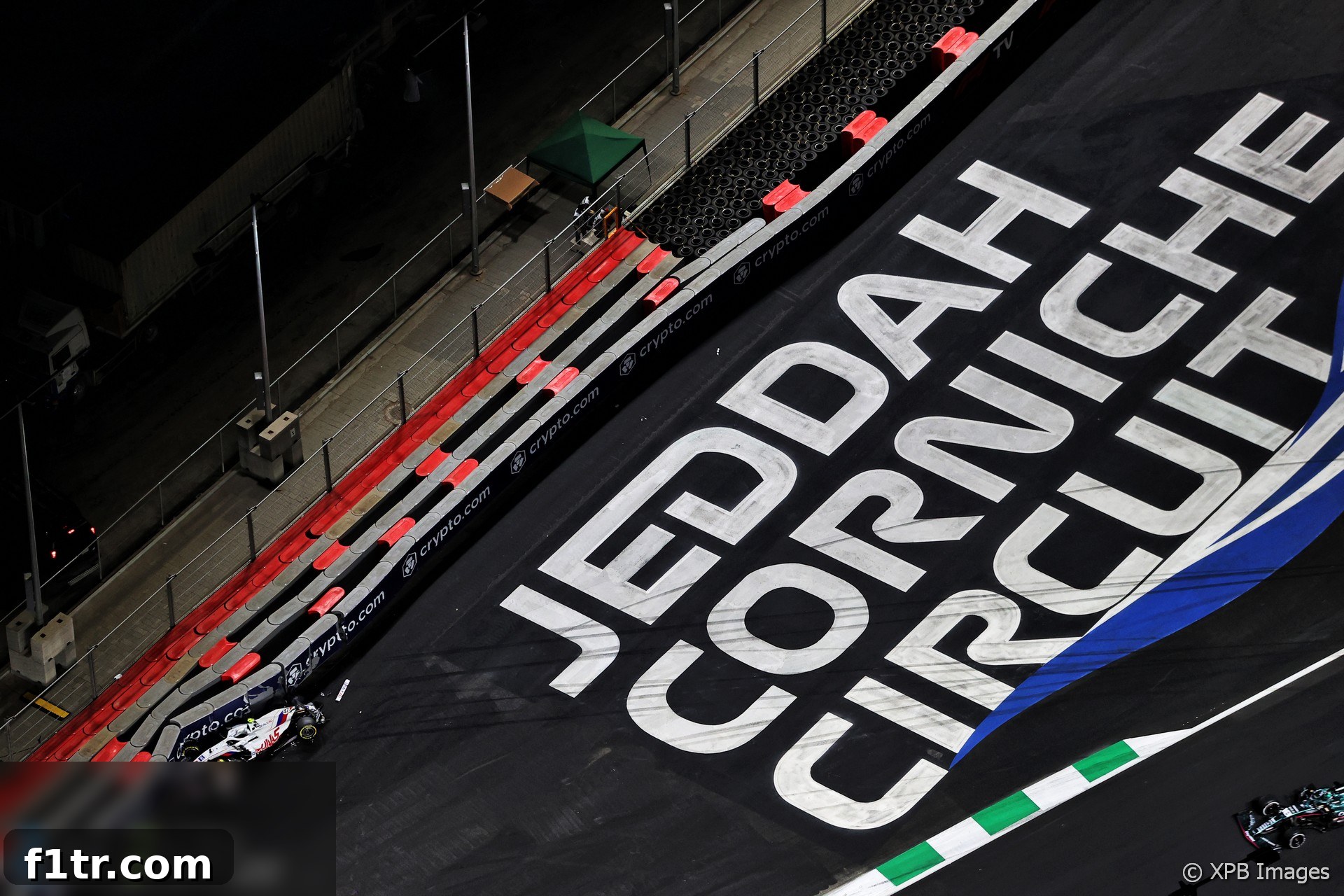
The inaugural Saudi Arabian Grand Prix, held on the newly constructed Jeddah Corniche Circuit, quickly established itself as one of the most talked-about events on the Formula 1 calendar. Beyond the geopolitical discussions that surrounded its controversial inclusion, the circuit itself became a focal point of intense debate among drivers, teams, and fans alike. Billed as the “world’s fastest street circuit,” Jeddah promised a unique blend of speed and challenge, but it also raised significant questions about safety, visibility, and the very nature of modern track design in motorsport.
Before the wheels even turned in anger, prominent drivers voiced their apprehension. Sergio Perez, for instance, famously described the track as “very dangerous” and ominously predicted a “big shunt.” His concerns, echoed by many of his peers, were not born of fear but of an intimate understanding of racing dynamics on a high-speed, unforgiving layout. As the weekend unfolded, these predictions regrettably came to pass, validating the drivers’ foresight. The sport, in its pursuit of breathtaking spectacle and unprecedented challenges, appeared to have pushed the boundaries of safety to an alarming degree, resulting in multiple incidents across both Formula 1 and Formula 2 categories.
The Jeddah Corniche Circuit: A Fusion of Speed and Peril
The marketing tagline “world’s fastest street circuit” was more than just hyperbole; it accurately reflected the ambitious design philosophy behind the 6.1-kilometer Jeddah Corniche Circuit. Unlike traditional street circuits such as Monaco, Baku, or Singapore, which are typically constrained by pre-existing urban infrastructure, Jeddah benefited from a blank canvas. This rare freedom allowed renowned track designers, Tilke Architects, to craft a high-octane ribbon of asphalt featuring an astonishing 27 numbered corners. The result was a circuit where average qualifying speeds soared past 250 kph, making it even faster than venerable purpose-built tracks like Silverstone.
However, this blistering pace came with a significant caveat: unlike traditional circuits with expansive run-off areas, Jeddah was relentlessly hemmed in by concrete barriers. Drivers were rarely more than a few meters from these unforgiving walls at any point along its considerable length. Several drivers, including Perez, highlighted the peculiar decision to deliberately place these barriers so close to the racing line, rather than out of structural necessity. This design choice, which prioritized visual drama and a heightened sense of risk, became one of the primary points of contention and a key area drivers hoped to see modified for future editions of the race.
A Weekend Marred by Crashes and Near-Misses
The three days of on-track action in Jeddah served as the ultimate real-world test for this highly anticipated circuit, moving beyond simulations and hypothetical scenarios. Unfortunately, the weekend witnessed an uncomfortable number of significant accidents across both the Grand Prix and the three rounds of Formula 2. These incidents led to multiple red flag stoppages and lengthy Safety Car periods, severely disrupting the flow of racing and raising serious questions about the circuit’s inherent safety profile.
The most severe Formula 1 incident occurred during the second restart of the main race, involving Charles Leclerc, Sergio Perez, George Russell, and Nikita Mazepin. While the latter three were forced to retire, thankfully, all drivers walked away relatively unscathed. However, the Formula 2 feature race began with an even more alarming accident between Théo Pourchaire and Enzo Fittipaldi, leading to both drivers being hospitalized. Fittipaldi, in particular, suffered a broken heel, a stark reminder of the physical toll such high-speed impacts can take.
A recurring scene of danger emerged at the 220 kph left-hand kink of Turn 22, which proved to be the circuit’s most treacherous section. Both Leclerc and Mick Schumacher experienced eerily similar crashes into the barriers after losing control on entry. Formula 2 drivers Pourchaire and Logan Sargeant also shunted at the same corner. The F2 feature race was red-flagged a second time and eventually abandoned following another collision at Turn 22 involving Olli Caldwell and Guilherme Samaia, though mercifully, these impacts were less severe.
Beyond the actual crashes, a series of hair-raising near-misses dominated discussions throughout the weekend. Heavy traffic during practice and qualifying sessions for both series created alarming scenarios. Drivers on blistering hot laps found themselves hurtling towards rivals circulating at significantly lower speeds, either cooling down on their way back to the pits or attempting to create space before their own flying laps. A particularly close call involved Nikita Mazepin, who, after rapidly negotiating Turns 7 and 8, suddenly encountered Lewis Hamilton’s Mercedes crawling along the apex, forcing him to take immediate evasive action.
Despite these serious concerns, drivers were almost universally effusive in their praise for the circuit’s thrilling and challenging nature from a driving perspective. Yet, this excitement was consistently tempered by anxieties over limited visibility at high speeds, particularly through the numerous blind corners. Daniel Ricciardo of McLaren candidly described the first sector, where the Hamilton-Mazepin incident occurred, as “a bit sketchy.” George Russell went further, stating, “It’s a bit of a recipe for disaster. I think there are some things they need to modify to make these kinks just straights. It is so blind and we have already seen too many incidents waiting to happen.” Perhaps Sebastian Vettel offered the most insightful comparison, likening the circuit to “Suzuka, but with barriers,” perfectly encapsulating the perilous blend of high-speed technicality and unforgiving confinement.
FIA Approval and “Rough Edges”
Despite the significant driver apprehension and the numerous incidents, the FIA, through its stringent regulatory process covering track configurations, run-off areas, barrier designs, minimum track widths, and facility quality, officially deemed the Jeddah circuit safe enough to host the world championship and its feeder series. The track was granted its coveted FIA Grade One certification on the very day before the first practice session commenced, a testament to the rapid construction schedule and the FIA’s confidence in its final design. Michael Masi, the FIA F1 Race Director, had consistently emphasized that no compromises on safety would be made, despite the extremely compressed timeframe for its completion.
Following the Grand Prix, Formula 1’s commercial rights holder, FOM, which had inked a lucrative multi-year deal with the Saudi Motorsport Group promoters, expressed their satisfaction. Ross Brawn, F1’s Motorsport Director, lauded it as “a fabulous first event, a fabulous track and a brilliant race.” However, even Brawn acknowledged the need for refinements, adding, “There were one or two rough edges that will be sorted out for the next race in March 2022. Inputs from all stakeholders will be considered and the track and venue will be honed for this next event.” This statement offered a glimmer of hope that driver feedback would be taken seriously in addressing the circuit’s perceived shortcomings.
Interestingly, not all driver feedback was critical. Many were pleasantly surprised by the high level of grip offered by the newly laid asphalt, a stark contrast to typical street circuits and fresh surfaces that often present notoriously low adhesion levels. This unexpected characteristic likely contributed to the relatively low number of single-car, unforced errors compared to what might be seen at other challenging street venues like Monaco, Singapore, or Baku. While the F2 feature race start crash was undeniably severe, it occurred on the pit straight and highlighted an omnipresent risk in motorsport: standing starts where a stalled car can be struck from behind, a scenario that has sadly played out at many other venues across various racing series.
The Pervasive Visibility Problem
Throughout the race weekend, the most frequently cited hazard for drivers was not the inherent characteristics of the circuit itself, but rather the presence and actions of their fellow competitors. The combination of high speeds, blind corners, and limited run-off areas created numerous situations where drivers on hot laps were unsighted, rapidly approaching slower cars that were off the racing line. These alarming scenes led to race control issuing warnings to drivers not to slow down unnecessarily between the exit of Turn 22 and the long, sweeping Turn 25. However, this directive inadvertently encouraged drivers to slow down just before the final corner, Turn 27, resulting in significant traffic congestion and near-misses during Q1.
The aforementioned incident between Mazepin and Hamilton in third practice was undoubtedly frightening, but it also underscored a critical reliance on team communication. With only limited rearward visibility provided by slim mirrors, drivers are heavily dependent on their race engineers to alert them to approaching traffic, its speed, and trajectory. A momentary lapse in communication can have severe consequences, as demonstrated by this incident where Mercedes failed to provide Hamilton with sufficient warning of the rapidly approaching Haas.
This visibility challenge is by no means unique to Jeddah; it’s a recurring issue in Formula 1, despite the sophisticated real-time GPS data and constant radio communication available. Similar incidents have occurred at other circuits throughout the season. The stewards themselves acknowledged the unique difficulties presented by Jeddah’s layout, emphasizing in their notes that “it is essential that teams communicate effectively and proactively with their drivers” given the “nature of this circuit.” The reliance on informal “gentlemen’s agreements” among drivers to self-regulate ahead of qualifying laps has demonstrably failed on multiple occasions this season, notably in Bahrain and Austria. This recurring problem across various circuits suggests a need for more formal and rigorously enforced arrangements between competitors to mitigate these entirely avoidable and dangerous traffic scrums.
The Art of Controlling the Racing
The combination of Jeddah’s extreme speeds and confined nature presented race control with a series of exceptionally difficult and high-stakes decisions. The integrity of all forms of circuit racing heavily relies on the vigilance and decisive action of race direction to prioritize safety. While those in race control are human and susceptible to inconsistencies, the critical importance of acting swiftly and unequivocally in the interests of safety cannot be overstated, particularly on a circuit like Jeddah.
Ahead of the race, Lando Norris articulated his uncertainty about whether Jeddah had pushed the boundaries of safe track design too far. When questioned about the track’s safety, he replied, “I don’t know – you’d say yes but something could suddenly happen and everyone’s going to be like ‘I told you so’. It’s tricky. If there’s going to be a crash here realistically it’s going to be a big crash especially if it’s in the faster sector of sector one or the chicane where Charles crashed. I don’t know where the line is between having a street circuit and not much run-off and then having a normal circuit. I’m not sure where the line is. For now it’s okay but something could happen and I could be wrong.” Thankfully, his most dire fears for the F1 race itself did not fully materialize, but the occurrence of two red-flag incidents was certainly cause for deep reflection.
One of these red-flag incidents, which eliminated three cars, happened after a standing restart. Race starts are inherently the most dangerous phases of any Grand Prix, and on Sunday, drivers had to contend with not one, but three standing starts. The practice of bunching up the field far more tightly during standing restarts compared to rolling restarts significantly contributed to the initial contact between Perez and Leclerc at the second restart, which then cascaded into the weekend’s most extensive multi-car crash and another race stoppage. While standing restarts after red flags are consistent with race control’s general approach throughout the season, there is a compelling argument to be made for a more selective application of this method, especially on circuits with limited maneuverability. The race director holds the sole discretion to choose between a standing or rolling restart, and this discretion could be utilized more judiciously in scenarios where a multi-car melee is a heightened risk.
Later in Sunday’s race, a substantial piece of debris from one car remained off the racing line for over a minute before a Virtual Safety Car (VSC) was finally deployed to facilitate its safe recovery. On a circuit as narrow and fast as Jeddah, any debris left on the track, even briefly, dramatically escalates the risk of further accidents. Fernando Alonso vocally expressed his frustration over the team radio, stating: “The circuit is in the worst condition of the weekend, we’ve had 100 red flags and now we’re racing at 300kph with the circuit like this.” His comments underscored the tension between maintaining race flow and ensuring absolute safety on a track already perceived as inherently high-risk.
F1’s Swift Return and Future Outlook
Evidently, the inaugural Saudi Arabian Grand Prix left drivers with a strong impression that there is ample room for improvement in how races can be conducted safely on the Jeddah Corniche Circuit. While they were largely positive about the thrilling challenge the circuit presented from a driving standpoint, their concerns about visibility, barrier proximity, and the management of incidents were undeniable. Michael Masi, upon departing Saudi Arabia, expressed the view that only “minor changes” would be required for the track’s next outing. “There’s some fine-tuning that will happen across the board,” he stated, acknowledging “teething issues” inherent to any brand-new event and facility. He concluded that he could not foresee anything “in a major way” needing to be addressed.
However, it is clear that several prominent drivers hold strong opinions on precisely what this “fine-tuning” should entail, especially regarding the critical aspect of sight lines around Jeddah’s multitude of fast, blind corners. With the circuit scheduled to host its next F1 race just over three months later, all stakeholders – from drivers and teams to the FIA and promoters – will undoubtedly be keenly observing which specific areas are addressed. The challenge for the organizers and the FIA will be to implement meaningful safety enhancements without diluting the circuit’s unique character and the exhilarating challenge that drivers, ultimately, also appreciate. Balancing the desire for spectacular racing with the paramount need for driver safety will be the defining task for the future of the Saudi Arabian Grand Prix.
2021 Saudi Arabian Grand Prix
- Mercedes seal record eighth consecutive constructors title as Hamilton misses driver’s crown
- Analysis: Is Jeddah circuit’s layout fit for F1 or a “recipe for disaster”?
- Hamilton closes on another Schumacher record with first ‘hat-trick’ of 2021
- How Hamilton and Verstappen’s roughest scrap yet played out on the radio
- Brawn defends Masi following criticism of Saudi Arabian GP decisions
Browse all 2021 Saudi Arabian Grand Prix articles