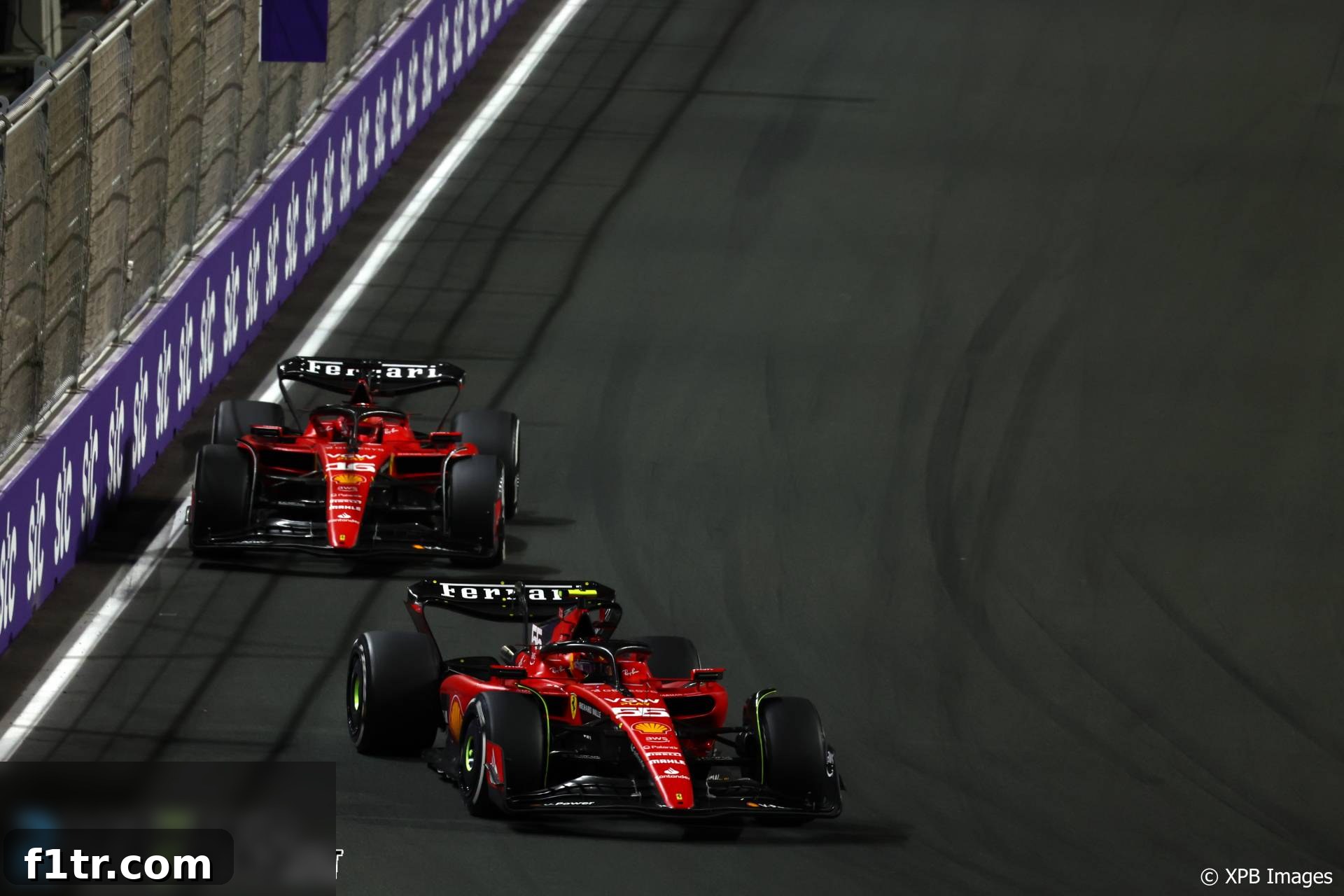
The exhilarating start to the 2023 Formula 1 season brought a stark reality check for Scuderia Ferrari at the Saudi Arabian Grand Prix. Following what they hoped would be a promising opening to their campaign, the iconic Italian team found themselves significantly off the pace of their rivals, particularly the dominant Red Bull Racing. In a candid post-race interview, Carlos Sainz Jnr admitted that the second race clearly demonstrated Ferrari’s position was not as competitive as the team had initially believed or hoped for.
Both Ferrari drivers, Sainz and his teammate Charles Leclerc, finished outside the coveted top five positions, marking a disappointing weekend for the Prancing Horse. Sainz crossed the finish line in sixth place, with Leclerc following closely behind in seventh. This outcome was far from the aspirations of a team that had targeted being the primary challenger to Red Bull in the constructor’s championship.
The Safety Car Interruption and its Limited Impact
The Jeddah Corniche Circuit provided its usual dose of drama, including a Safety Car period that emerged shortly after both Ferrari drivers had completed their crucial first pit stops. This timing was undeniably inconvenient for the team’s strategy. Sainz elaborated on the situation, explaining, “It wasn’t the best timing because we were out there on the medium [tyres] over-cutting Stroll and starting to show a bit of a better pace after struggling a lot in dirty air behind Stroll.” The Safety Car effectively neutralized any advantage they might have gained from their pit strategy and tyre choice, forcing a regrouping of the field.
However, despite the strategic disruption, Sainz held a pragmatic view on its overall influence on their final standing. He confessed, “But I honestly think the result wouldn’t have changed much.” This statement is telling, suggesting that the underlying performance deficit of the SF-23, rather than mere race incidents, was the primary factor dictating their finishing positions. It indicated a deeper issue that even optimal race circumstances might not have been able to overcome, casting a shadow on Ferrari’s inherent race pace compared to their front-running competitors.
Ferrari’s Enduring Struggle with Tyre Degradation
The most glaring weakness highlighted by the Saudi Arabian Grand Prix, according to Sainz, was Ferrari’s persistent problem with tyre degradation. The final stint of the race, run on the hard compound tyres, served as a definitive benchmark for this issue. Sainz directly acknowledged, “The last stint on the hard proves that we are not where we want to be, that we still deg[rade] more than the Mercs, we still deg more than the Astons and we lack a bit of race pace.”
Tyre degradation, often referred to as ‘deg’, is a critical factor in modern Formula 1, determining a car’s ability to maintain performance over a race distance. When a car degrades its tyres more rapidly, it loses grip and speed faster than its rivals, forcing drivers to either manage their pace excessively or make earlier, and potentially more frequent, pit stops. For Ferrari, this means their car is simply harder on its tyres than those of Mercedes and Aston Martin, let alone the class-leading Red Bull. This inherent characteristic compromises their strategic flexibility and consistently puts them at a disadvantage in a straight fight over race stints.
This struggle with tyre management is not a new challenge for Ferrari, having plagued them in various forms in previous seasons. The inability to keep tyres within their optimal operating window for extended periods creates a domino effect: drivers must either push less, losing crucial lap time, or risk dramatically falling off a performance cliff. The consequence is a substantial lack of consistent race pace, making it exceedingly difficult to challenge for podiums, let alone victories, against rivals with superior tyre longevity.
The Detrimental Impact of “Dirty Air”
Adding another layer of complexity to Ferrari’s tyre woes is the car’s sensitivity when running in “dirty air” – the turbulent airflow disturbed by a preceding car. This aerodynamic phenomenon significantly reduces a following car’s grip and cooling efficiency, exacerbating existing problems. Sainz candidly explained, “Right now we are not where we want to be in terms of race pace and the car in general, the balance, even in dirty air following we just struggle a bit. If we already overheat the tyres in clean air, imagine following. We just eat them alive and we need clean air to produce some kind of decent lap time.”
This paints a grim picture for Ferrari’s ability to engage in close-quarter racing, which is fundamental to overtaking and defending positions. The car’s tendency to overheat its tyres even in clean, undisturbed airflow becomes a critical vulnerability when forced to run in the wake of another competitor. The turbulent air prevents effective cooling and disrupts the car’s aerodynamic balance, leading to even faster tyre degradation and a further drop in performance. This sensitivity makes it incredibly challenging for Sainz and Leclerc to gain positions or even defend against faster cars without rapidly compromising their tyre life, trapping them in compromised positions during the race.
Hopes Dashed: Jeddah Expectations Versus Reality
Before the Saudi Arabian Grand Prix weekend commenced, there was a palpable sense of optimism within the Ferrari garage. Strong performances during Friday practice sessions had led the team to believe they could genuinely contend for the title of the “second force” on the grid, placing them as the closest rivals to the seemingly untouchable Red Bulls. Sainz openly shared this initial optimism: “I’m a bit surprised because after Friday and before the weekend, I thought that we had a chance of being the second force here in Jeddah.”
However, the reality of race day quickly dispelled these hopes. The stark performance difference, particularly evident in the long runs on harder compounds, proved that the initial promise was illusory. “But I think that last stint on the hard proves that we still have a lot of work to do. We have a weakness in the race and that we need to wait for the developments to come to see if we can improve that weakness,” Sainz reiterated. This signifies a fundamental gap between their single-lap qualifying pace, which often appears competitive, and their sustained race performance, a disparity that undermines their championship ambitions.
Strategic Downforce and Cornering Sensitivities
In an attempt to mitigate their chronic tyre degradation issues, Ferrari implemented a specific aerodynamic strategy in Jeddah. Sainz revealed that the team opted for a higher downforce setup compared to some rivals, possibly even similar to what they ran in Bahrain, which typically would imply less straight-line speed. “We didn’t run as low drag in Bahrain. Actually we ran a very similar rear wing as in Bahrain and this is probably why we were not as fast on the straights as maybe in Bahrain. In Bahrain we were maybe lower downforce than the others, here we were equal,” he explained. The intention behind this was likely to generate more grip through corners, thereby reducing the stress on the tyres and potentially extending their life.
However, this tactical choice did not yield the desired effect, further emphasizing that the problem extends beyond simple downforce levels. Sainz clarified that the car’s primary limitation isn’t a lack of drag efficiency or engine power, but rather inherent characteristics that affect its behavior. “Our limitation [is not] the drag or the power, it’s race pace. It’s the deg, is some sensitivities that the car has in cornering and we know are not the right ones but we know and we will develop.” These “sensitivities” likely refer to how the car reacts to various cornering loads, driver inputs, and track conditions, indicating a complex aerodynamic and mechanical interaction that causes suboptimal performance and accelerates tyre wear. Identifying these specific characteristics is crucial for their development roadmap.
The Road Ahead: Development and Determination
Despite the evident challenges, a glimmer of positivity shines through in the team’s self-awareness. “We know exactly our weaknesses, this is a positive,” Sainz stated, underscoring that understanding the problem is the first step towards finding a solution. However, he also tempered expectations by acknowledging that immediate fixes are not possible. “Obviously we cannot do magic to bring the developments early, but I know the team is pushing flat out to bring them and this will improve our race pace for sure.”
The emphasis is now firmly on the development trajectory of the SF-23. Formula 1 is an incessant arms race, and Ferrari’s engineers back in Maranello are under immense pressure to design and implement upgrades that directly address these identified weaknesses, particularly concerning tyre degradation and the car’s behavior in corners and dirty air. These developments might involve significant changes to the car’s floor, suspension geometry, or other aerodynamic elements. The expectation is that these improvements, once introduced, will allow Ferrari to unlock more consistent race pace and finally close the gap to the front-runners. The long season provides opportunities, but the urgency for effective upgrades is paramount if Ferrari wishes to remain in contention for competitive results.
Red Bull’s Dominance Sets the Benchmark
The context for Ferrari’s struggles is Red Bull’s commanding performance. Max Verstappen and Sergio Perez have shown formidable pace and unparalleled tyre management across the opening races, establishing themselves as the clear benchmark. The gap to Red Bull, particularly in race trim, has proven to be substantial, forcing every other team, including Ferrari, to reassess their strategies and development priorities. Sainz himself has previously acknowledged Red Bull’s deserving dominance, a sentiment that resonates even more profoundly after the Saudi Arabian Grand Prix.
This undeniable superiority from Red Bull intensifies the pressure on Ferrari. Not only do they need to catch up, but they also have to fend off strong challenges from a resurgent Aston Martin and a determined Mercedes. The battle for second place in the Constructors’ Championship appears to be fiercely contested, and Ferrari’s current performance puts them at a disadvantage in that fight as well. The psychological impact of realizing their initial hopes were overblown can also be significant, requiring strong leadership and unwavering focus from the team to maintain morale and push forward.
Conclusion: A Challenging Path Ahead for Ferrari
The 2023 Saudi Arabian Grand Prix served as a critical inflection point for Ferrari. While the team remains optimistic about their ability to address fundamental issues, the challenges are significant. The combination of high tyre degradation, exacerbated by running in dirty air, and intricate cornering sensitivities collectively undermines their race pace. Despite the dedicated efforts to optimize downforce, the SF-23 still requires substantial development to become a consistent contender.
Ferrari’s path forward is clear: relentless development is needed to transform the SF-23 into a machine capable of sustaining performance across a full race distance. The team’s candid acknowledgment of its weaknesses is a positive sign, indicating a clear direction for improvement. However, the Formula 1 calendar moves swiftly, and the pressure is on Maranello to deliver the necessary upgrades promptly to allow Carlos Sainz Jnr and Charles Leclerc to consistently fight at the sharp end of the grid and reclaim their aspirations of challenging for top honors.
2023 Saudi Arabian Grand Prix
- “Total transparency” needed over Ben Sulayem allegations – Russell
- FIA president Ben Sulayem under investigation for interfering in F1 race – report
- Two races, no points: How 2023 compares to McLaren’s worst starts to a season
- Don’t complain about Red Bull dominating F1, they deserve it – Sainz
- Alfa Romeo identify “massive debris” which ruined Bottas’ race
Browse all 2023 Saudi Arabian Grand Prix articles