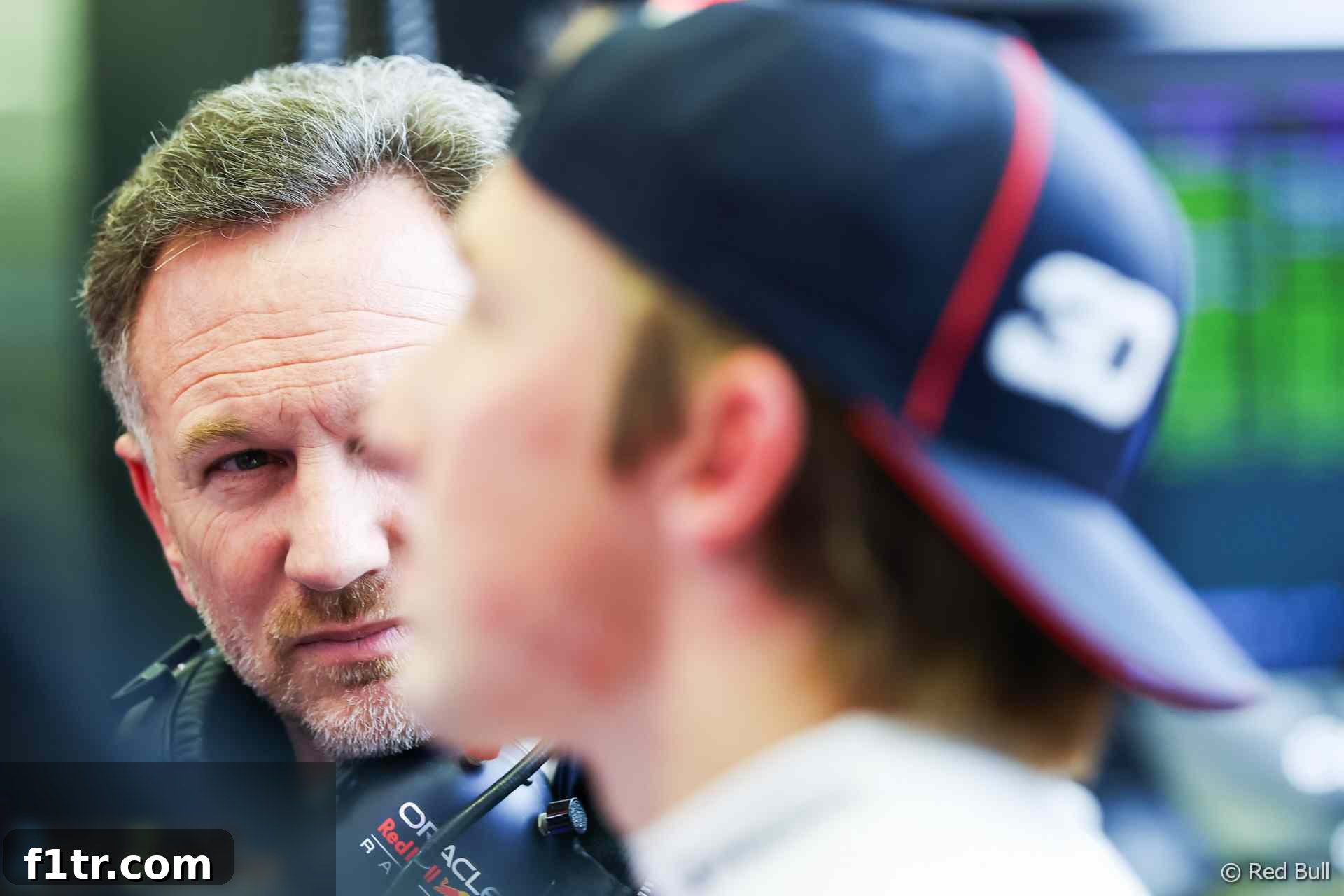
The recent news that Red Bull has reportedly dismissed Liam Lawson after merely two starts for the premier team has sent ripples of shock and speculation through the Formula 1 community. While rumors had circulated for days regarding the potential ousting of the promising young driver, the confirmation of his departure from the Red Bull main team’s immediate plans remains a truly astonishing decision, especially when viewed against the backdrop of Red Bull’s historically extensive patience with his predecessor, Sergio Perez.
Advert | Become a Supporter & go ad-free
Red Bull’s commitment to Perez extended over a significant period, a tenure that many argue ultimately cost them the Constructors’ Championship in the preceding season. Just three months prior, as hopes dwindled for Perez to salvage another underwhelming season, Team Principal Christian Horner publicly articulated the rationale behind choosing Lawson, a driver with only 11 Grand Prix starts to his name, as Perez’s designated replacement in the formidable Red Bull Racing car.
“We felt that Liam’s trajectory, coupled with his innate mental strength and resilience, presented the ideal attributes to partner Max,” Horner stated emphatically. He further elaborated on the immense challenge, acknowledging that “arguably that seat is the toughest in Formula 1, going up against Max Verstappen, who is undoubtedly at the peak of his career.”
It is beyond dispute that Max Verstappen represents an extraordinarily high benchmark for any driver to be measured against. His unparalleled talent and consistent performance make him a formidable opponent, even for seasoned veterans. However, Red Bull possesses a distinct advantage over its rivals: it is the sole team whose ownership extends to a secondary Formula 1 outfit, a team explicitly designed to cultivate and prepare future talent for the main squad. This unique infrastructure should, in theory, position Red Bull as the team least prone to hastily promoting a driver only to discard them after a mere two competitive rounds. The very essence of a junior team is to provide a controlled environment for development, allowing drivers to gain crucial experience before being thrown into the intense spotlight of the senior team.
The performance disparity between Lawson and Verstappen in the mighty RB21 was indeed considerable. In qualifying at Melbourne, the newcomer found himself over a second slower than his reigning world champion teammate. While he managed to narrow this deficit to three-quarters of a second in Shanghai the following weekend, the gap between Lawson and Verstappen over a single lap remained consistently larger than that observed between any other pair of teammates on the grid. This raw pace difference, while significant, raises questions about the expectations placed upon a driver stepping into such a demanding role with minimal preparation.
Subsequently, the team officially announced Yuki Tsunoda as Lawson’s replacement. This decision places considerable pressure on Tsunoda, and anxious expressions are sure to be visible on the Red Bull pit wall if he fails to bridge the performance gap any closer when the paddock descends upon Suzuka for the Japanese Grand Prix next week. The scrutiny will be intense, as Tsunoda will be judged not just on his own performance, but also in comparison to the high bar set by Verstappen and the expectations that Lawson seemingly failed to meet in his brief stint.
Advert | Become a RaceFans supporter andgo ad-free
Following qualifying in Australia, McLaren Racing CEO Zak Brown, never one to miss an opportunity to apply pressure on Christian Horner, publicly questioned Red Bull’s decision-making. He openly wondered why Lawson had been promoted over Tsunoda, who had impressively secured fifth place on the grid. “Yuki did a great job,” Brown enthused during an interview with Sky, adding pointedly, “he’s probably the guy who should be in the Red Bull if you look at how he’s performed, but they seem to make some strange driver choices from time to time.” Brown’s comments highlighted a perceived inconsistency in Red Bull’s driver management philosophy, suggesting a lack of clear strategy or perhaps an overreliance on subjective judgment rather than objective performance metrics.
The Chinese Grand Prix race weekend, Lawson’s second competitive outing in the RB21, was particularly challenging, unfolding under treacherously slippery conditions. Lawson attempted a risky gamble, trying to navigate a rain shower on slick tyres, a decision that unfortunately culminated in a spin into the wall at Turn Two. Reflecting on Lawson’s struggles, Alexander Albon, a driver with firsthand experience of the immense difficulty of competing against Max Verstappen in a Red Bull car, offered a sympathetic perspective.
“It’s very early to say how he’s going to do,” Albon remarked, emphasizing the broader context. “I think, for everyone out there, the conditions and the general format of qualifying now make things very tight. Firstly, let’s start with the fact that qualifying is closer than ever, which is great for everyone. But it also means that if you’re just a little bit off, you’re likely going to be out in Q1. Then in the race, there’s not much to say. Everyone was struggling out there. I think, especially for the rookies and the ones with a little bit less experience, they were on the back foot for most of Sunday. So I think we need to give him a bit of time to get up to speed.” Albon’s insights underscore the immense pressure and learning curve faced by new drivers, particularly when thrust into the hot seat of a championship-contending team under adverse conditions.
Initially, Christian Horner appeared to echo Albon’s assessment, advocating for patience with his new recruit. “You can’t judge Liam on what we’ve seen so far,” Horner stated candidly after the Chinese Grand Prix. “It’d be very unfair to do that. He’s had a really difficult run so far. Let’s see about the race tomorrow, and then of course, as we get to tracks that he starts to know, I think he’ll start to come alive.” This initial support and understanding from the team principal suggested a commitment to Lawson’s development and a recognition of the steep learning curve involved.
Advert | Become a RaceFans supporter andgo ad-free
Yet, with Lawson now definitively out of the main Red Bull driving picture, the rapid change in Horner’s stance begs critical questions. What precisely transpired to alter the team principal’s conviction so swiftly regarding the necessity of allowing Lawson to prove himself on familiar circuits? More fundamentally, why did Liam Lawson not possess the requisite experience on a wider range of tracks when he was given this monumental opportunity in the first place? These questions point to a deeper issue within Red Bull’s driver development pipeline and its decision-making processes.
Liam Lawson and Yuki Tsunoda, despite Tsunoda being a year older, ascended through the junior racing categories in parallel. While Lawson himself maintained he held the competitive edge, in reality, there was frequently very little to distinguish their performances. Both demonstrated immense talent and potential. However, Red Bull chose to fast-track Tsunoda’s path to F1 after he outperformed Lawson in the 2019 Formula 3 championship. Tsunoda was subsequently promoted to Formula 2 the following year and made his Formula 1 debut a year after that, embarking on a swift and direct trajectory.
Lawson’s progression, by contrast, was markedly slower and more circuitous. He endured an additional year in Formula 3, followed by two seasons in Formula 2. By the close of the 2022 season, a vacancy emerged at Red Bull’s sister F1 team (then known as AlphaTauri), and Lawson, by all accounts, appeared to be the logical and obvious candidate for an F1 promotion. Instead, in a perplexing strategic move, Red Bull opted to send him to Japan’s highly competitive Super Formula series. If, at this pivotal juncture, Red Bull was genuinely contemplating the long-term possibility of their promising junior driver joining their elite top team within two years, then why was he not placed with another F1 squad in 2023, even on loan, to gain invaluable F1 experience?
Advert | Become a RaceFans supporter andgo ad-free
Indeed, Red Bull went to extraordinary lengths to explore alternatives to Lawson for the AlphaTauri seat. They publicly flirted with the idea of bringing in IndyCar star Colton Herta, despite his undeniable deficiency in superlicence points, rendering him ineligible for an F1 seat. Following this, they ventured outside their established young driver programme to hire Nyck de Vries, a move that surprised many observers. This sequence of events starkly illustrates Red Bull’s apparent reluctance to give Lawson his F1 break even when a clear opportunity presented itself within their own ecosystem.
However, less than half a season into his tenure, Red Bull concluded that de Vries was not performing to the required standard. By this point, another high-profile candidate, Daniel Ricciardo, had re-emerged as an option for the seat Lawson had so long coveted. Ricciardo subsequently replaced de Vries, seemingly pushing Lawson further down the pecking order. Fate, however, intervened dramatically when Ricciardo sustained a hand injury just three races into his comeback. It was this unforeseen circumstance that finally granted Liam Lawson his much-anticipated F1 debut, an opportunity that, until then, Red Bull had appeared remarkably hesitant to provide, despite his evident talent and consistent performance in other categories.
Red Bull’s abrupt decision to dismiss Lawson from their main team’s immediate plans thus represents the third peculiar and arguably flawed call they have made concerning his career development within their expansive racing programme. Firstly, the inexplicable choice not to offer him an F1 drive in 2023 when a clear vacancy existed at AlphaTauri. Secondly, the logic behind promoting him to the highly demanding main Red Bull Racing seat at the close of last year, considering that Yuki Tsunoda had accumulated eight times as many Grand Prix starts and demonstrated comparable, if not superior, speed in recent outings. And thirdly, the most baffling of all, is the decision to give up on him after a mere two competitive appearances, both of which took place at circuits where he possessed no prior F1 experience and under challenging circumstances. These three points collectively paint a picture of inconsistent and, at times, contradictory management of a promising young talent.
Indeed, very few of Red Bull’s decisions throughout Liam Lawson’s career trajectory make coherent sense. When a team opts to cut ties with a driver after such a minuscule number of races, the onus of responsibility clearly shifts away from the driver and squarely onto the management who hired him. It suggests a profound misjudgment of his preparedness and potential. The fact that Red Bull is the only team on the grid privileged with the luxury of a second, dedicated junior F1 squad, specifically designed to nurture and develop young talent, provides absolutely no excuse for getting this fundamental aspect of driver management so profoundly wrong. This systematic failure to properly integrate and assess their own talent pool is a significant blot on their otherwise formidable record.
Christian Horner will undoubtedly find little enjoyment in being reminded that his recent decision to overlook Lawson for Tsunoda inadvertently validates Zak Brown’s earlier observations about Red Bull’s “strange driver choices.” However, it is crucial to remember that the team principal is not the sole voice in these pivotal decisions. Helmut Marko, the influential ex-F1 racer who presides over Red Bull’s comprehensive young driver programme, has a well-documented reputation for relishing the opportunity to critique the efforts of drivers a mere quarter of his age. Prior to the commencement of the season, when asked to evaluate the rookie class of 2025, Marko controversially dismissed Alpine’s Jack Doohan as merely a C-grade talent who would be replaced before the season concluded.
Conspicuously absent from Marko’s often-blunt assessments, however, was any explicit commentary regarding Liam Lawson’s potential to complete as little as one-twelfth of the season in a Red Bull Racing car. This glaring omission, coupled with the rapid turn of events, surely underscores the urgent need for a trenchant, perhaps even clickbait-friendly, assessment of Helmut Marko’s profound and often controversial role in Red Bull’s apparent and ongoing failure to consistently identify and cultivate an adequate, long-term team mate for its star driver, Max Verstappen. The current situation with Lawson highlights a systemic issue that transcends individual driver performance, pointing instead to a deeper malaise within Red Bull’s talent management strategy.
Advert | Become a RaceFans supporter andgo ad-free
Comment
- The shadow of motorsport’s worst tragedy hangs over F1’s latest safety debate
- F1 got lucky three ways. But now it has a difficult and urgent problem to solve
- Verstappen’s overreaction shows he knows he cost himself the 2025 title
- F1’s sticking-plaster fix for Qatar tyre failures is an embarrassment
- The FIA’s stewards grabbed the chance to correct their mistake – unlike last time
Browse all comment articles