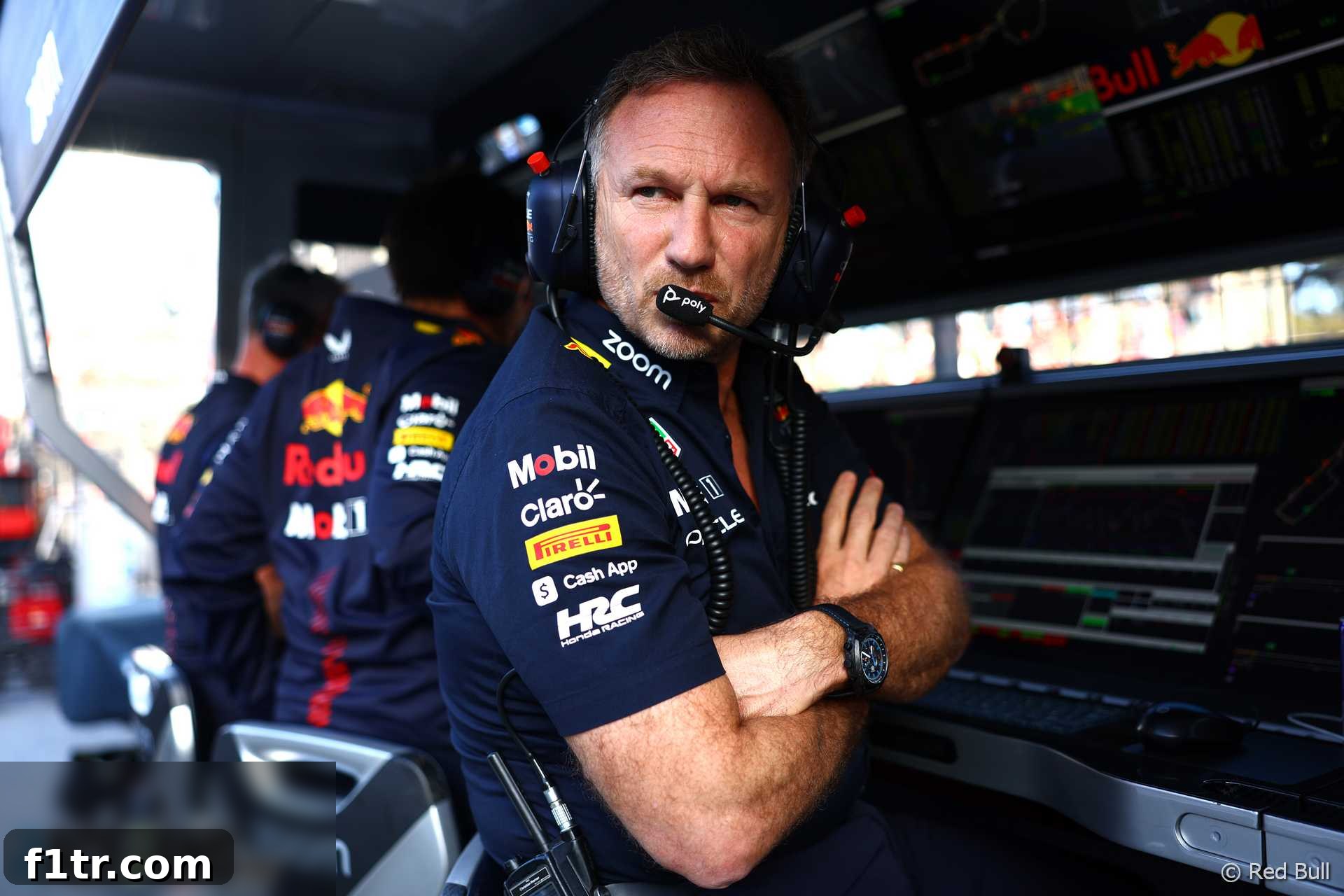
Red Bull Racing stands at a pivotal juncture, fresh off a dominant start to the Formula 1 season. Team Principal Christian Horner has underscored the critical need for the reigning constructors’ champions to relentlessly extend their current points lead. This proactive strategy is imperative, he emphasizes, before the full impact of their significantly reduced aerodynamic testing allocation begins to reshape the competitive landscape.
Advert | Become a Supporter & go ad-free
As per Formula 1’s performance-balancing aerodynamic testing regulations (ATR), the current world champions are inherently granted the least amount of wind tunnel and Computational Fluid Dynamics (CFD) development time among all teams. This disadvantage was further compounded last year by a substantial penalty: Red Bull was found to have breached F1’s stringent budget cap during the intensely competitive 2021 season. Initially, Red Bull was limited to 70% of the reference total for wind tunnel runs and CFD simulations. The budget cap infraction, however, saw this allocation dramatically cut further to a mere 63%, presenting a unique and significant challenge to their ongoing development efforts.
Despite these restrictive conditions, Red Bull has launched its 2023 campaign with remarkable strength and consistency. Both Max Verstappen and Sergio Perez have secured two Grand Prix victories each, propelling the team to a commanding position in the constructors’ championship. They currently hold more than double the points of their closest rival, a testament to their exceptional engineering and strategic prowess in the early stages of the season. This early success provides a crucial, albeit temporary, buffer against future challenges.
Seizing the Moment: Building an Indispensable Buffer
Christian Horner articulated the team’s immediate focus: “At the moment it’s the two of them, there’s a slight gap between the rest of the field, but there’s 19 more races to go and five sprint races.” This statement highlights the long and arduous nature of the F1 calendar, emphasizing that early leads, while valuable, are by no means guarantees of eventual victory. Horner stressed the importance of fortifying this advantage before competitors like Aston Martin, Mercedes, and Ferrari inevitably bring significant upgrades to their cars and begin to close the performance gap.
The team principal’s strategy is clear: “So there’s a huge amount of racing, there’s a whole variance of different circuits to go through, so it could ebb and flow between the two of them – reliability will be a big factor. And of course what we’re more focused on as well at the moment is building a buffer with both of the drivers because when we get back to Europe, I’m sure there’s going to be sizeable upgrades, and of course we have a reduced capacity to develop. So that’s where our focus is trying to build a gap.” This forward-thinking approach acknowledges the cyclical nature of F1 development and the anticipated surge in rival performance as the season progresses, particularly once the European leg of the calendar begins.
The Real-World Impact of Reduced Aerodynamic Testing
The penalty imposed on Red Bull translates directly into a tangible disadvantage in their ability to refine and develop their car. While Ferrari is permitted 240 wind tunnel runs, Mercedes 256, and Aston Martin a generous 320, Red Bull is restricted to just 201 runs. This stark difference underscores the strategic challenge. Wind tunnel testing and CFD simulations are the lifeblood of modern Formula 1 car development, allowing teams to meticulously analyze and optimize every aerodynamic surface. Each run provides invaluable data, informing design changes and performance enhancements.
“We have just a limited amount of runs, so you have to be selective,” Horner explained, highlighting the forced precision required from his technical team. “You can’t run so many iterations. You’ve got to focus on the things that we really want to look at. So it’s being a lot more selective in what you’re able to research.” This means Red Bull cannot afford the luxury of extensive experimentation or exploring numerous conceptual pathways. Their development process must be incredibly efficient, targeted, and right the first time, placing immense pressure on their engineers to prioritize effectively and avoid costly mistakes in their limited testing windows.
Navigating the Competitive F1 Landscape
The current Formula 1 season is shaping up to be a fascinating battle of engineering ingenuity, strategic foresight, and driver skill. While Red Bull enjoys a significant performance lead, the chasing pack is relentless. Aston Martin has shown remarkable improvement, challenging the established front-runners with impressive pace and consistency. Mercedes and Ferrari, perennial contenders, are undoubtedly working tirelessly behind the scenes to unlock further performance from their packages. Both teams possess formidable resources and a proven track record of developing their cars throughout a season.
The anticipation of “sizable upgrades” from these rivals is a well-founded concern. As the season progresses, particularly after the initial flyaway races and the return to Europe, teams typically introduce comprehensive upgrade packages targeting various aspects of car performance, from floor designs to wing elements and brake ducts. For Red Bull, with their constrained development capacity, matching the sheer volume of upgrades from their competitors will be a monumental task. This makes their early season points haul not just a bonus, but an essential defensive shield against the inevitable performance convergence.
*Due to their penalty for exceeding the budget cap in 2021, Red Bull’s allocation this year is reduced from 70% to 63%
The Art of Selective Development
In an environment of limited resources, Red Bull’s technical team, led by Adrian Newey, faces the ultimate test of efficiency. Their approach to aerodynamic development must shift from broad exploration to laser-focused optimization. This means identifying the most impactful areas for improvement, rigorously simulating them with CFD, and then validating only the most promising concepts in the wind tunnel. Each wind tunnel run becomes a precious commodity, demanding maximum data extraction and precise interpretation. The margin for error is razor-thin.
This selective strategy carries inherent risks. While it forces a disciplined approach, it also means Red Bull might miss out on unexpected performance gains discovered through more extensive, exploratory testing. It requires an exceptional understanding of the car’s underlying aerodynamics and the ability to predict future performance trends with high accuracy. The team’s ability to maintain its competitive edge will hinge on its capacity to make every single one of its allocated wind tunnel runs count towards tangible, performance-enhancing improvements.
Advert | Become a RaceFans supporter andgo ad-free
Long Season, Varied Circuits: Beyond Pure Development
Beyond the aerodynamic development battle, the sheer length and diversity of the Formula 1 calendar introduce further variables. Nineteen remaining races and five sprint races mean a wide array of circuit characteristics, from high-speed power tracks to technical street circuits and high-downforce layouts. A car that excels on one type of track might struggle on another, leading to an “ebb and flow” in performance throughout the season.
Reliability, as Horner rightly pointed out, will also be a major determinant. Mechanical failures, crashes, or unforeseen issues can quickly erode a points lead, irrespective of a car’s outright pace. Red Bull’s early focus on building a substantial points buffer is therefore a multifaceted strategy, designed to mitigate not only the impact of their development handicap but also the inherent unpredictability of a grueling championship season. The performance of both Max Verstappen and Sergio Perez will be crucial, as every point from both drivers contributes to the constructors’ standings and bolsters the team’s overall position.
Conclusion: A Defining Season for Red Bull
The 2023 Formula 1 season is shaping up to be a defining one for Red Bull Racing. Their dominant start is a powerful statement of intent and a testament to their engineering prowess. However, the shadow of their budget cap penalty and the resulting aerodynamic testing restrictions loom large. Christian Horner’s clear directive to capitalize on their current advantage and build an unassailable points buffer reflects a deep understanding of the strategic challenges ahead.
Red Bull’s success will not only depend on their ability to out-develop their rivals with limited resources but also on their strategic adaptability, impeccable reliability, and the continued brilliance of their drivers. As the season unfolds and the European leg approaches, the true test of their selective development strategy will come to light. The battle for the championships will undoubtedly be a captivating spectacle, showcasing whether Red Bull can truly turn their early season momentum into an enduring legacy, even with one hand tied behind their back.
Bringing the F1 news from the source
RaceFans strives to bring its readers news directly from the key players in Formula 1. We are able to do this thanks in part to the generous backing of our RaceFans Supporters.
By contributing £1 per month or £12 per year (or the equivalent in other currencies) you can help cover the costs involved in producing original journalism: Travelling, writing, creating, hosting, contacting and developing.
We have been proudly supported by our readers for over 10 years. If you enjoy our independent coverage, please consider becoming a RaceFans Supporter today. As a bonus, all our Supporters can also browse the site ad-free. Sign up or find out more via the links below:
- Become a RaceFans Supporter
- RaceFans Supporter FAQ
2023 Miami Grand Prix
- Verstappen picks Miami Grand Prix as his best drive of 2023 so far
- Albon “maximised most races this year” despite single point scored to date
- A sign the upgrades worked? Ferrari see an upside to Leclerc’s Miami crashes
- Red Bull ‘surprised other teams under-delivered’ with their 2023 cars
- F1’s driver intros are right for US market but wouldn’t work at Silverstone – Horner
Browse all 2023 Miami Grand Prix articles