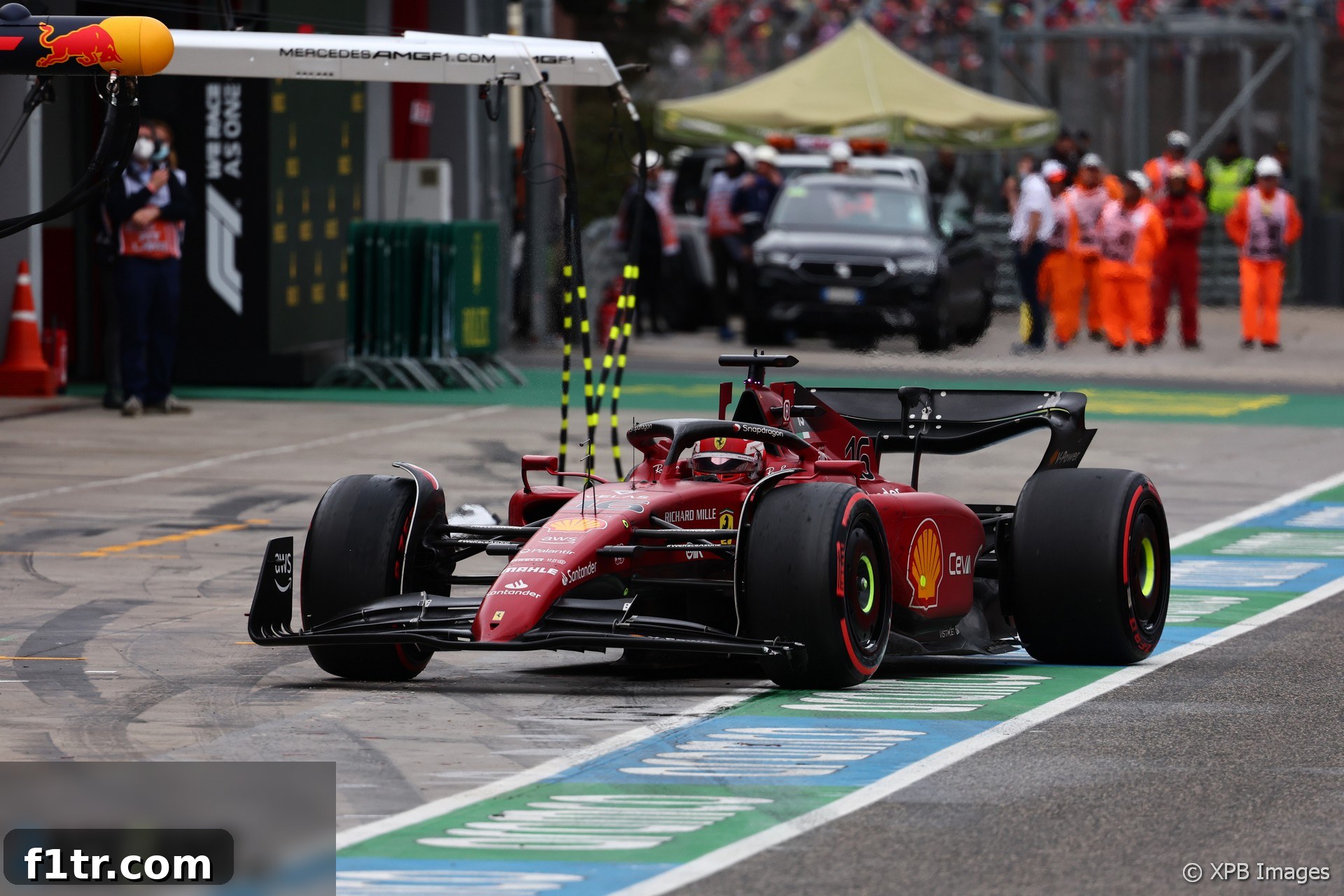
Leclerc’s Costly Imola Spin: Horner Details the Miscalculation That Propelled Red Bull to Victory
The 2022 Formula 1 season delivered early drama and pivotal moments, none more stark than the Emilia-Romagna Grand Prix. Amidst the high-stakes battle at Ferrari’s home circuit in Imola, Scuderia driver Charles Leclerc suffered a critical spin while aggressively pursuing Red Bull’s Sergio Perez for second place. This error proved immensely costly for Ferrari and provided a significant boost for their championship rivals, Red Bull Racing.
According to Red Bull Team Principal Christian Horner, Leclerc’s attempt to pass Perez was marked by excessive risk, culminating in an unfortunate incident that reshaped the race’s outcome. The Monegasque driver, determined to secure a higher podium finish, pushed the limits perhaps a step too far, ultimately paying a hefty price.
The Critical Moment: Leclerc’s High-Stakes Overtake Attempt
The incident unfolded at the Variante Alta chicane, a challenging section of the Imola circuit known for its unforgiving nature. Leclerc, who had been running in a strong third position, was locked in a fierce duel with Perez. With the championship momentum finely balanced between Ferrari and Red Bull, every position counted, and Leclerc was clearly aiming to improve on his P3 standing.
As he chased Perez, Leclerc made his move, pushing his Ferrari F1-75 to its absolute limit. However, a slight misjudgment saw him clip the kerb too hard, sending his car into an uncontrolled spin and subsequently into the barrier. While he managed to recover and continue the race, the damage was done. Having been poised for a podium finish, Leclerc ultimately crossed the finish line in sixth place, salvaging a handful of points but losing valuable ground to his rivals.
Christian Horner’s Insight: “Too Greedy on That Soft Tyre”
Christian Horner offered a candid assessment of the incident, pinpointing the factors that contributed to Leclerc’s mistake. Horner observed Leclerc’s aggressive driving throughout the race, particularly highlighting his pace at a specific part of the track. “He was pushing very hard all race, you could see at the top of the hill,” Horner commented. “I think turn 14, at the chicane, that was the one part of the track that he was consistently quicker than Checo and it just looked like he got a little bit too greedy on that soft tyre.”
Horner’s remarks underscore the delicate balance between aggression and control in Formula 1. On soft compound tyres, grip levels can deteriorate rapidly, especially when a driver is consistently pushing the car to its limits. Overdriving or seeking that extra fraction of a second can often lead to a loss of traction, particularly in high-speed sections or over kerbs. Leclerc’s “greed” on the soft tyre, as Horner described it, suggests an attempt to extract more performance than the tyre could deliver safely, especially under the intense pressure of a direct battle for position.
Despite the severity of the spin, Leclerc’s ability to continue the race and secure six championship points was noted by Horner as a stroke of luck. “But mistakes can happen and he was actually lucky to finish the race and obviously still get six place points. It was a bonus for us that obviously we were able to take a few more points off them with him not finishing on the podium.” This outcome not only cost Ferrari potential podium points but also allowed Red Bull to significantly extend their advantage in both the Drivers’ and Constructors’ Championships at a crucial stage of the season.
The DRS Factor and Track Changes
Adding another layer to Leclerc’s miscalculation was a pre-race adjustment to the Drag Reduction System (DRS) activation point. The DRS zone was moved closer to the very chicane where Leclerc spun, a modification that subtly altered racing dynamics. Horner believes this change played a role in Leclerc’s error, suggesting the Ferrari driver was acutely focused on maximizing his chances of utilizing DRS.
DRS, designed to aid overtaking, allows drivers to open a flap on their rear wing, reducing drag and increasing top speed on designated straight sections of the track. To activate DRS, a driver must be within one second of the car ahead at a specific detection point. “To do that, you needed to be really quick over that chicane to get into the DRS detection zone before the last couple of corners,” Horner explained. “So that was obviously what he was trying to try to get within.” Leclerc’s aggressive line and speed through the chicane were likely an attempt to position himself perfectly for the DRS detection zone, which would have granted him a significant advantage over Perez on the subsequent straight. In his eagerness, he seemingly pushed beyond the car’s limits, leading to the fateful contact with the kerb and loss of control.
Red Bull’s Resurgence: A Perfect Weekend for the Bulls
While Leclerc’s spin marked a moment of misfortune for Ferrari, it underscored a triumphant weekend for Red Bull Racing. The incident effectively removed the last significant threat to a dominant one-two finish for the Milton Keynes-based squad. Max Verstappen led the charge, securing a Grand Slam (pole position, win, fastest lap, leading every lap), with Sergio Perez holding off the recovering Leclerc to seal second place.
For Red Bull, this performance was more than just a race win; it was a perfect recovery following the disappointment of the previous race in Australia, where Verstappen was forced to retire while running in second. “It’s fantastic,” Horner exclaimed. “It’s one point off a maximum score over the whole weekend. A one-three yesterday, one-two today, fastest lap, it was just the rebound that we needed after the disappointment of Australia a couple of weeks ago.”
The team’s success at Imola was not merely down to Leclerc’s mistake but a testament to Red Bull’s strategic prowess and flawless execution. Horner lauded the collective effort: “It was a phenomenal team performance because we took a bit of a risk going into the weekend with a couple of small parts we introduced the car, which is always tricky when you’ve only got one session. But we attacked the weekend from the word go.” Introducing new components with limited practice time (due to the sprint race format) is a high-risk strategy, yet Red Bull’s engineering and pit crew executed it flawlessly, demonstrating their confidence and capability.
Horner also gave immense credit to his drivers, Verstappen and Perez, whose performances were instrumental in securing the team’s dominant finish. “Both drivers have been unbelievable. Both Max and Checo have driven brilliantly this weekend. That one-two finish all credit to the team, brilliant pit stop strategy today, but also back in back in the factory in Milton Keynes.” The synergy between driver skill, strategic calls, and the tireless work of hundreds of individuals at the factory culminated in one of Red Bull’s most memorable performances. “The hard effort and work and obviously picking ourselves up after the disappointment of Australia to come back with a result like that here in Imola was one of our best ever results.” This victory not only solidified their position in the championship but also sent a strong message to their competitors about Red Bull’s resilience and championship aspirations.
Championship Implications and Future Outlook
Leclerc’s spin at Imola had significant ramifications for the 2022 Formula 1 World Championship. While he retained the lead in the Drivers’ Championship, his advantage over Verstappen was considerably narrowed. Red Bull’s dominant one-two finish allowed them to close the gap significantly on Ferrari in the Constructors’ Championship, turning the early season into a thrilling two-horse race. The psychological impact on both teams was palpable; Red Bull gained immense confidence, while Ferrari was left to reflect on a missed opportunity at their home race.
The Emilia-Romagna Grand Prix served as a stark reminder of the razor-thin margins in Formula 1, where a single mistake can alter the course of a race and potentially a championship. It highlighted the relentless pressure on drivers to extract every ounce of performance, often blurring the line between heroic driving and costly errors. As the season progressed, the lessons learned at Imola undoubtedly shaped the strategies and approaches of both Ferrari and Red Bull.
Ultimately, Christian Horner’s analysis of Charles Leclerc’s Imola spin provides a fascinating glimpse into the high-octane world of F1, where calculated risks, strategic decisions, and driver intuition converge to produce unforgettable moments of triumph and despair. Red Bull’s ability to capitalize on Ferrari’s misfortune underscored their championship mettle and set the stage for an epic battle throughout the 2022 season.
2022 Emilia-Romagna Grand Prix Related Content
- Aston Martin’s first points reward “immense” effort by factory after Melbourne crashes
- Verstappen becomes 14th driver in F1 history to score more than one ‘grand slam’
- Transcript: “I need more power” – Hamilton and Russell’s contrasting fortunes at Imola
- Ferrari backs increase to six sprint races as F1 Commission meets in London
- Ocon blames pit equipment after penalty for near-miss with Hamilton in pits
Browse all 2022 Emilia-Romagna Grand Prix articles