Christian Horner Defends Sergio Perez After Challenging Imola Performance: A Look at Red Bull’s New Driver’s Adaptation
Red Bull Racing Team Principal Christian Horner has publicly defended new recruit Sergio Perez following a tumultuous second race for the Mexican driver at the Emilia-Romagna Grand Prix in Imola. Despite a promising qualifying session, Perez encountered a series of costly errors during the race, ultimately finishing outside the points in 12th place. Horner’s comments underscore the team’s patience and belief in Perez’s potential, attributing his struggles to the natural adaptation period required to master the challenging Red Bull-Honda RB16B car.
Perez’s Promising Start and Subsequent Race Day Struggles at Imola
The weekend at Imola began on a high note for Sergio Perez, who showcased his undeniable talent by qualifying in a career-best second position, remarkably ahead of his highly-regarded teammate, Max Verstappen. This stellar Saturday performance fueled optimism within the Red Bull camp and among fans, suggesting Perez was quickly coming to grips with his new machinery and ready to challenge at the front. However, Sunday’s race painted a different picture, becoming a stark reminder of the steep learning curve involved in joining a top-tier Formula 1 team.
The drama began almost immediately after the lights went out. Perez, starting from the front row, was swiftly overtaken by Verstappen, who then went on to deliver a dominant performance, securing a commanding victory. While Verstappen was cruising to victory, Perez’s race unravelled with a series of unfortunate incidents. A first-lap error saw him lose a crucial position to Charles Leclerc, signaling the start of his difficulties.
The Safety Car Incident and Penalty
Perhaps the most impactful moment of Perez’s race came during an early Safety Car period. While circulating behind the Safety Car, he made a crucial error, sliding off-track and losing several positions. In an attempt to regain these lost places, Perez then overtook the cars that had passed him. This action, however, directly contravenes Formula 1 regulations, which strictly require drivers to hold their position behind the Safety Car. As a direct consequence of this transgression, the stewards handed Perez a 10-second time penalty, a severe blow to his already faltering race.
This penalty had to be served during his pit stop, adding further pressure and compromising his track position. The incident highlighted the intense focus and discipline required in every aspect of a Grand Prix, where even minor misjudgments can lead to significant penalties and derail a promising performance.
Further Setbacks and Unsuccessful Recovery Attempts
The string of misfortunes for Perez did not end with the Safety Car penalty. After serving his penalty, he suffered another setback, spinning at the treacherous Villeneuve chicane. This error dropped him out of the vital top-10 points-paying positions, further dimming his hopes of salvaging a respectable result. Despite his best efforts to claw his way back into contention, the damage was done.
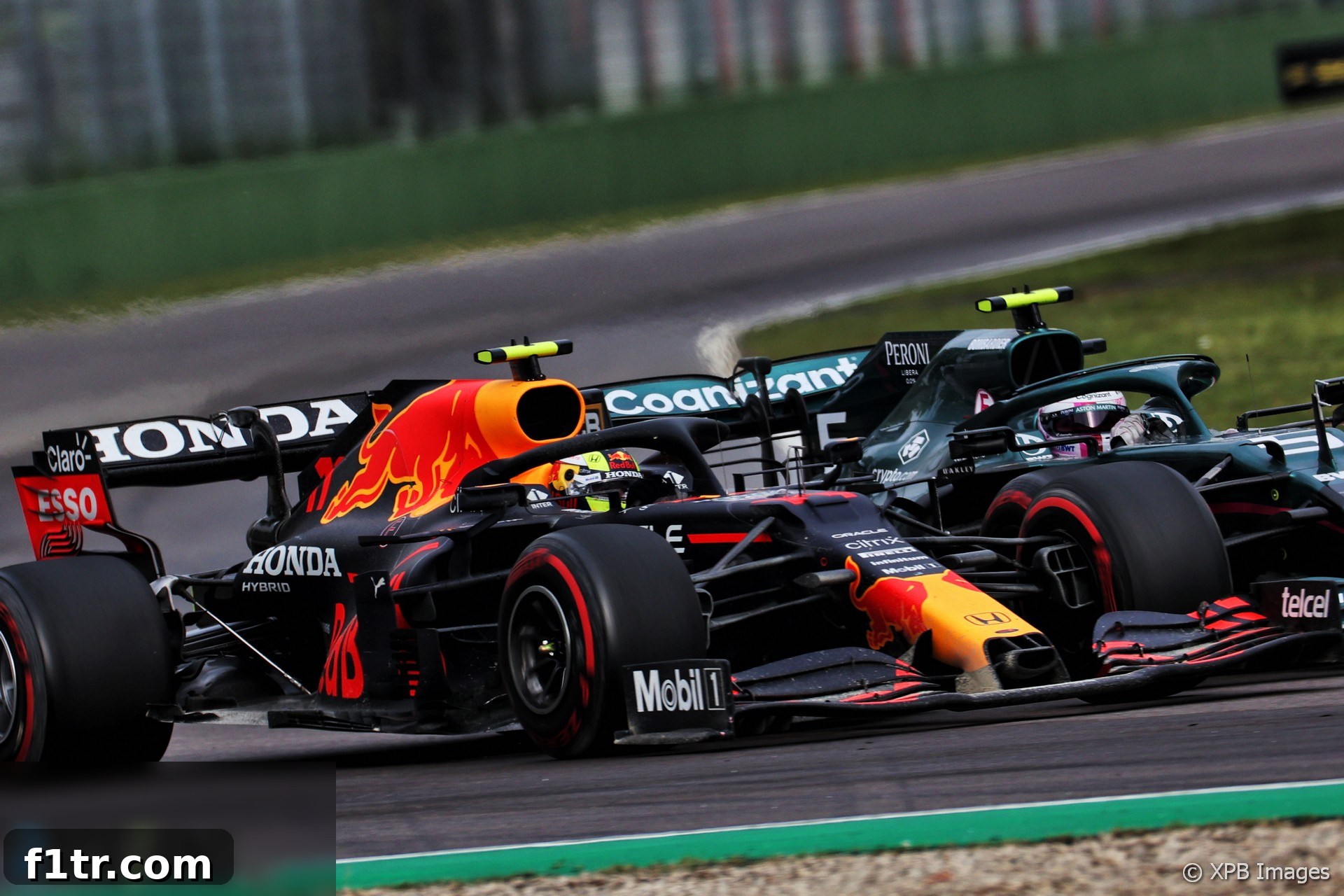
Later in the race, while attempting to overtake Sebastian Vettel, Perez ran wide again after bouncing aggressively over the kerbs at Tamburello. This repeated unforced error underscored his ongoing struggle to find the limits of the Red Bull car and consistently extract its performance. Ultimately, he crossed the finish line in 12th place, over a minute behind his victorious teammate, Max Verstappen. It was a stark contrast that vividly illustrated the gap Perez needed to bridge.
Christian Horner’s Perspective: Patience and Confidence in Perez
Despite the catalogue of errors and the disappointing outcome, Christian Horner refused to cast blame on Perez. Instead, the Red Bull Team Principal offered a reassuring perspective, emphasizing the time and experience needed for any driver to fully integrate with a new team and car, especially one as unique and demanding as the Red Bull-Honda RB16B.
“I think that it’s just time in the seat,” Horner stated, highlighting the critical importance of mileage and consistent practice in adapting to the nuances of a high-performance Formula 1 machine. He acknowledged Perez’s strong qualifying performance as a testament to his underlying speed and potential, suggesting that the raw talent is undeniably present.
Horner candidly described Perez’s Sunday as a “messier race for him,” referencing the early Safety Car mistake, the subsequent 10-second penalty, and the spin behind the Ferraris. He openly admitted the frustration of not having Perez finish higher, particularly given the car’s inherent pace. “It’s frustrating not to have him up there, but he’s certainly finding his pace, finding his feet, and I’m sure he’s going to have much stronger weekends ahead,” Horner confidently predicted. This vote of confidence from the team principal is crucial for Perez, providing mental fortitude as he navigates the demanding early stages of his Red Bull tenure.
Horner’s stance is typical of a team principal who understands the complexities of F1 adaptation. Red Bull, known for its demanding environment, also recognizes that even experienced drivers need time to gel. The RB16B is famously tailored to Max Verstappen’s aggressive driving style, making it a challenging beast for any new driver to tame. Horner’s words suggest that the team is prepared to offer Perez the necessary support and patience to unlock his full potential.
Sergio Perez’s Adaptation Challenge: “Miles Away” From Comfort
Sergio Perez himself has been transparent about the significant challenge of adapting to the Red Bull-Honda RB16B. He openly admitted to being “miles away” from where he wants to be with the car. This candid assessment reveals the profound difference in handling characteristics compared to the Force India and Racing Point machines he drove for the past seven seasons in Formula 1.
Perez has frequently described the Red Bull’s handling as “unnatural” to him. This is a common hurdle for drivers switching teams, especially when moving to a car with a distinctly different aerodynamic philosophy and chassis setup. The Red Bull cars, particularly those designed under Adrian Newey, are known for their strong front end but often require a very specific driving style to maximize their performance, sometimes described as ‘pointy’ or ‘on the nose’. This contrasts sharply with the more stable rear-end bias of many other F1 cars, which might have suited Perez’s previous driving approach.
Adapting to such fundamental differences goes beyond mere practice; it requires re-calibrating muscle memory, understanding how the car reacts at the limit, and trusting its behavior under various conditions. This process is both physically and mentally taxing. It involves countless hours in the simulator, debriefs with engineers, and crucially, extensive track time to build confidence and extract the optimum performance from the car.
The stakes are particularly high for Perez. Joining Red Bull means stepping into a car capable of winning races and challenging for championships. The pressure to perform immediately and consistently alongside a driver of Verstappen’s caliber is immense. His ability to adapt quickly and effectively will be crucial not only for his personal success but also for Red Bull’s aspirations in the Constructors’ Championship, where having two strong, consistent points scorers is paramount against rivals like Mercedes.
Looking Ahead: The Road to Consistency for Perez and Red Bull
While the Emilia-Romagna Grand Prix was undoubtedly a difficult weekend for Sergio Perez, it provides valuable lessons for both the driver and the Red Bull Racing team. The team’s unwavering support, as articulated by Christian Horner, is a positive sign, indicating that they understand the complexity of the task at hand and are committed to helping Perez succeed.
For Perez, the focus will now shift to relentless analysis and continued refinement of his driving style to better suit the RB16B. Every lap in the car, every debrief with his engineers, and every simulator session will be critical in closing the gap to Max Verstappen and achieving the consistency expected of a Red Bull driver. His experience and race craft, honed over years in F1, suggest he has the capability to overcome this adaptation period. The challenge lies in how quickly he can make the Red Bull car feel like a natural extension of himself.
The coming races will be a crucial test of Perez’s progress. As the Formula 1 season progresses, the need for both Red Bull drivers to consistently score strong points will intensify, especially in their championship battle against Mercedes. A strong, reliable second driver is an essential asset in securing a Constructors’ title, and Perez’s ability to find his rhythm will significantly impact Red Bull’s overall championship prospects. The team and its fans will be eagerly watching for his “stronger weekends ahead,” as promised by Horner, hoping that the difficult Imola race was merely a necessary stumble on the path to sustained success.
Related Articles: 2021 Emilia-Romagna Grand Prix Insights
- Poor Imola pace was “100% tyres”, says Bottas
- Bottas says Imola crash is “history” after reading Russell’s apology
- ‘Lewis and Valtteri are team mates to me as Nicholas is’ says Russell after ‘private’ Wolff talks
- ‘Hamilton didn’t break the rules by reversing’ shouldn’t be a story
- 2021 Emilia-Romagna Grand Prix Star Performers
Browse all 2021 Emilia-Romagna Grand Prix articles