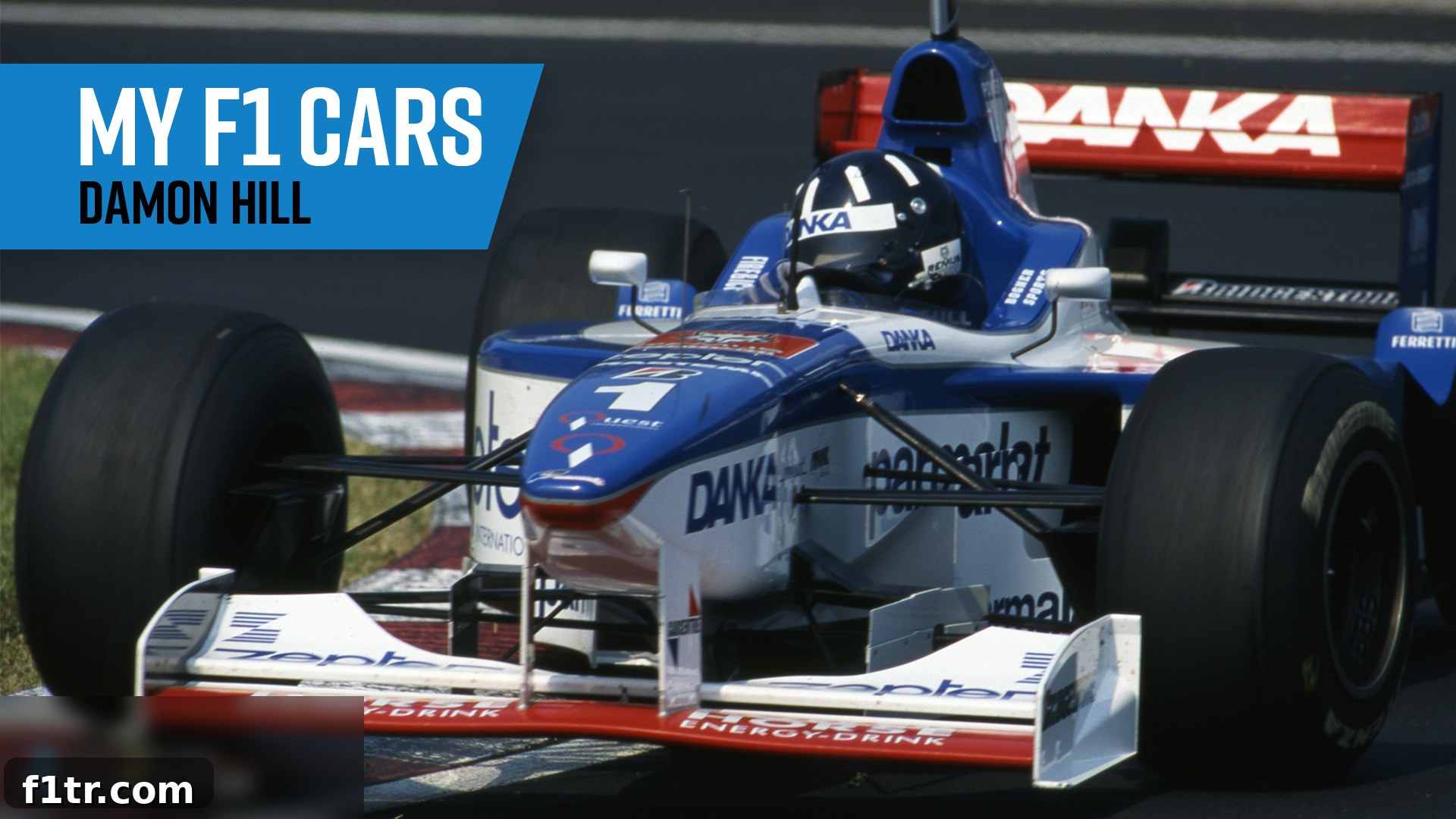
Damon Hill’s journey into the elite world of Formula 1 was anything but conventional. As the son of a two-time world champion, Graham Hill, he bore a name synonymous with racing greatness, yet his path was distinctly his own, marked by early adversity, unwavering determination, and a unique perspective forged through years of relentless effort. Before ever stepping into a contemporary F1 machine, Hill had the rare privilege of piloting his legendary father’s historic Formula 1 cars, an experience that undoubtedly shaped his understanding and appreciation for the sport’s rich heritage.
An Unconventional Path to Formula 1
The tragic death of Graham Hill in an aircraft accident in 1975, shortly after his retirement from F1, left a profound void and challenging circumstances for his then 15-year-old son, Damon. Despite the immense legacy, the family found itself in financially constrained situations. Damon’s early career saw him work as a building labourer and a motorcycle courier, using the income from his construction job to fund club racing events. His initial competitive forays were on two wheels, primarily at Brands Hatch, where he raced the very machine he used for dispatch duties. However, his mother, Bette, harbored concerns about the safety of motorcycle racing. In a pivotal moment, she encouraged him towards cars, sending him to the Winfield Racing School in France in 1983, a decision that would ultimately set him on his destined course.
Hill’s progression through the junior racing ranks, including Formula Ford, Formula 3, and Formula 3000, was steady but not without its challenges. While he proved an occasional winner in the first two categories, Formula 3000 presented a tougher nut to crack. By this point, Damon was in his thirties, a husband and father with a mortgage, adding further pressure to his racing ambitions. Yet, his raw talent shone through, evidenced by occasional pole positions and podium finishes. Crucially, these performances were enough to capture the attention of key figures in F1, including Peter Collins, then the Benetton team boss, and more significantly, Sir Frank Williams, whose team would eventually become the stage for Hill’s greatest triumphs.
First Glimpse of Grand Prix Power: The Benetton and Williams Tests
Damon Hill’s inaugural experience with Formula 1 machinery came courtesy of Benetton at the iconic Paul Ricard circuit. He was invited to test a turbocharged Benetton B187-Ford, its power strategically trimmed to naturally aspirated levels for comparison testing after the turbo era had officially concluded. Even with reduced power, the experience left an indelible mark. Hill vividly recalls the “mind-blowing power and acceleration,” despite the car having “only” 650bhp compared to the fearsome 1,000bhp available in full qualifying trim during the turbo heyday.
“On the back straight, the Mistral, it went like a rocket,” Hill recounts. “Then at the end of the straight, it’s got all this downforce you can’t believe it, and you just nail it through there. You’re sitting almost on the front wheels, in the corner of your eye you see these huge tyres, and in the mirrors, a long way back these big rear tyres. [The car] seemed to rotate around the front axis. It was all just berserk, really, the best way to describe it.” This early exposure to the pinnacle of motorsport affirmed his passion and capabilities.
In 1991, an opportunity arose with Williams, offering him crucial test duties. He initially worked with the Renault-powered FW13, which was rigged with a manual gearbox. This role soon evolved, and he became instrumental in developing the semi-automatic transmission for the FW14, the first Williams car designed by the legendary Adrian Newey. Hill’s involvement extended further to the development of the active suspension system for the FW14B, the car that would go on to be an all-conquering successor, showcasing his technical acumen and ability to provide valuable feedback to engineers.
Brabham’s Last Gasp: A Challenging F1 Debut
Before cementing his place at Williams, Hill received an unexpected opportunity to make his Formula 1 race debut with the struggling Brabham team. Once a dominant force in F1, Brabham had fallen on hard times by 1992, limping into the season with a reworked version of their previous chassis, powered by customer Judd engines after losing Yamaha’s backing. The team’s fortunes were dire, and their cars were far from competitive.
The original choice for Eric van de Poele’s teammate, Akihiko Nakaya, was denied a superlicence. Italian driver Giovanna Amati stepped in but failed to qualify for the first three races, and her promised sponsorship never materialized. This opened the door for Hill. He had previous ties with Middlebridge, who owned Brabham, having driven for them in F3000 in 1990. “I had watched Mark Blundell and Martin Brundle at Brabham in 1991, then a seat opened up because Giovanna Amati’s money never came,” Hill explains, detailing his somewhat fortuitous entry.
Hill openly described the Brabham BT60B as “a completely rubbish car and at the back of the grid.” However, for him, the experience was invaluable. “I wanted to know what it’s like to be in a grand prix,” he states. “I needed to get the experience because everyone could see what times I was doing in the active Williams, but it wasn’t registering because I wasn’t actually competing. So, they gave me a go.”
His debut was fraught with challenges. At Monaco, the cramped cockpit design meant he couldn’t fully shift gears, leaving him with only four available ratios. “I went around hairpin in about third I think,” he recalls, highlighting the absurdity of the situation. Despite the car’s woeful performance, Hill managed to qualify for the 1992 British Grand Prix, his home race. He lined up 26th out of 26 cars, an astonishing 7.4 seconds slower than Nigel Mansell in the dominant Williams-Renault FW14B. Yet, he persevered, finishing 16th, a testament to his grit and determination. This performance, though overshadowed by Mansell’s dominant win, was a quiet triumph for Hill.
Hill credits Tim Densham, the team’s chief designer who also doubled as his race engineer, for getting the car into its “sweet spot” at Silverstone and later at the Hungaroring. At the Hungarian Grand Prix, Hill once again put his Brabham on the grid and finished 11th in what proved to be the once-great team’s final race. “Then they ran out of money and it folded,” Hill summarises. “It was probably quite dangerous, because I think they were running old bits. It was a bit wild, really, but we didn’t know any different.” This brief, challenging stint at Brabham provided Hill with invaluable race experience, proving his worth despite the uncompetitive machinery.
The Pinnacle of Technology: Williams FW15C and Breakthrough Wins
In a dramatic turn of events for the 1993 season, reigning champion Nigel Mansell left Williams for IndyCar, opening a coveted seat alongside the returning four-time world champion, Alain Prost. In December 1992, Damon Hill was announced as Prost’s teammate, signaling a monumental leap in his career. He would be driving the all-new FW15C, a car that would redefine technological sophistication in Formula 1.
Hill had actually shaken down an earlier version of the car before the end of the 1992 season, but the Williams team was so dominant with the FW14B that they saw no immediate need to introduce the FW15C. When it finally debuted, the FW15C was arguably the most technologically advanced F1 car ever built. It incorporated fully active suspension, traction control, and anti-lock braking systems, giving Williams an unprecedented advantage. Hill vividly describes the car as “awesome, and a lot of fun.”
“It had unfeasibly low ride heights controlled by a hydraulic platform that could gauge precisely how far the floor was from the ground, within a millimetre or so,” Hill explains, detailing its revolutionary design. “You could generate downforce, it could change attitudes fore and aft, side to side. You could play with it in all sorts of directions. We developed traction control in that car. By the end, we had power brakes with a pressure transducer on the pedal instead of the pedal being hydraulic. It converted pressure into a signal that then braked the car for you, so you had anti-lock brakes. It was just mind-blowing to drive.”
After a couple of setbacks and near-misses, Hill clinched his first Grand Prix victory in Hungary, followed by two more consecutive wins in Belgium and Italy. This incredible run cemented his status as a top-tier driver. However, the astonishing pace of technological advancement, particularly in driver aids, prompted the FIA to intervene. Fearing that technology was overshadowing driver skill, the governing body banned a swathe of these technologies for the 1994 season. Hill, having experienced the pinnacle of F1 engineering, took the FW15C for one last blast at Estoril before the “simpler cars” era arrived.
The Challenging Year (1994): Senna’s Legacy and Schumacher Rivalry
The 1994 season brought dramatic changes, both regulatory and emotional. Damon Hill found himself with a new, legendary teammate, Ayrton Senna, and a formidable new rival in Michael Schumacher, driving for Benetton. The mechanically suspended FW16, designed to comply with the new regulations, proved troublesome from the outset. It was a stark contrast to the sophisticated FW15C, initially a handful to drive.
The season opener in Brazil saw Hill finish second, but a lap down on Schumacher, while Senna, uncharacteristically, spun out of the race. “That [car] was such a rough ride and Ayrton spun off, which I think gives an indication of how difficult it was,” Hill explains. “He was totally exhausted and couldn’t hang on. It was like a bucking bronco, quite difficult to drive so we had to work on it.” The motorsport world was then plunged into mourning with the shocking death of Ayrton Senna at Imola, an event that profoundly impacted the sport and the Williams team. Following further hasty revisions to the regulations, Williams introduced a ‘B’ version of the FW16 with heavily revised aerodynamics to improve its stability and safety.
“Obviously we started to sort it, but we had lost Ayrton by then and it was all a bit of an unpleasant season,” Hill reflects. “After Imola there were a lot of changes to the aero, so they basically cut off all the bits.” Despite the immense pressure and the tragic circumstances, Hill shouldered the responsibility of leading Williams, scoring six victories, including what many consider his greatest win – a masterclass in challenging conditions at Suzuka. He entered the final round in Adelaide just one point behind Michael Schumacher. The championship culminated in one of F1’s most infamous moments when Schumacher, after hitting a wall, controversially collided with Hill, forcing both out of the race and securing Schumacher his first title. When asked if he ever discussed the incident with Schumacher, Hill states, “I don’t think he felt he had to, really. I think he just left it there. That’s what he did, and that’s what happened, and that was the result.”
The Continued Pursuit (1995): Battling for Supremacy
The 1995 season brought further regulatory changes from the FIA, demanding additional aerodynamic reductions and a decrease in engine capacity to three litres. In response, Williams designed the FW17 from a clean sheet, adopting a new aerodynamic philosophy. “The philosophy changed slightly after Adrian knew they weren’t going ahead with the big aero [of the past], that they were going to cut the front wings and endplates and all the rest of it, so the shape of the ’94 car was no longer relevant,” Hill elaborates, explaining the shift from the “dolphin nose shape to a higher nose shape, much more sort of pencil looking.”
The FW17 proved to be a strong contender, delivering four victories and five additional podium finishes for Hill. However, it was ultimately insufficient to stop Michael Schumacher, who, with Benetton, had also started using the powerful Renault V10 power units, aligning with Williams on engine supply. Hill recalls the impressive and continuous evolution of these engines: “The basic block was pretty much the same, but they just kept on coming back with 200 revs more, and the power just kept on going up all the time. It was quite fun to develop the Renault engine, and I have to say that during my time at Williams the Renault engine development was very impressive, and it was the class of the field.”
He also cherished his working relationship with Adrian Newey, the design genius behind the Williams cars. “I really respect Adrian, he is a really good driver-engineer who listens to the driver,” Hill affirms. “You could tell he wanted to hear what you have to say, which is really encouraging. He was very good at making me a part of a team. He is very competitive and also has a sense of humour, but he doesn’t like to lose.” This mutual respect and collaboration were key factors in Williams’s sustained success.
World Champion (1996): The Crowning Achievement
The 1996 season saw Damon Hill achieve his ultimate ambition, winning the Formula 1 World Championship. His weapon of choice, and indeed his favorite F1 car, was the Williams FW18. This car, also his final Williams, not only delivered his family’s third world title but was a masterpiece of design and engineering. Another new teammate arrived in the form of IndyCar champion and Indianapolis 500 winner Jacques Villeneuve, who brought a different dynamic to the team. Hill notes, “He went his own way with the set-up because he never liked to be like everyone else, he wanted to be different. He would be different just for the sake of it. Even if it made no sense at all, he’d do it.”
The FW18, Hill asserts, was “a move-on, an evolution from the previous year and it was the best car I ever drove in F1.” Even surpassing the ultra-high-tech FW14B and FW15C, the FW18 stood out. “Better than all of them, it was just light, nimble, responsive, powerful, really well-balanced and it fitted me like a cast because I asked Adrian to ensure I fitted in the car.” With a grin, he adds, “I would say it’s the only car that had size 11 feet.”
The season was a resounding success: eight victories and the coveted World Championship title, with Villeneuve finishing runner-up, 19 points adrift. Yet, even before the championship was settled, Frank Williams made the controversial decision to decline extending Hill’s contract, stating, “I must do what’s best for the team.” This left the newly crowned world champion with limited options for the following season. He had eyed a seat at McLaren for 1998, where Adrian Newey was headed, but that team was full for 1997. Thus, the Williams chapter closed abruptly and somewhat unceremoniously. Hill never even took one of the cars he had driven to glory. “I wasn’t smart enough to keep them,” he admits. “I didn’t really like negotiating with Frank, so I just thought I better not push my luck.”
The Arrows Challenge (1997): A Near Miss and Tyre Wars
Hill’s next destination was a surprising one: Arrows. Tom Walkinshaw offered him a one-year deal for 1997. He would drive the neat, but under-powered, Frank Dernie-designed A17, powered by a Yamaha-badged Judd V10 engine. While renowned designer John Barnard had joined the team, his focus was primarily on the 1998 car, with limited input into Hill’s 1997 challenger. “The engine was really a Judd and they just developed the engine a bit,” Hill recalls, highlighting the modest resources available.
The arrival of Japanese tyre manufacturer Bridgestone as a rival to Goodyear sparked a new tyre war, with Arrows being among their clients. This competitive landscape dramatically impacted performance. “The Bridgestones were really the key to it because you could really use those tyres and they didn’t degrade. They were very durable and forgiving,” Hill explains. This newfound advantage almost led to a sensational victory for Hill and Arrows at the scorching Hungaroring. He led the race for a significant period, only for a hydraulic failure to set in with just over a lap remaining. Villeneuve, his former teammate, capitalized, snatching the win on the final lap and denying Arrows what would have been their only victory in 25 years of trying – a cruel twist of fate for the reigning champion.
The rising cornering speeds attributed to these advanced tyres spooked the FIA. President Max Mosley controversially demanded that slick racing tyres be replaced with narrower grooved versions for 1998. Hill remains scathing about this decision: “Grooved tyres, awful things. Absolutely the worst decision ever made, and it was made by Max Mosley because he said, ‘It’s not beyond the wit of man if you have less rubber on the road the cars will slide. If a wet race is exciting, then we just need to reduce that grip’, which proved he knew nothing about cars.”
Jordan’s Rise and Hill’s Final Chapter (1998-1999)
By the start of the 1998 season, Damon Hill, then 37, already had one eye on retirement. However, an opportunity arose with Eddie Jordan’s team, where he would partner Ralf Schumacher, younger brother of his fierce rival, Michael. “I went to Eddie because basically [McLaren] was off the table,” Hill explains, detailing his thought process: “So I thought, ‘Okay, retirement package two years at Jordan, if I like, I stay.’”
The Jordan 198 had a difficult start to the season, failing to score points in the first half, and technical director Gary Anderson departed. Hill’s recollection is that “the car wasn’t too bad, it was a bit boxy, wasn’t a beauty but it was okay.” He quickly identified a fundamental issue: “Basically, I tried to explain that ‘you’re never going to win anything if you keep copying everyone else.’” With the arrival of Mike Gascoyne as technical director, Hill notes, “then I made progress.” He played a crucial role in developing the Mugen-Honda engine, which improved significantly over the season. His input helped transform the Jordan 198, culminating in a sensational performance at Spa, where he qualified third behind the dominant McLarens.
On race day at Spa, the heavens opened. In chaotic conditions, both McLarens and Michael Schumacher retired in collisions, leaving Hill to lead the Jordan team to its emotional first-ever Grand Prix victory, securing a historic one-two finish with Ralf Schumacher. It was a career highlight for Hill, demonstrating his enduring skill and ability to perform under pressure, even in unexpected circumstances.
The 1999 season brought Heinz-Harald Frentzen, the driver who had taken Hill’s Williams seat, as his new teammate at Jordan. However, Hill was becoming increasingly disillusioned with the sport. “When you’ve been at the front it’s very difficult to be making up numbers and to get the kind of spark you get from being at the front,” he reflected, acknowledging his age at 39. His desire to retire became apparent, even considering making his home British Grand Prix his final race.
His relationship with team owner Eddie Jordan also became strained. “Eddie wanted me to leave before the race. Then he said he wanted me to stay to the end, I think there was another deal going, that he wanted to get another driver because there was some money from somewhere. That’s usually the thing with Eddie,” Hill reveals. The contentious issue of sponsorship payments from Benson and Hedges further complicated matters. “He didn’t like the fact that I was being paid by [sponsor] Benson and Hedges, and basically I wanted to get some comfort that I was going to get paid properly. I think he took exception to that.”
Despite the turmoil, Hill saw out the 1999 season. While Frentzen mounted a surprise bid for the title, the former world champion secured just four points finishes: a fourth place at Imola, a fifth on home soil, and two sixth places. It was a quiet end to a remarkable career.
Legacy and Beyond: An F1 Expert
Today, Damon Hill continues to contribute to the world of Formula 1 as one of Sky’s esteemed F1 experts. Drawing upon his unparalleled experience as a World Champion and winner of 22 Grand Prix races, he provides incisive analysis and a unique driver’s perspective to millions of fans. It is a long way from the early days of thrashing a “clubbie” production motorcycle around Brands Hatch, where he won his only other championship title. Hill’s journey, from humble beginnings and personal tragedy to the pinnacle of motorsport, stands as a testament to his resilience, talent, and enduring passion for racing, cementing his place as a revered figure in Formula 1 history.
Further Insights into Iconic F1 Cars
- Hill on Williams’ dominant cars, Brabham’s last gasp and the “worst decision” F1 ever made
- Herbert on his painful debut, Schumacher’s title-winning Benettons and more
- ‘Aston Martin still use my steering wheel design’ – Liuzzi on his F1 career in cars
- Villeneuve on Williams’ last title-winner, BMW grief and Alonso’s ‘un-driveable’ Renault
- Coulthard on the CVT Williams, McLaren’s little-known tricks and Newey’s first Red Bulls
Browse all My F1 Cars articles