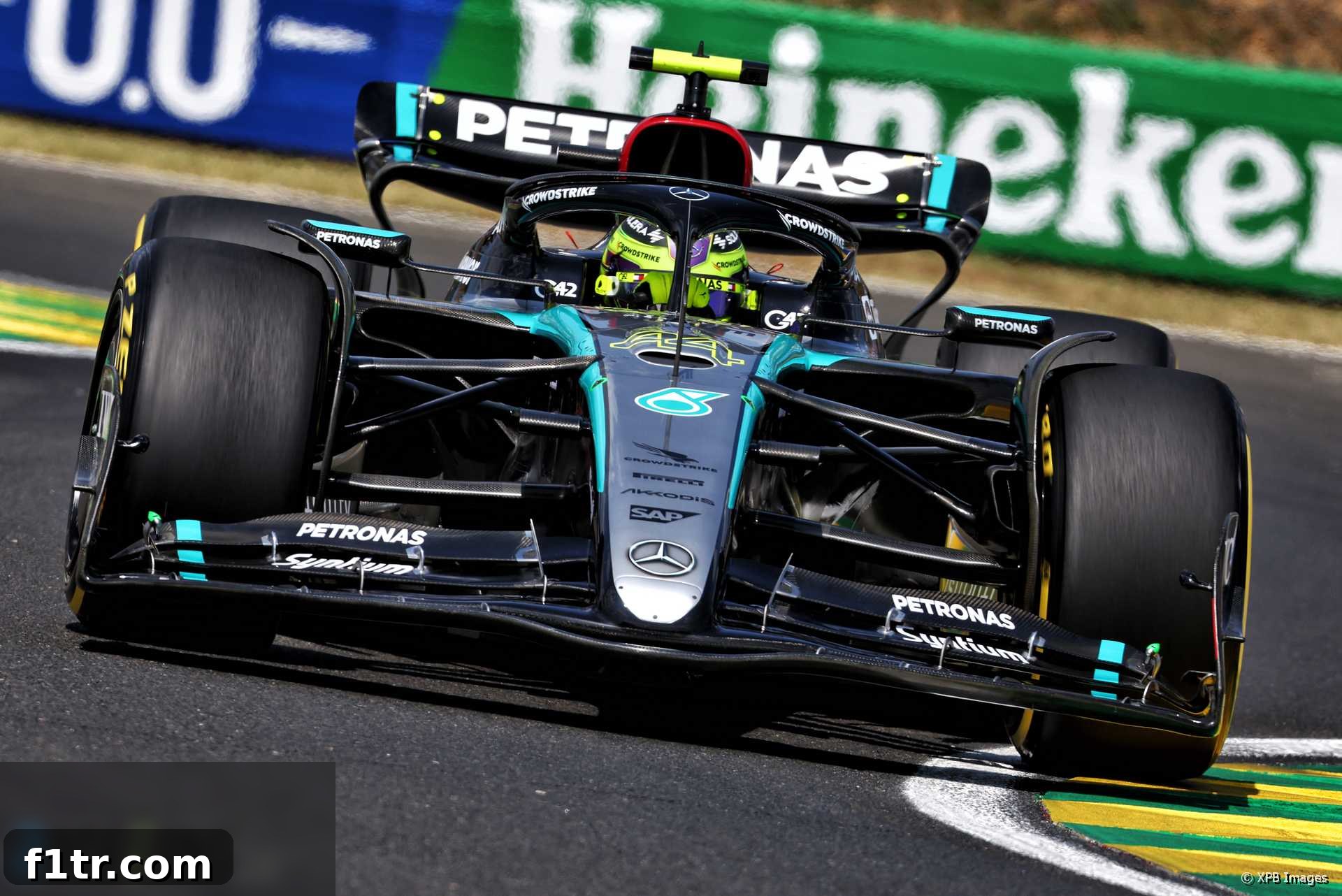
Lewis Hamilton’s Qualifying Challenge: Adapting to F1’s New Ground Effect Era
Seven-time Formula 1 world champion Lewis Hamilton has faced significant challenges in replicating his exceptional qualifying form since the introduction of the current technical regulations in 2022, according to Mercedes’ trackside engineering director, Andrew Shovlin. Hamilton, who holds an unparalleled record of 104 pole positions, has only managed to secure one pole since the sport embraced its new generation of ground effect cars.
Advert | Become a Supporter & go ad-free
This shift in performance has been particularly evident in the current season, where Hamilton has frequently found himself trailing his teammate George Russell in qualifying sessions. Shovlin attributes this in part to the fundamental characteristics of the new cars, suggesting they do not align as harmoniously with Hamilton’s aggressive and attacking driving style as the previous regulations, which were in place until 2021.
The Post-2022 Era: A Shift in Performance Dynamics
The 2022 Formula 1 technical regulations marked a significant overhaul, designed primarily to promote closer racing by enabling cars to follow each other more effectively. This was achieved through a dramatic shift back to ground effect aerodynamics, simplified front wings, and larger 18-inch wheels. While the intention was noble, these changes fundamentally altered how F1 cars generate downforce and how drivers interact with them.
Prior to 2022, Mercedes enjoyed an unprecedented era of dominance, clinching eight consecutive constructors’ championships. However, the introduction of the new regulations threw the team into a period of struggle, as they grappled with understanding and optimizing their W13, W14, and now W15 challengers. This uphill battle for overall car performance has undeniably compounded the qualifying difficulties faced by both drivers, but particularly highlighted the specific adaptation challenges for Hamilton.
Andrew Shovlin’s Insights: Unpacking Hamilton’s Driving Style and Car Synergy
Andrew Shovlin offered candid insights into the contrasting qualifying performances within the Mercedes garage. “George has always set a very high bar in qualifying,” Shovlin noted, emphasizing Russell’s consistent speed from his very first days in Formula 1, even during his tenure at Williams. “As soon as he was in F1, he was impressing. Even in the Williams, he was doing some pretty impressive qualifying sessions. So we know that he’s very quick.”
For Hamilton, the narrative has been different. “Lewis hasn’t disguised the fact that Saturdays were his tough day,” Shovlin revealed. “He’s struggled with this whole generation of car, really, not suiting his style. He’s been working on how he drives.” This acknowledgement from within the team underscores the deep-seated challenge for a driver whose style has been honed over decades to extract every ounce of performance from previous car generations. Hamilton’s aggressive approach to corner entry and mid-corner dynamics, which previously allowed him to unlock immense speed, now appears to create undesirable side effects with the current ground effect machinery.
The Ground Effect Challenge: Why Mercedes Struggles
The new ground effect cars demand a different approach to driving. Their performance is heavily reliant on maintaining a stable aerodynamic platform, especially through high-speed corners. Any slight disruption, such as aggressive steering inputs or over-driving, can lead to a loss of downforce, making the car unpredictable and prone to oversteer or snap instability. This appears to be a core issue for Hamilton.
Shovlin elaborated on how Hamilton’s attacking style manifests as a problem on a single qualifying lap: “It’s particularly [that] he struggled on the single lap. So his long run pace is always there and that’s been really useful. It’s more just the way that he wants to attack a corner, when you do that, then the car would snap to oversteer. You start to build tyre temperature.” This specific feedback highlights a critical interaction between driver input, car aerodynamics, and tire management – a triumvirate that must be perfectly balanced for a fast qualifying lap.
Overheating the rear tires is a common pitfall in modern F1, especially with the Pirelli compounds. An aggressive driver might push the tires beyond their optimal operating window, leading to a loss of grip and ultimately, slower lap times. Hamilton’s characteristic attacking style, which involves pushing the car to its absolute limit through corners, might be causing the rear tires to generate excessive heat, consequently reducing their peak performance for the crucial single-lap assault.
Mercedes’ engineering efforts have therefore been directed at bridging this gap. “Most of our work has been trying to give him a car that you can drive the very attacking style, extract the lap time out of it without it just sort of breaking away on the way in and catching him by surprise,” Shovlin explained. This involves complex adjustments to suspension, differential settings, and aerodynamic balance, all aimed at providing a more forgiving and predictable platform that still allows Hamilton to unleash his natural speed without compromising tire integrity or stability.
Advert | Become a RaceFans supporter andgo ad-free
Race Pace vs. Qualifying Performance: A Hamilton Paradox
Despite his qualifying struggles, one undeniable strength for Lewis Hamilton remains his formidable race pace. Shovlin pointed this out directly: “His long run pace is always there and that’s been really useful.” This creates a fascinating paradox: a driver who struggles to extract peak performance over a single lap often shines brightest during the sustained effort of a Grand Prix. This was vividly demonstrated when Hamilton recently ended a two-and-a-half-year victory drought, showcasing that his race craft, tire management over longer stints, and ability to navigate race conditions remain among the best in the business.
The difference lies in the demands of each discipline. Qualifying requires an all-out sprint, a perfectly executed lap on the knife-edge of grip, where every millisecond counts. Race pace, conversely, rewards consistency, strategic tire preservation, and the ability to adapt to changing fuel loads and tire degradation. Hamilton’s mastery of these race-day variables allows him to climb through the field and maintain strong positions, even when starting further down the grid than he would prefer. However, in an era where track position is paramount, starting deeper in the pack consistently adds an extra layer of difficulty to his race weekend.
Looking Ahead: Mercedes’ Path to Recovery
The Mercedes team has been tirelessly working to address their car’s inherent issues since 2022. From the ill-fated “zero pod” concept to subsequent efforts to improve the car’s handling and aerodynamic efficiency, the journey has been arduous. Shovlin acknowledged this ongoing effort: “We had a huge amount of work trying to get the car to be quicker – it just hasn’t been quick enough – but also with a handling balance that the drivers can actually attack the lap on Saturday.”
Recent developments suggest progress is being made. While Russell has maintained a slight edge in qualifying, the margins have become finer. “We’ve made progress. Recently, George has outqualified Lewis by some fairly fine margins. So it’s great for the team that Lewis is back up there and he’ll be pushing on. But we’ll keep working on that and I’m sure that we’ll see hopefully some more Lewis pole positions as well,” Shovlin expressed optimistically. This indicates a growing understanding of the car and a better ability to set it up for a qualifying assault, potentially unlocking more of Hamilton’s innate speed on Saturdays.
The ultimate goal for Mercedes and Hamilton is to find a car setup that allows his attacking style to flourish within the constraints of the new regulations, converting his proven race pace into stronger starting positions. As Hamilton prepares for his final season with Mercedes before his much-anticipated move to Ferrari, the drive to overcome these qualifying hurdles and add to his record pole count remains a powerful motivation, both for him and the team.
Hamilton and Russell’s Qualifying and Race Performances Compared
The following tables provide a snapshot of Lewis Hamilton’s and George Russell’s qualifying (Q) and race (R) performances across the past three seasons under the new technical regulations. While the specific data for each grand prix would typically be filled in, these structures are crucial for tracking and analyzing the trends discussed above, highlighting the ongoing challenge for Hamilton in Saturday sessions compared to his robust Sunday outings.
2022 Season Overview
| BAH | SAU | AUS | EMI | MIA | SPA | MON | AZE | CAN | GBR | AUT | FRA | HUN | BEL | NED | ITA | SIN | JAP | USA | MEX | BRZ | ABU | ||
| Hamilton | Q | ||||||||||||||||||||||
| R |
Advert | Become a RaceFans supporter andgo ad-free
2023 Season Overview
| BAH | SAU | AUS | AZE | MIA | MON | SPA | CAN | AUT | GBR | HUN | BEL | NED | ITA | SIN | JAP | QAT | USA | MEX | BRZ | LAS | ABU | ||
| Hamilton | Q | ||||||||||||||||||||||
| R |
2024 Season – First 12 Rounds
| BAH | SAU | AUS | JAP | CHI | MIA | EMI | MON | CAN | SPA | AUT | GBR | ||
| Hamilton | Q | ||||||||||||
| R |
Miss nothing from RaceFans
Get a daily email with all our latest stories – and nothing else. No marketing, no ads. Sign up here:
Related Articles: 2024 Hungarian Grand Prix
- Verstappen names Hungarian GP the most stressful moment of his title-winning year
- McLaren team orders “a new situation we’re inexperienced at handling” – Piastri
- Verstappen dismisses critics of “vocal” radio messages and late-night simracing
- Norris’ former McLaren team mates say he was right to give up win
- Mercedes surprised Hamilton’s car was “completely unscathed” in Verstappen clash
Browse all 2024 Hungarian Grand Prix articles