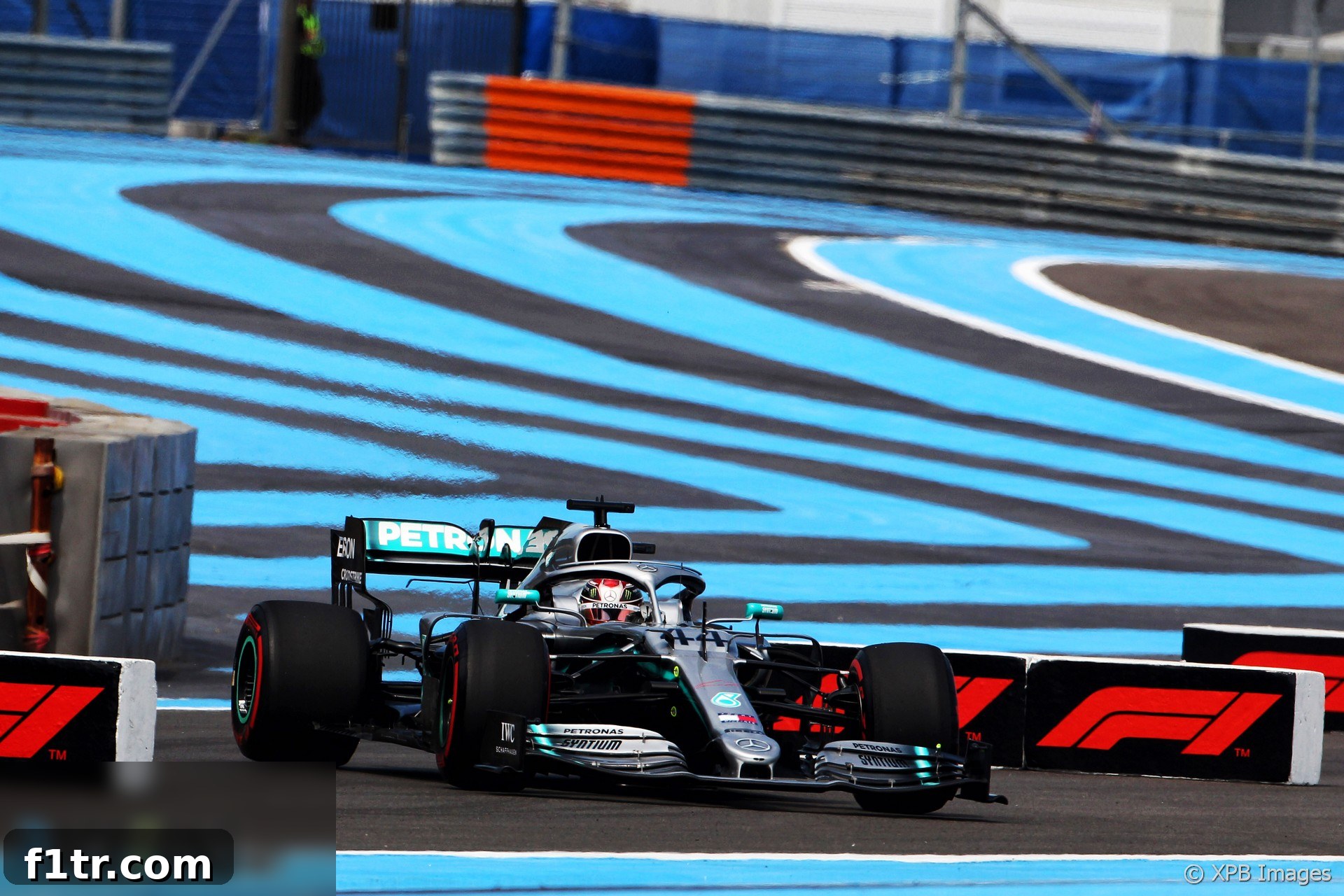
Lewis Hamilton, the celebrated seven-time Formula 1 world champion, found himself at the center of a steward’s inquiry during the second practice session for the French Grand Prix at the Paul Ricard circuit. An on-track incident involving his formidable rival, Max Verstappen of Red Bull Racing, prompted an investigation that could have carried significant consequences, including a grid penalty for the upcoming race. However, after a thorough review, the race stewards ultimately decided against penalizing Hamilton, a ruling that has generated considerable discussion within the Formula 1 community and among dedicated fans.
Lewis Hamilton Avoids Penalty Following Paul Ricard Practice Incident with Max Verstappen
The incident unfolded on the afternoon of the second free practice session at the distinctive Paul Ricard circuit, a venue characterized by its expansive run-off areas and the iconic blue and red striped safety zones. Mercedes driver Lewis Hamilton, pushing the limits of his W10 challenger, experienced a loss of control at Turn 4, resulting in a spin. His car gracefully slid onto the extensive tarmac run-off, a scenario often observed at this particular corner, designed to provide a safe recovery space for drivers.
As Hamilton initiated the process of rejoining the main racing line, striving to do so safely and without impeding other competitors, Max Verstappen’s Red Bull car approached with considerable speed. Verstappen, engaged in a crucial flying lap, was navigating the section between Turns 4 and 5 when he encountered Hamilton’s slowly re-entering Mercedes. The close proximity of these two championship protagonists necessitated an adjustment to Verstappen’s racing line, which consequently led him to run wide at the exit of Turn 5 as he successfully bypassed the rejoining Hamilton.
Situations involving drivers rejoining the track after an off-track excursion, especially when other cars are in close vicinity, are consistently scrutinized by race officials. The potential for dangerous scenarios, even during practice sessions, is treated with utmost seriousness, and the regulations governing track re-entry are meticulously enforced to uphold driver safety and ensure fair competition. Given the high stakes of the Formula 1 season and the intense, often fiery, rivalry between Hamilton and Verstappen, every on-track interaction between them is subjected to intense examination by teams, media, and the global fanbase.
In-Depth Analysis of the Stewards’ Investigation and Rationale
Immediately following the conclusion of the practice session, both Lewis Hamilton and Max Verstappen were summoned to the stewards’ office. This is a standard and necessary procedure for any on-track event that warrants further investigation, allowing officials to gather first-hand accounts from the drivers involved. The stewards conducted a diligent review of all available evidence, which included multiple angles of video footage, critically examining on-board cameras from both Hamilton’s and Verstappen’s cars, comprehensive telemetry data, and various circuit CCTV feeds to reconstruct the incident with the highest possible degree of accuracy.
Following an extensive deliberation, the stewards ultimately concluded that no penalty would be levied against Lewis Hamilton. Their official communiqué outlined several pivotal factors that informed this decision. Crucially, their report stated, “The drivers agreed that the situation was not particularly dangerous and did not give Verstappen a lasting disadvantage in this practice session.” This mutual understanding and agreement between the two drivers themselves proved to be a significant mitigating circumstance in the decision-making process. The fact that Verstappen, the directly affected driver, did not perceive the incident as overtly dangerous or as having a significant, lasting impact on his practice performance, weighed heavily in Hamilton’s favour.
The stewards’ notes further elaborated on Hamilton’s proactive efforts to ensure a safe rejoin. It was noted that “Both drivers agreed that the limited rear visibility and the angle of car 44 made it difficult for Hamilton to see the approaching car and agreed that Hamilton re-joined slowly.” The inherent design of contemporary Formula 1 cars, while optimized for aerodynamic performance, often compromises a driver’s rearward visibility. This challenge is exacerbated when rejoining the track from an unconventional angle. Hamilton’s acknowledged slow re-entry was recognized as a deliberate and responsible measure to minimize any potential risks.
Reinforcing this perception of responsible driving, the stewards’ report highlighted a critical observation: “The stewards could observe from the on-board video that Hamilton looked in his mirrors at least twice before attempting to re-join the circuit.” This detail is paramount. It unequivocally demonstrated that Hamilton actively engaged in checking his surroundings and did not rejoin the track in a careless or reckless manner. While mirror checks are not always infallible, especially at high speeds, this proactive step indicated a conscious and diligent adherence to safe re-entry protocols, distinguishing his actions from potentially more negligent rejoining maneuvers.
F1’s Approach to Unsafe Rejoining: A Comparison to Sebastian Vettel’s Canadian GP Penalty
The decision to exonerate Hamilton from any penalty inevitably drew immediate comparisons to other recent, high-profile incidents involving unsafe track rejoining, most notably the controversial penalty imposed on Sebastian Vettel during the Canadian Grand Prix earlier in the same season. That incident, which occurred during the actual race, saw the Ferrari driver rejoin the track in what was deemed an “unsafe fashion” directly in front of Lewis Hamilton, a ruling that ultimately cost Vettel a hard-fought victory due to a five-second time penalty.
The stark contrast between these two rulings provides a vivid illustration of the complexities and nuanced interpretations inherent in Formula 1 stewarding. While both incidents involved a driver rejoining the track after an excursion and in close proximity to a rival competitor, several critical distinctions undoubtedly influenced the stewards’ divergent outcomes:
Practice vs. Race Conditions: The Stakes Involved
- Canadian Grand Prix (Sebastian Vettel): Vettel’s incident occurred during the heat of the race itself, where the stakes are at their absolute zenith. Any perceived unsafe maneuver or actions that confer an unfair advantage during a race are treated with the utmost gravity, as they directly impact the final outcome of the competition, championship points, and potentially the course of the entire season.
- Paul Ricard Practice (Lewis Hamilton): In contrast, Hamilton’s incident took place during a free practice session. While safety remains the paramount concern even in practice, the competitive element is significantly less acute. The primary objective of practice is for teams and drivers to fine-tune their car setups, test new components, and familiarize themselves with the circuit. A momentary disadvantage in practice, as acknowledged by Verstappen, rarely has any lasting impact on the ultimate results of the race weekend.
Impact on Rival and Driver Intent
- Canadian Grand Prix (Sebastian Vettel): Vettel’s rejoin, following his off-track excursion, unequivocally forced Hamilton to take significant evasive action to avoid a collision. This was seen as creating a dangerously unsafe situation and clearly impeding Hamilton’s ability to challenge for the race lead. The stewards perceived that Vettel’s actions directly created an unsafe condition that materially affected his closest competitor.
- Paul Ricard Practice (Lewis Hamilton): While Verstappen had to deviate from his ideal line and consequently ran wide at Turn 5, both drivers mutually agreed that the situation was not “particularly dangerous.” There was no overt indication or accusation of Hamilton deliberately attempting to impede Verstappen, and the impact on Verstappen’s practice session was deemed negligible. Hamilton’s documented and repeated mirror checks further supported the absence of any malicious or reckless intent on his part.
Circuit Characteristics and Safety Design
- Canadian Grand Prix (Circuit Gilles Villeneuve): The Circuit Gilles Villeneuve in Montreal is a semi-permanent street circuit notoriously characterized by unforgiving concrete walls and minimal run-off areas. An unsafe rejoin in such an environment carries an exponentially higher risk of a major, high-speed collision due to the immediate proximity of hard barriers.
- Paul Ricard Practice (Paul Ricard Circuit): The Paul Ricard circuit, conversely, is renowned for its vast, open, and generously proportioned run-off areas. While any spin and subsequent rejoin demands caution, the inherent safety features of the track design—providing ample space for both drivers—likely contributed to the stewards’ assessment that the situation was not “particularly dangerous” in this specific context.
The differing outcomes in these two high-profile cases underscore the immense challenge faced by Formula 1 stewards, who must meticulously weigh numerous variables. These include the precise circumstances of each individual incident, the unique characteristics of the track layout, the specific stage of the race weekend (practice vs. qualifying vs. race), and the immediate and potential consequences of the actions taken. It also decisively highlights the growing importance of driver testimony and, crucially, mutual agreement between the involved parties, as demonstrably evidenced in Hamilton’s case.
Implications for Future Incidents and F1 Regulations
This ruling at Paul Ricard offers valuable insight into how Formula 1 stewards interpret and apply the “unsafe rejoin” regulations, particularly when incidents occur within a practice environment. While it is true that every on-track incident possesses its own unique set of circumstances, the pronounced emphasis on driver consensus regarding the perceived danger levels, the driver’s demonstrable efforts to rejoin safely (such as conducting mirror checks), and the critical context of the session in which the incident transpires (practice versus a competitive race) appears to be increasingly influential in judicial outcomes.
For the drivers competing at the pinnacle of motorsport, the message conveyed by this decision is clear: while momentary lapses and incidents can inevitably occur, actively demonstrating a conscious effort to rejoin the track safely and maintaining effective communication with rival competitors can prove absolutely crucial in mitigating the risk of receiving a penalty. For the legions of Formula 1 fans, this ruling further reinforces the understanding that steward decisions, while occasionally sparking passionate debate, are the result of detailed, multi-faceted reviews and careful consideration of numerous variables, extending far beyond merely the immediate visual impact of an incident.
Furthermore, the incident at Paul Ricard adds another subtle yet significant layer to the ongoing and utterly captivating rivalry between Lewis Hamilton and Max Verstappen. While ultimately no penalty was issued, their close encounter on track serves as a poignant reminder of the relentless competitive tension that defines their battle for supremacy within Formula 1. As the 2019 season progressed, every championship point, every strategic decision, and indeed every steward’s ruling, carried immense weight, making clarity and consistency in stewarding decisions even more paramount for the integrity of the sport.
Stay Connected with RaceFans for All the Latest F1 News and Updates
Ensure you never miss a single moment of the high-octane action, intricate technical developments, and pivotal decisions that shape the enthralling Formula 1 season. Keep yourself thoroughly up-to-date with all the breaking news, in-depth analyses, exclusive features, and expert insights directly from RaceFans, your trusted source for F1 content.
- Join the vibrant RaceFans community on Facebook for engaging discussions and real-time updates.
- Follow RaceFans on Twitter for instant news alerts, live race coverage, and immediate reactions from the world of F1.
- Subscribe to get daily email updates directly from RaceFans, ensuring you never miss a headline or critical story.
Explore More from the 2019 F1 Season
Delve deeper into the memorable moments, critical events, and pivotal narratives that collectively defined the exhilarating 2019 F1 season. From thrilling race victories and strategic masterstrokes to controversial decisions and candid driver insights, our extensive archive provides unparalleled coverage and detailed analysis.
- Ocon Reflects on His Career Low: Crying in the Melbourne Car Park at 2019 Grand Prix
- McLaren Racing Announces Reduced £71 Million Loss for 2019 Fiscal Year
- Daniil Kvyat: Hockenheim Podium in 2019 Was My “Biggest Achievement” So Far
- FIA’s New Encrypted Fuel Flow Meter: Targeting Ferrari’s Suspected ‘Aliasing’ Trick in 2019
- “He Smashed My Office Door”: 23 Must-See Moments from ‘Drive to Survive’ Season Two Featuring 2019 Season
Browse all 2019 F1 season articles to catch up on every development, analysis, and highlight from that memorable year in Formula 1 history.