Advert | Become a Supporter & go ad-free
2020 Russian Grand Prix: Hamilton Dominates Challenging FP3 at Sochi
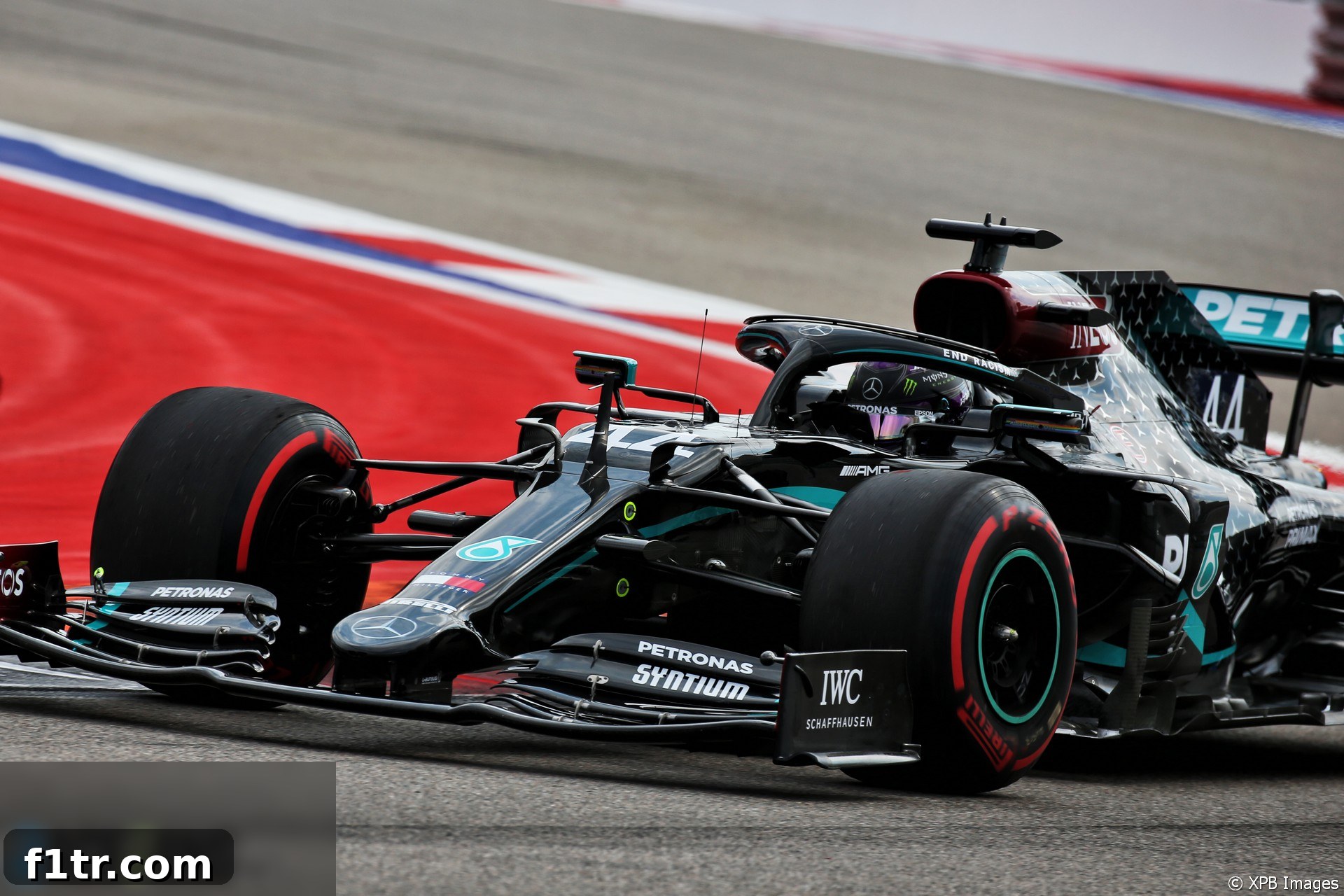
The final practice session for the 2020 Russian Grand Prix at the Sochi Autodrom saw Lewis Hamilton assert his dominance, setting the fastest time and leading his Mercedes team mate Valtteri Bottas. This crucial third practice (FP3) session provided teams and drivers with their last opportunity to fine-tune their cars before the all-important qualifying battle, setting the stage for what promises to be an electrifying grid showdown in Sochi.
Mercedes Assert Control Amidst Rising Temperatures and Tricky Track Conditions
While the Silver Arrows demonstrated their expected pace, Hamilton’s fastest lap of 1’33.279 was achieved under notably different conditions than those experienced during Friday’s sessions. The track temperature soared by approximately 10 degrees Celsius, adding another layer of complexity for drivers already grappling with the unique demands of the Sochi circuit. Unlike in second practice, where Mercedes drivers held a significant advantage, the gap to their closest rivals narrowed slightly, with less than a second separating the top two from the rest of the pack. Nevertheless, Hamilton and Bottas remained comfortably ahead, underscoring Mercedes’ strong position heading into qualifying.
Despite his leading time, Hamilton, much like his teammate Bottas, was not immune to the challenging conditions, particularly at Turn 7. This corner, infamous for Carlos Sainz Jnr’s hefty crash during the first practice session, continued to catch drivers out with its unsettling bumps. Bottas, in particular, struggled to find a clean flying lap, ending the session further off his teammate’s pace than usual, a testament to the unforgiving nature of the circuit. The technical precision required to navigate Sochi at speed, combined with the rising temperatures affecting tire performance, made FP3 a true test of driver skill and car setup.
Bumps and Spins: Sochi Autodrom’s Unpredictable Character
The Sochi Autodrom revealed some new challenges for the drivers in FP3, particularly a visible and pronounced bump at Turn 15. This specific section of the track proved to be a significant hurdle, causing multiple drivers to run wide or lose control. Daniil Kvyat, who finished ninth-fastest for AlphaTauri, reported over his team radio his surprise at the “quite deep” dip, highlighting the unexpected nature of the track’s evolution since the previous year’s event. The bump seemed to destabilize the cars, leading to dramatic moments and forcing drivers to adapt their lines and braking points continuously.
Kvyat’s AlphaTauri teammate, Pierre Gasly, was one of the many victims of Turn 15’s unpredictability. His session saw him pirouette to a halt after being caught out by the bump, emphasizing the fine margins at play. Later in the session, Haas driver Romain Grosjean also spun at the same corner. Grosjean’s frustration was palpable, engaging in a vigorous radio exchange with his engineer about the persistent shortcomings of his car’s handling. “I have no words,” he remarked as he rejoined the track, summing up the exasperation many drivers felt with the circuit’s demanding characteristics.
Midfield Momentum Shifts: Ocon’s Surge and Ricciardo’s Troubles
The midfield battle, as ever, provided plenty of drama and intrigue. Esteban Ocon, driving for Renault, delivered a standout performance. After struggling to match his teammate Daniel Ricciardo’s times in the earlier practice sessions, Ocon found significant pace, beating Ricciardo by over half a second. This impressive turnaround came despite Ocon’s complaints about traffic during his flying laps, underscoring his ability to extract performance when it mattered most.
Conversely, Daniel Ricciardo’s session was hampered by an unusual mechanical issue: a problem with his right-hand wing mirror. At one point, Ricciardo was seen holding onto the mirror with his left hand, a clear disruption to his focus and concentration during a crucial flying lap. Harsh vibrations caused by riding over a kerb appeared to be the culprit, causing the mirror to work loose. This small but significant malfunction undoubtedly impacted Ricciardo’s ability to maximize his car’s potential and contributed to Ocon’s superior pace in FP3.
Perez and Verstappen in the Mix; Vettel Shows Promise
In a typically tight midfield, Sergio Perez once again demonstrated the Racing Point’s strong performance, placing his car fifth. He was fractionally ahead of Max Verstappen, who continued to express dissatisfaction with the balance of his Red Bull. Verstappen’s ongoing struggles with car setup suggested that Red Bull still had work to do to unlock the full potential of their package on the Sochi circuit. Despite his complaints, Verstappen’s raw talent ensured he remained competitive, always a threat.
Sebastian Vettel, driving for Ferrari, finally enjoyed a more productive outing after a challenging season. He posted the seventh-fastest time, signaling a potential improvement in the Scuderia’s performance for the weekend. While still a few tenths shy of Verstappen, Vettel’s improved pace offered a glimmer of hope for Ferrari fans, suggesting that the team might have found a better operating window for their car in Sochi. This positive session for Vettel was a welcome development, providing a much-needed confidence boost for the four-time world champion.
McLaren’s Experiment and Albon’s Penalties
Lando Norris was the first driver out on track at the start of the session in his McLaren. Notably, Norris was the only McLaren driver to continue using the team’s new nose and front wing design, an experimental update aimed at improving aerodynamic efficiency. Despite the innovative components, Norris did not set a particularly competitive time in FP3, ending the session last. This outcome may suggest that McLaren still needs more time to fully understand and optimize the new package, or that the focus of his session was on data gathering rather than outright pace.
Just ahead of Norris on the timesheets was Alexander Albon, whose Red Bull session was complicated by track limits restrictions. Albon, like several other drivers throughout the weekend, fell foul of the strict adherence to track boundaries, resulting in one of his lap times being deleted. Such incidents highlight the increasing scrutiny on track limits in modern Formula 1, where even a slight transgression can have significant consequences for a driver’s performance in practice and, crucially, in qualifying.
Looking Ahead to Qualifying
With the FP3 session concluded, all eyes now turn to qualifying. Lewis Hamilton’s commanding performance in FP3 firmly establishes him as the favourite for pole position, but Valtteri Bottas’s determination to rebound from a less-than-perfect session cannot be underestimated. The Red Bulls, despite Verstappen’s balance complaints, are always a threat, while the midfield battle promises to be incredibly tight. The challenging track conditions, marked by the rising temperatures and unpredictable bumps, will ensure that drivers who can adapt fastest and maintain precision under pressure will be rewarded. The stage is set for an exhilarating qualifying session that will significantly impact the outcome of the 2020 Russian Grand Prix.
2020 Russian Grand Prix Third Practice Results
| Pos. | No. | Driver | Car | Best lap | Gap | Laps |
|---|---|---|---|---|---|---|
| 1 | 44 | Lewis Hamilton | Mercedes | 1’33.279 | 16 | |
| 2 | 77 | Valtteri Bottas | Mercedes | 1’34.055 | 0.776 | 19 |
| 3 | 55 | Carlos Sainz Jnr | McLaren-Renault | 1’34.096 | 0.817 | 17 |
| 4 | 31 | Esteban Ocon | Renault | 1’34.239 | 0.960 | 13 |
| 5 | 11 | Sergio Perez | Racing Point-Mercedes | 1’34.252 | 0.973 | 14 |
| 6 | 33 | Max Verstappen | Red Bull-Honda | 1’34.306 | 1.027 | 11 |
| 7 | 5 | Sebastian Vettel | Ferrari | 1’34.594 | 1.315 | 14 |
| 8 | 18 | Lance Stroll | Racing Point-Mercedes | 1’34.732 | 1.453 | 13 |
| 9 | 26 | Daniil Kvyat | AlphaTauri-Honda | 1’34.768 | 1.489 | 14 |
| 10 | 3 | Daniel Ricciardo | Renault | 1’34.787 | 1.508 | 12 |
| 11 | 10 | Pierre Gasly | AlphaTauri-Honda | 1’34.792 | 1.513 | 12 |
| 12 | 16 | Charles Leclerc | Ferrari | 1’34.806 | 1.527 | 14 |
| 13 | 63 | George Russell | Williams-Mercedes | 1’34.979 | 1.700 | 16 |
| 14 | 8 | Romain Grosjean | Haas-Ferrari | 1’35.257 | 1.978 | 14 |
| 15 | 6 | Nicholas Latifi | Williams-Mercedes | 1’35.292 | 2.013 | 14 |
| 16 | 20 | Kevin Magnussen | Haas-Ferrari | 1’35.451 | 2.172 | 14 |
| 17 | 99 | Antonio Giovinazzi | Alfa Romeo-Ferrari | 1’35.590 | 2.311 | 15 |
| 18 | 7 | Kimi Raikkonen | Alfa Romeo-Ferrari | 1’35.599 | 2.320 | 15 |
| 19 | 23 | Alexander Albon | Red Bull-Honda | 1’35.603 | 2.324 | 14 |
| 20 | 4 | Lando Norris | McLaren-Renault | 1’35.981 | 2.702 | 17 |
Third Practice Visual Gaps: A Closer Look at the Performance Spread
The visual gap analysis below provides an immediate understanding of the performance differences between drivers in the third practice session. Each bar represents a driver’s best lap time relative to the fastest driver, Lewis Hamilton, offering a clear graphical representation of the competitive spread across the grid.
Lewis Hamilton – 1’33.279
+0.776 Valtteri Bottas – 1’34.055
+0.817 Carlos Sainz Jnr – 1’34.096
+0.960 Esteban Ocon – 1’34.239
+0.973 Sergio Perez – 1’34.252
+1.027 Max Verstappen – 1’34.306
+1.315 Sebastian Vettel – 1’34.594
+1.453 Lance Stroll – 1’34.732
+1.489 Daniil Kvyat – 1’34.768
+1.508 Daniel Ricciardo – 1’34.787
+1.513 Pierre Gasly – 1’34.792
+1.527 Charles Leclerc – 1’34.806
+1.700 George Russell – 1’34.979
+1.978 Romain Grosjean – 1’35.257
+2.013 Nicholas Latifi – 1’35.292
+2.172 Kevin Magnussen – 1’35.451
+2.311 Antonio Giovinazzi – 1’35.590
+2.320 Kimi Raikkonen – 1’35.599
+2.324 Alexander Albon – 1’35.603
+2.702 Lando Norris – 1’35.981
Drivers more than ten seconds off the pace omitted from this visualization.
Combined Practice Times: A Weekend Performance Overview
For a comprehensive understanding of each driver’s performance throughout the Russian Grand Prix weekend so far, the table below presents the best lap times from all three practice sessions (FP1, FP2, and FP3). This overview highlights consistency, improvement, and challenges faced by teams as they prepared for qualifying and the race.
| Pos | Driver | Car | FP1 | FP2 | FP3 | Fri/Sat diff | Total laps |
|---|---|---|---|---|---|---|---|
| 1 | Lewis Hamilton | Mercedes | 1’37.716 | 1’33.786 | 1’33.279 | -0.507 | 67 |
| 2 | Valtteri Bottas | Mercedes | 1’34.923 | 1’33.519 | 1’34.055 | +0.536 | 69 |
| 3 | Carlos Sainz Jnr | McLaren-Renault | 1’36.970 | 1’34.723 | 1’34.096 | -0.627 | 61 |
| 4 | Esteban Ocon | Renault | 1’36.061 | 1’35.139 | 1’34.239 | -0.9 | 64 |
| 5 | Sergio Perez | Racing Point-Mercedes | 1’35.796 | 1’34.890 | 1’34.252 | -0.638 | 72 |
| 6 | Max Verstappen | Red Bull-Honda | 1’35.577 | 1’35.048 | 1’34.306 | -0.742 | 63 |
| 7 | Daniel Ricciardo | Renault | 1’35.430 | 1’34.577 | 1’34.787 | +0.21 | 61 |
| 8 | Sebastian Vettel | Ferrari | 1’36.323 | 1’35.183 | 1’34.594 | -0.589 | 72 |
| 9 | Lance Stroll | Racing Point-Mercedes | 1’35.965 | 1’35.627 | 1’34.732 | -0.895 | 68 |
| 10 | Daniil Kvyat | AlphaTauri-Honda | 1’36.230 | 1’35.461 | 1’34.768 | -0.693 | 73 |
| 11 | Pierre Gasly | AlphaTauri-Honda | 1’36.706 | 1’35.210 | 1’34.792 | -0.418 | 72 |
| 12 | Charles Leclerc | Ferrari | 1’36.896 | 1’35.052 | 1’34.806 | -0.246 | 72 |
| 13 | Lando Norris | McLaren-Renault | 1’37.110 | 1’34.847 | 1’35.981 | +1.134 | 78 |
| 14 | George Russell | Williams-Mercedes | 1’37.595 | 1’35.575 | 1’34.979 | -0.596 | 70 |
| 15 | Alexander Albon | Red Bull-Honda | 1’36.254 | 1’35.242 | 1’35.603 | +0.361 | 69 |
| 16 | Romain Grosjean | Haas-Ferrari | 1’37.649 | 1’36.858 | 1’35.257 | -1.601 | 70 |
| 17 | Nicholas Latifi | Williams-Mercedes | 1’37.784 | 1’35.563 | 1’35.292 | -0.271 | 56 |
| 18 | Kevin Magnussen | Haas-Ferrari | 1’37.430 | 1’35.729 | 1’35.451 | -0.278 | 68 |
| 19 | Kimi Raikkonen | Alfa Romeo-Ferrari | 1’37.230 | 1’35.516 | 1’35.599 | +0.083 | 71 |
| 20 | Antonio Giovinazzi | Alfa Romeo-Ferrari | 1’37.201 | 1’36.053 | 1’35.590 | -0.463 | 68 |
Advert | Become a RaceFans supporter andgo ad-free
More on the 2020 Russian Grand Prix
- Despite F1 drivers’ concerns, stewards don’t give penalty points for “minor infringements”
- 2020 Russian Grand Prix Star Performers
- “Slower” Ferrari only beat us because of Q3 tyre rule – Tost
- “I may not always get it right” says Hamilton after penalty criticism
- Why did the stewards make their second U-turn this year on a Hamilton penalty call?
Browse all 2020 Russian Grand Prix articles