Lewis Hamilton, the reigning Formula 1 champion and a vocal advocate for social justice, has steadfastly refuted allegations that he pressured his fellow competitors to participate in the pre-race ‘take a knee’ protest at the recent Austrian Grand Prix. Hamilton emphasized that the global fight against anti-racism transcends any single symbolic gesture, stressing the critical importance of individual choice and the broader context of the movement.
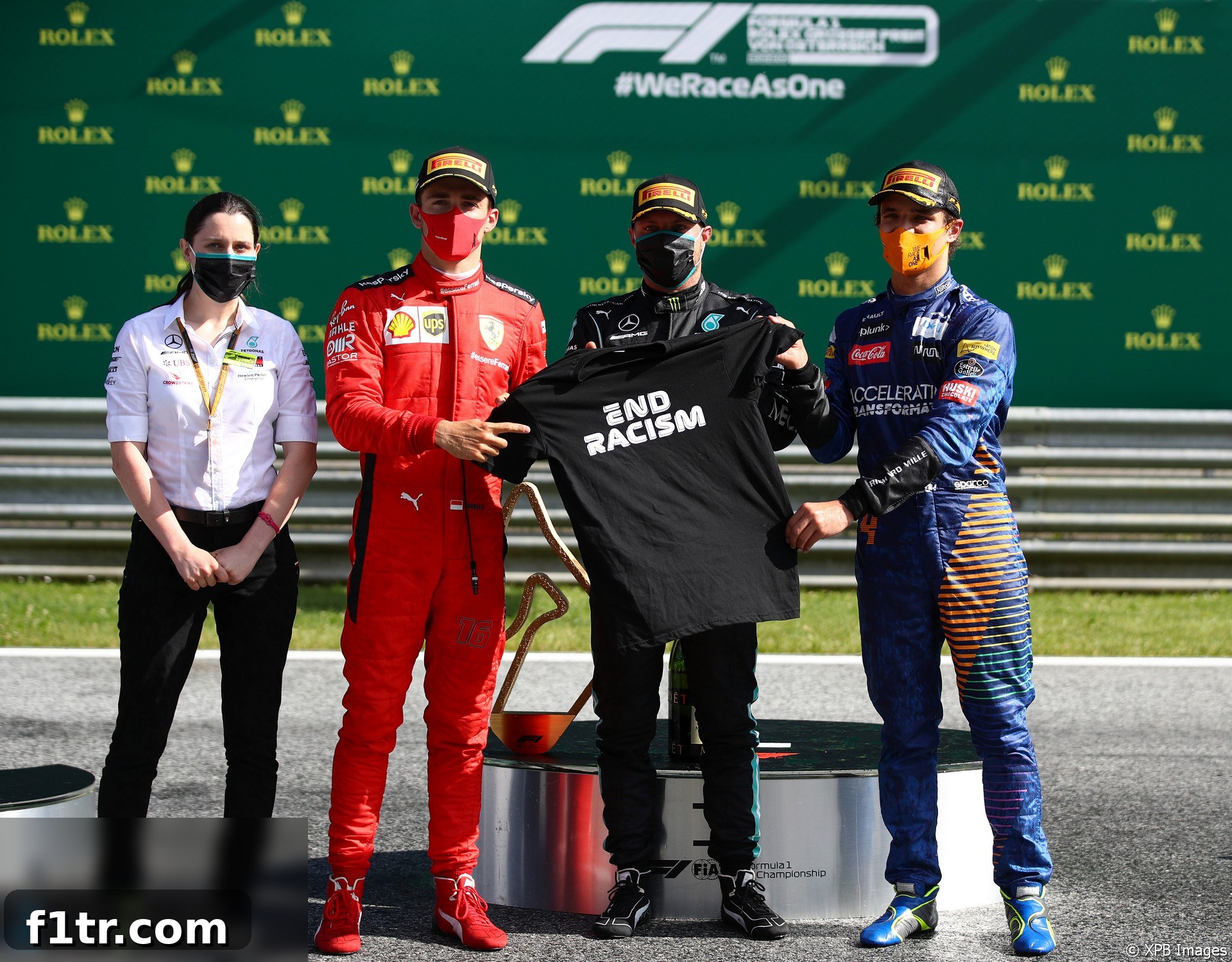
The highly anticipated Austrian Grand Prix saw all 20 Formula 1 drivers united in a powerful display of solidarity, donning anti-racism T-shirts emblazoned with “End Racism” on the grid. Fourteen of these drivers, including Hamilton, further demonstrated their support by symbolically ‘taking a knee’ – a gesture popularized by American football player Colin Kaepernick four years prior to protest racial injustice and police brutality. However, amidst swirling speculation, Hamilton made it unequivocally clear that he neither “requested nor demanded” any driver join him in the action.
Hamilton Clarifies Stance on ‘Take a Knee’ Gesture Amidst Austrian GP Protests
Speaking after the race, Hamilton shed light on the origins of the gesture within the F1 paddock, revealing that the idea was initially suggested by two other prominent drivers: Sebastian Vettel and Romain Grosjean. Notably, Vettel, like Hamilton, competed with a ‘Black Lives Matter’ slogan prominently displayed on his helmet, underscoring a shared commitment to the cause. Despite some drivers opting not to take a knee, Hamilton expressed his complete comfort with their individual decisions, reiterating his belief that participation should be a matter of personal conviction, not coercion.
“Honestly, I don’t know everyone’s different reasons or opinions,” Hamilton stated, addressing the diverse responses from his peers. “I am aware of some opinions from some of the drivers, but that’s more a private thing and I wouldn’t like to share. But I think ultimately, nobody should be forced into a scenario where they have to kneel.” This statement served to underscore his respect for the autonomy of each driver, framing the collective action as an opportunity for expression rather than a compulsory act.
Refuting Claims of Coercion: The True Story Behind F1’s Anti-Racism Stand
Hamilton was quick to dismantle claims that he had attempted to sway drivers into ‘taking a knee’, setting the record straight on the narrative that had begun to circulate. “There is a story, at least one out there, that is really incorrect,” he asserted. “I never requested or demanded anybody to take the knee. I never even brought it up.” This direct refutation aimed to quash any misconceptions about his leadership style and the democratic process that unfolded within the drivers’ assembly.
He further elaborated on how the decision to make the gesture was reached, pinpointing discussions within Formula 1 management and the Grand Prix Drivers’ Association (GPDA). “It was brought up by Formula 1 and it was brought up by the GPDA. When we did the drivers’ briefing, Seb and Romain both brought it up and asked the drivers whether or not they would do it.” This revelation highlighted a collective effort to address the issue, rather than a singular directive from Hamilton. He explained that during this meeting, “several that said they wouldn’t,” indicating a genuine discussion and diverse viewpoints among the racers. “And I let everyone just say what they wanted to say, and I just opened up to them and said, ‘look guys, just so you know, I will be doing it, but you do what you feel is right’.” This personal testimony reaffirmed his dedication to the cause while respecting the integrity of each driver’s choice.
Hamilton expressed profound gratitude for those who chose to kneel alongside him, acknowledging the symbolic power of their unified stance. “I’m really, really grateful for those who did kneel along with me. I think it’s still a really powerful message,” he remarked, recognizing the visual impact of the protest. However, he also offered a vital perspective on the limits of such gestures, emphasizing the deeper, more pervasive nature of the problem. “But ultimately, whether you kneel or do not kneel, that’s not going to change the world. It’s a much, much bigger issue across the world than just something as little as that.” This crucial distinction highlighted that while symbolic acts are important for raising awareness, they are merely a part of a much larger and more complex struggle against systemic racism. “But for me, personally, I think everyone had a right to their own personal choice and for me personally, that was what I felt was right to do. But I didn’t make the decision until last night.” This personal reflection underscored the deeply considered nature of his own participation.
Black Lives Matter: Distinguishing Humanity from Politics
Lewis Hamilton also took the opportunity to distance himself from any purely political interpretations of the Black Lives Matter movement, steadfastly emphasizing his support solely from an anti-racism and human rights perspective. This distinction is crucial for maintaining broad appeal and ensuring the core message of equality is not overshadowed by partisan debates. “There are certain people that are speaking about it and making it more political than it is,” he observed, acknowledging the different facets and interpretations of the movement.
“Then there are obviously, I think it’s London Black Lives Matter or the UK Black Lives Matter that have spoken on some more political issues,” he continued, carefully segmenting the broader movement from specific organizational agendas. “But I think the people that are at the rallies, the people out there marching, are fighting for one cause, and that’s for the equality. And it’s not a political thing, necessarily. I think for them, that’s what I went to London, that’s what they’re out there doing. When I wear the shirt, when I speak out, that’s what I’m supporting. I’m not supporting necessarily the political movements. That’s something completely different. So I think it’s important to try and keep it separate.” This nuanced explanation clarifies his focus on the fundamental human right to equality and justice, advocating for a universal principle rather than aligning with specific political factions.
A Journey of Advocacy: From Silence to Speaking Out
Hamilton’s current outspokenness represents a significant evolution in his public stance on social issues. He reflected on past opportunities to speak out against racism, specifically recalling a moment in 2017 when, following earlier anti-racism protests, he had considered ‘taking a knee’ at the United States Grand Prix. He ultimately did not proceed with it then, a decision he now openly admits to regretting, highlighting a period where external pressures may have tempered his voice. “This all started with Colin Kaepernick in the NFL,” Hamilton recounted, tracing the lineage of the protest gesture. “I think he sat down for the national anthem and he got a lot of backlash. And then he spoke to someone, I can’t remember who it is he spoke to, his team boss or something like that, and they suggested to take the knee.”
He vividly remembered the impact Kaepernick’s brave action had on him. “I thought that was a really powerful statement that he made. And then he lost his job. And didn’t get his job back. And he was a great athlete.” The professional repercussions faced by Kaepernick undoubtedly served as a stark warning to other athletes considering similar protests. Hamilton then revealed his personal connection to Kaepernick’s plight: “I’d actually spoken to him a couple of years ago, shortly after that before the US Grand Prix and I had a helmet and everything made in red with his number on the top. But back then I was kind of silenced, I was told to back down, don’t support it. Which I would say that I regret.” This candid admission offers a glimpse into the internal struggle and the external pressures he faced as a prominent athlete, making his current resolve to speak out even more significant. “So it was important for me to make sure that during this period of time I did my part.”
Sustaining the Movement: Hamilton’s Commitment to Continued Action
Looking ahead, Hamilton articulated his firm intention to maintain the spotlight on the anti-racism campaign in the weeks and months to come. While the specific form of his future protests remains fluid, he expressed a clear boundary regarding national anthems. “Whether [I’ll] continue to take a knee, I don’t know if there’s going to be opportunities to do that. I definitely don’t want to do that on national anthems.” This nuanced approach suggests a strategic consideration of how to maximize impact while respecting certain traditional protocols within the sport. His focus, however, remains unwavering on the underlying principles.
“But I would say definitely the background, I’ll continue to support, continue to try to improve my education on the situation, hopefully encourage others,” he affirmed. This commitment to continuous learning and advocacy highlights a long-term vision beyond fleeting gestures. Hamilton’s ultimate goal is to inspire genuine understanding and empathy, rather than enforce compliance. “I really don’t want it to be the case of people feeling forced. I want people to be excited to be a part of the change and want to encourage people to really take notice and think, ‘I’ve been so fortunate to not have experienced racism, but I can try to understand what it must feel like and I don’t want people to feel that way, I don’t want my kids to feel that way’.” This heartfelt appeal speaks to a desire for a fundamentally more equitable future, driven by collective consciousness and a shared commitment to human dignity. “So I want to be part of the change in the future. Our kids can lead a better life quality. And that’s really what it’s all about.” His vision extends beyond the racetrack, aiming to leave a lasting legacy of positive social transformation for future generations.
More from the 2020 F1 Season
- Grosjean to make F1 test return tomorrow for first time since Bahrain horror crash
- Pictures: Wrecked chassis from Grosjean’s Bahrain fireball crash to go on display
- Bottas vs Rosberg: Hamilton’s Mercedes team mates compared after 78 races each
- F1 revenues fell by $877 million in Covid-struck 2020 season
- Hamilton and Mercedes finally announce new deal for 2021 season
Browse all 2020 F1 season articles