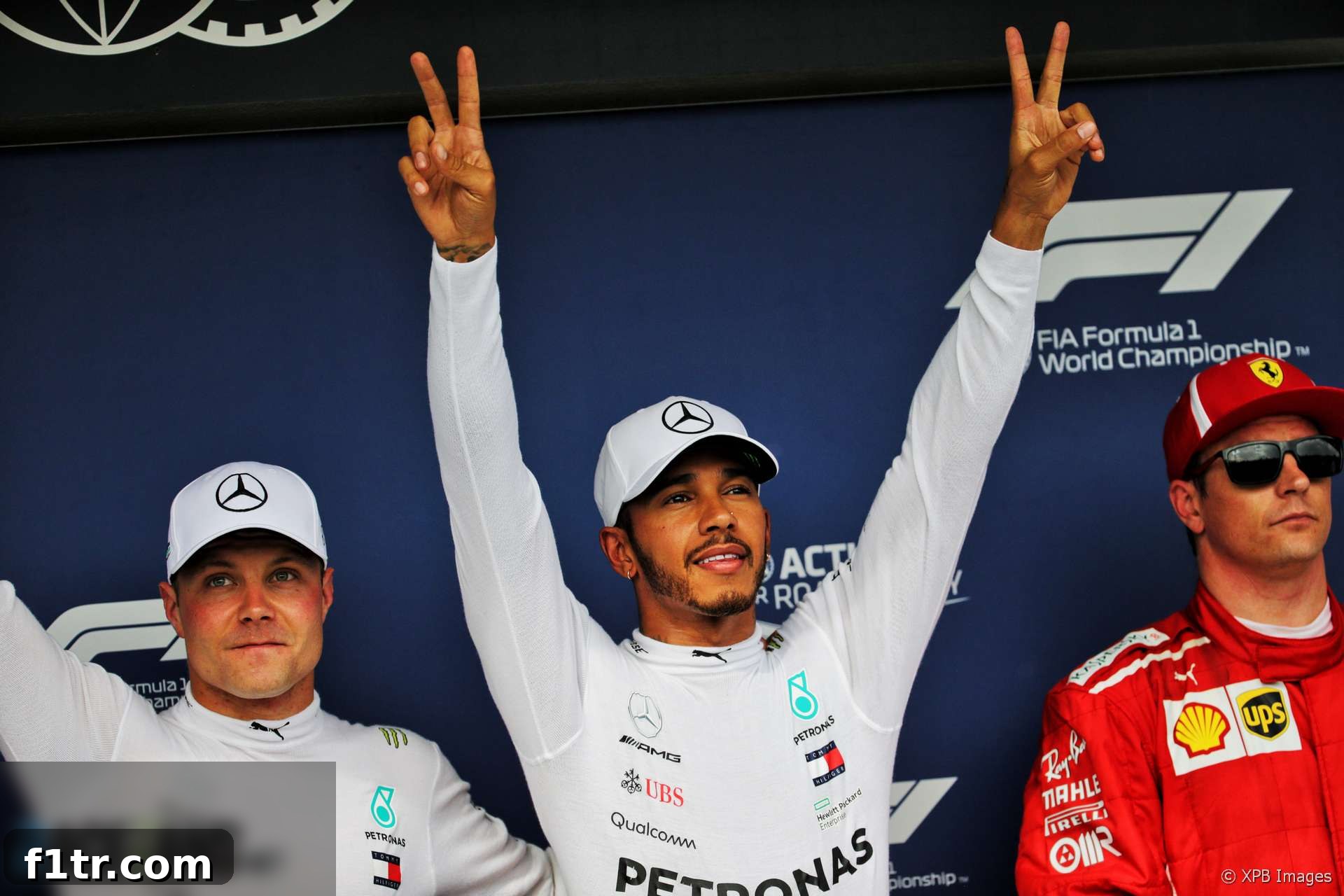
The stage was set for an unpredictable Saturday at the Hungaroring as a rain-hit qualifying session unfolded, offering Lewis Hamilton a golden opportunity to seize his sixth pole position for the Hungarian Grand Prix. What followed was a masterclass in strategy, precision driving, and timing, culminating in a dominant one-two for Mercedes on a circuit where Ferrari had previously showcased superior pace during practice sessions.
Often dubbed ‘Monaco without the walls’ due to its tight, twisty, and highly technical nature, the Hungaroring demands absolute precision. With overtaking notoriously difficult, qualifying takes on an elevated importance, making any advantage on the grid crucial. The looming threat of rain, which eventually materialized, only amplified the drama, turning the battle for pole into a high-stakes gamble on tyre choice and track evolution.
Qualifying Session Overview: A Battle Against the Elements
Q1: The Slick Tyre Gamble
The initial phase of qualifying commenced with a visibly damp track, yet dark clouds hinted at more rain to come. This atmospheric pressure spurred all 20 drivers to exit the pits without delay, each opting for intermediate tyres as the standard choice for the treacherous conditions. The Hungaroring, known for its rapid track evolution, soon began to show signs of drying, prompting a handful of astute drivers to take an early, calculated risk on slick tyres, hoping to capitalize on a rapidly improving surface.
Carlos Sainz Jnr was among the trailblazers, boldly switching to ultra-soft slick tyres. His decision was immediately vindicated as he rocketed to the top of the timesheets, shattering previous benchmarks by more than a second. This sensational lap served as an unmistakable signal for the entire paddock: slicks were now the tyres to be on. One by one, cars peeled into the pits for the rapid change.
Hamilton, having repeatedly radioed his team about the surprisingly swift drying of the track, was quick to make the switch and swiftly ascended to the top. Meanwhile, Sebastian Vettel of Ferrari took a more cautious approach, delaying his pit stop. This hesitation briefly placed him in a precarious position within the drop zone, with the specter of impending rain threatening to trap him. However, a well-timed final push saw him narrowly escape elimination, highlighting the razor-thin margins at play.
Daniel Ricciardo found himself cutting it even finer. Not only was he one of the last drivers to bolt on slick tyres, but he also uniquely chose the harder compound soft tyres, a decision that further complicated his situation. It took a monumental effort on his very last lap to pull himself out of danger and secure his passage into Q2. The pressure was immense, and his daring execution underscored the unpredictable nature of the session.
Ultimately, the treacherous conditions and strategic missteps proved too challenging for some. The Force India pair, Esteban Ocon and Sergio Perez, along with Stoffel Vandoorne, Charles Leclerc, and Sergey Sirotkin, found themselves eliminated at the first hurdle, unable to match the pace or adapt to the rapidly changing track.
Drivers eliminated in Q1:
| 16 | Stoffel Vandoorne | McLaren-Renault | 1’18.782 |
| 17 | Charles Leclerc | Sauber-Ferrari | 1’18.817 |
| 18 | Esteban Ocon | Force India-Mercedes | 1’19.142 |
| 19 | Sergio Perez | Force India-Mercedes | 1’19.200 |
| 20 | Sergey Sirotkin | Williams-Mercedes | 1’19.301 |
Q2: The Rainfall Strikes Back
As Q2 commenced, the track appeared dry enough for slicks, and most teams initially deployed their drivers on dry weather tyres. However, the capricious Hungarian weather had other plans in store. Ferrari, demonstrating astute foresight, made a critical strategic call, sending Sebastian Vettel out on intermediate tyres right from the start. Crucially, his teammate Kimi Raikkonen was kept on slicks, a decision that would prove pivotal.
Every other driver on the grid ventured out on slicks, a choice that seemed correct until they reached the final sector of the lap, where a sudden, torrential downpour began. This unforeseen deluge caught 14 drivers off guard, forcing them to hastily peel off into the pits for intermediate tyres. Vettel, however, was in the perfect position. Having already set his lap on intermediates in the brief window before the heaviest rain hit, he enjoyed the best conditions of the session, establishing a benchmark time that no one could subsequently beat. This brilliant strategic gamble by Ferrari momentarily put them in a commanding position.
As the rain intensified, securing a representative time during the first available window became paramount. The pressure led to errors, and Lance Stroll tragically threw away his opportunity, spinning into a barrier. His incident not only compromised his own session but also inadvertently caused further problems for Daniel Ricciardo.
The Red Bull driver was forced to back off due to the yellow flags deployed for Stroll’s incident as the Canadian driver gingerly rejoined the track. By the time Ricciardo could attempt another flying lap, the track was even wetter, rendering any improvement impossible. Consequently, he was unable to break into the coveted top 10, a harsh blow given Red Bull’s anticipated strength in wet conditions.
As the track continued to become progressively wetter, drivers who had already secured their passage into Q3 wisely pitted. The remaining drivers, battling for survival, were forced to switch to full wet weather tyres. While parts of the final sector began to show minor improvements, the increasing water levels across the rest of the circuit prevented any significant gains, sealing the fate of those struggling to find pace.
Drivers eliminated in Q2:
| 11 | Fernando Alonso | McLaren-Renault | 1’35.214 |
| 12 | Daniel Ricciardo | Red Bull-TAG Heuer | 1’36.442 |
| 13 | Nico Hulkenberg | Renault | 1’36.506 |
| 14 | Marcus Ericsson | Sauber-Ferrari | 1’37.075 |
| 15 | Lance Stroll | Williams-Mercedes | 1’37.674 |
Q3: The Mercedes Masterclass and Hamilton’s Dominance
The final and most critical segment of qualifying, Q3, commenced with the track still thoroughly wet, though the light rain that had plagued Q2 was beginning to subside. The remaining 10 elite drivers all opted for full wet weather tyres, but a crucial strategic decision loomed: when to pit for a second, fresher set of tyres to capitalize on a potentially drying line. This timing would prove decisive.
Mercedes initially informed Valtteri Bottas that the window was tight to execute three ‘push laps’ on their first set of wets, followed by two more rapid laps on a fresh set. Lewis Hamilton immediately set the benchmark, establishing the initial pace. When both Mercedes drivers eventually came in for their second set of tyres, Kimi Raikkonen cleverly stayed out for an extra lap, taking advantage of a slightly drier track to briefly snatch provisional pole position, injecting intense excitement into the session.
Bottas was serviced first by the Mercedes crew, but the team made a subtle yet critical strategic call, holding Hamilton in the pits for an additional few precious seconds. This calculated delay allowed the track to dry out just a fraction more, providing Hamilton with a marginally better surface for his final assault. “You’ve been quicker than the field all afternoon,” his race engineer, Pete Bonnington, calmly reassured Hamilton as he prepared for his make-or-break final lap.
Valtteri Bottas, the first of the Mercedes duo to complete his final run, delivered an exceptional lap, dislodging Raikkonen from pole position by a significant two-tenths of a second. The pressure was immense, but the flying Hamilton, exhibiting his renowned wet-weather mastery, found even more pace. He sensationally shaved another two-tenths off Bottas’s time, securing his fifth pole position of the year in breathtaking fashion. It was a testament to his skill, Mercedes’ impeccable timing, and the superior performance of their W09 in these challenging conditions.
Sebastian Vettel’s last-ditch effort left him just a couple of hundredths shy of his Ferrari teammate, placing him fourth on the grid. Meanwhile, Carlos Sainz Jnr continued his impressive performance, demonstrating consistent speed throughout the difficult conditions to claim a remarkable fifth place, ahead of Toro Rosso’s Pierre Gasly. The Red Bull team, surprisingly, found their much-vaunted wet weather pace failing to materialize, leaving Max Verstappen in a somewhat disappointing seventh position. Brendon Hartley rounded out a strong showing for Toro Rosso, securing eighth place ahead of his teammate, Gasly.
The 2018 Hungarian Grand Prix qualifying session was a truly thrilling spectacle, showcasing the strategic brilliance and raw driving talent required to conquer Formula 1’s most unpredictable conditions. Hamilton’s pole position set the stage for a captivating race, leaving fans eager to see if Mercedes could convert their qualifying advantage into a crucial victory.
Top ten in Q3:
| 1 | Lewis Hamilton | Mercedes | 1’35.658 |
| 2 | Valtteri Bottas | Mercedes | 1’35.918 |
| 3 | Kimi Raikkonen | Ferrari | 1’36.186 |
| 4 | Sebastian Vettel | Ferrari | 1’36.210 |
| 5 | Carlos Sainz Jnr | Renault | 1’36.743 |
| 6 | Pierre Gasly | Toro Rosso-Honda | 1’37.591 |
| 7 | Max Verstappen | Red Bull-TAG Heuer | 1’38.032 |
| 8 | Brendon Hartley | Toro Rosso-Honda | 1’38.128 |
| 9 | Kevin Magnussen | Haas-Ferrari | 1’39.858 |
| 10 | Romain Grosjean | Haas-Ferrari | 1’40.593 |
2018 Hungarian Grand Prix Related Content
- No win for Raikkonen in his last 30 podium appearances
- Top ten pictures from the 2018 Hungarian Grand Prix
- 2018 Hungarian Grand Prix Star Performers
- Hamilton extends points lead as Mercedes contain Ferrari
- Vettel doubts slow pit stop ended his victory shot
Browse all 2018 Hungarian Grand Prix articles