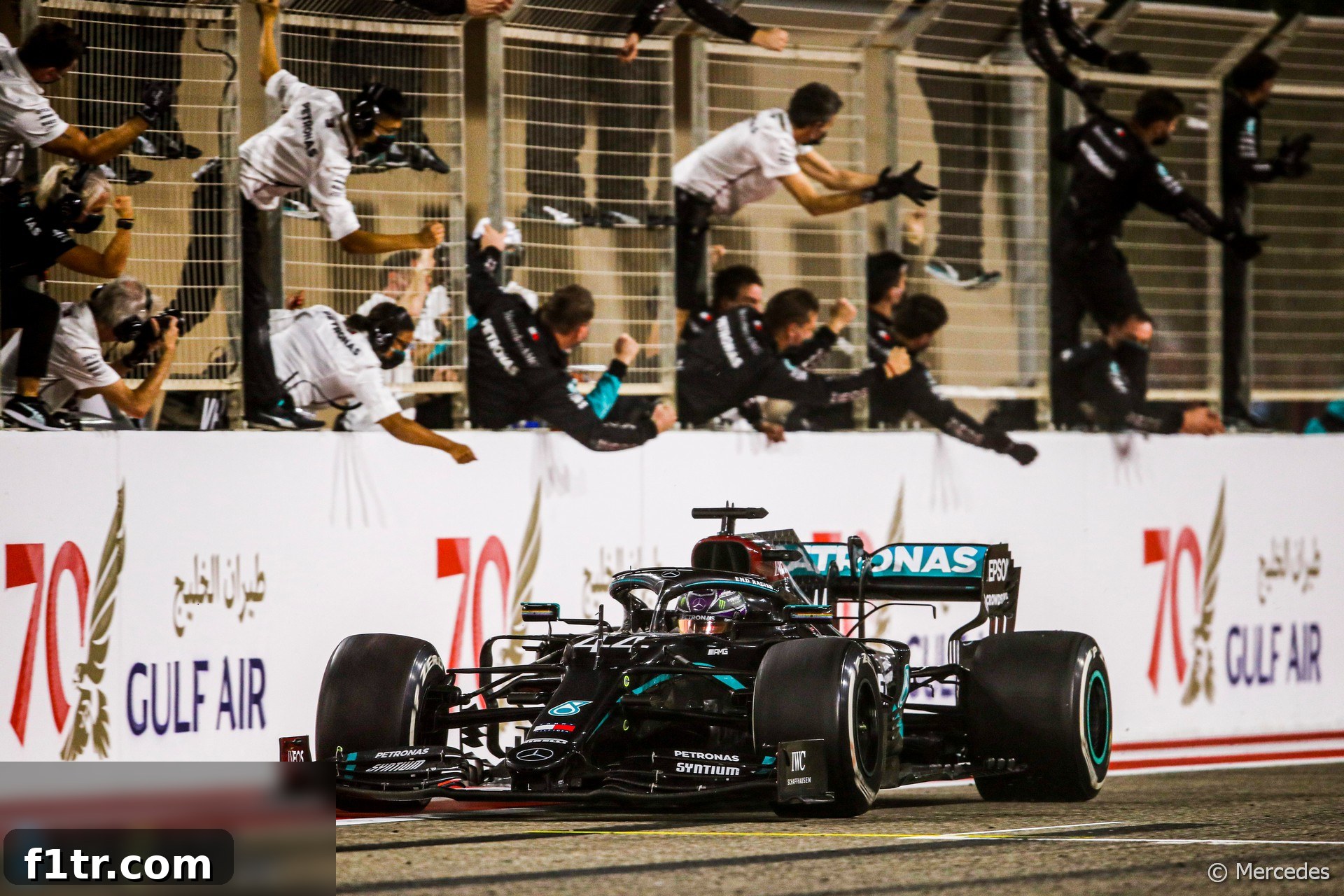
The Bahrain Grand Prix of 2020 was an event etched into Formula 1 history, not just for the dramatic and terrifying opening lap incident, but also for the relentless display of dominance by Lewis Hamilton. Once the dust settled and the incredible bravery of the medical and safety teams was acknowledged, the race culminated in a familiar sight: Hamilton crossing the finish line first from pole position, securing his 95th career victory.
This momentous win marked his fifth consecutive triumph, a personal best winning streak that underscored his unparalleled form. While extraordinary, Hamilton’s five-race streak places him among an elite group of drivers. Historically, seven other F1 legends have achieved streaks of similar or greater length, illustrating the sheer difficulty of maintaining such consistent excellence at the pinnacle of motorsport.
Hamilton’s Unprecedented Reign: A Look at His Record-Breaking Streaks
To truly appreciate Hamilton’s achievement, it’s essential to place it within the broader context of Formula 1 history. Drivers like Nigel Mansell, Jim Clark, and Jack Brabham each managed impressive streaks of five consecutive wins during their illustrious careers. These are names synonymous with greatness, having defined their respective eras with skill and dominance. Hamilton’s ability to consistently perform at this level, amidst ever-increasing competition and technological advancements, speaks volumes about his enduring talent.
The exclusive club of drivers with longer winning streaks includes some of the sport’s most iconic figures. Michael Schumacher, widely considered one of the greatest, achieved a seven-race winning streak. This feat was also matched by Nico Rosberg at the start of the 2016 season, a campaign that ultimately saw him clinch the championship title, marking Hamilton’s last championship defeat before his subsequent run of dominance.
Perhaps the most remarkable streaks belong to Alberto Ascari, who won seven successive races and, even more astonishingly, secured victories in nine consecutive appearances (excluding the 1953 Indianapolis 500, which was part of the world championship but he did not enter). More recently, Sebastian Vettel set a modern benchmark with an incredible nine consecutive wins in 2013, a testament to his and Red Bull’s absolute supremacy that season. Hamilton’s five-in-a-row firmly places him among these titans, continually rewriting the record books with each passing race.
Chasing More Milestones: Season Wins and Pole Positions
The Bahrain Grand Prix win not only extended Hamilton’s streak but also brought him closer to other significant season-long records. With two races remaining, Hamilton stood poised to equal the record for most wins in a single season – 13 victories – a benchmark currently held jointly by Sebastian Vettel and Michael Schumacher. What makes Hamilton’s potential achievement even more impressive is the context: Vettel achieved his 13 wins in a 19-race season (2013), and Schumacher in an 18-race season (2004). Hamilton, however, was on track to match this monumental figure in a condensed 17-race calendar, a testament to his extraordinary consistency and the Mercedes team’s flawless execution throughout a challenging year.
Furthermore, Hamilton was on the cusp of yet another unprecedented milestone. Should he secure pole position in the subsequent two races, he would become the first driver in the illustrious history of Formula 1 to reach an astonishing 100 career pole positions. This figure underscores his incredible raw speed and ability to extract maximum performance from his car in qualifying, a crucial aspect of grand prix racing.
Dominance Redefined: Laps Led and Unrivaled Consistency
Hamilton’s dominance in the 2020 season extended beyond race wins and pole positions; it permeated every aspect of his performance. By the close of the Bahrain Grand Prix, he had led an astounding 68.4% of all laps raced throughout the season. This statistic places him fourth in the all-time records for laps led in a single season, behind only a select few of F1’s most overwhelmingly dominant campaigns. Alberto Ascari’s crushing titles in 1952 and 1953 saw him lead over 77% of all laps, a truly untouchable benchmark of his era. Jim Clark’s masterful 1963 championship season also stands out, with the Scot leading 71% of laps. Hamilton’s 2020 performance firmly plants him among these legendary figures, illustrating his unparalleled control over the races and his ability to maintain a leading position for extended periods, rarely relinquishing his advantage.
The Bahrain Grand Prix: A Race of Drama, Resilience, and Record-Breaking Feats
While Hamilton’s triumph was the eventual headline, the Bahrain Grand Prix was a race defined by profound drama and extraordinary resilience, particularly following the horrifying crash involving Romain Grosjean.
Grosjean’s Miracle Escape: A Testament to F1 Safety
The opening lap of the Bahrain Grand Prix saw a truly terrifying incident as Romain Grosjean’s Haas veered off track, pierced the barrier, and erupted into a massive fireball. The sight sent shockwaves through the paddock and watching world. Miraculously, Grosjean emerged from the inferno after 28 seconds, suffering only burns to his hands and ankles. This incredible escape was a powerful testament to the relentless advancements in Formula 1 safety, particularly the life-saving ‘Halo’ cockpit protection device, the robust survival cell of the car, and the rapid response of the medical and safety teams. The incident led to an 80-minute delay, a necessary pause for barrier repairs and a moment for everyone to process the sheer magnitude of what had transpired. It was a stark reminder of the inherent dangers of motorsport and the extraordinary lengths taken to protect the drivers.
Red Bull’s Resurgence and Perez’s Heartbreak
Amidst the drama, Red Bull Racing showcased a strong performance, securing their first double podium finish of the year. Max Verstappen and Alexander Albon shared the podium, marking a significant achievement for the pair as teammates and a boost for Red Bull in the Constructors’ Championship battle. Verstappen, ever the relentless competitor, also claimed the fastest lap of the race, his 10th career fastest lap, putting him level with motorsport icons like Graham Hill, John Surtees, and Mario Andretti. His blistering pace was undeniable, as he set an incredible nine out of the ten fastest laps during the race – the only other driver to register a fastest lap was Daniel Ricciardo, highlighting Verstappen’s dominant speed. This performance underscored his potential for future championship challenges.
However, the race delivered a cruel blow to Sergio Perez, who had been driving a magnificent race for Racing Point and was on course for a well-deserved podium finish. A late-race MGU-K failure robbed him of what would have been his first consecutive podium finishes of his career, a particularly painful outcome given his impressive form throughout the season and his fight for a seat in the following year. It was a heartbreaking moment that exemplified the brutal highs and lows of Formula 1 racing, where mechanical reliability can snatch victory from the jaws of glory in an instant.
Sainz’s Stealthy Climb and McLaren’s Intra-Team Battle
For the second consecutive race, Carlos Sainz Jnr demonstrated remarkable recovery drive capabilities. Starting from 15th on the grid, the McLaren driver masterfully climbed 10 positions to finish fifth, showcasing his race craft and strategic acumen. Despite this impressive performance, it wasn’t quite enough to hold onto his one-point lead over teammate Lando Norris in the drivers’ championship, highlighting the intense and closely fought battle within the McLaren team as they pushed for third in the constructors’ standings.
The Longest Race: A Fitting End to a Dramatic Day
The 80-minute delay caused by Romain Grosjean’s crash meant that the Bahrain Grand Prix stretched to just under three hours. Lewis Hamilton officially won the race in two hours, 59 minutes, and 47.515 seconds. This made it the longest Formula 1 race since the notoriously wet 2016 Brazilian Grand Prix, another race won by Hamilton. Interestingly, the 2016 Brazilian GP victory took just over a minute longer for him to complete, further emphasizing the extreme conditions and extended duration of that memorable event.
The 2020 Bahrain Grand Prix will forever be remembered for its mix of horrifying drama, incredible resilience, and the relentless, record-setting brilliance of Lewis Hamilton. It was a race that encapsulated the very essence of Formula 1: danger, speed, human endeavor, and the pursuit of greatness.
Review the year so far in statistics here:
- 2020 F1 championship points
- 2020 F1 season records
- 2020 F1 race data
- 2020 F1 qualifying data
- 2020 F1 retirements and penalties
- 2020 F1 strategy and pit stops
Have you spotted any other interesting stats and facts from the Bahrain Grand Prix? Share the most intriguing numbers you’ve noticed in the comments below.
Join the RaceFans Supporters Drive!
If you’ve enjoyed RaceFans’ motor sport coverage during 2020, please take a moment to find out more about our Supporter Drive.
We’re aiming to welcome 3,000 new Supporters to help fund RaceFans so we can continue to produce quality, original, independent motorsport coverage. Here’s what we’re asking for and why – and how you can sign up:
- Join the RaceFans Supporters Drive!
Browse all 2020 Bahrain Grand Prix articles