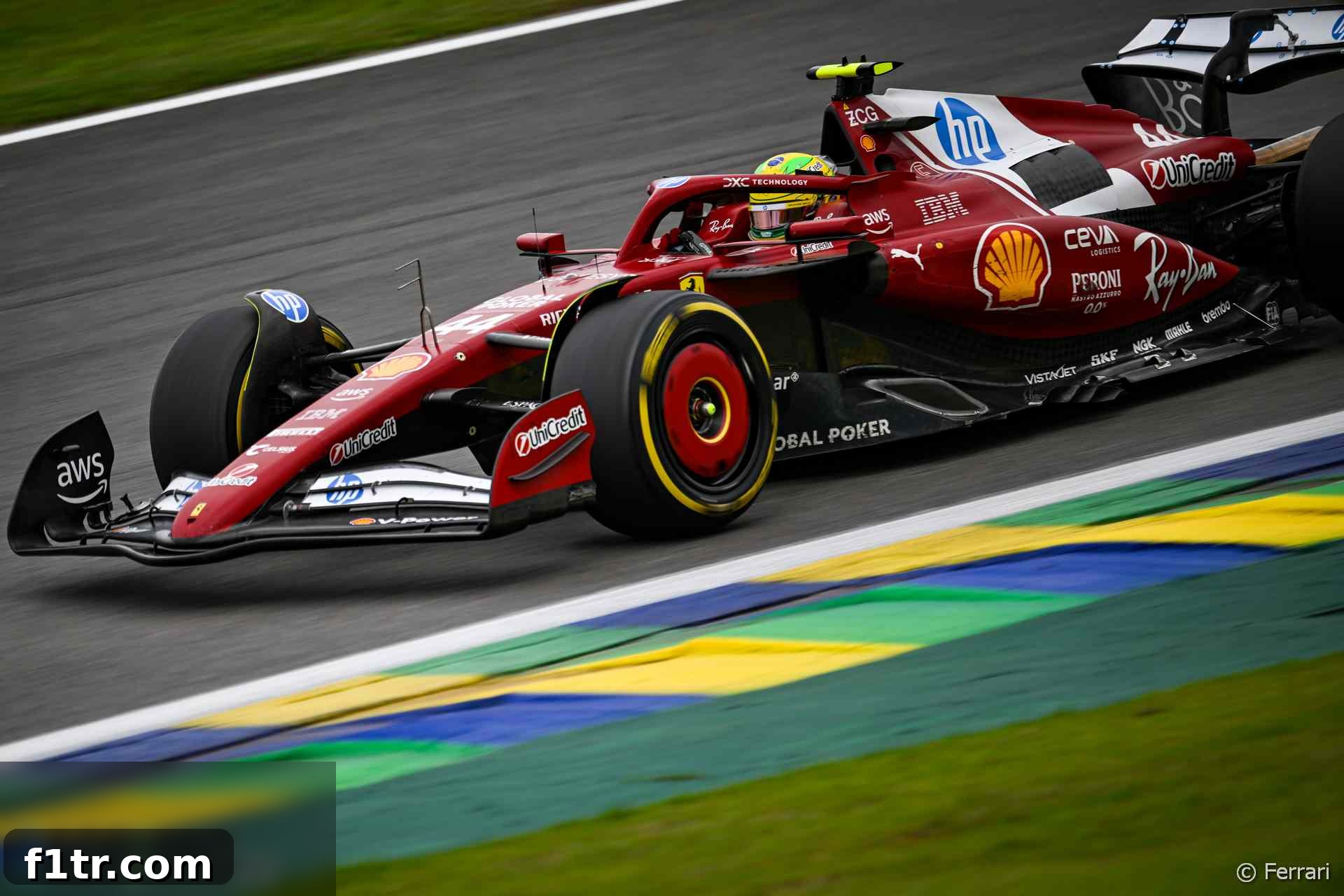
Lewis Hamilton found himself once again embroiled in controversy at the Interlagos circuit, expressing profound frustration after receiving a second consecutive penalty during the event. The incident, which significantly impacted his race, reignited debates surrounding Formula 1 stewarding and the intense pressures drivers face on track.
The Ferrari ace was hit with a five-second time penalty following a collision with Franco Colapinto of Alpine on the opening lap of the race. The contact occurred as Hamilton navigated the high-speed curve leading onto the start/finish straight, a critical section of the track where cars push the limits. Hamilton’s car made contact with the rear of the Alpine, an impact that, while seemingly minor at race speed, had severe consequences for the seven-time world champion’s challenge.
The immediate aftermath saw Hamilton voicing concerns over his car’s handling. “I’ve got damage,” he reported grimly over team radio on lap two, adding, “Yeah, I’m out of this race.” The initial assessment by the Ferrari crew confirmed a compromised front wing, which was swiftly replaced during a pit stop. However, a more critical issue was soon identified: significant damage to the car’s floor. This fundamental aerodynamic component, vital for generating downforce, was severely compromised, leading to an estimated loss of around 30 points of downforce. In the high-stakes world of Formula 1, such a deficit translates directly into a drastic reduction in grip, stability, and overall performance, effectively crippling the car’s ability to compete at the sharp end.
Despite the debilitating damage, Hamilton soldiered on, attempting to salvage what he could from the race. However, the stewards’ decision regarding the lap one incident would further complicate his efforts. It took until lap 29 for the penalty to be issued, a delay that often draws criticism for its impact on race strategy and the clarity of on-track situations. When his race engineer, Ricardo Adami, relayed the news – “we have a five-second time penalty for collision” – Hamilton’s frustration boiled over. “These guys are a joke,” he fumed, his voice laced with disbelief. “Complete joke. The car moved over on me, so I clipped my wing.” This immediate and visceral reaction underscored the depth of his exasperation, suggesting a strong belief that the incident was not entirely his fault, or at least that the penalty was unjust.
The critical damage sustained by Hamilton’s Ferrari was a direct consequence of the collision. The front wing, having made contact, broke off and was subsequently trapped underneath the car. This created a chain reaction, with the detached component scraping and tearing through the intricate carbon fibre structure of the floor. In modern Formula 1, the floor is arguably the most crucial aerodynamic element, responsible for generating a significant portion of the car’s overall downforce through ground effect. A loss of 30 points of downforce is not merely a minor setback; it’s a catastrophic blow to a car’s performance, making it incredibly difficult to maintain pace, manage tyre wear, and push for competitive lap times. For a driver of Hamilton’s calibre, accustomed to battling for victories, such a handicap transforms a race into a struggle for survival.
The timing of the penalty also played a significant role in Hamilton’s race trajectory. He had already made two pit stops to address the damage and manage his tyre strategy when the five-second sanction was announced. He then returned to the pits for his third stop on lap 32 to serve the penalty, adding further delay and track position loss. Ultimately, with his car severely compromised and any hope of a meaningful recovery extinguished, Hamilton retired from the race five laps later. This decision highlighted the futility of continuing in a car that was no longer capable of performing to the required standard, especially after incurring a time penalty.
As his car was pushed back into the garage, Hamilton sought clarification from Adami. “Which collision did I get accused of?” he asked. Adami responded, “Hit the Williams, turn 13, Colapinto,” mistakenly identifying Colapinto’s Alpine as a Williams. This minor misidentification further illustrates the chaotic nature of race control communications and the quick decisions made under pressure, although it did not alter the substance of the penalty.
The Anatomy of an F1 Penalty and Driver Conduct
Hamilton’s fiery radio message, labelling the stewards a “complete joke,” brought into focus the ongoing tension between drivers and race officials. The FIA has historically taken a dim view of such remarks, previously penalising drivers for using similar terms before revising its rules on ‘misconduct’. A notable precedent occurred at the 2023 Abu Dhabi Grand Prix, where Sergio Perez received a formal warning for expressing similar sentiments, stating “the stewards are a joke” over his radio in response to a penalty decision against him. While Hamilton’s comments were broadcast, the specific disciplinary action, if any beyond the race penalty, was not immediately detailed, leaving open questions about the consistency of enforcement regarding driver conduct.
The stewards’ official ruling attributed blame for the collision squarely to Hamilton. However, they also concluded that the contact itself was “minor enough to deserve a lenient penalty.” This distinction is crucial in F1 stewarding; while fault was assigned, the severity of the incident, rather than just the outcome, influenced the sanction. Factors such as whether the collision was intentional, the degree of impact on the other driver’s race, and potential safety implications are all weighed. In this instance, a five-second time penalty, accompanied by a penalty point on Hamilton’s licence, was deemed appropriate for an incident where the contact was judged to be relatively light, despite the extensive damage it caused to Hamilton’s own car.
Understanding the intricacies of such decisions requires a look at the broader context of F1 racing. Every manoeuvre is scrutinised, and the fine line between aggressive racing and an illegal move is often blurred. Turn 13 at Interlagos is a challenging corner, often a prime location for overtaking attempts or defending positions. Drivers are constantly pushing the limits of grip and track boundaries, making contact an ever-present risk. The stewards, operating under immense pressure and with vast amounts of data at their disposal, must make subjective judgments based on objective evidence, which rarely satisfies all parties involved.
Fan Sentiment and the Lingering Debate
The incident and subsequent penalty sparked considerable debate among fans and pundits alike, reflecting the deeply divided opinions that often follow controversial stewarding decisions. A poll conducted shortly after the race sought to gauge public perception regarding the fairness of Hamilton’s penalty for colliding with Colapinto. The results illustrated a significant split in opinion, highlighting the subjective nature of judging racing incidents.
Hamilton’s penalty for colliding with Colapinto was:
- No opinion (4%)
- Far too lenient (1%)
- Slightly too lenient (7%)
- Correct (35%)
- Slightly too harsh (21%)
- Far too harsh (32%)
Total Voters: 75
Of the 75 total voters, 35% believed the penalty was “Correct,” aligning with the stewards’ decision. However, a substantial portion of the audience felt the penalty was either “Slightly too harsh” (21%) or “Far too harsh” (32%), summing up to 53% who believed the penalty was overly severe. Conversely, a smaller percentage thought it was “Slightly too lenient” (7%) or “Far too lenient” (1%), with 4% having “No opinion.” This collective sentiment underscores the ongoing challenge for the FIA in achieving universal acceptance for its rulings, especially when a high-profile driver like Lewis Hamilton is involved.
Such outcomes are not uncommon in Formula 1, where every decision can have significant championship implications and elicit passionate responses from fans. The Interlagos incident became another chapter in the long-standing narrative of driver frustration versus official rulings, adding to the lore of contentious moments in the sport.
The repercussions of this race for Lewis Hamilton and Ferrari were clear: a lost opportunity for points, a damaged car, and a further dent to momentum. While the 2025 Brazilian Grand Prix presented its own unique challenges, this incident serves as a potent reminder of the razor-thin margins and intense scrutiny that define Formula 1. Every corner, every overtaking attempt, and every judgment call by the stewards contributes to the dramatic tapestry of the sport, fueling discussions long after the chequered flag falls.
Related Articles: Exploring the 2025 Brazilian Grand Prix and F1 Controversies
- 2026 rules will stop F1 teams making “strategic” engine changes for performance
- Tsunoda admits he could have “easily” scored points in Brazil
- Top 10: Most controversial penalty calls during a Formula 1 title fight
- Verstappen is eighth F1 driver to race from pits to podium: Brazilian GP stats
- Verstappen’s latest setback makes this season look even more like a 2007 repeat
Browse all 2025 Brazilian Grand Prix articles