Advert | Become a Supporter & go ad-free
Advert | Become a Supporter & go ad-free
Stewards Clear Hamilton and Norris Over Slow Driving Incident in Baku Q2
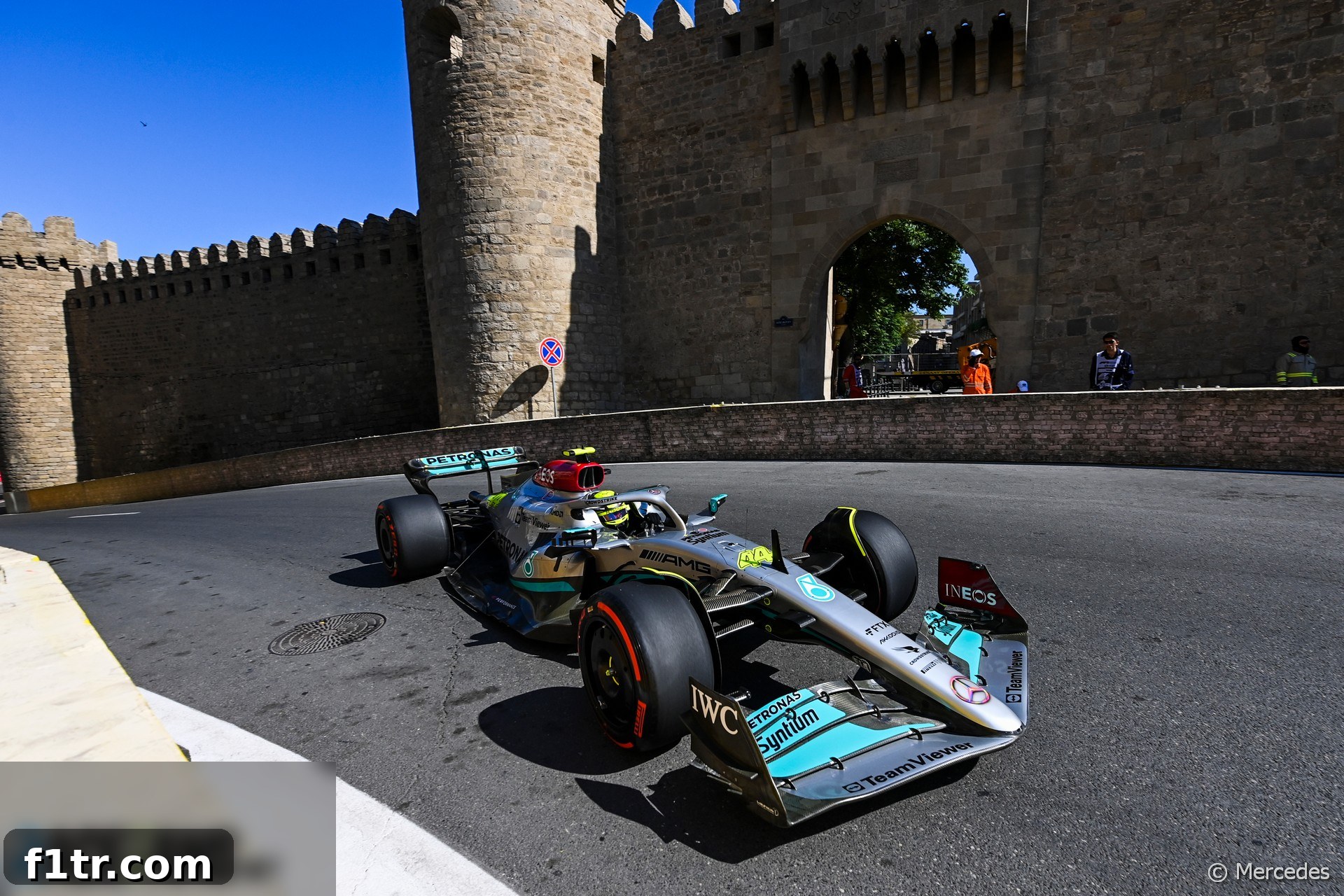
The exhilarating and often unpredictable qualifying session for the Azerbaijan Grand Prix saw its share of drama, not least an investigation into two of Formula 1’s biggest stars: Lewis Hamilton and Lando Norris. Both drivers were placed under scrutiny by the Baku stewards for driving unnecessarily slowly during the critical Q2 segment. Following a thorough review, the stewards ultimately cleared both competitors, deeming their actions permissible within the sporting regulations.
The Baku Bottleneck: A Strategic Stalemate at Turn 12
The incident that triggered the investigation occurred with approximately six minutes remaining in the second qualifying session. As both Hamilton’s Mercedes and Norris’s McLaren were on their out-laps, preparing for a crucial flying lap, they drastically reduced their speed to an almost complete stop at the exit of Turn 12. This peculiar maneuver, while appearing risky, is a common strategic ploy in Formula 1 qualifying, particularly on circuits with long straights like the Baku City Circuit.
The motive behind this strategic deceleration was clear: both drivers were vying for a slipstream, or “tow,” from the car ahead. A tow allows a following car to benefit from reduced air resistance, leading to a higher top speed on the straights and potentially shaving precious tenths off a lap time. Lewis Hamilton openly admitted his intention was to encourage Norris, and his McLaren team-mate Daniel Ricciardo who was also in the vicinity, to overtake him. This would have placed Hamilton in a prime position to benefit from the aerodynamic advantage offered by following the two McLarens down Baku’s extensive main straight.
However, Lando Norris, a shrewd competitor himself, had a similar strategy in mind. Recognizing Hamilton’s attempt to gain a tow, Norris refused to pass, creating a brief but tense standoff on track. This tactical deadlock forced Hamilton to commence his flying lap ahead of the McLarens, thus sacrificing the potential benefit of a slipstream. The lack of a tow, combined with a subsequent mistake in Turn Two, led Hamilton to abandon that particular push lap, highlighting the fine margins and strategic gambles involved in F1 qualifying.
Adherence to the Delta Time Rule: A Crucial Safety Measure
Prior to the qualifying session, Race Director Niels Wittich had issued a strict directive concerning minimum lap times between two designated Safety Car lines that straddle the pit lane entry and exit. This “maximum lap delta” of 2 minutes and 9 seconds is enforced to prevent drivers from slowing excessively on out-laps or in-laps, thereby creating dangerous speed differentials with cars on flying laps. Such regulations are vital for driver safety and to maintain a predictable flow of traffic on track, especially during high-stakes qualifying sessions where drivers are pushing to the absolute limit.
Despite the significant reduction in speed, the stewards noted that Hamilton’s out-lap time between the two Safety Car lines was precisely two minutes, well within the enforced delta time. This adherence to the established safety parameters proved to be a critical factor in the stewards’ decision. It demonstrated that while Hamilton was strategically slowing, he was still operating within the boundaries set by race control to ensure overall track safety.
Stewards’ Deliberation: Safety First and No Undue Hindrance
The stewards launched a comprehensive investigation, taking into account driver testimony and telemetry data. In his evidence, Hamilton confirmed his strategic intent: “The driver [Hamilton], in evidence, stated that he did slow down in order to endeavour to be passed by car four [Norris], to achieve a “tow” on his fast lap.” However, as Hamilton elaborated, “car four obviously had the same intent and decided not to pass him.” This mutual strategic play underscored the competitive nature of qualifying.
The stewards’ final verdict highlighted several key points that led to the clearance of both drivers. Firstly, as previously mentioned, Hamilton had respected the enforced delta time for the lap. This was a non-negotiable factor. Secondly, and equally important, the stewards observed that Hamilton had executed his slow-down maneuver in a safe and responsible manner. He had pulled over to the left of the circuit, significantly off the racing line, ensuring he did not impede or endanger any other competitor.
The location of the incident also played a role in the stewards’ assessment. The incident occurred on a relatively straight section of the track where visibility was not compromised. The stewards’ official statement concluded: “Although car 44 was slow, the stewards note that for the lap the delta time was respected, the driver pulled over to the left and off the racing line. This occurred on a straight where visibility was not an issue and there was no potential danger at any point, to any other driver.” This clear assessment of safety, combined with the adherence to the delta time, meant no penalties were warranted.
Implications and Grid Position for the Azerbaijan Grand Prix
The stewards’ decision meant that both Lewis Hamilton and Lando Norris could breathe a sigh of relief, avoiding any grid penalties that could have severely impacted their starting positions for Sunday’s main event. Hamilton, despite the strategic setback with Norris and his abandoned lap, eventually managed to navigate his way through to Q3. He secured a seventh-place starting position for the Azerbaijan Grand Prix, placing him two spots behind his Mercedes team-mate, George Russell, who qualified fifth.
While the incident itself was ultimately deemed non-punishable, it serves as a stark reminder of the intricate strategic battles that unfold even before the race begins. Formula 1 qualifying is not merely about raw speed; it’s a complex dance of timing, track position, and tactical maneuvering, all governed by a stringent set of rules designed to ensure fair play and, most importantly, driver safety. The stewards’ swift and reasoned judgment in Baku provides valuable clarity for future qualifying scenarios, reinforcing the balance between strategic competition and regulatory compliance.
Advert | Become a RaceFans supporter andgo ad-free
2022 Azerbaijan Grand Prix: Related Insights and Developments
- FIA Should Consider Black-Flagging Cars if Porpoising Threatens Driver Safety – Horner
- Transcript: Understanding Norris’s Reluctant Compliance with McLaren’s Baku Team Orders
- Drivers Express Concerns: Montreal Could Be Challenging in Stiff 2022 Cars Amid Bouncing Issues
- Ferrari Confirms Leclerc Was on Track for a Comfortable Win Before Retirement
- Lando Norris Calls for Penalties on Drivers Who Deliberately Slow Down in Qualifying
Browse all 2022 Azerbaijan Grand Prix articles and updates