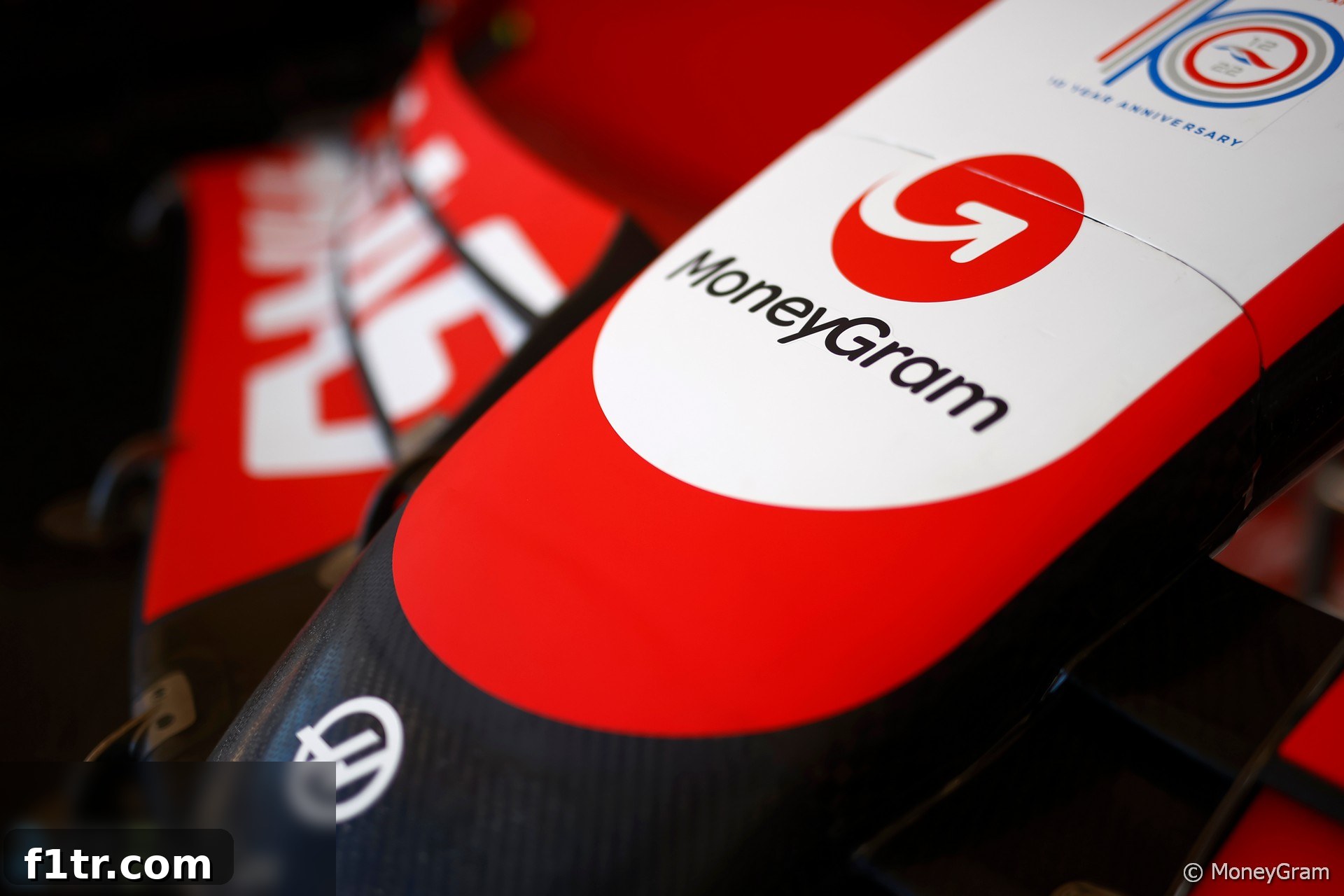
The Haas Formula 1 team is poised for a transformative year in 2023, largely thanks to a significant financial injection from its new title sponsor, MoneyGram. This strategic partnership is expected to enable the team to operate at the maximum budget allowed under Formula 1’s stringent cost cap regulations, a milestone that could profoundly impact its competitive standing.
For a team that has often navigated the competitive waters of Formula 1 with more limited resources compared to its wealthier rivals, reaching the cost cap represents a pivotal moment. It signifies not just financial stability but also the potential to invest more heavily in crucial areas such as car development, personnel, and advanced technologies. This newfound financial strength is anticipated to close the performance gap and enhance Haas’s aspirations on the global motorsport stage.
MoneyGram Partnership: A New Era for Haas F1
The announcement of a multi-year title sponsorship deal with MoneyGram last weekend marked a turning point for the Haas F1 Team. This partnership comes after a challenging period for the American outfit, which had been without a title sponsor since the start of 2022. The team had terminated its agreement with Russian firm Uralkali following Russia’s invasion of Ukraine, leaving a significant financial void.
The absence of a primary sponsor inevitably placed pressure on the team’s budget and operational capabilities throughout the 2022 season. The MoneyGram deal, therefore, isn’t just a sponsorship; it’s a lifeline and a statement of intent. It provides the financial bedrock necessary for Haas to not only sustain its operations but also to thrive within the highly competitive environment of Formula 1.
Team Principal Gunther Steiner has expressed considerable optimism regarding the implications of this deal. “The arrival of MoneyGram should get us to the cost cap, or at least very close,” Steiner stated, highlighting the direct impact on the team’s financial planning for 2023. He further elaborated on the budgeting process: “We are in the process now to do the budget for next year, so we’ll see where we get to. But that is saying, to get to the cost cap, we were not far off this year to be honest. So hopefully we are at the cost cap next year.” This indicates a gradual but determined ascent towards fully utilizing the permitted financial resources, an ambition that has been central to Haas’s long-term strategy.
Understanding Formula 1’s Cost Cap Regulations
The Formula 1 cost cap, introduced in 2021, was a revolutionary step aimed at fostering greater financial sustainability and competitive equality across the grid. Prior to its implementation, top teams could outspend their rivals by hundreds of millions of dollars, creating a stark two-tier system where success was often dictated by budget size rather than ingenuity alone.
Initially set at $145 million in 2021, the annual cap on team budgets has since seen adjustments. For 2022, it was set at $140 million, and for the upcoming 2023 season, it is slated to decrease further to $135 million (£116.8m). However, global inflationary pressures have led to discussions and potential adjustments to these figures, acknowledging the real-world economic challenges faced by teams.
The cost cap covers a broad range of expenses directly related to car performance and team operation. This includes development, manufacturing, and maintenance of the car, as well as operational costs like garage equipment, travel to races, and most personnel salaries. Crucially, certain areas are excluded from the cap, such as driver salaries, the salaries of the three highest-paid personnel, marketing expenses, engine costs (which are capped separately by the FIA), and spending on non-F1 related activities or heritage programs. This distinction is significant, as Steiner alluded to, when he mentioned the possibility of spending outside the cost cap with luxuries like private jets – an area traditionally associated with the sport’s wealthier participants but not directly tied to car performance for cap purposes.
Haas’s Journey Towards Financial Parity
Since its entry into Formula 1 in 2016, the Haas F1 Team, founded by American businessman Gene Haas, has largely operated as an independent entity, frequently relying on a leaner budget compared to established manufacturers and works teams. Despite flashes of competitiveness, the team has often faced the inherent limitations that come with financial constraints, particularly in the relentless development race of modern F1.
Reaching the cost cap is more than just about having money; it’s about having the freedom to plan and execute a comprehensive development strategy throughout the season. It means investing in crucial upgrades, attracting top-tier engineering talent, and utilizing advanced simulation tools and testing facilities to their fullest potential. For a team like Haas, operating at the cap means they can pursue performance gains with the same intensity as larger teams, reducing the risk of falling behind due to budgetary shortfalls.
Steiner’s ambition for Haas to reach the cost cap signifies a strategic shift. It underscores a desire to transform the team from a diligent midfield competitor into a consistent challenger. By being able to spend up to the maximum limit, Haas can now aim for sustained development, giving their drivers a more competitive package and offering a stronger proposition to future talent and sponsors.
Navigating the Cost Cap: Breaches and Controversies
While the cost cap has been widely lauded for its positive intentions, its implementation has not been without its challenges and controversies. Since its introduction, the FIA has been tasked with the complex job of auditing team finances and enforcing the regulations. This process has already led to several high-profile cases of non-compliance.
During the inaugural year of the cost cap in 2021, three prominent teams were found to have committed procedural breaches in the submission of their expenditure: Aston Martin, Red Bull Racing, and Williams Racing. Procedural breaches typically involve administrative errors, such as incorrect reporting or failing to follow stipulated financial processes, rather than directly exceeding the spending limit itself. These infractions, while less severe than an overspend, still highlight the complexity of the regulations and the need for meticulous financial management.
However, the most significant case involved Red Bull Racing, which was found to have exceeded the spending limit in 2021. The FIA classified this as a ‘Minor Financial Overspend’, which, according to the regulations, constitutes a breach of the cap by no more than 5%. In Red Bull’s case, this amounted to an overspend of £1.8 million (approximately $2.2 million at the time), significantly less than the 5% maximum ($7 million on a $140 million cap). Red Bull received a $7 million fine and a 10% reduction in aerodynamic testing time for a 12-month period, a penalty that sparked considerable debate across the paddock regarding its proportionality and deterrent effect.
Steiner’s Critique: The Definition of a ‘Minor Breach’
The discussion surrounding Red Bull’s overspend brought into sharp focus the interpretation of what constitutes a ‘minor’ breach, a point vocally contested by Gunther Steiner. Steiner believes that the current definition, allowing for an overspend of up to 5%, is far too lenient and undermines the spirit of the cost cap. “It should be smaller in my opinion,” he asserted.
To illustrate his point, Steiner broke down the financial implications: “If I call it now $140 million budget cap, 5% is $7 million. But in $140 million, you have got certain expenses which you cannot change.” He emphasized that while $7 million might seem a small percentage of the overall budget, its impact on competitive development is anything but minor. “So these expenses are not $7 million on development, it’s expenses, 5% on the development, it’s a bigger number. The percentage is the same, but it makes a bigger difference.”
Steiner’s argument highlights a critical aspect of Formula 1 economics: not all expenditures are equal in terms of their impact on car performance. A significant portion of a team’s budget is tied up in fixed costs, such as infrastructure, core personnel, and basic operational expenses. Therefore, any additional funds, particularly those acquired through an overspend, are likely channeled directly into performance-enhancing areas like aerodynamic development, chassis upgrades, or powertrain integration. An extra $7 million in these areas could fund substantial R&D, numerous CFD (Computational Fluid Dynamics) hours, or critical wind tunnel time, potentially yielding significant on-track performance advantages that could decide championships.
This perspective underscores the competitive integrity at stake. Even a seemingly small percentage overspend could allow a team to gain a material advantage, frustrating teams that diligently adhere to the rules. Steiner’s call to “rethink that one when the next Concorde Agreement is written” signals a desire for stronger, more precise financial regulations in the future. The Concorde Agreement is the tripartite commercial agreement between the FIA, Formula 1, and the ten competing teams, governing the sport’s commercial rights and regulatory framework. Any significant changes to the cost cap structure would likely be negotiated and enshrined within this crucial document.
The Future of F1’s Financial Landscape and Competitive Balance
The Haas F1 Team’s journey towards fully leveraging the cost cap, propelled by the MoneyGram partnership, is emblematic of Formula 1’s evolving financial landscape. The cost cap represents a bold experiment to level the playing field and foster a more competitive and sustainable sport. While its implementation has presented challenges, the overarching goal of reducing spending disparities remains critical for the long-term health and appeal of F1.
For smaller, independent teams like Haas, achieving financial parity by reaching the cost cap is not merely about surviving; it’s about having the tools to genuinely compete for points, podiums, and perhaps even challenging the established order. It empowers teams to recruit top talent, invest in cutting-edge technology, and pursue innovative design solutions without the constant shadow of budgetary limitations.
The ongoing debates surrounding the definition of minor breaches and the severity of penalties are crucial for refining these regulations. Ensuring fairness and robust enforcement is paramount to maintaining the credibility of the cost cap and preventing any team from gaining an unfair advantage. As Formula 1 continues to expand its global reach and attract new audiences, a financially stable and competitively balanced grid will be key to delivering thrilling racing and captivating storylines for years to come.
The MoneyGram deal isn’t just a win for Haas; it’s a positive indicator for the sport’s financial health and its commitment to a more equitable future. With greater financial muscle, Haas stands ready to embark on a new chapter, aiming to convert its enhanced resources into tangible on-track success and contribute to the vibrant spectacle that is Formula 1.
Related Articles
- Steiner annoyed by lack of apology from race director over COTA protest error
- How many victory chances did Hamilton have in his first winless F1 season?
- Income from new title sponsor will bring Haas up to cost cap level – Steiner
- Mexico’s first home win or Verstappen’s record 14th? Six Mexican GP talking points
- Mercedes doubt tyre strategy cost Hamilton chance to beat Verstappen to win
Browse all 2022 United States Grand Prix articles