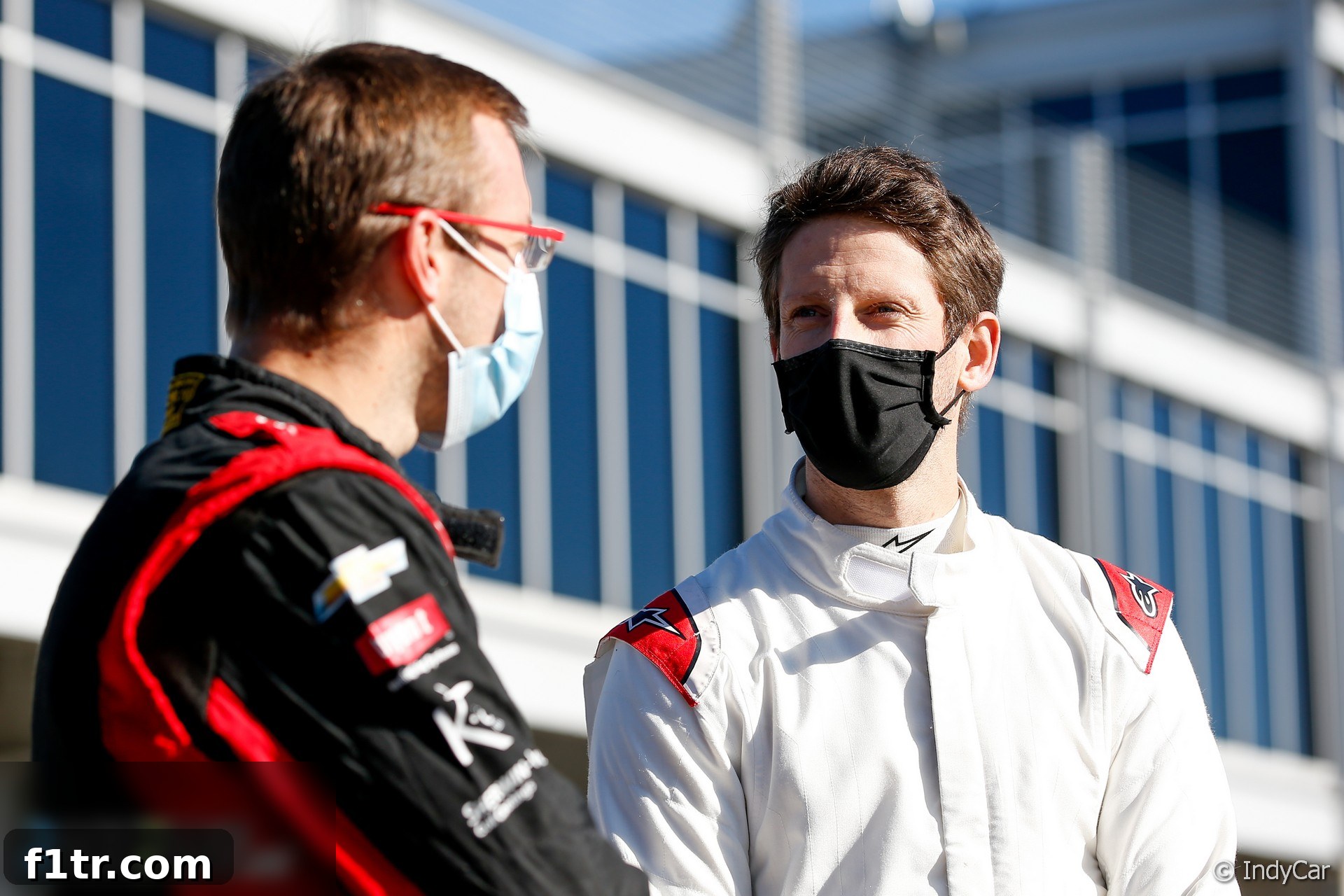
Romain Grosjean Embraces IndyCar Welcome and Adapts to New Challenges After F1 Transition
Former Formula 1 driver Romain Grosjean recently completed his inaugural IndyCar test at Barber Motorsports Park, an experience he described as remarkably welcoming. The seasoned Frenchman, known for his long and often tumultuous career in F1, admitted that his own approach to fellow competitors had matured significantly over the years, a change that aligns perfectly with the congenial atmosphere he encountered in the American single-seater series.
Grosjean’s transition to IndyCar marks a significant new chapter following his dramatic exit from Formula 1 due to a horrific crash at the 2020 Bahrain Grand Prix. The move has been widely anticipated by motorsport fans, keen to see the resilient driver back in action. His initial impressions highlight a stark contrast to the high-stakes, often solitary world of F1 paddocks.
A Warm Reception: The IndyCar Paddock Culture
“It’s definitely very different from what I used to have,” Grosjean remarked when asked about the atmosphere during his first test. This sentiment echoes a common observation among drivers who make the switch from European-based motorsport to IndyCar, where camaraderie often trumps fierce rivalries off-track.
Indeed, Grosjean’s decision to explore IndyCar was partly influenced by former Formula 1 colleague Marcus Ericsson, who successfully transitioned to the series in 2019 and has since thrived. Ericsson’s positive accounts likely painted an inviting picture of the IndyCar environment, which Grosjean now confirms firsthand.
The reception was immediate and genuine. “It’s been great,” Grosjean stated after his first day of testing. “Marcus wasn’t wrong. I’ve already had some good interaction with Sébastien Bourdais; he was in the next pit, so that was easy.” This proximity and ease of interaction between teams and drivers is a hallmark of IndyCar racing, fostering a more open and accessible atmosphere.
The friendly encounters weren’t limited to immediate neighbors. “Takuma Sato came over. I saw some of the other guys, Simon Pagenaud in the pit lane; he was driving, and I gave him a wave, and he gave it back. So generally, it’s been a great day in that aspect.” Such casual yet meaningful gestures of welcome contribute to the distinct culture of the IndyCar paddock, a stark departure from the often more reserved and competitive interactions seen in other premier racing series.
Building Team Relationships: A Matured Perspective
Grosjean will join Ed Jones at Dale Coyne Racing for the upcoming season, forming a new partnership that he anticipates will be built on mutual respect and friendliness. His reflections on past team dynamics reveal a personal evolution, recognizing the importance of positive relationships beyond the immediate competition.
“With Ed, my teammate, we have a good relationship as well,” he shared, acknowledging the foundation being laid. His candid admission highlights a shift in his professional ethos: “I told him I used to be an asshole as a teammate back in the day, but now I’m 35 and I like to be friendly.” This self-awareness speaks volumes about his growth, both as a person and a competitor.
While the desire to win remains paramount – “On track, you want to beat them, there’s no doubt” – Grosjean emphasizes the value of camaraderie outside the cockpit. “But outside of the track, I think if we can be friends, it’s mega.” This approach not only fosters a healthier team environment but also contributes to the overall positive atmosphere of the IndyCar series, where rivalries are often intense on track but respectful off it.
Back in the Cockpit: A Seamless Return and Learning Curve
For Grosjean, this test at Barber Motorsports Park was not just about getting acquainted with a new car and series; it was also his first time back in a racing machine since his fiery accident in Bahrain. The experience was, thankfully, free of apprehension, allowing him to focus entirely on the task at hand.
“It felt like home, to be fair,” he stated, a comforting declaration given the circumstances of his last race. “I didn’t have any apprehension or whatever, just going out there, learning the car.” This immediate comfort is a testament to his innate driving talent and mental resilience, crucial attributes for any top-tier racing driver.
While the initial drive was smooth, Grosjean realistically acknowledges that the true test will come during actual race conditions. “The real question is going to be a race start in April 18 here in Barber. But for now, driving the car is good.” Race starts in IndyCar, particularly on road courses like Barber, are known for their intensity and close-quarters action, presenting a different challenge compared to a solo test session.
A Spin and a Lesson: Understanding IndyCar Dynamics
His test wasn’t entirely without incident. Grosjean experienced one notable spin into a gravel trap at turn one, an occurrence that quickly became a valuable learning experience. “Basically, I just went too fast in,” he explained, showcasing his readiness to analyze and adapt.
The explanation for the spin delves into a key technical difference between IndyCar and Formula 1 machinery: the differential. “When I was on the brake, I also picked up the throttle, which you do in the high-speed. But because it’s a mechanical diff, it does open the diff when you do that and therefore it sends you, it makes the car lose [grip], whereas in Formula 1 it would actually stabilize the car.”
This insight is crucial for understanding the nuances of IndyCar driving. Formula 1 cars often feature sophisticated electronic differentials and traction control systems that allow for precise torque management, even when blending brake and throttle inputs. IndyCar, with its more traditional mechanical differential, requires a different approach. The mechanical diff reacts to torque differences between the wheels. When a driver applies throttle while braking and turning, especially in a high-speed corner, the sudden opening of the diff can cause the inner wheel to spin up and the car to lose rear grip, leading to a spin. For an F1 driver accustomed to electronic aids, this is a significant adjustment.
“So I would say it was a learning experience, and then I didn’t do it anymore, and it was better,” Grosjean concluded, demonstrating his rapid adaptation and ability to quickly integrate new knowledge into his driving style. Such moments are invaluable during testing, providing direct feedback on the unique characteristics of the car.
Navigating a “Super-Tight” Field: Performance and Adaptation
Despite the unofficial nature of the test times, Grosjean was pleased with his initial performance and impressed by the competitive intensity of the IndyCar field. “It’s definitely super-tight,” he observed, underscoring the high level of talent and close competition that defines the series. The absence of official timings often means teams are running different programs, but even without direct comparison, the feeling of intensity is palpable.
He noted some challenges with tire performance during the test. “For us, the last set of tires, I didn’t get anything out of it. It just didn’t feel great for some reason. And the sun was quite close, so visibility went down.” These variables are common in testing and racing, requiring drivers and teams to constantly adapt to changing conditions.
However, Grosjean also had encouraging moments. “But I think the set before, middle afternoon, we had a decent lap time, especially looking at the track condition, maybe a bit hotter.” Finding a strong pace mid-session, despite varied conditions, is a positive indicator for his potential.
Ultimately, the test reinforced the need for continuous effort and adaptation. “But generally, I don’t know, it’s difficult to say. It’s definitely super-tight, and we need to keep working, and I need to keep adapting my driving style and understand how to go faster in IndyCar because it’s a bit different than a Formula 1 car.” This statement encapsulates the ongoing challenge and excitement of his new venture. IndyCar machines, while powerful, demand a driving style that emphasizes mechanical grip, precise throttle control, and often a willingness to slide the car, differing significantly from the aerodynamically-dependent, ultra-precise driving required in F1.
Conclusion: An Exciting Chapter Begins
Romain Grosjean’s first IndyCar test was a resounding success, not just in terms of his performance but also in his embrace of the series’ unique culture. His candid reflections on personal growth, the warm welcome from his peers, and his rapid adaptation to the IndyCar machinery paint a promising picture for the upcoming season. The resilience shown in his recovery from the Bahrain crash, combined with his veteran experience and renewed enthusiasm, positions him as one of the most compelling stories to follow in the 2021 IndyCar season. Fans eagerly await his official race debut at Barber Motorsports Park, expecting to see a driven and more approachable Romain Grosjean tackle new challenges with characteristic flair.
IndyCar Insights
- IndyCar driver McLaughlin cleared of injury after crashing through barrier at Barber
- Schumacher says his IndyCar feels like ‘an F2 car, just with better tyres’
- IndyCar “way faster than Formula 1” in some corners, says Grosjean
- FIA to award more F1 superlicence points to IndyCar drivers from 2026
- Schumacher to race full-time in IndyCar with RLL in 2026
Browse all IndyCar articles