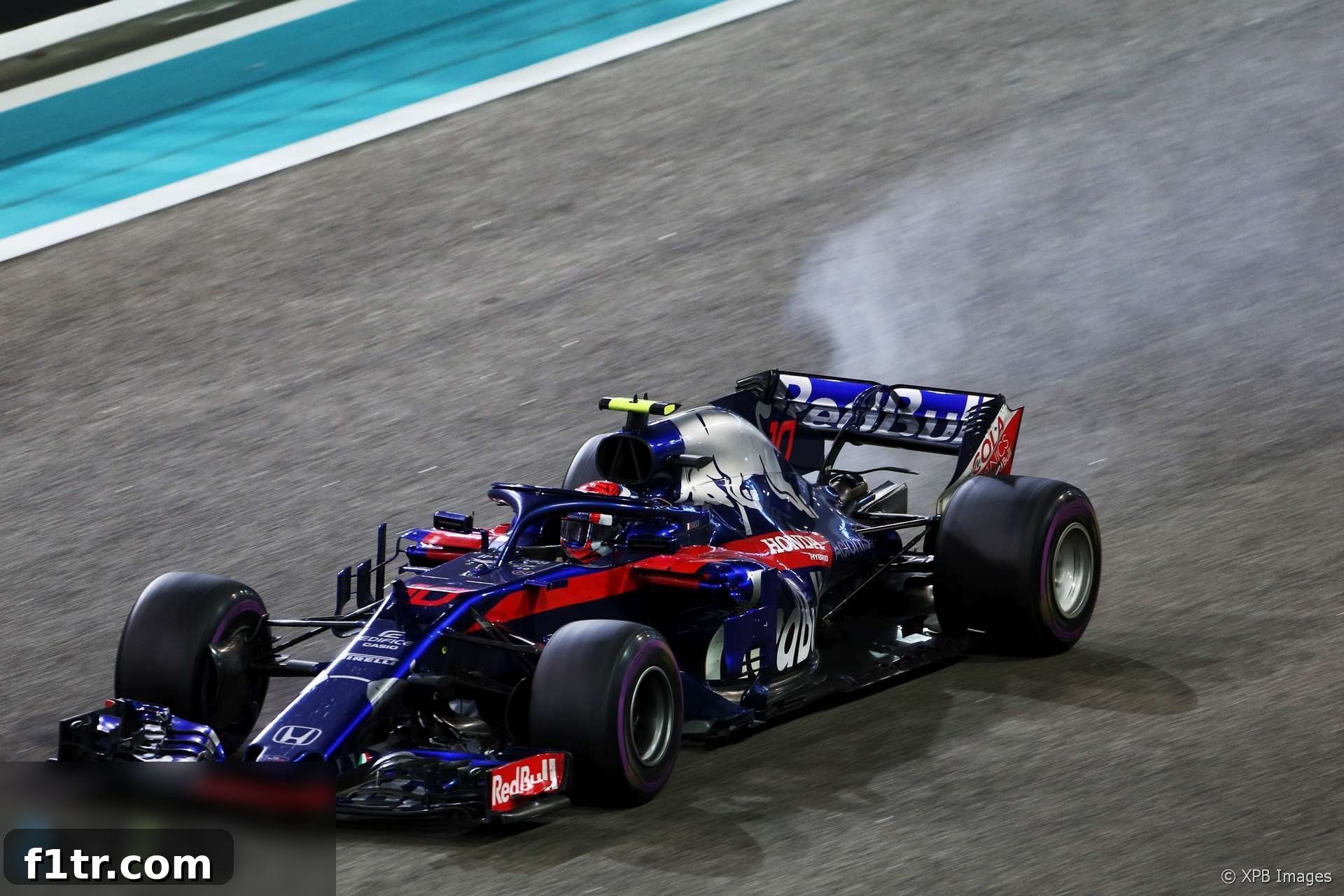
The exhilarating world of Formula 1 is a constant blend of technological marvel, driver skill, and strategic prowess. Yet, even amidst the peak of motorsport engineering, unexpected mechanical failures can trigger moments of high drama and critical safety concerns. One such incident unfolded at the 2018 Abu Dhabi Grand Prix, where Pierre Gasly’s Toro Rosso suffered a significant oil leak, prompting direct intervention from race control and raising pertinent questions about on-track safety and team communication protocols.
Race Control Demands Immediate Stop for Pierre Gasly After Alarming Oil Leak in Abu Dhabi
During the intense final laps of the 2018 Abu Dhabi Grand Prix, the air was thick with tension, not just from the competitive racing, but from a visible and dangerous oil spray emanating from Pierre Gasly’s Toro Rosso. The escalating nature of the issue quickly caught the attention of race control, leading to an urgent directive for the team to pull their driver off the track. This direct order underscored the FIA’s unwavering commitment to safety, prioritizing the integrity of the race and the well-being of all competitors over a team’s desire to continue.
The Unfolding Drama: Gasly’s Honda Power Unit Fails
Pierre Gasly, then driving for Toro Rosso, was experiencing a challenging conclusion to his race when his Honda power unit began to show critical signs of failure. What started as a plume of smoke quickly escalated into a more serious issue, with the car visibly spraying oil onto the track surface. This type of mechanical failure, particularly an oil leak, presents a significant hazard in Formula 1, as oil drastically reduces grip and can lead to dangerous loss of control for following cars, especially at high speeds. Despite the clear signs of distress from his car, Gasly’s engineer initially continued to issue blue flag messages, seemingly unaware or unwilling to acknowledge the severity of the developing engine catastrophe. It was this communication gap and the immediate danger posed by the leaking oil that forced the hand of the FIA race director.
FIA Race Director Charlie Whiting, a revered figure in motorsport for his meticulous attention to safety, revealed the proactive stance taken by race control. “We asked the team to make him stop,” Whiting stated, emphasizing the urgency of the situation. He further clarified the communication breakdown: “His engineer was still giving him blue flag messages and not addressing the fact that the engine was about to expire.” This insight highlights the complex environment of race communications, where a flurry of information can sometimes obscure critical issues. Only after race control’s explicit instruction did the team relay the message to Gasly, who then promptly pulled his stricken car off the circuit, ensuring no further oil was deposited onto the racing line.
Max Verstappen’s Terrifying Encounter with Oil Spray
The immediate danger of Gasly’s failing engine was acutely felt by Max Verstappen, who was running directly behind the Toro Rosso at the time. Verstappen’s candid comments after the race painted a vivid picture of the treacherous conditions. “The last few laps were not that easy as there was a Toro Rosso leaking oil onto my helmet,” he recounted, expressing his frustration and concern. “I couldn’t really see where I was going.” This direct exposure to oil spray not only compromised his visibility, a critical element for F1 drivers navigating at speeds exceeding 300 km/h, but also underscored the potential for a catastrophic accident. Reduced visibility, especially in the turbulent air behind another car, can lead to misjudgments, making even routine braking or cornering maneuvers incredibly risky.
Verstappen’s experience served as a stark reminder of the domino effect a mechanical failure can have. While Gasly’s immediate retirement addressed the source of the problem, the residual oil and the brief period of obscured vision for following drivers highlighted the fine line between a minor incident and a major pile-up. The potential for a high-speed collision due to impaired visibility on a circuit as demanding as Yas Marina is a nightmare scenario that race control constantly strives to prevent.
Esteban Ocon’s Similar Predicament and FIA’s Track Safety Protocols
Interestingly, Gasly was not the only driver to suffer an oil leak during the 2018 Abu Dhabi Grand Prix. Esteban Ocon also retired from the race with oil leaking from his Force India. However, the circumstances surrounding Ocon’s retirement and race control’s response differed slightly. Whiting addressed Ocon’s situation, stating, “I suppose he could have pulled off a little earlier, but he tried to get back to the pits as we saw. I think it was all okay.” This implies that Ocon’s leak was perhaps less severe or less directly on the racing line, allowing him to attempt to limp back to the garage, a common protocol for teams hoping to preserve engine components or minimize track disruption.
Whiting further elaborated on the FIA’s approach to track safety regarding fluid leaks. “We weren’t aware of any oil on the track. There may have been some oil in there in the smoke which was probably a minor inconvenience by comparison with oil on the track.” This distinction is crucial. While smoke and some residual oil mist can be an inconvenience, a direct deposition of liquid oil onto the racing surface is considered far more dangerous. F1 marshals play a vital role in this process, acting as the eyes and ears of race control. “Marshals are more focused on making sure that there’s no oil on the track, that’s what they’re trained to report to us,” Whiting confirmed. He concluded with a definitive statement on the FIA’s policy: “Obviously if an engine’s dropping oil on the track we would ask the team to stop the car immediately.” This protocol underscores the instantaneous reaction required when a direct threat to track grip and driver safety is identified.
The Broader Implications: Honda’s Reliability and F1 Engine Challenges
The 2018 season was a pivotal one for Honda in Formula 1. After a tumultuous period with McLaren, Honda had partnered with Toro Rosso, essentially using the junior Red Bull team as a proving ground for their significantly redeveloped power unit ahead of a full factory partnership with Red Bull Racing in 2019. Incidents like Gasly’s oil leak highlighted the ongoing challenges in achieving bulletproof reliability in the incredibly complex and highly stressed hybrid F1 power units. While Honda had shown promising performance gains, reliability remained a key hurdle. Engine failures not only lead to retirements but can also incur grid penalties in subsequent races if too many components are used beyond the allocated quota for the season. For a team like Toro Rosso, every point and every completed race lap was crucial for development and championship standing.
Such mechanical failures also have significant financial implications for teams, both in repair costs and potential loss of prize money from a missed finishing position. Moreover, they can impact team morale and undermine confidence in the power unit supplier. The balance between pushing the boundaries of performance and ensuring the durability of these sophisticated engines is a constant engineering tightrope walk for all manufacturers in Formula 1.
Lessons Learned: Enhancing Safety and Communication in Formula 1
The Abu Dhabi incident involving Pierre Gasly, while resolved without major consequence, provided valuable insights into the layers of safety protocols and communication within Formula 1. It reaffirmed the critical role of the FIA race director as the ultimate authority in ensuring safe racing conditions, capable of overriding team instructions when necessary. It also highlighted the necessity for seamless and real-time communication between race control, teams, and drivers, especially when mechanical failures pose immediate threats. The marshals’ diligent work in monitoring track conditions is another cornerstone of F1 safety, proving their invaluable contribution to keeping races safe and fair.
In a sport where fractions of a second and millimeter-perfect precision define success, the constant vigilance against unforeseen circumstances remains paramount. The 2018 Abu Dhabi Grand Prix oil leak incident stands as a potent reminder of the inherent dangers of motorsport and the unwavering dedication of the FIA and its personnel to mitigate those risks, constantly striving to enhance safety without compromising the exhilarating spectacle of Formula 1 racing.
Related Articles from the 2018 F1 Season:
- F1 feared “death knell” for Drive to Survive after Ferrari and Mercedes snub
- McLaren staff told us we were “totally crazy” to take Honda engines in 2018 – Tost
- ‘It doesn’t matter if we start last’: How Red Bull’s junior team aided Honda’s leap forward
- Honda’s jet division helped F1 engineers solve power unit problem
- McLaren Racing losses rise after Honda split
Browse all 2018 F1 season articles