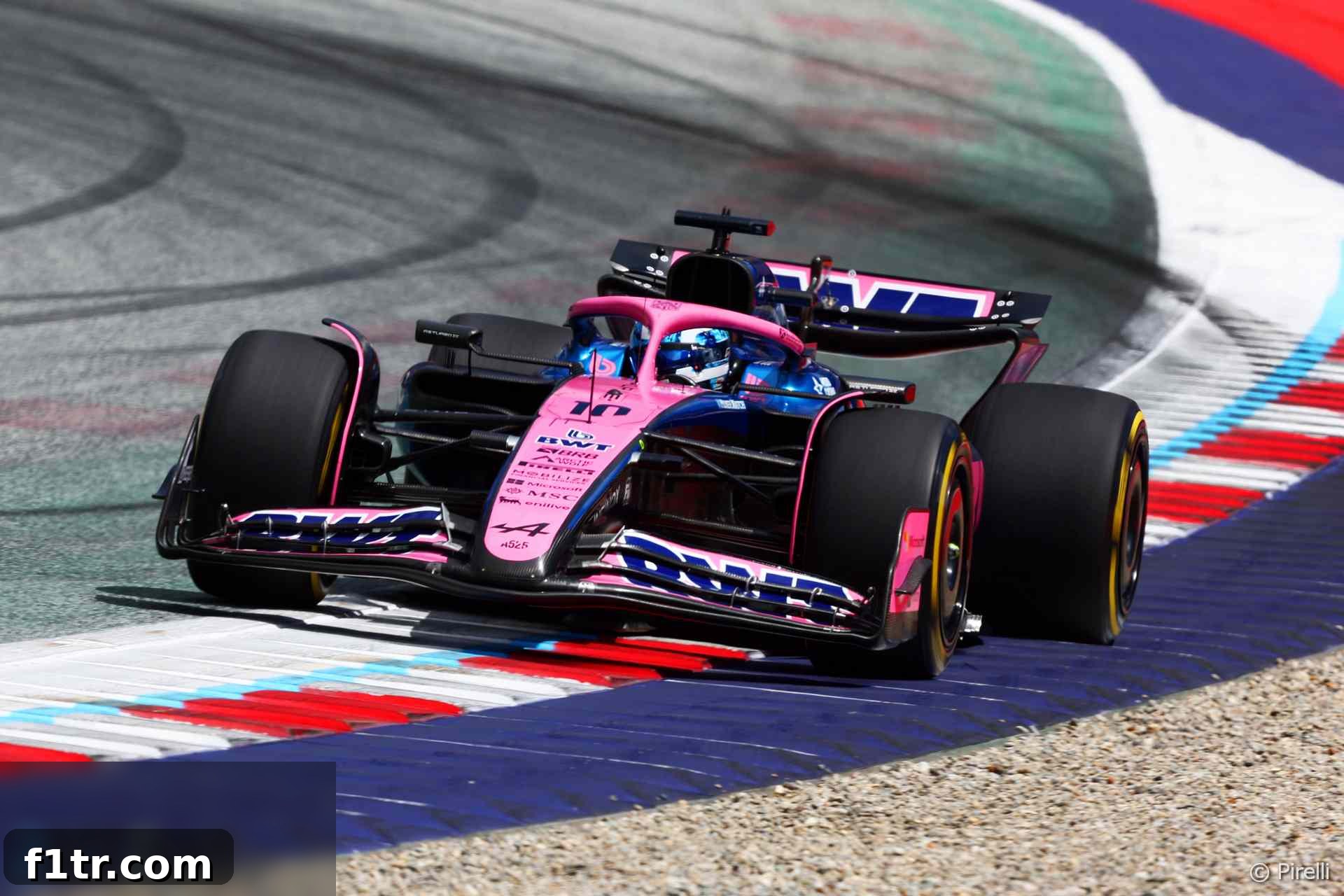
Pierre Gasly, the Alpine driver, found himself at the epicenter of a dramatic conclusion to Q3 at the Austrian Grand Prix. Convinced he could extract even more precious lap time from his car in the notoriously challenging final corner, Gasly pushed the absolute limits, only to spin out in a critical moment. This single mistake, while personally frustrating for the Frenchman, triggered yellow flags that reverberated throughout the pit lane, reshaping the qualifying landscape and significantly impacting the battle for pole position for several top contenders.
Pierre Gasly’s Q3 Drama: The Spin That Shook Austrian GP Qualifying
The atmosphere at the Red Bull Ring was electric as the final moments of Q3 unfolded, with drivers on their ultimate flying laps, each seeking to gain those critical hundredths of a second that could separate pole from the rest of the grid. For Pierre Gasly, this was his golden opportunity to capitalize on what had been a surprisingly strong qualifying session for the Alpine team. His race engineer’s directive echoed in his ears: “make it count” and “push those last two corners,” a clear instruction to leave absolutely nothing on the table in pursuit of maximum performance.
The Ill-Fated Final Lap and Its Cascading Consequences
As Gasly accelerated through the penultimate sector, his focus narrowed entirely on the final turn, a corner infamous for its high-speed entry and the fine margins between glory and mishap. He had identified a minuscule window to find additional speed there, a belief fortified by his strong Q2 performance where he had posted a time good enough for fifth position. “I knew after Q2 I had a tiny bit of speed to get in the last corner,” Gasly later explained, articulating his determined mindset to extract every last ounce of pace. However, in the high-stakes realm of Formula 1, the line between heroics and errors is extraordinarily thin, and Gasly was about to experience this brutal reality firsthand.
Attempting to carry more speed and tighten his line, Gasly misjudged his entry into the critical final turn. “When I turned in I didn’t manage to turn the car so I washed out a bit and missed the apex,” he recounted, detailing the crucial error. In a corner where precision is paramount, even a fractional deviation can have dire consequences. As he instinctively tried to correct the car and apply power, one wheel inevitably dipped into the unforgiving gravel trap, instantly sending the Alpine A524 into an uncontrollable spin. “Everything went very fast so it was pretty hectic,” he added, vividly describing the sudden, violent, and unforgiving nature of the incident that abruptly ended his pursuit of a higher grid slot.
The immediate aftermath of Gasly’s spin was the swift deployment of yellow flags, a standard safety protocol designed to alert drivers to an incident ahead and mandate a reduction in speed. However, the timing of these flags proved to be devastatingly impactful for several front-running competitors who were trailing just behind Gasly on their own crucial final runs. Oscar Piastri, who was demonstrating formidable pace and looked set to challenge for a top spot, found his last attempt at pole nullified. More significantly, Max Verstappen, the reigning world champion and a strong contender for pole, also had his only chance to set a competitive time on new tires effectively destroyed. The yellow flags meant he had to lift off the throttle, thereby ending his challenge for the top spot. Young talent Andrea Kimi Antonelli, too, saw his final flying lap aborted, denying him the opportunity to improve his grid position. The pole position fight, which had been building to an enthralling climax, was abruptly decided not by sheer speed or driver skill, but by a single, unfortunate error and its widespread regulatory repercussions.
Gasly’s Candid Reflection: Disappointment Tempered by Strategic Determination
Emerging from his car, the emotions for Pierre Gasly were a clear mix of frustration and a degree of satisfaction. While the disappointment of his Q3 mistake was palpable, there was also a discernible relief and pride in having guided the Alpine into the top ten, securing a valuable spot in the final qualifying segment, which was a significant achievement given their challenging season. “Obviously I’m not happy with my mistake in the end,” he openly admitted to the official F1 channel after qualifying. His initial ambition to find that elusive extra bit of speed had unfortunately backfired, leaving him last in Q3, a stark contrast to his impressive Q2 performance which had seen him comfortably within the top five.
Gasly’s willingness to immediately take full responsibility for the error was evident and commendable. He acknowledged that he was “pushing the absolute limit,” a testament to his unwavering commitment to extract every last fraction of performance from the Alpine A524. In the high-stakes, pressure-cooker environment of Formula 1 qualifying, drivers are perpetually flirting with the very edge of control, and sometimes, that edge unmercifully bites back. His detailed explanation of the incident – missing the apex, the car washing out, and the immediate, unavoidable consequence of hitting the gravel – offered profound insight into the split-second decisions and razor-thin margins that define a qualifying lap. Despite the momentary disappointment and the immediate impact on his grid position, Gasly’s professional demeanor, his immediate analytical breakdown of the situation, and his forward-looking resolve underscored his experience and maturity as a top-tier racing driver.
Alpine’s Unexpected Glimmer of Hope in a Stagnant Season
Beyond Gasly’s individual setback, his exceptional performance and the collective effort of the Alpine team offered a rare and much-needed glimmer of positivity in what has been an undeniably difficult and often frustrating year. Currently languishing at the very bottom of the constructors’ championship standings, Alpine has struggled significantly with the inherent pace and overall competitiveness of their A524 challenger. Therefore, Gasly’s unexpected presence in Q3, defying many pre-qualifying predictions, served as a crucial morale booster for the entire Enstone and Viry-Châtillon operations. “Looking at the performance, I think that’s the most important [thing],” Gasly stated, consciously shifting the focus from his personal mistake to the broader, more encouraging team achievement.
“We thought we’d struggle to get there and we had actually very good pace throughout the whole quali,” he continued, expressing genuine surprise and profound satisfaction with the car’s newfound potential. This unexpected turn of events suggests that the team might finally be finding some meaningful improvements, or perhaps the unique characteristics and demands of the Red Bull Ring circuit serendipitously played into their hands. Whatever the underlying reason, the team’s ability to extract “very good potential performance from this package” offered a much-needed shot in the arm for the beleaguered French squad. It hinted that their tireless development efforts, often unseen by the public, might finally be bearing some tangible fruit. For a team that has endured significant internal restructuring, leadership changes, and considerable public scrutiny over their lackluster performance, reaching Q3 was not just a small victory, but a crucial psychological boost, signaling a potential upward trajectory.
Eye on the Race: Securing Crucial Championship Points
With the complexities and drama of qualifying firmly behind them, Gasly’s attention immediately pivoted towards Sunday’s main event – the Austrian Grand Prix itself. Starting within the coveted top ten, even after the Q3 spin, presents an invaluable opportunity for Alpine to score their first truly meaningful championship points of the season. Gasly, ever the pragmatist and strategic thinker, readily acknowledged the inherent challenges that lay ahead. “Sundays generally I think are always a bit harder for us,” he conceded, recognizing that consistent race pace has often been a discernible area of weakness for Alpine when compared to their flashes of qualifying brilliance.
Despite this honest assessment, his determination and strategic focus remained unwavering. The primary objective for the race was crystal clear: secure championship points. “We start within the points, we need a good start and try to see what we can do from there,” he articulated, outlining a straightforward yet challenging plan. The psychological and championship implications of finishing inside the top ten are profoundly significant, especially for a team fighting tooth and nail to climb out of the championship cellar. “It doesn’t matter if you’re 11th or 15th. What matters is to be in the top 10 and get those points,” Gasly emphatically emphasized. This sentiment underscores the intense competition pervading Formula 1’s midfield and the immense premium placed on every single point earned, as each can dramatically alter a team’s standing and financial prospects.
A strong race performance, successfully converting their unexpected qualifying pace into tangible championship points, would not only provide a much-needed tangible reward for the team’s relentless efforts but also thoroughly validate their ongoing development work and strategic direction. It would serve as a powerful statement of intent, suggesting that Alpine is indeed capable of fighting their way back up the competitive grid, one crucial point at a time. For Gasly, the task of maintaining a position within the points-scoring places will demand a flawless start, disciplined and intelligent driving throughout the race, and impeccable strategic execution from the pit wall. The entire focus now shifts entirely to maximizing this newfound potential and ensuring that the promise shown on Saturday translates into a concrete, points-scoring result on Sunday, offering a much-needed ray of hope and renewed ambition for the embattled French racing team.