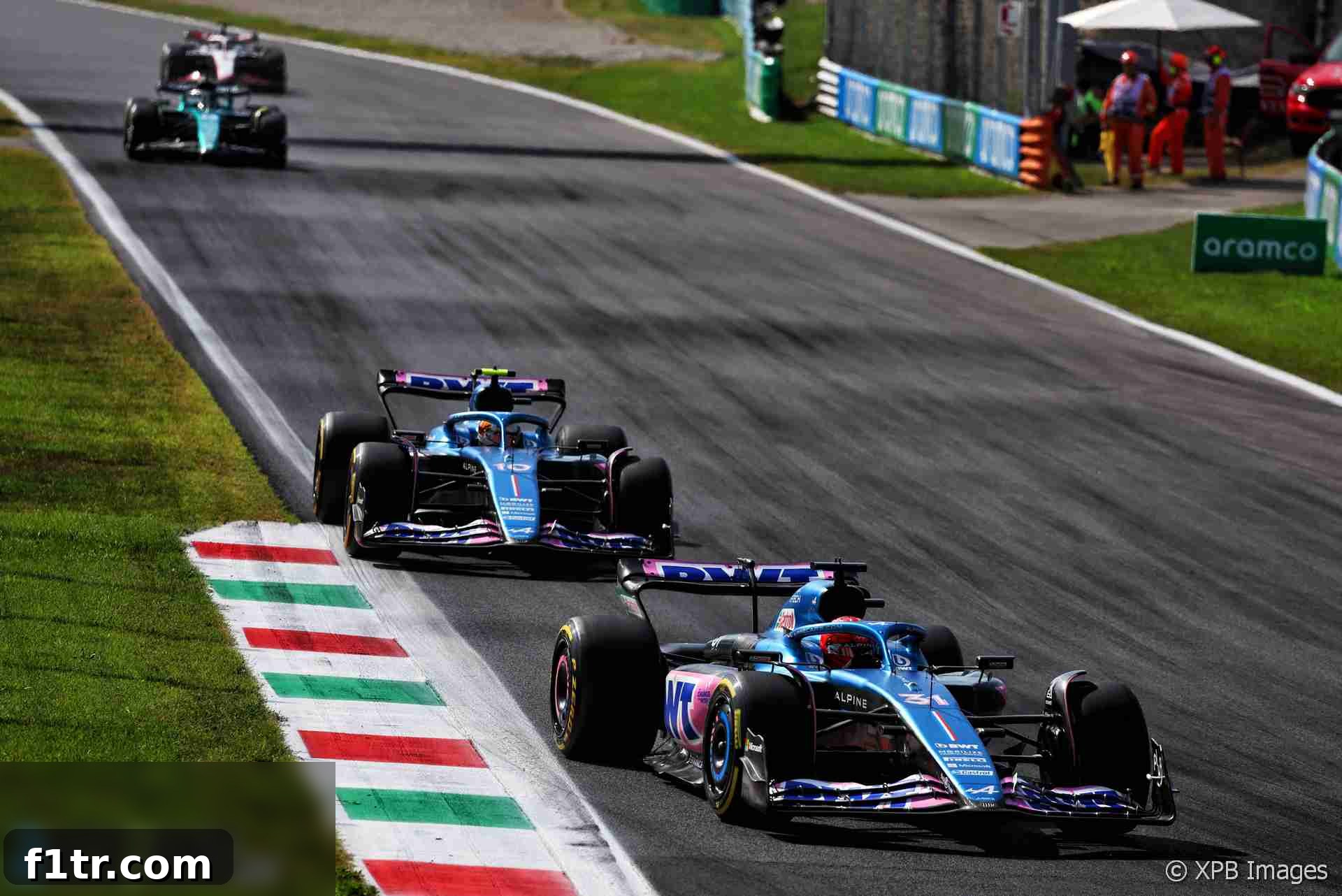
The 2023 Italian Grand Prix proved to be a challenging and ultimately disheartening weekend for the Alpine Formula 1 team. What was anticipated to be a tough outing at Monza, the revered “Temple of Speed,” turned into a stark exposure of the team’s current limitations, leaving both drivers, Pierre Gasly and Esteban Ocon, deeply frustrated and the team with much to ponder. After a remarkable podium finish at Zandvoort just a week prior, Pierre Gasly plummeted to a disappointing 15th place, while his teammate Esteban Ocon was forced to retire from the race prematurely due to a steering problem, underscoring the team’s struggles throughout the weekend.
A Disastrous Weekend at the Temple of Speed
Monza, with its iconic long straights and fast corners, demands a unique car setup characterized by extremely low downforce to maximize straight-line speed. It’s a circuit where aerodynamic efficiency and raw power are paramount, often revealing the inherent strengths and weaknesses of a car’s entire package. For Alpine, the A523 simply could not find its rhythm on this historic track. The struggles began in Saturday’s qualifying session, where both Gasly and Ocon failed to progress beyond Q1 – a rare and concerning occurrence for a factory-backed team with ambitions of climbing the constructors’ standings. This immediate lack of pace set a somber tone for the rest of the weekend, confirming the team’s pre-race apprehensions that Monza would indeed be a formidable challenge.
Qualifying Calamity: A Sign of Deeper Issues
The double Q1 elimination sent shockwaves through the Alpine garage. Both drivers openly admitted that their performance was “not good enough,” a candid assessment reflecting the severity of their competitive deficit. For a team that has consistently aimed to be at the front of the midfield pack, finding themselves rooted at the back in qualifying was a bitter pill to swallow. This inability to extract performance on a power-sensitive circuit like Monza pointed towards fundamental issues, raising questions not just about the Renault power unit but also the aerodynamic efficiency of the A523 in its lowest downforce configuration. The drivers’ inability to find any meaningful pace suggested that the car’s inherent characteristics were ill-suited to the demands of the Italian circuit, leaving them with little hope for a miraculous turnaround on Sunday.
Race Day Realities: Strategies and Setbacks
Sunday’s race offered little respite for the Alpine drivers. Gasly, still reeling from his Q1 exit, faced a race where every lap was a battle against a car that simply lacked the pace to compete. “It’s been super-painful,” Gasly confessed to media outlets, including RaceFans, after the race. “I don’t think we have ever had such a lack of competitiveness compared to our rivals.” His strategy, described as a “gamble” due to the significant performance deficit, involved an early pit stop and subsequently a second stop with 20 laps remaining, yet he could not climb higher than 15th. The painful reality was that he was nearly lapped by race winner Max Verstappen by the chequered flag, a stark indicator of Alpine’s struggles.
Esteban Ocon, meanwhile, managed to make some initial progress, climbing to tenth place before his planned pit stop on lap 24 of 51. However, his race ultimately ended in disappointment as a steering problem forced his retirement. Despite his early gains, Ocon’s eventual retirement highlighted the fragility and unreliability that can compound performance issues. Even before his mechanical setback, he had dropped to last after his pit stop, only moving up places as other drivers pitted or retired. His race was a testament to the uphill battle Alpine faced, even before technical woes intervened.
Advert | Become a RaceFans supporter andgo ad-free
Unpacking Alpine’s Performance Deficit
The core of Alpine’s struggles at Monza can be attributed to a combination of factors, primarily the characteristics of the A523 and its Renault power unit. Monza’s emphasis on straight-line speed inevitably puts the spotlight on engine performance, and Alpine has openly voiced concerns about their Renault power unit in recent weeks. They had previously unsuccessfully lobbied the FIA to equalize performance between engine manufacturers, arguing that they have been disadvantaged by the engine development freeze that came into effect at the beginning of last year. This freeze has, in their view, locked in a performance gap that they are unable to address through further development, leaving them vulnerable on power-sensitive circuits.
The Power Unit Predicament: Renault’s Struggle
The engine development freeze, implemented to control costs and prevent an escalating arms race, has indeed created a challenging landscape for manufacturers. For Renault, it means they are currently operating with a power unit specification that, according to Alpine’s internal assessments, lags behind their competitors. This competitive disadvantage becomes particularly glaring at tracks like Monza, where engine power directly translates into lap time. While the FIA aims for parity, the complex nature of F1 engine development means that achieving true performance equality is an ongoing and often contentious debate. Alpine’s persistent lobbying highlights their belief that the current regulations are unfairly penalizing them, especially when facing rivals with perceived superior engine packages.
Beyond the Engine: The A523’s Overall Package
However, Pierre Gasly’s assessment suggests that the problem runs deeper than just the power unit. He stressed that “it’s the whole package which has got to be better for this track,” indicating that the A523 chassis and aerodynamic concept also played a significant role in their underwhelming performance. While Monza demands a low-downforce setup, achieving this without sacrificing too much stability or cornering grip is a delicate balance. It appears the A523 struggles to find this optimal balance, possibly lacking the inherent aerodynamic efficiency to be fast in a low-drag configuration. This implies that even if the Renault power unit were on par with competitors, the car’s fundamental aerodynamic characteristics might still leave it at a disadvantage on circuits requiring extreme efficiency and minimal drag. Understanding and rectifying this “whole package” issue will be crucial for Alpine’s future development and competitiveness.
Driver Perspectives and Team Resilience
The drivers’ reactions encapsulated the team’s predicament. Gasly’s raw honesty about the “painful” lack of competitiveness painted a vivid picture of the challenge. For a driver who had just stood on the podium, to be so far adrift a week later is a testament to the volatile nature of Formula 1 and the specific difficulties Alpine faced at Monza. Esteban Ocon, while also disappointed, took a more measured approach, viewing the Monza weekend as “a good one in terms of learning and looking at the difficulties that we had.” His stoic perspective, perhaps forged from tougher times earlier in his career with teams like the now-defunct Manor squad where he experienced even greater performance deficits, highlights the resilience required in F1. “I’ve had worse [weekends] in the past,” Ocon noted, offering a glimmer of determination. This mindset will be vital for Alpine as they navigate the remainder of the season and plan for 2024.
Looking Ahead: Analysis and Anticipation
The two weeks leading up to the Singapore Grand Prix offer Alpine a critical window for in-depth analysis. Ocon expects “plenty of analysis” to be conducted, and this will be essential to truly quantify the sources of their performance drop. Understanding whether the issues were predominantly power-related, aerodynamic, or a combination of both, will dictate their development path. The upcoming Singapore Grand Prix, a high-downforce street circuit, presents a completely different challenge and will be a crucial test of the A523’s versatility and the team’s ability to adapt. While Monza exposed a glaring weakness, Alpine remains committed to improvement. Gasly’s hope to “come back next year with a stronger package” underscores the long-term vision, but immediate lessons from Monza must be applied to salvage what they can from the current season and build a more competitive foundation for the future.
Bringing the F1 news from the source
RaceFans strives to bring its readers news directly from the key players in Formula 1. We are able to do this thanks in part to the generous backing of our RaceFans Supporters.
By contributing 1 per month or 12 per year (or the equivalent in other currencies) you can help cover the costs involved in producing original journalism: Travelling, writing, creating, hosting, contacting and developing.
We have been proudly supported by our readers for over 10 years. If you enjoy our independent coverage, please consider becoming a RaceFans Supporter today. As a bonus, all our Supporters can also browse the site ad-free. Sign up or find out more via the links below:
- Become a RaceFans Supporter
- RaceFans Supporter FAQ
Advert | Become a RaceFans supporter andgo ad-free
2023 Italian Grand Prix
- Despite close battles at Monza, F1 drivers want more powerful DRS
- Monza “frustrating” for Alonso but Aston Martin expect better form in coming races
- F1 changed rules to stop Mercedes in 2021 but we won’t ‘cry foul’ now – Wolff
- McLaren will bring ‘follow-up to Austria upgrade’ before focusing on 2024 car
- Magnussen explains why his driving style rarely works with the Haas VF-23
Browse all 2023 Italian Grand Prix articles