The exhilarating yet often unforgiving world of Formula 1 consistently delivers moments of high drama, and the 2012 Japanese Grand Prix at Suzuka was certainly no exception. Among the many narratives unfolding on the iconic circuit, one incident quickly overshadowed others: a first-lap collision between seasoned veteran Mark Webber and the then-rookie Romain Grosjean. This wasn’t merely a racing incident; it ignited a fiery verbal exchange, reigniting debates about driver conduct, safety, and the intense pressures of Grand Prix racing. Webber, known for his frankness, did not hold back in his assessment, famously labeling Grosjean a “first-lap nutcase” and expressing immense frustration over what he perceived as a preventable and recurrent error. The incident became a defining moment in Grosjean’s early career, further cementing a reputation he was desperately trying to shed.
Advert | Become a Supporter & go ad-free
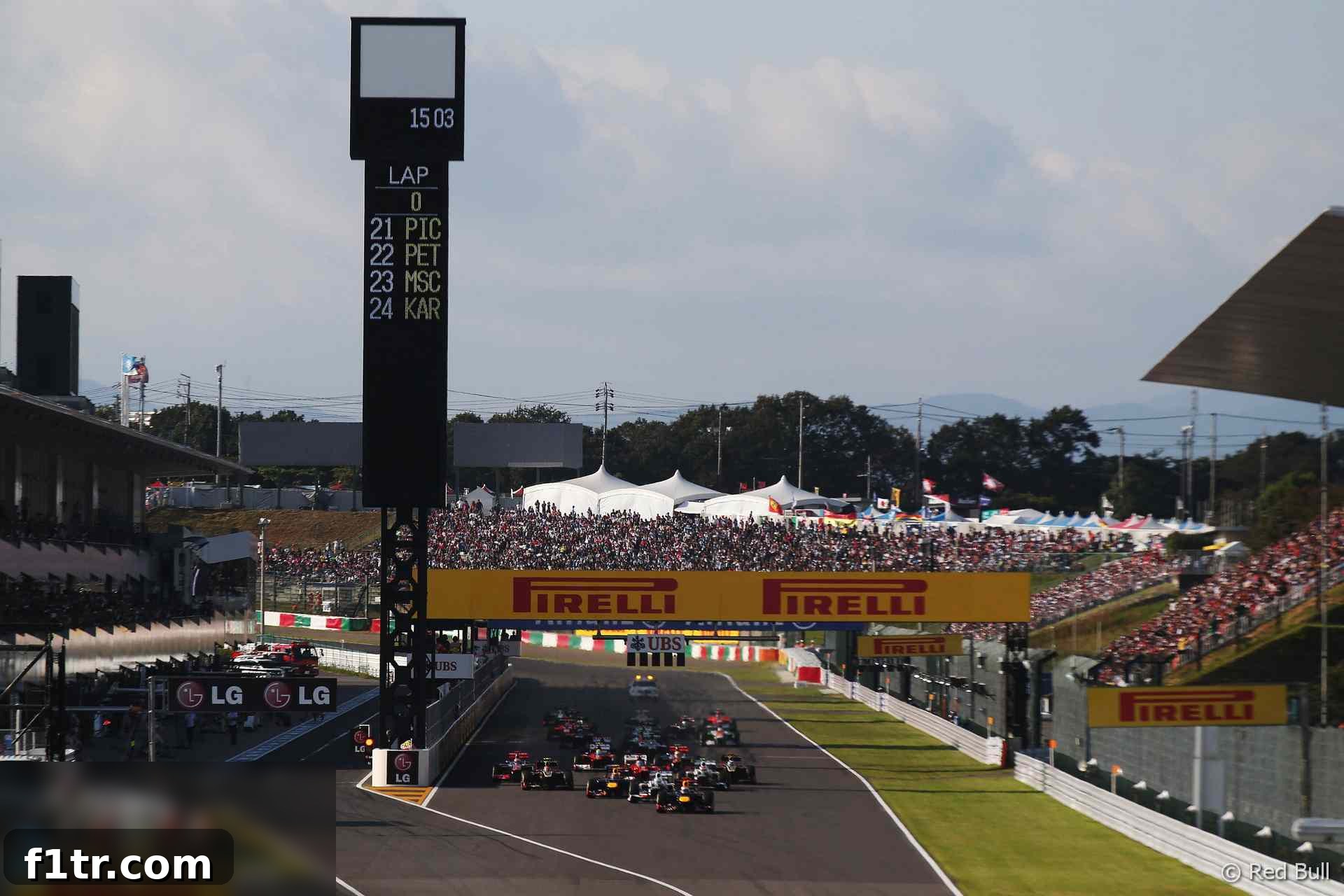
The Suzuka Circuit, with its challenging S-curves and high-speed sections, demands absolute precision and respect. The start of any Grand Prix at Suzuka is a notoriously tight affair, with drivers battling for every inch of tarmac heading into Turn 1. On that fateful Sunday, as the lights went out and the pack surged forward, the familiar chaos of a Formula 1 start unfolded. However, for Mark Webber, the race was effectively over before it had truly begun. His Red Bull RB8 was clipped by Romain Grosjean’s Lotus E20, sending Webber spinning and significantly compromising his race. While he managed to rejoin, the damage was done, both to his car and his championship aspirations. The Australian driver, typically measured in his post-race comments, was visibly seething as he recounted the events.
“I haven’t obviously seen what happened at the start but the guys confirmed that it was first-lap nutcase again, Grosjean,” a visibly frustrated Webber stated after the race. His choice of words, though harsh, underscored a deeper exasperation shared by many within the paddock regarding Grosjean’s propensity for early-race incidents. Webber continued, articulating the collective sentiment of his fellow competitors: “And, yeah, the rest of us are trying to fight for some decent results each weekend but he’s trying to get to the first corner as fast as he can at every race.” This wasn’t just about his own race being ruined; it was about a perceived disregard for the safety and efforts of other drivers who were meticulously preparing and executing their strategies each weekend.
Webber’s frustration was palpable. He described the crash as “immensely frustrating,” a sentiment amplified by the fact that Grosjean had only recently returned from a one-race ban. That ban was imposed following a spectacular multi-car pile-up at the start of the Belgian Grand Prix earlier in the season, an incident for which Grosjean was deemed solely responsible. The memory of that high-profile punishment was fresh in Webber’s mind, leading him to suggest with a touch of sarcasm: “maybe he needs another holiday.” It was a stinging indictment, implying that Grosjean had not learned his lesson despite the severe repercussions of his previous actions.
“He needs to have a look at himself, obviously, it was completely his fault,” Webber asserted, leaving no room for ambiguity. He questioned Grosjean’s judgment and consistency, echoing a sentiment that was becoming increasingly prevalent among his peers. “You know, how many mistakes can you make? How many times can you make the same error? First-lap incidents, it’s quite embarrassing at this level for him.” These remarks from a highly respected, championship-contending driver like Webber carried significant weight, highlighting the professional standards expected in Formula 1 and the perceived breach of those standards by Grosjean.
Romain Grosjean, for his part, was quick to offer an explanation, acknowledging the incident as a “stupid crash” but maintaining he was actively trying to avoid trouble. The weight of his recent ban and the scrutiny he was under were clearly heavy on his mind. “Well, yes, after the ban I’m very careful at the start,” Grosjean explained. “I kept my line and trying to avoid any contact with Perez which was on the left. I was focussing on that and didn’t see the delta speed with Mark.” His statement painted a picture of a driver caught between two pressures: the need to be cautious after his ban, and the instinctive aggression required at a Formula 1 start. The “delta speed” comment suggested a misjudgment of the closing rate rather than a deliberate act of recklessness, a crucial distinction he hoped to convey.
Grosjean reiterated his objective, which unfortunately, did not come to fruition. He added, “I was just trying to avoid any contact, that was my main objective and yeah, it didn’t work. It was a stupid crash.” The admission of a “stupid crash” showed a degree of self-awareness and regret, but it did little to alleviate the frustration of those whose races were compromised, especially Mark Webber. Grosjean’s early career was marked by a series of such incidents, which while often attributed to inexperience and exuberance, began to accumulate into a worrying pattern. The Japanese Grand Prix crash was another chapter in this challenging period, contributing to the perception that he was a fast driver, but one prone to costly errors at the most critical moments – the race starts.
The broader context of Grosjean’s 2012 season is essential for understanding the intensity of Webber’s reaction. Before Suzuka, Grosjean had already been involved in several first-lap collisions that year, most notably the infamous Belgian Grand Prix incident where he triggered a massive pile-up involving Fernando Alonso, Lewis Hamilton, and Sergio Pérez. That crash not only ended the races of several top contenders but also placed Alonso, a championship hopeful, in serious danger. The subsequent one-race ban for Italy was a rare and significant penalty in modern F1, intended as a clear message about unacceptable driving standards. Despite this, the Suzuka incident seemed to suggest that the message hadn’t fully resonated, or at least, hadn’t completely altered Grosjean’s aggressive starting style. This continuous pattern was what truly exasperated drivers like Webber, who felt their safety and championship chances were being unnecessarily jeopardized by one driver’s repeated errors.
For Mark Webber, the impact of the Suzuka clash was more than just a ruined race. While he wasn’t in direct contention for the 2012 Drivers’ Championship, every point was vital for the Constructors’ Championship battle, where Red Bull Racing was fiercely competing. More importantly, it was about maintaining momentum and avoiding unnecessary setbacks in a highly competitive season. The incident forced him into an early pit stop for repairs, relegating him to the back of the field and forcing him to fight an uphill battle for the remainder of the race. Such incidents not only cost points but also inflicted significant damage on a team’s budget, requiring costly repairs and potentially affecting development resources for future races. Webber’s seasoned perspective allowed him to see beyond the immediate impact, recognizing the broader implications for team morale, strategy, and overall performance.
The aftermath of the Suzuka incident, though not resulting in another ban for Grosjean, certainly amplified the scrutiny on him. Media pundits and fans alike engaged in lively debates about whether Grosjean was simply a victim of circumstance, a hot-headed talent who would eventually mature, or a genuine danger on the track. Lotus, his team, stood by him, acknowledging his talent but also working intensively to help him refine his race craft, particularly at the start. The incident contributed to a narrative that would follow Grosjean for a significant part of his career, a reputation for being fast but inconsistent, brilliant but sometimes prone to unforced errors. It served as a stark reminder of the fine line between aggressive, championship-winning driving and reckless, career-damaging mistakes in the cutthroat world of Formula 1.
Ultimately, the collision between Mark Webber and Romain Grosjean at the 2012 Japanese Grand Prix became a memorable footnote in a thrilling season. It highlighted the ever-present tension between individual ambition and collective responsibility on the track. Webber’s passionate outburst underscored the frustration of experienced drivers facing what they perceived as avoidable risks, while Grosjean’s explanations shed light on the immense pressure faced by young talents trying to make their mark. The incident served as a potent example of how quickly fortunes can change in Formula 1, and how a single moment of misjudgment at the critical opening phase of a race can have far-reaching consequences, both for the individuals involved and for the broader narrative of the sport.
Advert | Become a RaceFans supporter andgo ad-free
2012 Japanese Grand Prix
- Kobayashi edges Vettel for top Japanese GP driver
- Rate the race result: 2012 Japanese Grand Prix
- Grosjean: ‘The team’s not happy and I’m not happy’
- No apology needed from Raikkonen – Alonso
- F1 fans’ videos from the 2012 Japanese Grand Prix
Browse all 2012 Japanese Grand Prix articles