Ted Toleman, whose recent passing marks the end of an era, founded a Formula 1 team that, despite its relatively brief existence and limited on-track success, carved out a significant and enduring place in the sport’s illustrious history. The legacy of Toleman Motorsport extends far beyond its modest statistics, serving as a vital launchpad for numerous successful careers and evolving into one of F1’s most enduring and championship-winning entities.
During its comparatively short tenure in Formula 1, Toleman competed in just 57 Grands Prix. The team never clinched a World Championship, nor did it manage a single Grand Prix victory under its own name. It only participated in three full seasons, a testament to its challenging journey in the pinnacle of motorsport.
Yet, the impact of Toleman was profound. It became the crucial starting point for many individuals who would go on to achieve great success, both drivers and key team personnel alike. Moreover, the foundation laid by Ted Toleman’s visionary team blossomed into a powerhouse under subsequent ownerships, transforming into a formidable force that, in various guises, remains one of the ten teams still competing in F1 today.
The Genesis: From Family Business to Motorsport Ambition
The Toleman family’s journey into the automotive world began in 1926 when Ted Toleman’s grandfather established the automotive group bearing their name. Under Ted’s leadership, the enterprise’s ambitions expanded dramatically, venturing into the competitive world of motor racing. This expansion began with saloon car racing and gradually progressed to junior single-seater series, demonstrating an early commitment to nurturing talent and pushing technological boundaries. However, Ted Toleman’s vision soon outgrew these categories. Initially contemplating an entry into Formula 3, he made the strategic decision that a more ambitious step was warranted, aiming one rung higher on the ladder into Formula 2.
Formula 2: Laying the Foundations of Success
Toleman’s arrival in Formula 2 was met with immediate, if somewhat deceptive, success. Rad Dougall piloted the team’s March 782 chassis to a podium finish at Thruxton in 1978, hinting at the potential within the fledgling outfit. However, this promising start proved to be a false dawn. The Toleman crew, largely inexperienced with the demands of mainland European circuits that comprised the majority of the F2 calendar, struggled for consistency, with Dougall scoring only one more point throughout the rest of the season.
Despite these initial European hurdles, the team’s resolve was unwavering. The following year, Dougall secured a significant victory at Thruxton, driving a March chassis meticulously prepared by the gifted young designer Rory Byrne. This win underscored Toleman’s serious commitment to success. His teammate, Brian Henton, came tantalizingly close to clinching the championship in their second season, ultimately losing out after the FIA rejected the team’s post-season appeal following their disqualification from the crucial Enna round.
The hard work and perseverance paid off spectacularly in 1980. Brian Henton captured the coveted Formula 2 title, a remarkable achievement that was further amplified by his teammate, Derek Warwick, securing a commendable second place in the championship standings. This double success in Formula 2 provided the ideal momentum for Toleman to ambitiously pursue the next step: Formula 1. True to their ethos of nurturing talent, the team decided to bring both their championship-winning F2 drivers with them into the demanding world of Grand Prix racing.
Toleman’s Formula 1 Journey Begins
1981: The Challenging Debut and the ‘Flying Pig’
As Toleman Motorsport geared up for its audacious leap into Formula 1, the team significantly expanded its roster of staff, bringing in critical expertise. Among the notable hirings was Pat Symonds, a brilliant engineer who would go on to enjoy immense success within the team and the sport. Symonds played a pivotal role in assisting with the research and development of Rory Byrne’s inaugural F1 car design for Toleman, the TG181.
In a bold move that defied conventional wisdom of the era, Toleman decided against the popular and proven route of utilizing the normally aspirated Cosworth DFV engine for its debut F1 car. Instead, they forged a crucial partnership with engine specialist Brian Hart, with whom they had previously collaborated successfully in Formula 2. The objective was clear: to produce a cutting-edge 1.5-litre turbocharged engine. This decision was largely influenced by the undeniable potency of the turbo engine Renault had introduced to F1 in 1977. While many established rivals were cautious and slow to adopt the turbocharged format, Toleman made a high-stakes gamble on its future potential.
Initially, this ambitious gamble did not yield immediate dividends. The TG181 chassis proved to be significantly overweight, earning it the unflattering but memorable nickname ‘The Flying Pig’. Hart’s early turbocharged power units, while promising, suffered from the typical teething problems of early turbo designs: a pronounced turbo lag that delivered its considerable power in an abrupt burst, often some time after the driver requested it, making the cars incredibly challenging to drive and inconsistent on track.
These inherent shortcomings, compounded by the inevitable reliability problems that plague any new F1 entrant, initially made Toleman a subject of amusement and skepticism within the paddock. After missing the first three rounds of the 1981 season, Toleman finally made its much-anticipated debut at Imola, the home circuit of their sponsor Candy. However, the debut was far from auspicious; Warwick’s car spectacularly caught fire just moments after leaving the pits, even before reaching the first corner, Tamburello. In an era where more cars often entered than there were grid slots available, neither Toleman qualified on the team’s debut, with their best effort over four seconds too slow to even make the back row. It took until their tenth appearance of the season for Brian Henton to finally get a Toleman car onto the grid. He brought it home in tenth place, though points were only awarded to the top six finishers at the time. Derek Warwick managed the team’s only other starting position that year, lasting 43 laps in the season finale at Las Vegas before his gearbox failed, encapsulating a truly challenging first year in F1.
1982: Perseverance and Glimmers of Potential
Entering their second season, Toleman struggled to shake off their unwanted reputation as ‘tail-end Charlies’. Rory Byrne, ever the innovator, produced an updated C-spec version of the TG181, hoping to address some of its predecessor’s deficiencies. However, early season struggles persisted. After Warwick managed to qualify for the season-opener, neither Toleman car appeared on the grid again until round four at Imola. This race, famously, saw most of their rivals boycott due to a fierce dispute between the organizers, highlighting the chaotic and political landscape of F1 during that period.
Despite these setbacks, the Toleman team plugged away with unwavering determination. Gradually, through relentless development and sheer hard work, they began to unlock greater pace and, crucially, improved reliability from the Hart turbo engine and Byrne chassis. This tenacious effort culminated in a truly remarkable moment at their home race at Brands Hatch. Derek Warwick, driving with immense skill, led a glorious 16 laps of the British Grand Prix, stunning the paddock and thrilling the home crowd, before retiring under mysterious circumstances. While many suspected the car had been underfuelled to achieve such an astonishing early pace, it was an undeniable demonstration of the team’s emerging potential.
The progress continued through the season. At the final two races of 1982, Warwick debuted Toleman’s latest design, the TG183, which proved to be a genuine and significant step forward in performance and handling. Reflecting on this evolution years later, Warwick told RaceFans in 2020, “It was much better. Different monocoque, much stiffer. The Hart engine got better and better.” This marked a clear turning point for the team. Back at Las Vegas for the season finale, Warwick qualified an impressive tenth, their best starting position yet on a full grid. An ignition fault unfortunately ruined his race, but the message was clear: better days were unequivocally ahead for Toleman.
1983: The Breakthrough Season
The 1983 Formula 1 season opener provided undeniable proof of Toleman’s significant progress. A remarkable display saw five different constructors fill the top five places on the grid. Leading the charge was the Williams of reigning world champion Keke Rosberg, followed by a Renault, a Ferrari, a Brabham – and in a stunning testament to their development, Derek Warwick’s Toleman-Hart TG183B, demonstrating the team’s newfound competitiveness among the elite.
Despite this incredibly promising start, the elusive first championship point for Toleman took longer to secure than anticipated. It wasn’t until the twelfth round of the sixteen-race season that Warwick finally delivered, breaking Toleman’s points drought. However, from that pivotal moment onwards, the team’s fortunes were undeniably transformed.
Warwick embarked on an impressive streak, consistently scoring points in each of the remaining races of the season. At the penultimate round, held on home ground at Brands Hatch, he secured a superb fifth place finish, crucially ahead of his teammate Bruno Giacomelli. This result marked Toleman’s very first double points finish, a significant milestone that highlighted the team’s growing strength and consistency. They concluded the year an impressive ninth in the constructors’ standings, just two points behind established champions Tyrrell and Lotus, clearly demonstrating their emergence as a genuine midfield contender. Any astute incoming driver looking for a rising team with immense potential would have been wise to identify Toleman’s growing capabilities.
Coincidentally, the team was indeed in need of a new driver. Renault, recognizing Warwick’s immense talent and potential, had successfully poached him to replace the departing Alain Prost. In Warwick’s place, Toleman made a signing that would forever alter their trajectory and leave an indelible mark on Formula 1 history: a young Brazilian driver who would soon become one of the greatest legends of the sport, and who almost delivered a shock victory for the team.
1984: The Arrival of a Legend – Ayrton Senna
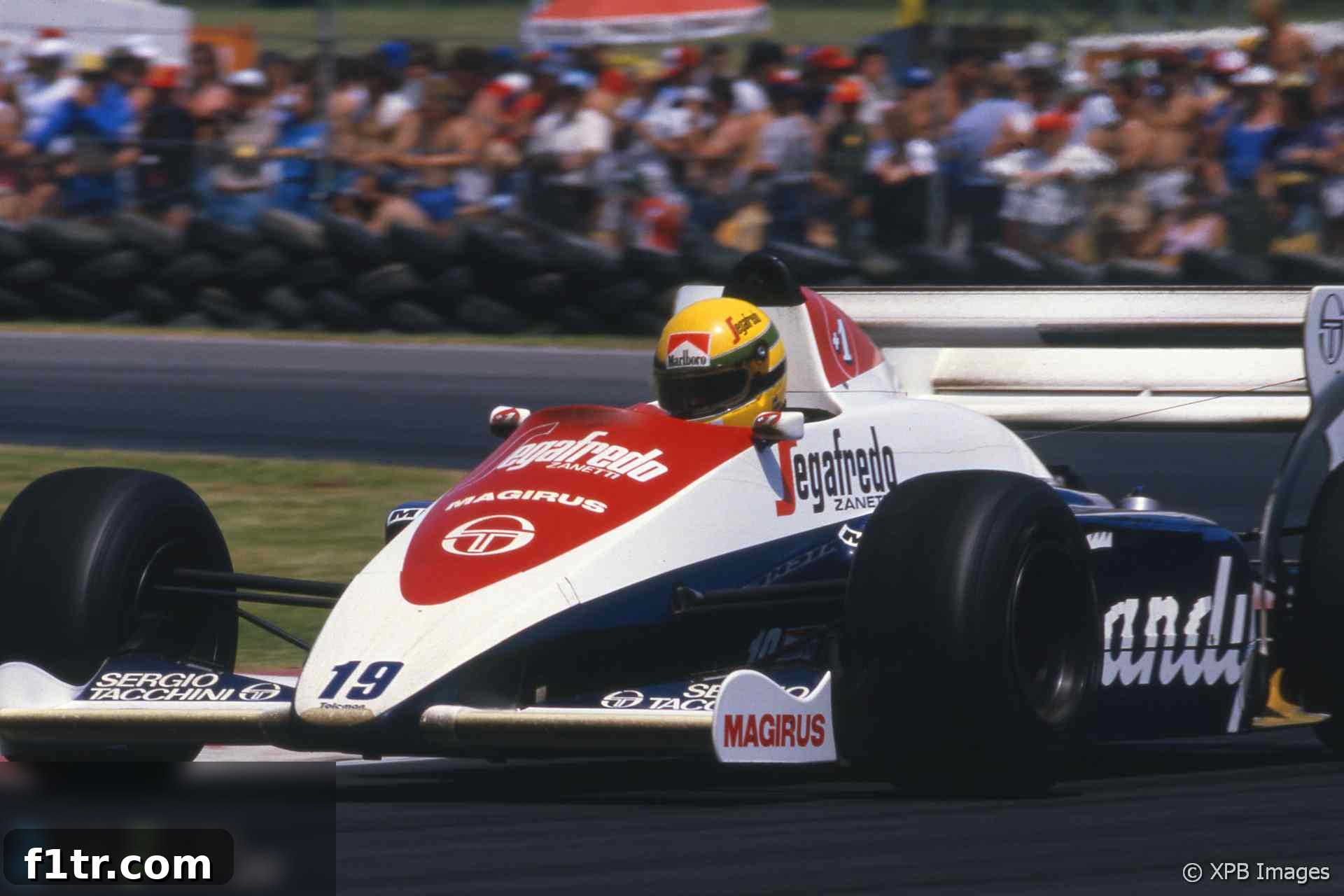
The 1984 Formula 1 season marked the electrifying debut of Ayrton Senna with Toleman Motorsport, following his dominant British Formula 3 championship victory the previous year. Senna’s path to F1 was already legendary; he had famously tested for powerhouse teams like Williams, Brabham, and McLaren, but found them unwilling to accommodate his unwavering preference to immediately secure a race seat, rather than endure a waiting period. Toleman, recognizing his raw, undeniable talent, seized the opportunity.
Toleman appointed Senna alongside Johnny Cecotto, forming an entirely new driver line-up for the season. Senna’s F1 debut at his home race in Brazil was not the fairytale he might have hoped for; he became the first driver to retire in his inaugural Grand Prix, his TG183B’s turbo failing just eight laps in. However, the true measure of the driver and the team quickly emerged. In only his second race at Kyalami in South Africa, Senna skillfully brought the car home in sixth place, securing his first championship point, albeit three laps down. He remarkably repeated this impressive feat in the very next round at Zolder in Belgium, showcasing his incredible adaptability and the car’s improving reliability. The new TG184 chassis presented its own challenges, letting him down at Dijon. This period also saw the team switch to Michelin tyres, having severed ties with Pirelli due to dissatisfaction over their failure to qualify at Imola.
Senna’s drive in the 1984 Monaco Grand Prix, contested under appallingly wet conditions, instantly became the stuff of legend and a pivotal moment in F1 history. Starting from a modest 13th on the grid, Senna patiently and masterfully worked his way through the field as other, more experienced drivers succumbed to the treacherous conditions. As the rain intensified, he began to relentlessly cut seconds out of the advantage held by race leader Alain Prost, who was struggling significantly more in the worsening grip. Eventually, with Senna and Tyrrell’s Stefan Bellof rapidly closing in on the leader, the red flag was controversially thrown, ending the race prematurely. The race was not restarted, leaving Senna and the Toleman team incandescent with rage and fuming over their lost shot at a historic maiden victory, a moment that highlighted both Senna’s prodigious talent and Toleman’s potential.
Later in the season, a contentious turn of events saw Senna infuriate the Toleman management by signing a contract to join the Lotus team for the following year, without prior consultation with Toleman. In an extraordinary and rare disciplinary measure, Toleman team principal Alex Hawkridge took the drastic step of benching the prodigious driver for one race, fielding Pierluigi Martini in his place. By this point, Stefan Johansson had taken over the other Toleman car, as Johnny Cecotto had sustained severe leg injuries at Brands Hatch, further complicating the team’s season.
Senna eventually returned for the final races of the season and, in his swansong drives for the Toleman team, added a further third podium finish to those he had already spectacularly achieved in Monaco and Britain. This remarkable performance helped Toleman achieve its best-ever constructors’ championship finish, securing a highly respectable seventh place. The 1984 season, defined by Senna’s arrival and breakthrough performances, showcased the true potential of the Toleman package and cemented its place in F1 lore.
1985: A Season of Challenges and Transformation
The mid-season split from Pirelli in 1984 came back to haunt Toleman at the very beginning of the 1985 season. Compounding their woes, Michelin, their new supplier, chose to withdraw from Formula 1 entirely, and Goodyear, the dominant tyre supplier, was unwilling to take on another customer team. With Pirelli also unwilling to extend a helping hand to their former customer, Toleman found themselves in an unprecedented and critical situation: no tyres to race on. This immediate crisis severely hampered their ability to attract much-needed sponsorship, pushing the team to the brink.
In this dire period, Ted Toleman engaged in crucial discussions with Luciano Benetton, the influential head of the burgeoning sportswear company, who at the time sponsored Alfa Romeo and had previously backed Tyrrell. An agreement was reached for Benetton to acquire the struggling Toleman team, with a crucial condition: all of its dedicated staff – numbering just over 60 individuals – were to be retained. This commitment ensured the continuity of talent and expertise that Ted Toleman had painstakingly built.
Through persistent efforts, the team eventually managed to procure tyres for a single car by purchasing the Spirit team’s existing contract with Pirelli. This lifeline allowed Toleman to field one car for Teo Fabi from the fourth round of the season at Monaco. However, there was no repeat of their 1984 heroics in the dry race conditions. Fabi narrowly scraped onto the 20-car grid by a mere tenth of a second but, tragically, lasted only 16 laps before the ever-temperamental turbo engine failed, reflecting the lingering struggles.
The season proved to be a theme of unfulfilled potential for Toleman’s final year. Fabi firmly believed that Rory Byrne’s TG185 chassis possessed enormous underlying potential. This belief was spectacularly vindicated at the Nürburgring, where Fabi sensationally put the car on pole position by an astounding seven-tenths of a second, demonstrating the raw speed the car was capable of. However, a dreadful start saw him plummet to eighth place, and he later retired from the race with a broken clutch, a frustrating end to a promising weekend. Toleman concluded its final season in Formula 1 without scoring a single point, a bittersweet ending to its independent journey.
The Enduring Legacy: From Toleman to Alpine
In the off-season, Toleman Motorsport underwent its inevitable transformation and was officially rebranded as Benetton Formula. The very next year, the team delivered its inaugural victory, a momentous achievement courtesy of Gerhard Berger at the Autódromo Hermanos Rodríguez in Mexico, proving that the foundations laid by Ted Toleman were indeed solid and capable of winning.
While Ted Toleman’s team did not enjoy the championship success it arguably deserved while competing under his family name, that success came in abundance in the following years. Benetton went on to achieve global dominance, winning multiple World Championships with the legendary Michael Schumacher in the fiercely competitive 1990s. The team then evolved further, becoming Renault F1, and continued its championship-winning pedigree by taking Fernando Alonso to two consecutive World Championship victories in the mid-2000s.
Today, the team operates under the Alpine F1 Team banner, proudly carrying on the lineage that began with Toleman. It most recently celebrated a Grand Prix victory as recently as 2021, showcasing its enduring competitive spirit. While the team may currently be navigating another challenging spell in its long and storied history, the underlying strength and resilience that Ted Toleman instilled in its foundations remain. Whatever the name above the garage door, the team Ted Toleman founded has consistently found its way back to the front of the grid, a testament to his original vision and the unwavering spirit of the people involved. There should be no doubt that they possess the intrinsic capability to do so once again, ensuring Toleman’s legacy continues to shine brightly in Formula 1.
Discover More F1 History
- When did F1 last have a mid-season break longer than five weeks? 1990
- Did Norris actually win Formula 1’s closest championship fight of all time?
- Hamilton is Ferrari’s first new driver in 44 years to complete season without a podium
- Ferrari are on course to lose an F1 record they’ve held since 2004
- Red Bull in 2010 or Ferrari in 1979? Past title fights illustrate McLaren’s current dilemma
Browse all history articles