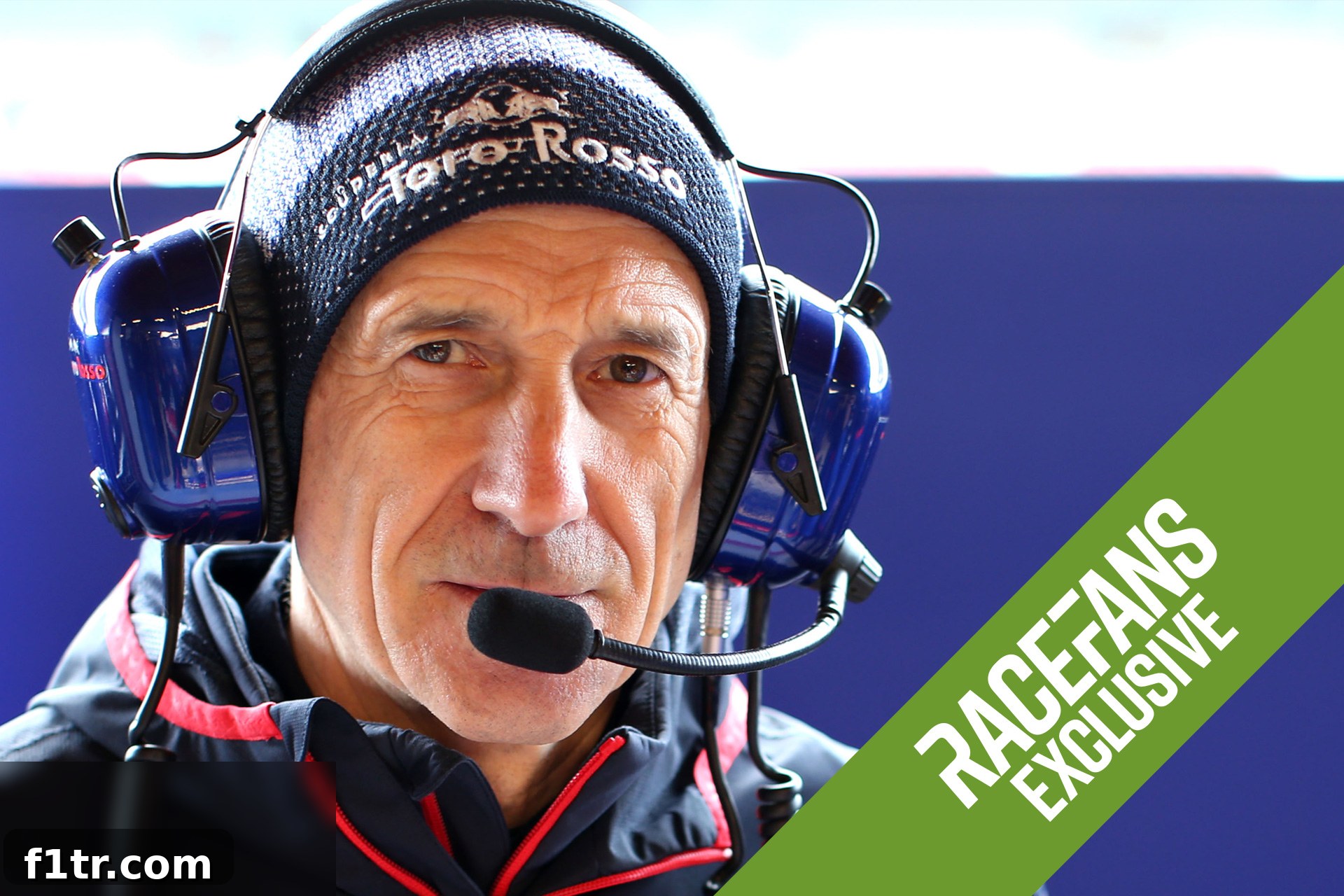
In a revealing exclusive interview at the Circuit de Catalunya, Toro Rosso team principal Franz Tost expressed a strong sense of urgency to Liberty Media regarding the finalization of the 2021 Formula 1 season regulations. Tost also shed light on how the pivotal new Red Bull-Honda partnership promises significant advantages for his team, painting a comprehensive picture of the challenges and opportunities facing F1 and Toro Rosso in the coming years.
Franz Tost stands as one of Formula 1’s most enduring team principals, rivaled in tenure only by Christian Horner, the head of sister team Red Bull Racing. Despite his long presence at the helm of Toro Rosso, Tost remains somewhat of an enigmatic figure to many within the sport. His lengthy career, alongside Horner’s, speaks volumes about their individual capabilities and unwavering tenacity, as well as the profound trust invested in them by Red Bull owner Dietrich Mateschitz. Mateschitz, famously not known for his patience – a trait he shares with his trusted motorsport advisor Helmut Marko – has nonetheless entrusted these executives with controlling F1 entities that collectively generate over half a billion per annum. Their longevity and performance have arguably surpassed many other prominent figures in the sport.
The 63-year-old Austrian is deeply immersed in the world of motorsport. His journey began as a competitor in Formula Ford and Formula Three, pursued concurrently with his studies in sport science and management. He later transitioned into team management, notably overseeing the burgeoning career of Ralf Schumacher. Tost followed Schumacher into Formula 1, and subsequently joined him at Williams. It was there that his talents caught the attention of BMW, Williams’ Bavarian engine supplier at the time, leading to his appointment as F1 track operations manager. When Mateschitz acquired the struggling Minardi team at the end of 2005, with the vision of establishing a finishing school for Red Bull’s most promising young drivers, Tost’s extensive CV made him the obvious choice for team principal.
During the first day of testing at the Circuit de Catalunya, following an open media session and prior television commitments, Tost sat down for his exclusive one-to-one interview. “You booked first, so you get the first slot,” the team’s media manager confirmed. While his earlier media session offered a preliminary overview, there were many more critical topics to delve into.
The Urgency of F1’s 2021 Regulations: Tost Demands Decisive Action
Toro Rosso is widely considered one of the teams poised to benefit most from Formula 1’s proposed budget cap, slated for introduction in 2021. The team’s streamlined structure and business model, designed for efficiency and resourcefulness, naturally align with restrictions on spending and parts sharing. Consequently, Tost is a fervent advocate for the immediate and decisive introduction of robust cost controls, rather than a diluted, ineffective process.
When asked if the regulatory process was moving quickly enough, Tost’s answer was a succinct and emphatic “No.” This naturally prompted the follow-up question: “Why?”
“It’s too slow,” Tost asserted. “They should come up with decisions. We’re talking for a long time now, and the technical regulations are not fixed yet, the sporting regulations are not fixed yet. We have this cost cap, money distribution, and all this kind of stuff. All the main pillars are still in discussion, and Liberty Media has to come up now with decisions.” His frustration stems from the impending 2021 season, with crucial details remaining unresolved just months before the traditional 18-month lead time required for major rule changes under the FIA’s International Sporting Code. This critical deadline looms large, potentially allowing the governing body to impose rules without full team consensus, a prospect that further underscores the need for swift action.
The current impasse raises questions about the degree of team involvement in the post-2020 regulatory process. While technical working groups and meetings are ongoing, Tost offered a provocative perspective on the level of team consultation.
“The teams are still involved. There are technical working group meetings, and so on,” he acknowledged. “But once more, if I were at Liberty Media, I wouldn’t involve the teams so much, because Liberty Media has the infrastructure to come up with rules. Ross Brawn, Pat Symonds, and all the others are so experienced they know exactly what Formula One needs, they know exactly which direction to go. They just should decide ‘we should go for it’.”
Tost’s rationale is clear: prolonged discussions with teams, each pursuing their own self-interest and agenda, inevitably lead to deadlock. “If they continue asking the teams, they will never come up with a solution because every team will just look for their own advantage, and every team has their own agenda. And they can’t come up with a result.” He concluded, “The governance is the next point which has to be finalised, but there is the Sporting Code, and the sporting regulations, that’s it.”
Liberty Media vs. Bernie Ecclestone: A Contrast in Leadership
The question of whether to exclude teams entirely from the decision-making process is a complex one. Tost believes complete exclusion is neither necessary nor practical, but a more directive approach is vital. “I don’t think that they will be completely excluded, that’s not necessary. But the FIA and Liberty have to come up with proper proposals and say ‘Look, this is the direction that we want to go,’ and then of course there will be a discussion with the teams.” He understands that universal agreement is improbable, stating, “If part of the teams don’t agree, then [FIA/Liberty] have to decide. There will not be all teams which will not agree; there will always be some teams ‘yes’ and some teams ‘no’. If you get a proposal with let me say 50 points, then maybe you feel ‘Ah, 10 points are bad for us but 40 points are OK for us’.” This highlights the need for a strong leadership that can navigate dissenting opinions and make the ultimate call for the greater good of the sport.
Given the rapidly approaching deadline, the possibility of postponing the regulation changes by a year was explored. Tost was dismissive of this idea, recognizing it as a mere deferral of the problem.
“No, I don’t think it’s possible because it’s not only the regulation changes; it’s also the money distribution, it’s the cost cap, it’s many things. And what does it change if you postpone it by one year? You just discuss another year in addition. If you can’t make a decision until now, why should you be able to make a decision one year later?” This pragmatic view underscores his belief that delaying decisions only prolongs the uncertainty and further hinders progress.
To further understand the current regulatory inertia, a comparison was drawn between Liberty Media’s approach and that of former F1 supremo Bernie Ecclestone. Tost’s answer was both concise and telling: “Liberty is discussing and talking. Bernie just decided.” When asked which method he found more effective, his response was immediate: “The decision one!” This stark contrast highlights a fundamental difference in governance philosophies, with Tost clearly favoring a more decisive, top-down approach to navigate complex, multi-stakeholder issues in Formula 1.
Regarding the implementation of the budget cap, a source suggested that Liberty intended to operate a ‘shadow’ budget cap during 2019, tracking team expenditure against notional limits. Tost confirmed awareness of such concepts and expressed Toro Rosso’s full support. “Yes, there are different models they are talking about, and the ideas are quite good. The rest we will see. We from Toro Rosso support them; if they want to know anything, we are open. We are absolutely open. If they want to see anything, if they want to know details, we show it to them.” This openness from Toro Rosso demonstrates their commitment to the budget cap and their belief in its potential to level the playing field.
Shaping the Future: Calendar Expansion and Race Weekend Formats
During his earlier open session, Tost had hinted at the potential for calendar expansion, with an implication that “the more, the better.” This led to a discussion about whether the F1 calendar could realistically grow to, say, 25 races, while simultaneously adhering to a budget cap. After all, more races invariably incur more costs.
“But you get more money,” Tost countered. “Otherwise, it doesn’t make sense. Look, one thing is clear: to increase the number of races only makes sense if you increase the revenues, for the teams as well. I hope this is clear, because otherwise you don’t need more races. It must be clear: If we have more races, we need to have more revenues, otherwise we can’t afford it and otherwise it doesn’t make sense.” His logic is sound: any expansion must be financially viable for the teams, ensuring they can absorb the increased operational demands without compromising their stability or the intent of the budget cap.
Finally, the conversation turned to mooted changes in the F1 weekend format, which could potentially be introduced as early as next year if Liberty’s staggered implementation plans proceed. Tost, having witnessed numerous qualifying format changes throughout his 13 years as team boss, remained unfazed by the specifics. “[What’s] decisive is that we have interesting races,” he declared.
“If the races are boring, you can have whatever weekend format you want to have. To have no Friday, to have only Saturday, Sunday – if [on] Sunday the race is boring, no one cares. We should be concentrated what really counts, and what really counts is that we have interesting races.” While acknowledging that canceling Friday activities might displease organizers who rely on ticket sales for that day, Tost views these as secondary concerns.
“[But] for me these are secondary points. I personally don’t care whether we are here on the Saturday, Sunday, or whether we are here also on Friday. Because they think is to reduce the time being at the track by one day… I don’t think that this is a major topic which counts, because you have to send the mechanics, you have to send the people who build up the garage anyway earlier one, two days. Maybe you gain a day or whatever, but once more: We should be concentrated to come up with what really counts, and that’s to come up with interesting races.” His focus unequivocally lies on the on-track spectacle and competitive racing, which he believes is the ultimate draw for fans.
The Red Bull-Honda Alliance: A New Dynamic for Toro Rosso
The competitiveness of Red Bull with their new Honda power unit is poised to significantly influence the excitement of the 2019 F1 season. While Tost firmly believes Red Bull Racing can win races this year, he refrains from making the same prediction for his own team. “Because we have a completely different infrastructure,” he explains realistically. “You cannot compare Toro Rosso with Red Bull Racing or with Ferrari or with Mercedes. These are teams that are operating with [budgets of up to] €500 million; we have less than a third of this budget, and are simply not in a position to compete against these top teams. This is also not the target of Toro Rosso. But I think, because of this co-operation with Red Bull Technology, that we can also improve our performance.”
This clarifies Toro Rosso’s position within the Red Bull-Honda constellation. Tost emphasized parity in their relationship with Honda, stating, “I don’t talk about number one or number two, because we get the same hardware and software from Honda. And as I mentioned already in the past, I’m more than happy and confident that Red Bull [Racing] is running a Honda engine because then there are two teams, and it’s the Red Bull [brand] and overall it’s referred to as one company. This will help us to improve [our] performance. Last year was a build-up year for Honda as well as for us, and it was not an easy season, but we got everything together.” The strategic alignment is designed to benefit both Red Bull brands, fostering shared development and progress with Honda.
Given Toro Rosso’s well-known role as a development platform for Red Bull’s drivers, a natural question arises regarding its function concerning engines. Will Toro Rosso be expected to ‘carry the can’ for the senior team, particularly considering its 2018 record of consuming more engines than any other team, allegedly in the name of future development?
Tost immediately rebuffed such insinuations: “No, we are not a development team. Toro Rosso is a team on its own. What I always say and mention is ‘if there’s something from Honda’s side which has to be tested, which at the end will be integrated in the development progress, of course this is fine to do it’. But it’s not that we are their development team.” This distinction is crucial; while Toro Rosso is willing to assist with specific testing, its primary mandate remains its own competitive performance, not solely acting as a Honda test bed.
With both Red Bull and Toro Rosso now sharing common power units, a strategic plan is in place to share non-listed parts—those for which teams are not required to hold intellectual property—to optimize time and cost. This echoes the successful Ferrari-Haas model of technical collaboration. Tost detailed the specific components Toro Rosso will source from Red Bull and its engineering arm, Red Bull Technology: “We have got from them the rear part of the car, which means the gearbox, the rear suspension, the hydraulic system, and that’s it. We could have had it last year, but they had another [Renault] engine.” This strategic sharing marks a significant shift from previous years, streamlining the design and manufacturing process for Toro Rosso.
Elaborating on how this has evolved from the previous model, Tost explained: “From last year to this year, we have another gearbox, and we have another rear suspension, but the front end, the wishbones are Toro Rosso wishbones; the [car] internals are mixed with Red Bull.” This highlights a hybrid approach, where core components are shared for efficiency, while specific front-end elements remain proprietary to Toro Rosso, maintaining a degree of independent design and identity.
When asked if this was a one-way street, with parts flowing only from Milton Keynes to Faenza, Tost confirmed: “No. The parts which we get from them are being produced by them. The rest we do ourselves. What we have from them, the gearbox, is [their] last year’s gearbox. A little bit [was] changed to mount the Honda engine. And the suspension is their last year’s suspension, not this year’s.” This clarifies that Toro Rosso benefits from tried-and-tested components from the senior team, adapting them as needed, while still developing many of its own parts.
Technical Leadership at Toro Rosso: A Seamless Transition
The recent departure of technical director James Key to McLaren (with his start date to be confirmed shortly) necessitated a reorganization of Toro Rosso’s technical structure. Tost outlined the new leadership, with Jody Egginton stepping into a more prominent role.
“We’ve got the deputy technical director [Egginton], and then we have the different departments downstream where all the persons are responsible for their departments. It’s the aero department, it’s mechanical design, and it’s bodywork design,” Tost explained. He added, “We have separate people responsible for manufacturing, because we have mechanical manufacturing, composite manufacturing, so this is different.” This detailed structure ensures that all critical technical areas are covered and managed efficiently.
Clarifying the progression within the technical leadership, Tost confirmed the logical next step for Egginton: “The deputy technical director position is below technical director, and as James is not anymore with us, sooner or later Jody Egginton will become technical director.” He concluded with a characteristic measure of anticipation, “We will see [when], we will see.” This methodical approach to succession planning is typical of Tost’s leadership style, reflecting his pragmatic and considered nature. His undimmed passion for racing and his sharp insights into the sport’s political and technical landscape shone brightly throughout the interview, underscoring his enduring influence in Formula 1.
- The year of sprints, ‘the show’ – and rising stock: A political review of the 2021 F1 season
- The problems of perception the FIA must address after the Abu Dhabi row
- Why the budget cap could be F1’s next battleground between Mercedes and Red Bull
- Todt defied expectations as president – now he plans to “disappear” from FIA
- Sir Frank Williams: A personal appreciation of a true racer
Browse all RacingLines columns