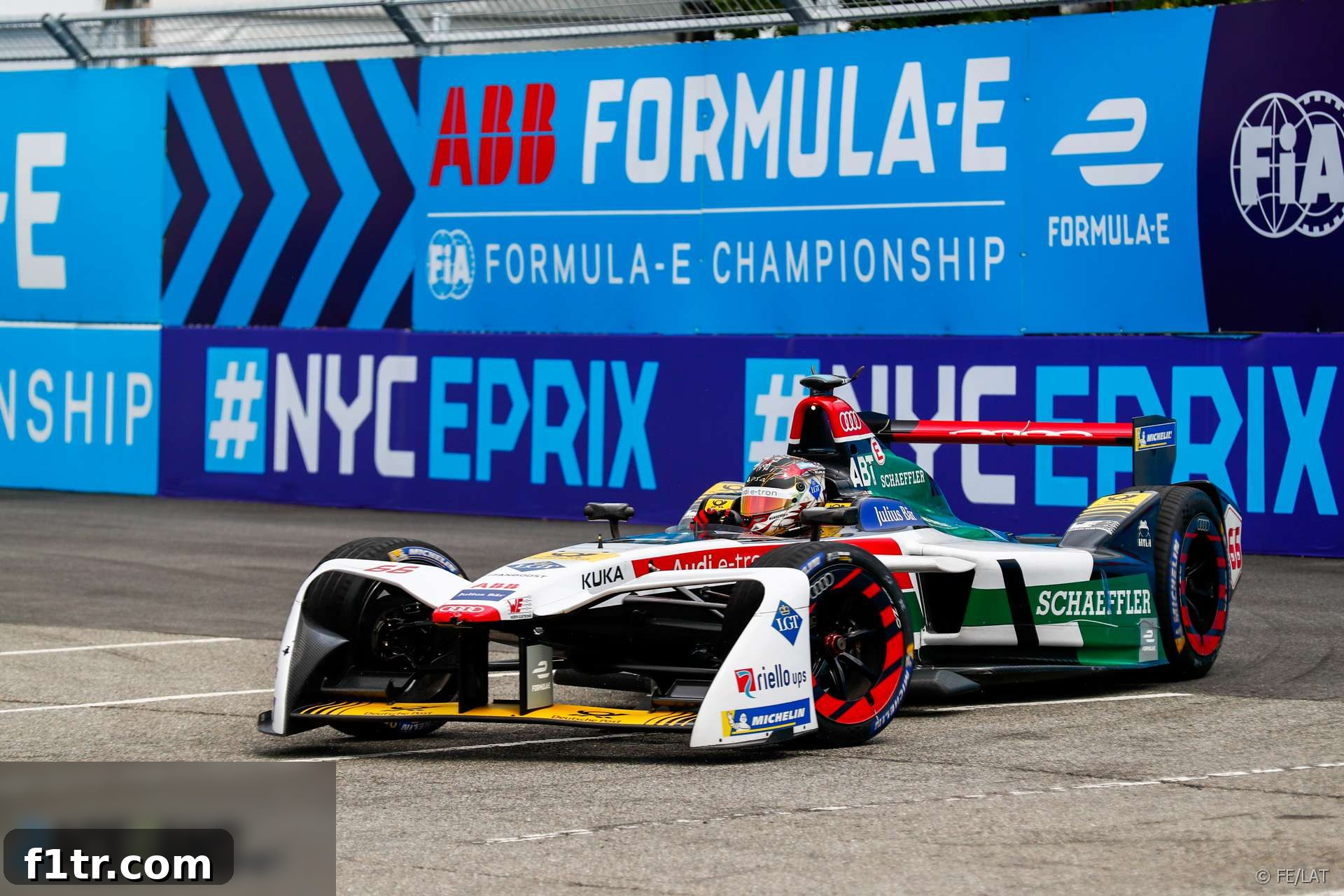
Since its inception just four years ago, the all-electric Formula E championship has navigated a challenging path to win over its critics. A primary hurdle has been the noticeable performance disparity between Formula E’s nascent electric vehicle technology and the formidable speed of Formula 1 cars. This crucial difference often leads to direct, albeit unfair, comparisons.
FIA President Jean Todt underscored this point earlier in the year, stating, “They are two completely different categories. Formula E has not the performance of Formula 1 at the moment.” While this distinction remains clear, there is a fundamental aspect of Formula E that even its most ardent detractors must acknowledge and commend. This very quality explains why automotive giants like Mercedes-Benz and Porsche are enthusiastically lining up to join the series, recognizing its unparalleled potential.
Many facets of modern motorsport have progressively closed off avenues for substantial technical development, often for reasons of cost control or competitive parity. Junior racing championships, for instance, are almost exclusively single-make series, where every competitor uses identical equipment. IndyCar, a prominent open-wheel series, employs a highly specified aerodynamic kit and rigorously defined engine regulations, leaving little room for proprietary innovation. In GT racing, the widespread adoption of Balance of Performance (BoP) regulations actively prevents teams from innovating their way to a significant, sustained advantage. Even series that traditionally encouraged competitive car development have suffered when unchecked, as evidenced by the World Endurance Championship’s LMP1 category, which dwindled to a single, dominant manufacturer, stifling competition and innovation.
In stark contrast, Formula E, much like Formula 1 in its purest form, is fundamentally designed to accelerate automotive development. Arguably, in the context of real-world applicability and future mobility, Formula E fulfils this mandate with at least the same efficacy as, if not more than, F1 currently does. It positions itself as a critical proving ground for electric vehicle technology, offering a unique platform where innovation is not just permitted but actively encouraged and central to the championship’s identity.
While Formula 1 teams dedicate immense financial resources to aerodynamic advancements – developments that offer minimal direct benefit to everyday road vehicles – Formula E’s strategic use of a standardized chassis redirects the entirety of its development budget towards the powertrain. This focused approach means every engineering dollar is invested in improving electric motors, inverters, gearboxes, and the complex energy management systems that are directly transferable to the next generation of electric road cars.
Formula 1 has found itself constrained by a set of regulations that permit only a specific configuration of V6 turbo-hybrid engines, leading to a situation where new manufacturers have shown little interest in joining the sport in the foreseeable future. Formula E, conversely, has adopted a more progressive strategy, gradually opening up its powertrain regulations over its initial seasons. This flexibility and the direct relevance of the technology being developed have proven to be a significant draw for global automotive manufacturers, who see the series as a vital research and development laboratory.
Given this clear directive for innovation, a natural question arises: what tangible achievements has Formula E delivered in its relatively short lifespan? Have manufacturers such as Renault, Audi, and others genuinely pushed the boundaries of electric powertrain and battery technology? And perhaps the most direct measure of performance evolution in racing: have lap times significantly decreased over the championship’s first four years?
Quantifying these advancements isn’t entirely straightforward, particularly when comparing performance across seasons. Unlike Formula 1, which largely utilizes a consistent set of established circuits with stable layouts, Formula E has raced on a diverse array of temporary street circuits, many of which have varied in configuration or have been entirely replaced over its initial four years. This fluidity means there isn’t a single, unchanged track where the championship has competed in all four seasons, making direct, season-to-season comparisons challenging. However, by examining lap times at tracks that have maintained consistent layouts for at least two or three seasons, a clear trend emerges regarding the pace of development.
The championship’s inaugural season saw all teams utilize a fixed-specification powertrain supplied by Spark Racing Technology, ensuring a level playing field and allowing the series to establish itself. However, from the 2015-16 championship onwards, a pivotal regulatory shift occurred: manufacturers were granted the freedom to develop their own critical powertrain components. This included the electric motor (EMotor), differential, and gearbox, although the traction battery remained a standardized component across all teams for the Gen1 era.
Manufacturers eagerly embraced this opportunity for innovation, responding with a diverse range of engineering solutions. This technical differentiation is widely credited not only with fostering more compelling and competitive racing but also with generating a greater variety of race winners compared to Formula 1, where victories have often been concentrated among a mere handful of top teams in recent years. The direct competition in powertrain development meant that different philosophies could lead to different strengths, encouraging a vibrant technical contest.
The impact of this newfound freedom in development was immediate and substantial. Between the first and second seasons, lap times improved significantly, dropping by approximately 1.4%. While this percentage might initially seem modest when compared to the dramatic year-on-year performance gains often seen in Formula 1, it is crucial to remember a fundamental difference: Formula E strictly prohibits aerodynamic development. All performance gains in the Gen1 era, therefore, had to come from advancements in the powertrain, energy management, and mechanical grip, making a 1.4% improvement a testament to the rapid strides being made in electric propulsion technology.
It’s important to clarify that the progress achieved within Formula E hasn’t solely been attributable to powertrain development. Tyre technology has also played a crucial, albeit indirect, role in enhancing overall performance. Michelin, the championship’s sole tyre supplier, has made significant advancements in reducing the weight of its tyres. As motorsport director Pascal Couasnon explained, “To give more weight to put batteries [in], we – in two generations of tyres – decreased the weight of the tyre by 10 kilos over the set.” This reduction in unsprung mass not only contributes to better handling and efficiency but also strategically frees up crucial weight allowance that can then be allocated to improving battery capacity or other vital components, showcasing a holistic approach to performance enhancement.
While the rate of development in Formula E experienced a slight moderation after its initial rapid surge in the second season, the most recent championship demonstrated renewed momentum, with lap times dropping by almost 1% year-on-year. Cumulatively, by the conclusion of their competitive lifecycle, the first-generation Formula E cars were approximately 2.6% quicker than they were at the championship’s launch. This substantial evolution was palpable to those behind the wheel. James Rossiter, who experienced a show car at the series’ launch and later Venturi’s car in its final Gen1 season, remarked that the latter “feels totally different,” highlighting the dramatic strides made in terms of power delivery, efficiency, and overall driving dynamics over just four years.
Direct comparisons with Formula 1 lap times must be made with caution due to differing tyre development philosophies and track characteristics. However, for context, consider Formula 1’s performance during the second year of its V6 hybrid turbo regulations in 2015, where lap times decreased by approximately 1.3%. The following year, with the introduction of softer tyre compounds at several circuits, F1 cars saw an additional 2.5% improvement. These figures, while impressive, often include significant aerodynamic advancements, a luxury not afforded to Gen1 Formula E cars, further underscoring the efficiency gains achieved in electric powertrain technology.
Despite the remarkable progress already documented, Formula E’s most significant leap forward is still on the horizon. The new season is poised to begin in just two months, and in the coming days, teams will commence rigorous testing of the championship’s revolutionary second-generation chassis. This new iteration promises to usher in an era of unprecedented performance for electric racing.
Expectations are high for substantial gains across the board, including marked improvements in energy efficiency, extended range that will eliminate the need for mid-race car swaps, and a significant boost in outright performance. Critically, the peak power output in qualifying trim is set to increase by a remarkable 25%, reaching 250kW. This power surge, combined with other technological enhancements, is anticipated to deliver not merely a step forward for electric racing, but a monumental leap, cementing Formula E’s position at the forefront of automotive innovation and sustainable motorsport.
Quotes: Dieter Rencken and Hazel Southwell
Discover More on Formula E
- McLaren to quit Formula E at end of season
- Wehrlein beats Jaguar pair to title in dramatic Formula E finale
- Wehrlein’s London win sets up thrilling three-way title showdown in finale
- Da Costa takes hat-trick of wins in chaotic second Portland race
- Da Costa inherits Portland win from Evans after Cassidy spins lead away
Browse all Formula E articles