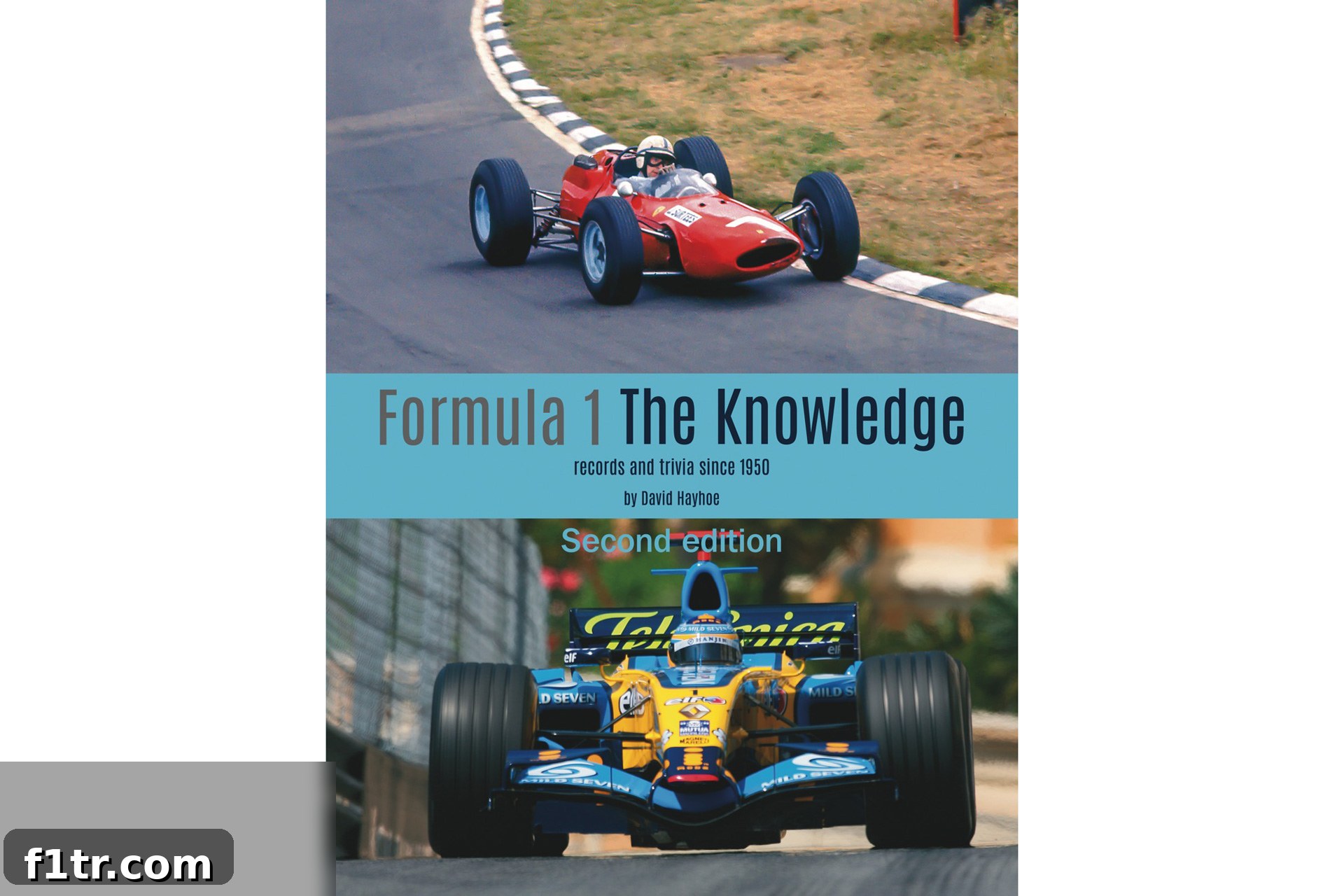
Formula 1: The Knowledge Second Edition – Unlocking the Secrets of F1 Through Data
In the high-octane world of Formula 1, numbers tell a story. While some statistics are mere trivialities, designed to fill airtime or social media feeds with meaningless banter about hotdogs and lobsters, others are profound. The truly valuable stats are those that enlighten, reveal hidden narratives, quantify the impact of fortune’s unpredictable hand, and, crucially, measure the pinnacle of human and mechanical achievement. These are the statistics that captivate, educate, and even entertain, transforming raw data into compelling insights.
We’re talking about the metrics that define greatness: Who mastered the art of overtaking? Who consistently set the fastest qualifying laps? Which underdog rose against all odds to claim an unlikely championship? These are the questions that fuel the passion of Formula 1 fans, and it is precisely these questions that ‘Formula 1: The Knowledge’ by David Hayhoe seeks to answer with unparalleled depth and precision.
David Hayhoe: The Master Chronicler of Formula 1 By The Numbers
David Hayhoe stands as one of the preeminent authorities on Formula 1 statistics. His reputation is forged over decades of meticulous compilation and analysis. Since 1991, he has been the driving force behind the statistics section of the definitive Autocourse annuals, a testament to his expertise and dedication. His contributions also extend to the revered Grand Prix Data Book, often considered the Wisden equivalent for motorsport. When it comes to the quantitative history of Formula 1, Hayhoe’s name is synonymous with accuracy and comprehensive insight.
Three years prior to this second edition, Hayhoe ventured into self-publishing with the first iteration of ‘Formula 1: The Knowledge.’ This initial volume quickly established itself as a groundbreaking statistical guide. It purposefully eschewed the often repetitive and unnecessarily bulky approach of simply listing endless race results. Instead, it adopted a revolutionary thematic structure, breaking down the sport chapter-by-chapter into digestible segments focused on drivers, teams, engines, circuits, regulations, and numerous other crucial aspects.
A Thematic Approach to F1 Data: Why It Works
This thematic organization is where ‘Formula 1: The Knowledge’ truly shines. Unlike conventional F1 history books that might chronologically detail each season, Hayhoe’s approach allows for a far more insightful and comparative analysis. Imagine delving into a chapter dedicated solely to pole positions, exploring the drivers with the most poles, the teams that dominated qualifying, or the circuits where qualifying prowess was most crucial. Or perhaps you’re curious about overtaking records, penalties, retirements, or the performance of specific engine manufacturers across different eras. This book provides direct access to these focused insights, enabling readers to identify trends, compare eras, and appreciate the nuances of the sport in a way that a simple chronological log never could.
While such a detailed statistical compilation might sound inherently dry, Hayhoe masterfully injects life into the numbers. This is not a book designed for a cover-to-cover linear read, but rather an indispensable reference tool. It’s the book you instinctively reach for whenever a question pops into your mind: “I wonder if anyone has ever achieved X?” or “Which team holds the record for Y at Z circuit?” The answers are almost invariably within its pages, presented with clarity and authority.
Beyond the Raw Numbers: Stories and Context
What truly elevates ‘Formula 1: The Knowledge’ above a mere data repository are its engaging semi-prose sections. Hayhoe sprinkles these throughout the book, offering welcome breaks from the extensive tables and charts. These sections delve into unusual coincidences, recount intriguing historical anecdotes such as drivers literally pushing their own cars to the finish line, or memorable brushes with the law that added a touch of human drama to the often-stoic world of racing. Furthermore, a useful potted history of the ever-evolving Formula 1 rule book provides essential context, explaining how regulatory changes have profoundly impacted the sport’s dynamics and statistical outcomes.
These narrative interludes transform the book from a purely academic reference into a captivating exploration of Formula 1’s rich tapestry. They humanize the statistics, adding layers of meaning and making the wealth of information more accessible and enjoyable for a broader audience, from the casual fan to the most dedicated statistician.
The Second Edition: Evolution and Presentation
This second edition sees the book published by Veloce, a respected name in motorsport publishing. While the core content – the meticulously researched and detailed deconstruction of Formula 1 by nearly every conceivable metric – remains the book’s paramount strength, some aspects of the presentation in this edition present a noticeable clash. The neat, condensed format that characterized the original self-published version is retained, which is excellent for handling such a vast amount of data. However, the exterior cover changes and the addition of a new photographic section inside, particularly in the choice of font, can feel somewhat disjointed from the established aesthetic. The selection of images, while generally high quality, occasionally gives the impression of being chosen more for availability than for a specific, direct relevance to the surrounding text or statistics.
One might wish for a more deliberate attempt to marry each picture to a significant titbit of information or a particular record, enhancing the visual storytelling rather than merely providing decorative elements. Despite these minor design critiques, it is crucial to reiterate that these are peripheral observations. The heart and soul of ‘Formula 1: The Knowledge’ lies in its statistical core, which remains unchallenged in its thoroughness and insight. Not a single “bad stat” can be found within its extensive pages.
Conclusion: An Indispensable Resource for F1 Enthusiasts
David Hayhoe’s ‘Formula 1: The Knowledge Second Edition’ is far more than just a book; it is an indispensable reference library for anyone with a serious interest in Formula 1. It is a testament to the power of well-researched, intelligently organized data to illuminate, inform, and fascinate. Whether you are a casual fan looking to deepen your understanding, a hardcore enthusiast seeking to settle a debate, or a professional commentator in need of a definitive factual source, this book delivers with authority and clarity.
It stands as a towering achievement in motorsport literature, offering a unique lens through which to appreciate the legends, the machines, and the sheer competitive spirit that define Formula 1. This book doesn’t just present numbers; it unlocks the knowledge embedded within them, making it a cornerstone of any serious F1 collection. In a world saturated with ephemeral content, Hayhoe’s work offers enduring value, proving that good statistics truly tell the most compelling stories.
RaceFans Rating
Buy “Formula 1: The Knowledge (Second Edition)”
Explore more RaceFans book reviews.
Formula 1: The Knowledge (Second Edition)
- Author: David Hayhoe
- Publisher: Veloce
- Published: 2019
- Pages: 544
- Price: £55.00
- ISBN: 9781787112377
Related Reviews and Articles
- “F1 Insider: Notes from the Pit Lane” – Ted Kravitz’s new F1 book reviewed
- “Grid to Glory: 75 Milestone F1 Moments” – Alex Jacques’ new book reviewed
- “Formula 3000: Where Legends Earned Their Stripes” reviewed
- Review: The latest official F1 video game
- Understanding F1 Rules: A Historical Overview
Browse all Reviews