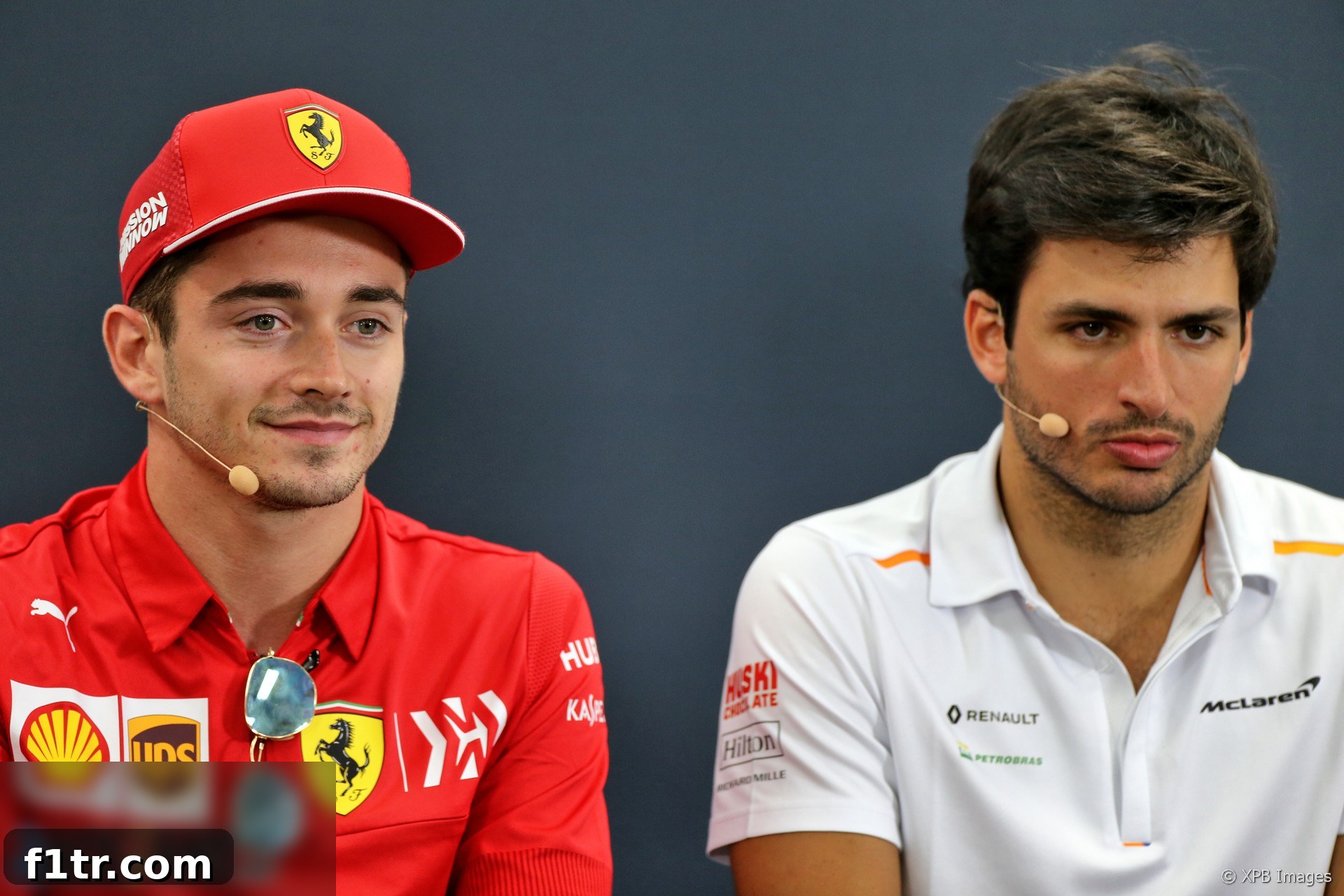
Ferrari’s Youthful Gamble: Charting a New Course with Leclerc and Sainz
As Formula 1’s most historic team and a perennial contender for championship honours, Ferrari has, for much of its storied existence, tended to favour experience over raw youth. The Scuderia’s driver selections have traditionally leaned towards seasoned veterans and proven winners, a philosophy predicated on the belief that a steady hand, extensive knowledge, and race-craft developed over many seasons are paramount to conquering the demanding world of Grand Prix racing. This long-standing approach shaped many of their championship-winning lineups, yet recent years have witnessed a profound strategic pivot, signaling a bold departure from this deeply ingrained tradition.
The landmark signing of Charles Leclerc, a prodigious talent brimming with potential, marked the initial shift in this philosophy just a few seasons ago. That move swiftly proved its worth, as Leclerc not only demonstrated exceptional speed but also out-scored his four-times world champion teammate, Sebastian Vettel. Now, with Vettel’s departure from Maranello confirmed, Ferrari is resolutely doubling down on this youthful trajectory. His place will be taken by another rising star, Carlos Sainz Jnr, to partner Leclerc for the 2021 F1 season and beyond. This new pairing, with Leclerc aged 23 and Sainz 26, immediately raises a compelling and often debated question: will their combined ages make this the youngest driver lineup Ferrari has ever commenced a season with? This strategic embrace of burgeoning talent signals not just a change in driver personnel, but a fundamental re-evaluation of how Ferrari intends to reclaim its place at the pinnacle of Formula 1.
The Youngest Lineup: A Nuanced Historical Perspective
Determining whether Charles Leclerc and Carlos Sainz Jnr constitute Ferrari’s absolute youngest starting lineup is a more intricate task than it initially appears, primarily due to the complex and ever-evolving nature of Formula 1’s formative years. The sport, and indeed Ferrari’s involvement, predates the universally adopted two-car team structure we recognise today. In those nascent decades, driver entries were often fluid and opportunistic, with multiple cars sometimes dispatched to a single race, driven by an array of different individuals. This historical fluidity complicates direct comparisons with modern, fixed-pair lineups, where teams operate with two dedicated drivers from the season’s outset.
For an extreme example that highlights this historical complexity, consider Ferrari’s approach to the 1957 season-opener in Argentina. The Scuderia’s commitment to the race was extensive, sending an astonishing six cars to Buenos Aires. These vehicles were piloted by no fewer than nine different drivers throughout the event, including luminaries such as Mike Hawthorn, Peter Collins, Luigi Musso, Eugenio Castellotti, Cesare Perdisa, Wolfgang von Trips, Jose Froilan Gonzalez, and Alfonso de Portago. Such a diverse and extensive roster makes it impossible to define a singular “pairing” in the contemporary sense. Furthermore, there were even occasions when Ferrari, for various strategic or logistical reasons, did not participate in the season’s inaugural Grand Prix, as occurred in the very first year of the World Championship in 1950, and again in 1967.
Despite these historical intricacies and fluctuating team structures, one statement can be made with absolute certainty: Ferrari has never before commenced an F1 season with a two-driver lineup *fixed from the outset* that averaged younger than the combined ages of Carlos Sainz and Charles Leclerc. While the team might have had individual younger drivers, or an even lower average age across a larger, more transient squad at a specific race, this particular pairing represents a definitive and intentional commitment to youth at the forefront of their championship challenge. For instance, in 1962, when the season began at Zandvoort, Ferrari’s contingent included the remarkably young 20-year-old Ricardo Rodriguez and 27-year-old Giancarlo Baghetti. However, they were part of a three-car effort that also featured the then 35-year-old world champion Phil Hill, significantly increasing the overall average age of the *entire* team for that event. The Leclerc-Sainz duo, therefore, represents a unique and strategic investment in two rising stars.
The Leclerc-Sainz Partnership: Ambition Meets Potential
The impending partnership between Charles Leclerc and Carlos Sainz Jnr is laden with immense potential, yet it also brings a distinct set of challenges for Ferrari. Both drivers are fiercely ambitious, talented, and demonstrably quick, but neither has yet claimed a World Championship title. This reality places them in a unique position within Ferrari’s history, as the Scuderia has traditionally sought out established champions or drivers on the cusp of greatness. When they embark on their inaugural season together, their combined tally of F1 race victories currently stands at just two – both achieved by Leclerc. This statistic, while reflecting their relative youth and career stage, also underscores the immense pressure and responsibility they will shoulder as they aim to lead F1’s most iconic team back to glory.
Skepticism might suggest that this pairing could initially be among Ferrari’s least successful in terms of immediate championship contention, particularly given the recent struggles of the team. However, such a judgment would be premature and would overlook significant factors at play, including the performance of the car, the strategic direction of the team, and their own growth as drivers. Their success will not solely depend on their individual talents, but critically on Ferrari’s ability to provide a competitive machine and a cohesive environment that allows both drivers to flourish. The true measure of their partnership will unfold as the seasons progress, offering a fresh narrative for a team eager to write new chapters of triumph. Their youth, rather than being a deficit, could in fact be their greatest asset, offering a long-term vision, adaptability, and a dynamic energy that Ferrari sorely needs to rejuvenate its F1 campaign.
Sebastian Vettel’s Departure: The Champion’s Curse and the German Void
Sebastian Vettel’s departure from Ferrari marks the conclusion of an era that promised so much but ultimately delivered less than anticipated. A four-time world champion upon his arrival at Maranello, Vettel was widely expected to emulate his idol Michael Schumacher and usher in a new golden age for the Scuderia. Yet, despite moments of brilliance, numerous race victories, and fierce championship battles, the coveted drivers’ championship remained stubbornly elusive. His tenure adds another name to the growing, and somewhat disheartening, list of multiple champions who joined Ferrari but failed to add another title to their already illustrious careers.
Of the sixteen multiple world champions in Formula 1 history, a significant five arrived at Maranello already holding more than one title. Strikingly, only two of these legendary figures – the inimitable Juan Manuel Fangio and the incomparable Michael Schumacher – succeeded in clinching further championships during their time with Ferrari. Icons like Alain Prost and Fernando Alonso, despite their immense talent and multiple titles achieved elsewhere, found themselves unable to break this “champion’s curse” at Ferrari. Vettel’s experience, unless he secures a miraculous championship in his final year, will sadly place him in this category, highlighting the unique and often demanding environment of the Scuderia, where even the most decorated drivers can struggle to find that ultimate success.
Vettel’s potential exit from the F1 grid entirely, if he does not secure a seat for the following season, would also signify a notable shift in the sport’s landscape. It would mean, for the first time since the 1991 British Grand Prix, that Formula 1 would be without a German driver. This absence would mark the end of an impressive streak of German representation at the pinnacle of motorsport, a legacy powerfully built by drivers like Michael Schumacher and, more recently, Sebastian Vettel himself. The implications extend beyond just one driver; it speaks to the changing demographics of talent coming through the ranks in various motorsport nations and the cyclical nature of national dominance in Formula 1.
The Domino Effect: Sainz, Ricciardo, and McLaren’s Revival
Carlos Sainz’s move to Ferrari is not just a story about the Scuderia; it’s a critical piece in a larger driver market puzzle that reverberates throughout the Formula 1 paddock. His transfer marks a significant moment for McLaren, as Sainz is the first driver to transition directly from the Woking-based team to Maranello since Kimi Raikkonen made the switch in 2007. That year was also notable as the last time Ferrari began a season without a previous world champion in its driver lineup – though Räikkönen would go on to win the championship in his very first season with the team, a testament to his immediate and impactful arrival.
Sainz’s distinctive choice to carry the number 55 will make him the first Ferrari driver in history to bear that particular number, adding a unique personal touch to his new chapter. His departure from McLaren, however, created a high-profile vacancy, which was swiftly filled by the charismatic Australian, Daniel Ricciardo. Ricciardo’s arrival at McLaren, bringing his iconic number three, will form a visually neat pairing with Lando Norris’s number four. This numerical alignment surprisingly harks back to a period of McLaren’s past glory. The last occasion two McLarens sported the numbers three and four on track was also the last time the team stood atop the podium – Jenson Button’s triumphant victory at the 2012 Brazilian Grand Prix. This coincidental detail adds a layer of hopeful symbolism for McLaren, a team that has been diligently working its way back to competitiveness after a challenging period. The intricate driver reshuffle underscores the dynamic and interconnected nature of F1, where one team’s gain often sparks a chain reaction of opportunities and challenges for others, shaping the grid for years to come.
Ferrari’s Evolving Driver Philosophy: A Look Back and Forward
Ferrari’s driver choices throughout its history have often reflected the prevailing competitive landscape and the team’s strategic objectives. The current shift towards a younger, less championship-laden lineup with Leclerc and Sainz stands in stark contrast to certain periods where experience was overwhelmingly prioritized, or where circumstances dictated unexpected pairings. The last time Ferrari fielded two drivers who had never, at any point in their careers, won a world championship, offers a compelling historical parallel. This occurred in 1999, during a challenging season where Mika Salo admirably stepped in to substitute for an injured Michael Schumacher for six races, partnering Eddie Irvine. Neither Salo nor Irvine ultimately achieved a world championship title, making that a rare instance of a non-champion duo for Ferrari in modern times.
This historical context emphasizes the boldness of the current strategy. Rather than relying on established champions to deliver immediate results, Ferrari is investing in a future built on youthful talent, nurtured and developed within the Maranello environment. It’s a clear statement of intent: to build a new era of success from within, with drivers who can grow and evolve with the team over the long term. This approach requires patience, strategic vision, and an unwavering belief in the potential of their chosen talents. The journey ahead for Leclerc and Sainz will not only define their careers but also shape the next chapter of Ferrari’s enduring legacy in Formula 1. It signifies a proactive step towards building a sustainable foundation for future championship bids, moving away from short-term fixes and embracing a new generation of racing excellence.
Conclusion: A New Era for the Scuderia
Ferrari’s decision to entrust its Formula 1 future to the youthful exuberance and raw talent of Charles Leclerc and Carlos Sainz Jnr represents a pivotal moment in the Scuderia’s illustrious history. It is a calculated gamble, a definitive move away from a decades-long preference for battle-hardened veterans, signaling a fresh, forward-looking strategy. This pairing, the youngest starting lineup in Ferrari’s fixed two-driver history, embodies a new era of ambition and potential that resonates throughout the F1 paddock.
While the road to championship glory is notoriously arduous, and the immediate success of this pairing remains to be seen, the intent is clear: Ferrari is building for a sustainable, competitive future. The echoes of past champions who fell short at Maranello serve as a stark reminder of the immense challenges ahead, but also highlight the unique opportunity for Leclerc and Sainz to forge their own legacy, unburdened by past expectations. Their combined talent, hunger, and drive offer Ferrari a renewed sense of purpose, injecting dynamism into the heart of Formula 1’s most iconic team. As the red lights go out on the new season, the world will watch with keen anticipation to see if this youthful revolution can indeed steer Ferrari back to its rightful place at the summit of motorsport, ushering in a new era of unbridled success.