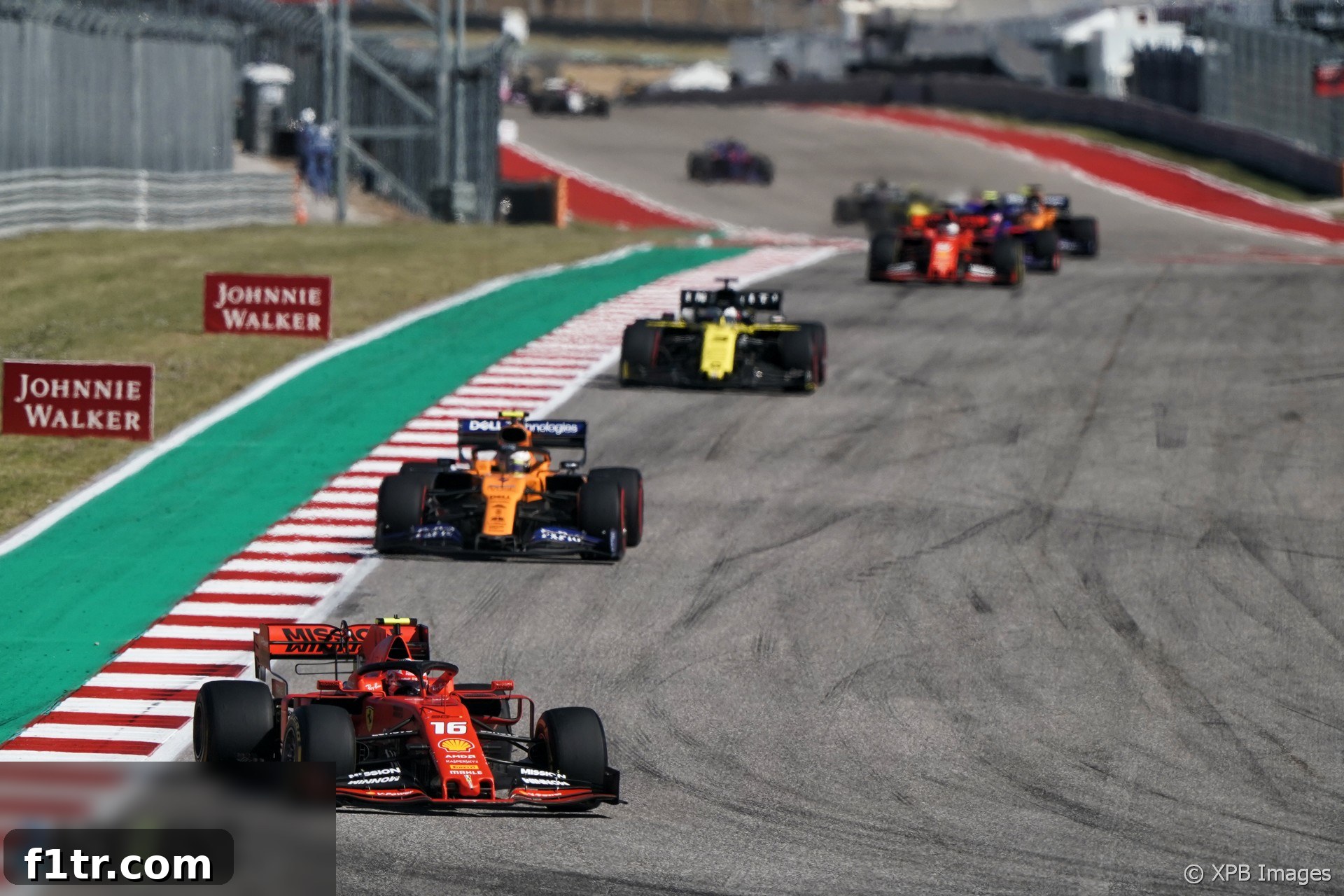
Scuderia Ferrari found itself under intense scrutiny following a challenging performance at the Circuit of the Americas (COTA). The team, which had previously enjoyed a significant straight-line speed advantage throughout the 2019 Formula 1 season, conceded a noticeable dip in this crucial area in Austin. This downturn came amidst swirling paddock rumors and direct comments from rival teams regarding a recent technical directive issued by the FIA, which sought to clarify regulations surrounding power unit legality. Despite the visible change in pace, Ferrari staunchly denied making any alterations to its power unit or its operational methods, with team principal Mattia Binotto vigorously defending the team’s integrity against what he termed “disappointing comments” from competitors.
Advert | Become a Supporter & go ad-free
The controversy ignited after an FIA technical directive was issued prior to the United States Grand Prix, specifically addressing fuel flow measurement and energy recovery systems. This directive aimed to close potential loopholes that some teams were suspected of exploiting to gain an unfair advantage in engine performance. Given Ferrari’s pronounced straight-line speed dominance in preceding races, particularly at high-speed tracks like Spa and Monza, the timing of the directive and the subsequent dip in their performance at COTA immediately fueled speculation. Competitors like Lewis Hamilton and Max Verstappen were quick to voice their observations, subtly implying that the ruling might have impacted Ferrari’s formidable power unit. Such remarks only intensified the pressure on the Maranello-based squad, forcing Mattia Binotto to issue a strong rebuttal.
Binotto, visibly frustrated by the insinuations, firmly stated, “Ferrari did not alter its power unit or change how they operate it in response to a recent FIA technical directive.” He emphasized that the team always operates within the regulatory framework and that any suggestions otherwise were unfounded and unfair. However, even as he defended the team against accusations of impropriety, Binotto had to acknowledge the undeniable reality of their on-track performance. He conceded that Ferrari “wasn’t as strong on the straights in Austin as they have in recent races,” a candid admission that only added complexity to the narrative surrounding the team’s engine performance.
“It’s true that we were not gaining on the straight as much as in the past races,” Binotto reiterated, directly addressing the core issue that had been the subject of much discussion. This statement marked a significant departure from Ferrari’s form throughout the middle part of the 2019 season, where their cars often exhibited superior acceleration and top speeds on the straights, making them incredibly difficult to overtake. However, he offered an explanation that attempted to contextualize this change, suggesting it was part of a broader setup strategy. “But as well as that I think we matched our competitors in cornering, at least lap time in quali. So the trade off between grip limit and power limit has been moved this weekend.” This implied that Ferrari might have opted for a higher-downforce setup to gain cornering performance, which inherently sacrifices straight-line speed. This delicate balance, known as the “trade-off” in Formula 1 engineering, is a constant challenge for teams seeking optimal performance at varying circuit layouts.
The immediate consequence of this performance shift was the end of Ferrari’s impressive run of six consecutive pole positions. At COTA, Sebastian Vettel narrowly missed out on pole, qualifying a mere 12 thousandths of a second behind Valtteri Bottas, landing him in second place. His teammate, Charles Leclerc, qualified further back in fourth. While qualifying performance remained respectable, albeit not dominant, the race day proved to be a far more challenging affair for the Italian team. Leclerc could only manage a fourth-place finish, a significant gap from the leading Mercedes cars, while Vettel’s race ended prematurely in retirement after he struggled immensely at the start, quickly losing positions before suffering a suspension failure.
Binotto acknowledged the disparity between their Saturday and Sunday pace. “We were competitive in quali, now there is something in the race to understand,” he stated, highlighting a critical area for analysis and improvement. “We need to understand what’s best for the next race again in term of trade-off.” This sentiment underscored the team’s commitment to dissecting their performance data to optimize their car’s setup for upcoming Grands Prix. The difference between qualifying and race performance is often attributed to factors such as tire degradation over longer stints, fuel loads, and the car’s balance in traffic. For Ferrari, the struggle in the race suggested that their chosen “trade-off” for COTA might have been less effective in race conditions compared to single-lap qualifying runs.
Adding to Charles Leclerc’s difficulties at COTA was an unexpected power unit issue during final practice, forcing his team to revert to an older ‘spec two’ engine for qualifying and the race. This older specification, while still competitive, was known to be slightly less powerful than the updated unit. Binotto downplayed the impact, stating Leclerc’s engine was “not down by quite a lot, it was slightly down, which was what we had expected between an upgrade of engines.” The damaged engine was promptly returned to Maranello for thorough inspection and analysis by the engineers, a standard procedure to understand any failures and prevent future occurrences. Despite the minor power deficit, Leclerc’s frustrations ran deeper than just engine specifications.
Leclerc, who finished the race a significant 50 seconds behind winner Valtteri Bottas, attributed his struggles primarily to a profound lack of grip throughout the race. “Overall there was just no grip,” he lamented. “I never found the grip with the tyres, simple as that. I can [explain] specifically corner by corner, but it wouldn’t make sense. Overall the car was feeling very, very poor and I never felt I got the tyres working so I was just sliding all around.” This candid assessment from the Monegasque driver painted a vivid picture of a car that was simply unwilling to cooperate with the tires on COTA’s notoriously bumpy surface. A lack of grip not only hampers cornering speed but also accelerates tire degradation, forcing drivers into compromised lines and making it difficult to extract consistent performance. It highlights a fundamental setup issue or a mismatch between the car’s characteristics and the circuit’s demands, independent of the power unit controversy.
The Ferrari situation at the Circuit of the Americas epitomized the intense technical and political landscape of Formula 1. While the team successfully defended against accusations of illegality, the shift in their performance, particularly their diminished straight-line advantage, was undeniable. This scenario served as a compelling demonstration of how FIA technical directives can subtly, or sometimes overtly, influence competitive dynamics within the sport. The challenges faced by both Vettel and Leclerc, from mechanical failures to a fundamental lack of car-to-tyre grip, painted a picture of a team grappling with complex engineering puzzles. As the 2019 season drew to a close, Ferrari was left with significant questions to answer regarding their car’s overall package, the efficacy of their setup philosophies, and the ongoing development trajectory of their power unit, ensuring that the saga of their engine performance would continue to be a focal point in the subsequent discussions and analyses of the season.
Advert | Become a RaceFans supporter andgo ad-free
2019 F1 season Related Articles
- Crying in the Melbourne car park at 2019 grand prix was my career low – Ocon
- McLaren Racing reports reduced £71 million loss in 2019
- Kvyat: Hockenheim podium last year was “my biggest achievement” so far
- How the FIA’s new encrypted fuel flow meter targets Ferrari’s suspected ‘aliasing’ trick
- “He smashed my office door”: 23 must-see moments from ‘Drive to Survive’ season two
Browse all 2019 F1 season articles