F1 Drivers Brace for Neck Strain as Catalunya Drops Chicane for Spanish Grand Prix
Formula 1 drivers are preparing for an exceptionally demanding physical challenge at this weekend’s Spanish Grand Prix. The Circuit de Catalunya has undergone a significant layout change, abandoning the slow chicane at the end of the lap and reverting to its original, high-speed final two corners. This modification, welcomed by many for its potential to improve racing, will undoubtedly push drivers’ physical limits, particularly their necks, which are expected to be “falling off” after the intense G-forces.
A Blast from the Past: Reverting to Catalunya’s Original High-Speed Layout
The decision to remove the chicane marks a return to the layout used between 1991 and 2006, offering a nostalgic and exhilarating challenge for the modern era of Formula 1. The original configuration features a sweeping, high-speed right-hand corner leading directly onto the long main straight, a stark contrast to the tight, momentum-killing chicane that has been a feature since 2007.
In a grid full of elite talent, Fernando Alonso stands as the sole active driver with extensive race experience on the original layout, having competed on it during his early F1 career. While other drivers have tested the revised route, Alonso’s insight into the nuances of the original corners will be invaluable.
Oscar Piastri, a rising star, had a brief taste of the high-speed section during a McLaren filming day. “At that point it was rumoured it might happen so we just did a couple of laps,” he recalled. Piastri didn’t shy away from admitting the physical toll this change will bring: “It’ll be sore. I’m sure everyone will be sore.” However, he noted the modern advantage of “very big headrests nowadays,” offering a “luxury” for drivers to lean on during the grueling high-speed corners.
Reflecting on the early season challenges, Piastri added, “We had Saudi as our second race of the year, so that was quite the baptism of fire, for my neck anyway and I’m sure others.” Despite the anticipated discomfort, the general sentiment among drivers is positive. Piastri summarized, “But it’ll be a good challenge for us all and I think it will be much nicer to drive even if our necks are falling off.” This underlines the drivers’ preference for challenging, flowing circuits over slower, more artificial sections.
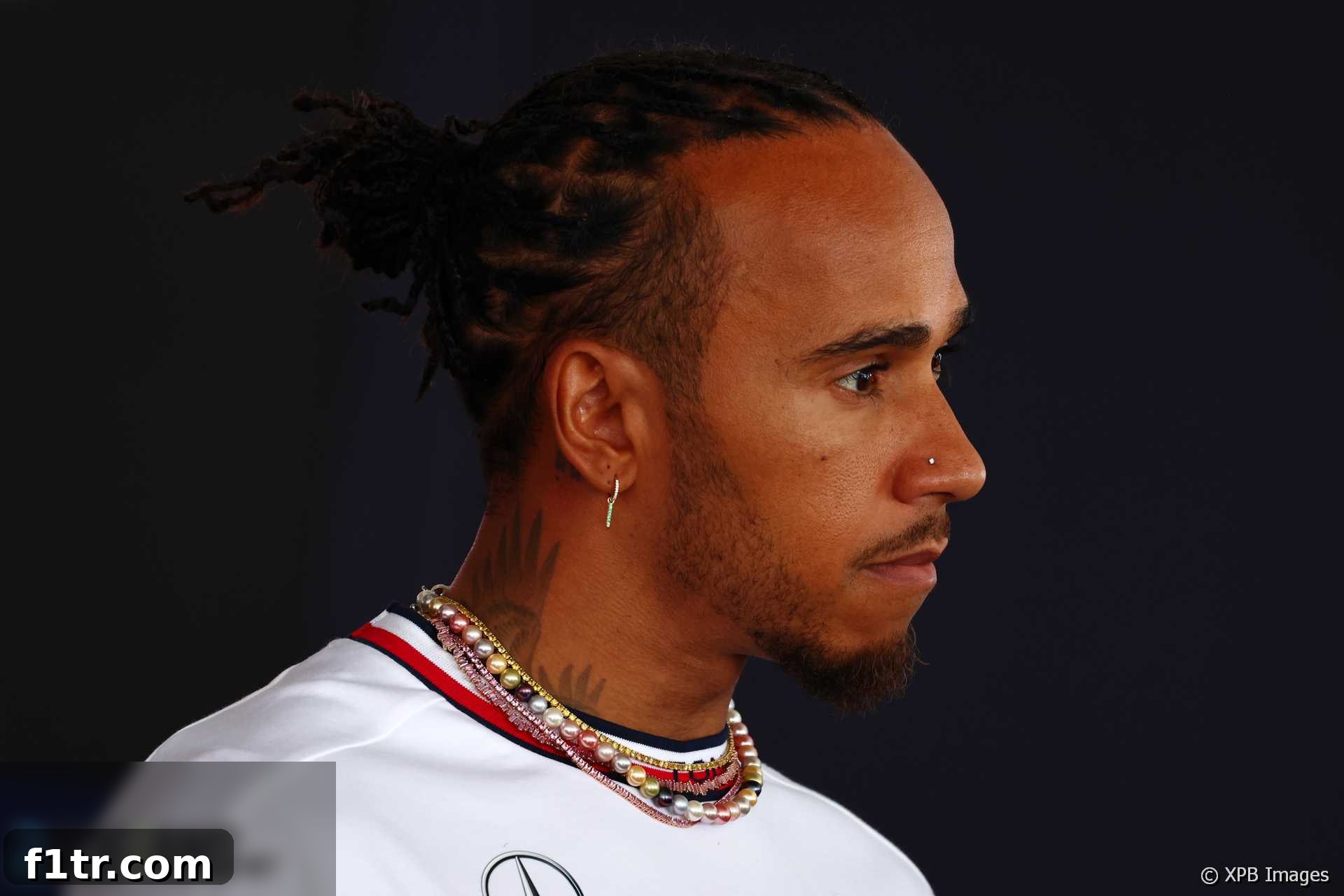
The chicane was a new addition in Lewis Hamilton’s inaugural F1 season in 2007. However, the seven-time world champion did experience the previous version during pre-season testing. He vividly remembers the intense physical demands of the original layout from a 2006 test with McLaren.
“I remember testing here in 2006, my first test in the McLaren, and that was two, three, four days of the high-speed last corner,” Hamilton recounted. “And I remember I couldn’t hold my head up.” In a classic display of competitive stubbornness, he initially refused assistance. “The team said Gary – Gary Paffett was one of the test drivers – he uses a pad, do you want a pad? And I’m like ‘no, no, my neck’s strong’.” This bravado quickly faded. “And I remember getting into turn one and straight away not being able to hold my head up. I came back and said ‘no, my neck’s good…’. I was in so much pain, struggling to sleep at night.” This anecdote perfectly illustrates the sheer physical toll the original layout imposes, even on highly conditioned athletes.
Enhancing the Race: More Overtaking, Better Flow
The original introduction of the chicane in 2007 was primarily driven by safety concerns. However, Formula 1 has evolved dramatically since then. Today’s cars are engineered to pass far tougher crash tests, and safety innovations like the Halo cockpit protection system provide unparalleled driver security. Furthermore, extensive upgrades to the run-off areas and barriers at the exit of the final two corners have been implemented, making the return to the high-speed configuration a viable and safe option.
Beyond safety, a significant motivation for removing the chicane is the hope for improved racing. Several drivers believe that the high-speed corners will allow them to follow other cars more closely, enhancing the aerodynamic performance and creating more opportunities for overtaking on the long main straight. The slow chicane often bunched cars up, making it difficult to maintain close proximity through the subsequent sector, thus limiting slipstream advantages.
Hamilton expressed this optimism, stating, “I hope that we’re able to follow, with the cars we have, a bit better through the last two corners than we have the little Mickey Mouse chicane.” The term “Mickey Mouse chicane” itself reflects the drivers’ long-standing frustration with its artificial nature and the way it disrupted the natural flow of the circuit.
Alexander Albon, the Williams driver, is particularly enthusiastic about the change, convinced it will lead to superior racing, especially with the current generation of F1 cars designed for ground effect aerodynamics.
“It’s great,” Albon affirmed. “I think it’s really good. I don’t know a driver who’s been negative about it.” He minced no words about the former chicane: “It was always a bit of – I don’t want to call it an ugly piece of work, but it was tricky and it ruined the rest of the track because the flow was just so different to before. Not that I’ve driven it, but I will do soon.”
Albon’s primary focus is on the improved racing spectacle. “More than anything, it’s the racing that I hope is going to improve and it will do, I’m sure,” he stated confidently. He elaborated on the limitations of the chicane: “Last year, you could always stay pretty close through [turns] 10 and 12 because of the lines you can take – always a bit different, you can always find a bit of clean air. If you went in tight through 10 or wide through 11, you could always offset the car in front. But once you go through 13, 14, 15, it was always single-line. You had to copy the same line.”
With the current aerodynamic regulations, cars are designed to follow more effectively through high-speed corners. “These high speed corners the car follows, with these regulations, not too bad,” Albon observed. This leads him to believe, “I reckon it’s going to be one of the easier overtaking tracks we go to this year, at least by our pre-race statistics. Maybe we’re wrong but let’s hope we’re not.”
Strategic Implications and Car Performance
The removal of the chicane will not only impact driver physiology and overall race dynamics but also necessitate strategic adjustments in car setup and race strategy. Teams will have to re-evaluate their aerodynamic packages, balancing downforce for the high-speed final sector with straight-line speed for the main straight. Tire degradation, especially for the front tires which will be under immense pressure through the long, fast corners, will be another critical factor.
Albon also highlighted a potential advantage for his team: “The removal of the chicane is going to help us a little bit more. Those three corners was always a bit of a tricky one for us, we’d always lose quite a lot of lap time through there. So getting rid of that is perfect.” This suggests that certain car philosophies might be inherently better suited to the new, faster layout, adding another layer of intrigue to the Spanish Grand Prix.
A New Era for the Spanish Grand Prix
The Circuit de Catalunya has long been a staple of the F1 calendar, renowned for its technical challenge and as a testing ground for car development. By reverting to its original, flowing layout, the circuit aims to rejuvenate its racing pedigree, offering a faster, more physically demanding experience for drivers and a more exciting spectacle for fans. This bold move blends the circuit’s rich history with modern safety standards and the pursuit of enhanced on-track action. The 2023 Spanish Grand Prix is set to be a true test of driver and machine, promising a memorable weekend as Formula 1 embraces a faster, more traditional challenge in Barcelona.
Bringing the F1 news from the source
RaceFans strives to bring its readers news directly from the key players in Formula 1. We are able to do this thanks in part to the generous backing of our RaceFans Supporters.
By contributing £1 per month or £12 per year (or the equivalent in other currencies) you can help cover the costs involved in producing original journalism: Travelling, writing, creating, hosting, contacting and developing.
We have been proudly supported by our readers for over 10 years. If you enjoy our independent coverage, please consider becoming a RaceFans Supporter today. As a bonus, all our Supporters can also browse the site ad-free. Sign up or find out more via the links below:
- Become a RaceFans Supporter
- RaceFans Supporter FAQ
2023 Spanish Grand Prix: Related Articles
- Ben Sulayem raises safety concerns over “too many people on the grid” at races
- Why Ferrari say their change in design is the result of “discipline”, not “copying”
- Hamilton and Russell were seeking tow from Sainz when they collided – Mercedes
- Red Bull’s Spanish GP diffuser update was ‘inspired by rivals’ including Williams
- Why McLaren always doubted second-row start in Spain would lead to points finish
Browse all 2023 Spanish Grand Prix articles