Advert | Become a Supporter & go ad-free
The Controversial 2021 Belgian Grand Prix: Unpacking F1’s Points Dilemma
The 2021 Formula 1 season delivered many memorable moments, but few were as polarising and hotly debated as the decision to award championship points for the Belgian Grand Prix. What transpired at the iconic Spa-Francorchamps circuit was an unprecedented event: a Grand Prix that officially ran for just three laps, all completed behind the Safety Car, yet still saw drivers collect precious championship points. This decision ignited a furious debate among fans, teams, and even drivers, questioning the very essence of what constitutes a ‘race’ in Formula 1.
A Washout at Spa: The Events of a Chaotic Race Day
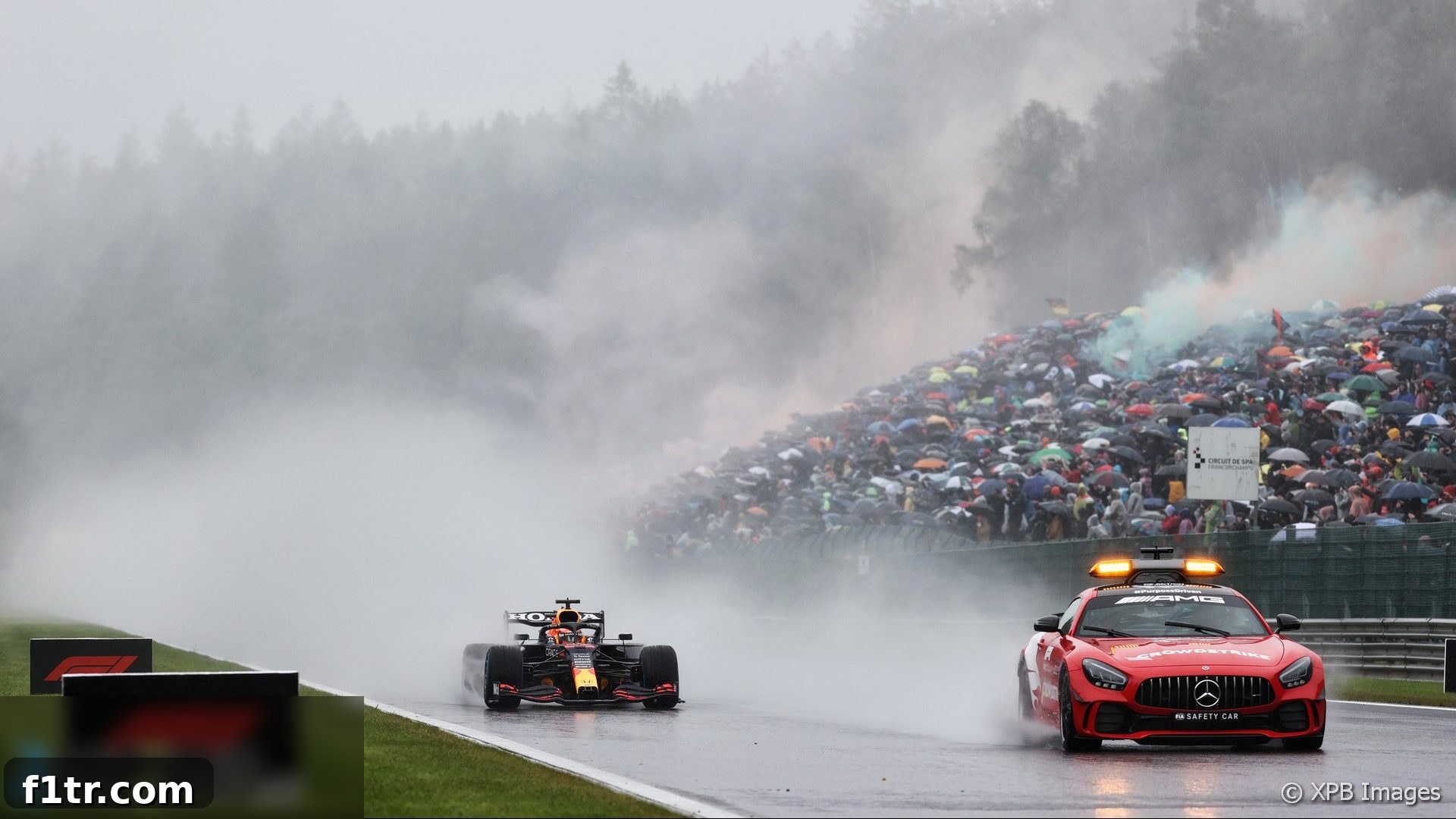
The highly anticipated annual visit to the Ardennes Forest for the Belgian Grand Prix turned into a complete washout. Persistent, torrential rain plagued the circuit throughout Sunday, making conditions treacherous and unsafe for competitive racing. After multiple delays stretching several hours, and numerous attempts to get the race underway, the cars were eventually sent out onto the track. However, these brief excursions were exclusively behind the Safety Car, never once transitioning to green flag racing conditions where drivers could truly compete.
Despite the lack of genuine racing, Formula 1’s sporting regulations stipulated that a final race classification could be determined. This was based on the positions after a single completed lap. Crucially, the FIA (Fédération Internationale de l’Automobile) determined that the event met the minimum criteria for half-points to be awarded, specifically that more than two laps had been completed. The winner, Max Verstappen, had crossed the finishing line three times behind the Safety Car, thus fulfilling the technical requirement. This led to a distribution of half-points, with Verstappen claiming 12.5 points and other top-10 finishers earning their proportional share.
The Core of the Controversy: Justifying Points Without Racing
The decision to award points was contentious primarily because the “race” itself only officially began after an extended delay, with many speculating that this was a deliberate move to activate the points system. Critics argued that sending cars out for a token few laps behind the Safety Car, only for the race to be immediately red-flagged again, was an artificial manoeuvre. It appeared to serve no purpose other than to provide a technical justification for awarding points, despite the complete absence of actual racing. The integrity of the championship was called into question, with many feeling that points should only be earned through genuine on-track competition.
Adding fuel to the fire was the stark contrast with other FIA-sanctioned world championships. For instance, the World Endurance Championship (WEC), also governed by the FIA, has rules that prevent the awarding of championship points if no green flag racing laps have been completed. This inconsistency highlighted a perceived flaw in Formula 1’s regulations, prompting immediate scrutiny. Following the widespread outcry, then-FIA President Jean Todt confirmed that F1’s rules, particularly those governing the mechanism for awarding points in such extreme circumstances, would be reappraised. This acknowledgement underscored the severity of the situation and the clear need for revised regulations.
Advert | Become a RaceFans supporter andgo ad-free
Arguments For Awarding Points: Upholding Qualifying Merit
For
Proponents of awarding points argued that the starting grid for the race was not a matter of chance but the direct result of a conventional, hard-fought qualifying session. Drivers had legitimately earned their positions through merit and performance under challenging conditions on Saturday. Formula 1 race results, especially at circuits like Monaco, are not uncommonly a close reflection of the qualifying order, where track position is paramount. In this context, some argued that the Belgian Grand Prix, despite its unique circumstances, was merely an extreme example of this phenomenon.
Furthermore, racing in adverse weather conditions is an inherent part of motorsport. Drivers and teams must be prepared for all eventualities, and sometimes external factors dictate the outcome. The exceptional performance of drivers like George Russell, who qualified his Williams in a stunning second place, was a testament to his skill in the wet qualifying session. To completely negate such achievements, supporters argued, would undermine the effort and risk taken during qualifying. The existing rules, imperfect as they might be, were followed, and ignoring them would set a dangerous precedent for future race cancellations or partial events.
Against
Conversely, the arguments against awarding points were numerous and compelling. The fundamental reward for performing well in qualifying is securing a good starting position for the race – not automatically gaining points without competitive action. Critics vehemently argued that no actual race took place; there was no green flag running, no overtakes, no strategic pit stops under racing conditions, and no genuine competition for position.
The absurdity of the situation was highlighted by comparisons: had drivers completed 30 laps of flat-out racing and then a sudden storm stopped the event, they would have scored the same amount of points as they did for merely completing three Safety Car laps. This scenario, many asserted, was a nonsensical devaluation of genuine racing effort and skill. The purpose of a Grand Prix is to race, and without that core element, the event should be considered void of championship significance. Awarding points in such a manner diluted the meaning of the championship and risked alienating fans who expect a fair and sporting contest for every point earned.
Expert Commentary: The View from the Paddock and Beyond
Even many drivers who benefited from the points haul last weekend expressed dissatisfaction with the outcome. Take Sebastian Vettel, for example, who achieved his third-highest individual score of the season, yet was openly unhappy that a brief tour behind the Safety Car contributed to his championship tally. This sentiment from within the sport itself strongly indicated a problem with the regulations.
The inconsistency when compared to other racing series grates even more. If the World Endurance Championship has the foresight to understand that simply parading cars around behind a Safety Car for a few laps does not constitute a race worthy of points, then Formula 1, as the pinnacle of motorsport, should certainly adopt a similar rationale. Sporting integrity demands a clear distinction between a procession and genuine competition. The 2021 Belgian Grand Prix served as a stark reminder that F1’s rulebook needed urgent revision to align with the spirit of racing.
The Aftermath and Future Implications for F1 Regulations
The controversy of the 2021 Belgian Grand Prix prompted immediate and necessary action from the FIA. Jean Todt’s commitment to reappraise the rules, particularly those concerning minimum race distances and point allocation, was a direct response to the widespread criticism. The incident highlighted a significant loophole in the regulations that allowed for championship points to be awarded under conditions that fell far short of a competitive sporting event.
Moving forward, Formula 1 has implemented changes to its points system for shortened races. The revised rules now require a minimum of two green flag racing laps, not just Safety Car laps, for points to be awarded. Furthermore, a tiered points system has been introduced, where different levels of points are awarded based on the percentage of the race completed. This aims to prevent a repeat of the Spa situation, ensuring that points genuinely reflect the amount of racing that has occurred. These adjustments are crucial for restoring faith in the championship’s fairness and maintaining the high standards expected of the sport.
Your Say: The Enduring Debate
The 2021 Belgian Grand Prix remains a significant talking point in Formula 1 history, a stark example of how sporting regulations can be pushed to their limits by extreme circumstances. The debate it ignited underscores the importance of clear, unambiguous rules that uphold the integrity and competitive spirit of the sport.
What are your thoughts on this unprecedented event? Should points ever have been awarded for a Grand Prix with no green flag racing? Share your perspective and join the discussion in the comments section below.
A RaceFans account is required in order to comment. If you do not have one, register an account here or read more about registering here.
Advert | Become a RaceFans supporter andgo ad-free
Related Debates and Polls
- What must Formula 1 fix with its new rules – and what should it leave unchanged?
- ADUO: Do F1 teams who fall behind deserve to get help to catch up?
- F1 is considering doubling its sprint races. Do you want more or fewer?
- Will this be a fight or a rout? 20 questions for the 2026 Formula 1 season
- Which Formula 1 team has the best-looking car – and the worst – for the 2026 season?
Browse all debates and polls