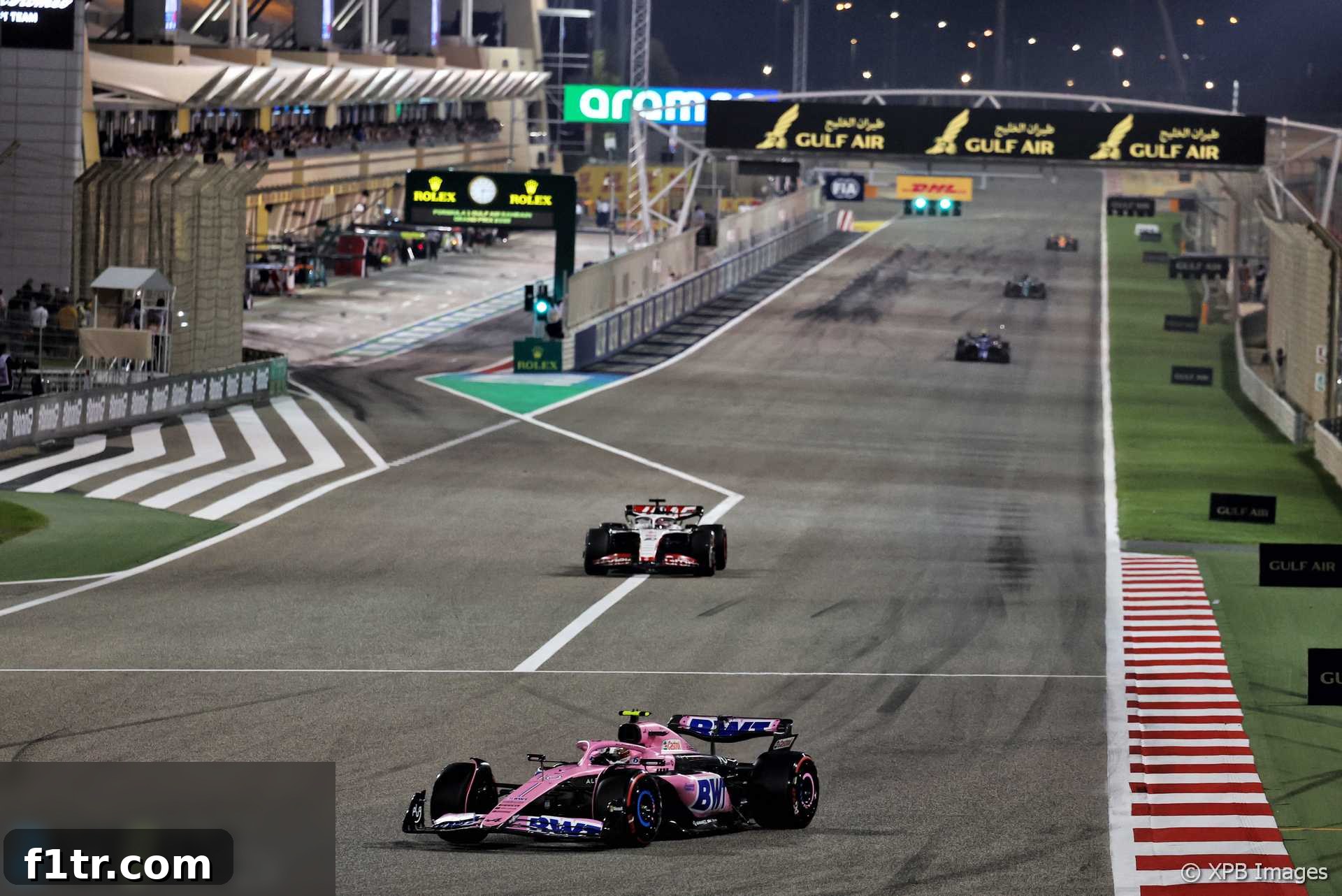
Pierre Gasly’s Alpine Debut Derailed by Sudden Car Balance Shift in Bahrain Qualifying
In a challenging start to his tenure with the BWT Alpine F1 Team, Pierre Gasly found himself at the very back of the grid for the season-opening Bahrain Grand Prix. The French driver expressed surprise and frustration after a sudden and inexplicable change in his car’s balance severely hampered his qualifying efforts, leading to a Q1 elimination and a last-place start for his Alpine debut.
The highly anticipated 2023 Formula 1 season opener in Bahrain presented an immediate hurdle for Gasly, who moved from AlphaTauri to Alpine over the winter break. While his new teammate, Esteban Ocon, successfully navigated the qualifying sessions to secure a respectable ninth position on the grid, Gasly’s session was cut short, culminating in a disappointing P20. This stark contrast in performance within the same team underscored the unique challenges Gasly faced as he adjusted to his new machinery and environment.
A Q1 Exit Plagued by Technical Mystery and Track Limits
Gasly’s qualifying woes began even before the dramatic car balance shift. He was already struggling to find consistent pace and make the cut for Q2 when his quickest lap time was unceremoniously deleted due to a track limits infringement. This penalty, often a minor setback for some, proved to be the final nail in the coffin for Gasly’s qualifying aspirations, cementing his position at the very rear of the field.
For any Formula 1 driver, especially one making his debut with a new team, a strong qualifying performance is crucial for building confidence and setting the tone for the season. Gasly’s last-place start in Bahrain was far from ideal, casting a shadow over what should have been an exciting new chapter in his career. The deletion of his lap time further highlighted the razor-thin margins in Formula 1, where every millimeter and every hundredth of a second counts, particularly when a driver is already wrestling with an unpredictable car.
The Enigmatic Shift in Car Balance: From Understeer to Oversteer Chaos
Throughout much of the Bahrain Grand Prix weekend leading up to qualifying, Pierre Gasly had consistently reported issues with a lack of front-end grip, a condition commonly known as understeer. This means the car struggles to turn into corners, forcing the driver to apply more steering input and often compromising apex speed and overall lap times. Drivers and engineers typically dedicate considerable effort during practice sessions to dial out such issues, aiming for a neutral and predictable car balance that allows the driver to push confidently.
However, the qualifying session brought with it an entirely unexpected and dramatic shift in the car’s handling characteristics. Gasly recounted his bewilderment after the session, stating, “I don’t fully have the answers now. But I looked for more front the whole weekend and struggled with understeer, understeer.” He then vividly described the sudden transformation his Alpine underwent during the crucial Q1 session: “[Then] just everything clicked in quali in these conditions, I don’t know why, and it was just way too extreme for the conditions and was a bit all over the place on all the exits.”
This “all over the place on all the exits” description suggests a sudden and aggressive transition from understeer to a highly unstable oversteer, where the rear of the car loses grip easily, particularly when applying power. Such a drastic and unexpected change in balance is incredibly difficult to manage at the very limit of performance, especially during the high-pressure environment of a qualifying hot lap. The car becoming unpredictable and unstable on corner exits would have made it nearly impossible for Gasly to confidently push for optimal lap times, directly explaining his struggle to extract the necessary performance to progress.
Unprecedented Behavior: A Disconnect from Pre-Season Testing
One of the most perplexing aspects of Gasly’s predicament was the stark contrast between the car’s qualifying behavior and its performance during pre-season testing. Testing, by its very nature, is designed to identify and rectify such fundamental handling issues before the competitive action begins. Gasly revealed that there was no indication during the extensive pre-season testing program that the Alpine A523 would exhibit such an abrupt and severe change in balance when pushed to its limits.
“It’s very natural to extract all the pace in testing,” he explained, emphasizing that testing environments often allow drivers to find the limits gradually and systematically. He continued, “[This was] pretty much the first time that we went all-out and just the car behaved very different to what I have experienced before.” This statement is critical, as it underscores the fundamental difference between controlled testing runs, often conducted on older tires or with specific setup goals, and the raw, unadulterated push for maximum performance in qualifying. The car’s true characteristics, particularly under extreme loads, changing track conditions, and fresh soft tires, often only fully reveal themselves when pushed to the absolute breaking point.
The discrepancy between testing performance and qualifying reality poses a significant diagnostic challenge for the Alpine engineering team. Understanding precisely why the car reacted so unpredictably in the intense qualifying conditions – whether due to subtle changes in track temperature, wind conditions, specific setup adjustments, or even driver input – will be paramount for preventing similar issues in future races. This complex diagnostic process involves meticulous data analysis, comparing countless sensor readings, and integrating detailed driver feedback to pinpoint the root cause of the sudden instability.
Confidence Amidst Adversity: Looking to Race Pace and Strategic Opportunities
Despite the deeply disappointing qualifying result, Gasly remains remarkably composed and optimistic about the Alpine A523’s underlying potential. He firmly believes that the car possesses “way more pace than what we’ve showed” in qualifying. This confidence is a vital asset for any racing driver, especially when facing a difficult start to a new chapter.
His optimism extends particularly to the car’s long-run performance, which is often a more accurate indicator of a car’s race-day potential than a single qualifying lap. “It just needs a bit of analysing. I’m quite confident in the long run. We’ve got some good pace so I know we’ll come back but it’s not ideal to start the first race where we’ll start.” This suggests that while the single-lap qualifying pace was elusive and unpredictable, the Alpine might be kinder on its tires or simply more stable and manageable over a race distance, potentially allowing Gasly to make significant progress through the field.
Starting from the very back of the grid at the Bahrain International Circuit presents a formidable challenge. The Sakhir track, while offering some overtaking opportunities with its long straights and heavy braking zones, can be tricky to navigate through traffic, and managing tire degradation while battling through a congested midfield will be a stern test. Gasly will need to combine shrewd race strategy, excellent tire management, and assertive, clean driving to salvage points from his difficult starting position and demonstrate the true pace he believes the car possesses.
The Road Ahead for Gasly and Alpine in the 2023 Season
Pierre Gasly’s debut qualifying session with Alpine was undoubtedly a baptism of fire. It served as a stark reminder of the inherent complexities of Formula 1 and the often-unpredictable nature of high-performance machinery. However, the true measure of a driver and a team is often found not in the absence of setbacks, but in their ability to overcome adversity, learn from unexpected challenges, and adapt swiftly.
For Alpine, this incident highlights the immediate need to understand and address the car’s inconsistent behavior under extreme qualifying conditions. Their ambition to solidify their position at the sharp end of the midfield, and potentially challenge the top teams, hinges on providing both Gasly and Esteban Ocon with a stable, predictable, and consistently competitive platform. Gasly’s valuable feedback will be instrumental in this diagnostic process, as his extensive experience allows him to articulate the subtle nuances of car behavior effectively.
As the 2023 season progresses, all eyes will be on Pierre Gasly to see how quickly he can fully adapt to the Alpine and consistently unlock its potential. His demonstrated determination, combined with the team’s commitment to meticulous analysis and continuous improvement, suggests that this initial setback in Bahrain is merely a blip, rather than a defining moment, in what promises to be an intriguing season. The journey back through the field in the race will be a testament to his skill and resilience, setting the stage for future battles and showcasing the true spirit of Formula 1 competition.
2023 Bahrain Grand Prix Related Articles
- FIA no longer applying its limit on F1 cars ‘porpoising’
- Why F1’s 2023 tyres are requiring drivers to change their management style
- The familiar and unfamiliar problems holding McLaren back at the start of 2023
- ‘Not like a rookie’: How McLaren glimpsed Piastri’s potential in curtailed debut
- “I’m a shouty guy”: Tsunoda told to rein in “emotional” radio chatter
Browse all 2023 Bahrain Grand Prix articles