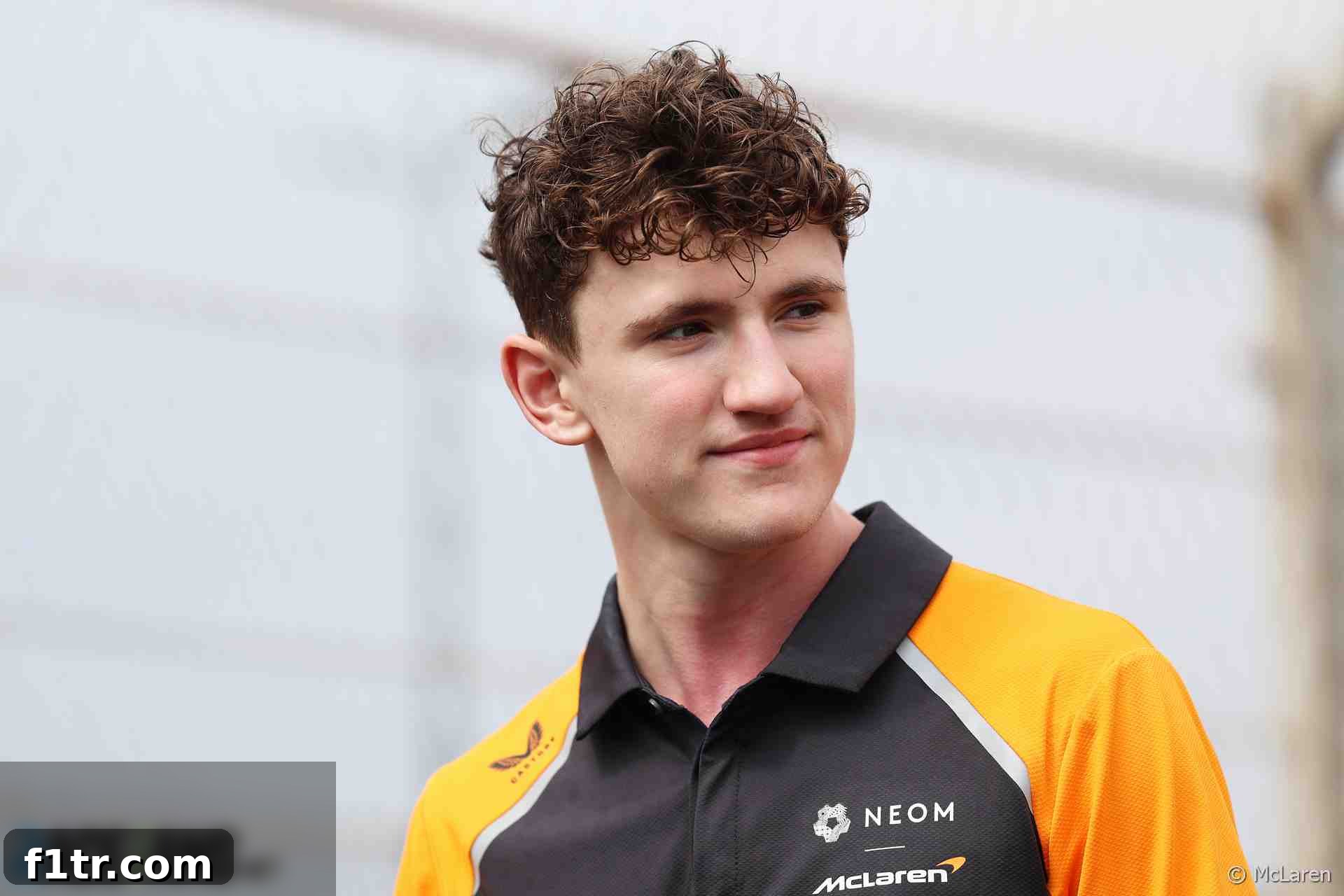
The highly anticipated moment for Formula 2 championship leader Alex Dunne has arrived, as he prepares to make his official Formula 1 practice debut with McLaren at the upcoming Austrian Grand Prix this weekend. This significant milestone marks a crucial step in the 19-year-old Irish driver’s journey and underscores McLaren’s robust commitment to nurturing top-tier talent within its extensive driver development program.
Dunne will take the wheel of Lando Norris’s McLaren MCL38 for the first practice session at the iconic Red Bull Ring, a challenging circuit renowned for its high-speed sections and technical corners. This opportunity is not merely a symbolic gesture but a vital component of Formula 1’s regulations, designed to give emerging talents valuable track time in the pinnacle of motorsport and allow teams to evaluate their potential under real-world grand prix conditions.
Alex Dunne: A Rising Star’s Path to F1
Alex Dunne’s ascent through the motorsport ranks has been marked by consistent performance and remarkable dedication. Currently leading the fiercely competitive Formula 2 championship, he has firmly established himself as one of the most exciting prospects outside of Formula 1. His impressive track record in junior categories caught the eye of McLaren, leading to his inclusion in their prestigious driver development program, a pathway that has successfully guided many drivers to the sport’s highest echelons.
This upcoming practice session won’t be Dunne’s first experience with modern F1 machinery. He has previously had the chance to drive McLaren’s 2023 car, the MCL60, under F1’s Testing of Previous Cars (TPC) regulations. These private test sessions provide a crucial understanding of the car’s mechanics and intricate systems, but an official Free Practice 1 (FP1) session during a Grand Prix weekend presents an entirely different level of pressure and scrutiny. It offers an invaluable opportunity to interact with the team during a live race weekend, adapt to the demanding schedule, and perform alongside the world’s best drivers.
Beyond his F2 commitments, Dunne also serves as a reserve and development driver for McLaren’s Formula E operations. This dual role across different disciplines further highlights his versatility and the breadth of his talent, making him a valuable asset to McLaren’s multifaceted motorsport portfolio. His experience in electric racing also equips him with unique skills in energy management and technical feedback, which can be transferable to the hybrid era of Formula 1.
McLaren’s Strategic Vision: Beyond F1
McLaren’s involvement in motorsport extends far beyond Formula 1. The Woking-based outfit maintains a significant presence in IndyCar, demonstrating its commitment to various top-tier racing series globally. Looking ahead, the team has ambitious plans to enter the World Endurance Championship’s Hypercar class in 2027, signalling a strategic expansion of its racing endeavors and a desire to compete for major titles across multiple prestigious categories. This diverse portfolio not only strengthens the McLaren brand but also provides varied pathways for its development drivers.
Interestingly, McLaren is also due to quit Formula E at the end of the current season. This decision allows the team to consolidate its resources and sharpen its focus on its primary F1 and IndyCar operations, alongside the exciting new venture into the World Endurance Championship. The reshuffling of priorities reflects a calculated move to maximize their competitive edge in key series, while continuing to invest heavily in their F1 program and the future talent that underpins it.
Understanding F1’s Rookie Practice Regulations
The inclusion of young drivers in official F1 practice sessions is not left to chance; it’s a mandatory requirement imposed by the sport’s governing body, the FIA. All Formula 1 teams are obligated to utilize a total of four first practice sessions throughout the season – two per car – to run drivers who have participated in no more than two previous Grand Prix races. This regulation serves multiple critical purposes within the sport’s ecosystem.
Firstly, it acts as a vital platform for emerging talents to gain direct, real-world experience in an F1 car during a race weekend. This exposure is incomparable to simulator work or private testing, as it involves sharing the track with seasoned professionals, adhering to strict timing, and contributing to the team’s data collection under competitive pressure. It offers a taste of the intense environment a future F1 driver would face.
Secondly, these sessions provide an invaluable opportunity for teams to assess their junior drivers’ capabilities. It allows engineers to analyze their feedback, compare their pace against regular drivers, and observe how they handle the psychological demands of a Grand Prix weekend. This data is crucial for making informed decisions about their driver development pathways and potential future F1 seats.
Lastly, it contributes to the overall health and sustainability of Formula 1 by ensuring a continuous pipeline of new talent. Without such mandated opportunities, it would be significantly harder for young drivers, regardless of their potential, to bridge the gap from junior categories to Formula 1, thus enriching the sport with fresh faces and exciting prospects for years to come.
F1 Teams’ Rookie Practice Drivers for 2025: A Glimpse into the Future
The table below provides a comprehensive overview of how various F1 teams are allocating their mandatory rookie practice sessions for the 2025 season. This showcases the strategic planning involved and highlights some of the most promising young drivers currently being groomed for a potential future in Formula 1. Each entry represents a significant opportunity for these individuals to demonstrate their skill and resilience on the global stage.
| Team | Car No. | Event (Car 1) | Practice Driver (Car 1) | Event (Car 2) | Practice Driver (Car 2) |
|---|---|---|---|---|---|
| McLaren | 4 | Austrian Grand Prix | Alex Dunne | Mexican Grand Prix | Pato O’Ward (car TBC) |
| 81 | |||||
| Ferrari | 16 | Bahrain Grand Prix | Dino Beganovic | ||
| 44 | |||||
| Red Bull | 1 | Bahrain Grand Prix | Ayumu Iwasa | ||
| 22/30 | |||||
| Mercedes | 12 | Australian Grand Prix | Andrea Kimi Antonelli | Chinese Grand Prix | Andrea Kimi Antonelli |
| 63 | Bahrain Grand Prix | Frederik Vesti | |||
| Aston Martin | 14 | Bahrain Grand Prix | Felipe Drugovich | ||
| 18 | |||||
| Alpine | 7/43 | Australian Grand Prix | Jack Doohan | Chinese Grand Prix | Jack Doohan |
| 10 | |||||
| Haas | 31 | Spanish Grand Prix | Ryo Hirakawa | Mexican Grand Prix | Ryo Hirakawa |
| 87 | Bahrain Grand Prix | Ryo Hirakawa | Abu Dhabi Grand Prix | Ryo Hirakawa | |
| Racing Bulls | 6 | Australian Grand Prix | Isack Hadjar | Chinese Grand Prix | Isack Hadjar |
| 30/22 | |||||
| Williams | 23 | Spanish Grand Prix | Victor Martins | ||
| 55 | Bahrain Grand Prix | Luke Browning | |||
| Sauber | 5 | Australian Grand Prix | Gabriel Bortoleto | Chinese Grand Prix | Gabriel Bortoleto |
| 27 |
As the table illustrates, a diverse array of talent is being given these crucial opportunities. Drivers like Andrea Kimi Antonelli, a highly-touted Mercedes junior, are receiving multiple sessions, underscoring their teams’ faith in their capabilities. Others, such as Felipe Drugovich for Aston Martin and Jack Doohan for Alpine, are also prominent figures on this list, each vying for a future F1 seat. These sessions are not just about setting fast lap times; they are comprehensive assessments of a driver’s technical understanding, ability to integrate with the team, and composure under pressure. The strategic placement of these sessions, often at tracks that require specific skills or during weekends where data collection is paramount, further emphasizes their importance.
The Red Bull Ring: A Debut Stage
The Red Bull Ring in Spielberg, Austria, offers a unique and demanding environment for a rookie debut. Known for its picturesque Styrian Alps backdrop, the circuit is relatively short but incredibly fast, featuring dramatic elevation changes and a layout that punishes even the smallest mistakes. Its compact nature means lap times are tight, and every tenth of a second counts. For a driver like Alex Dunne, making his FP1 debut here presents a dual challenge: getting to grips with an F1 car at speed while navigating a circuit that demands precision and bravery. However, it also provides an excellent opportunity to showcase raw speed and adaptability, qualities highly valued in Formula 1.
What Lies Ahead for Alex Dunne?
Alex Dunne’s debut at the Austrian Grand Prix is more than just a single practice session; it’s a potential launchpad for his Formula 1 ambitions. A strong, consistent, and error-free performance will undoubtedly bolster his reputation within the McLaren hierarchy and across the wider F1 paddock. It could pave the way for further practice outings, increased simulator work, and a closer look at a potential full-time F1 role in the coming seasons.
While the path to a full-time F1 seat is notoriously difficult, Dunne’s current F2 championship lead, combined with McLaren’s clear investment in his development, positions him as a strong contender for the future. His performance this weekend will be closely watched by fans, pundits, and, most importantly, key decision-makers within McLaren and other F1 teams, as the sport continuously seeks its next generation of superstars.
Conclusion: The Future is Bright for F1’s Young Talent
The Austrian Grand Prix promises to be a memorable weekend, not just for the established F1 stars battling for victory, but also for Alex Dunne as he embarks on his official Formula 1 journey. His debut, along with the numerous other rookie appearances scheduled throughout the 2025 season, underscores Formula 1’s unwavering commitment to fostering new talent and ensuring a vibrant, competitive future. These opportunities are vital stepping stones, offering a glimpse into the incredible potential of the sport’s next generation and adding an exciting layer to the already thrilling world of Grand Prix racing.
2025 Austrian Grand Prix: Related Articles
- Wiping Verstappen out in Austria wasn’t as bad as Monza debut crash – Antonelli
- Piastri explains “f*** me up” radio message after third run-in with an Alpine at Austrian GP
- Bortoleto admits he made a “mistake” in fight with “very smart” Alonso at Austrian GP
- Tsunoda on longest point-less run for a Red Bull driver in 16 years: Austrian GP stats
- “Confused” Russell couldn’t tell if Leclerc was “trying to help me or Lewis” at start
Browse all 2025 Austrian Grand Prix articles